👻 HAUNTED PLACE · EXP. Nº9477
ACTIVE
Wymering Manor
Wymering Manor is an Elizabethan house in a Portsmouth suburb that has been sold two things it is not: medieval, and open.
Where is Wymering Manor?
- Location
- Portsmouth, Hampshire, England, United Kingdom
- Type
- House / mansion
- Coordinates
- 50.846, -1.078
- Last updated
LOCATION
Why is Wymering Manor said to be haunted?
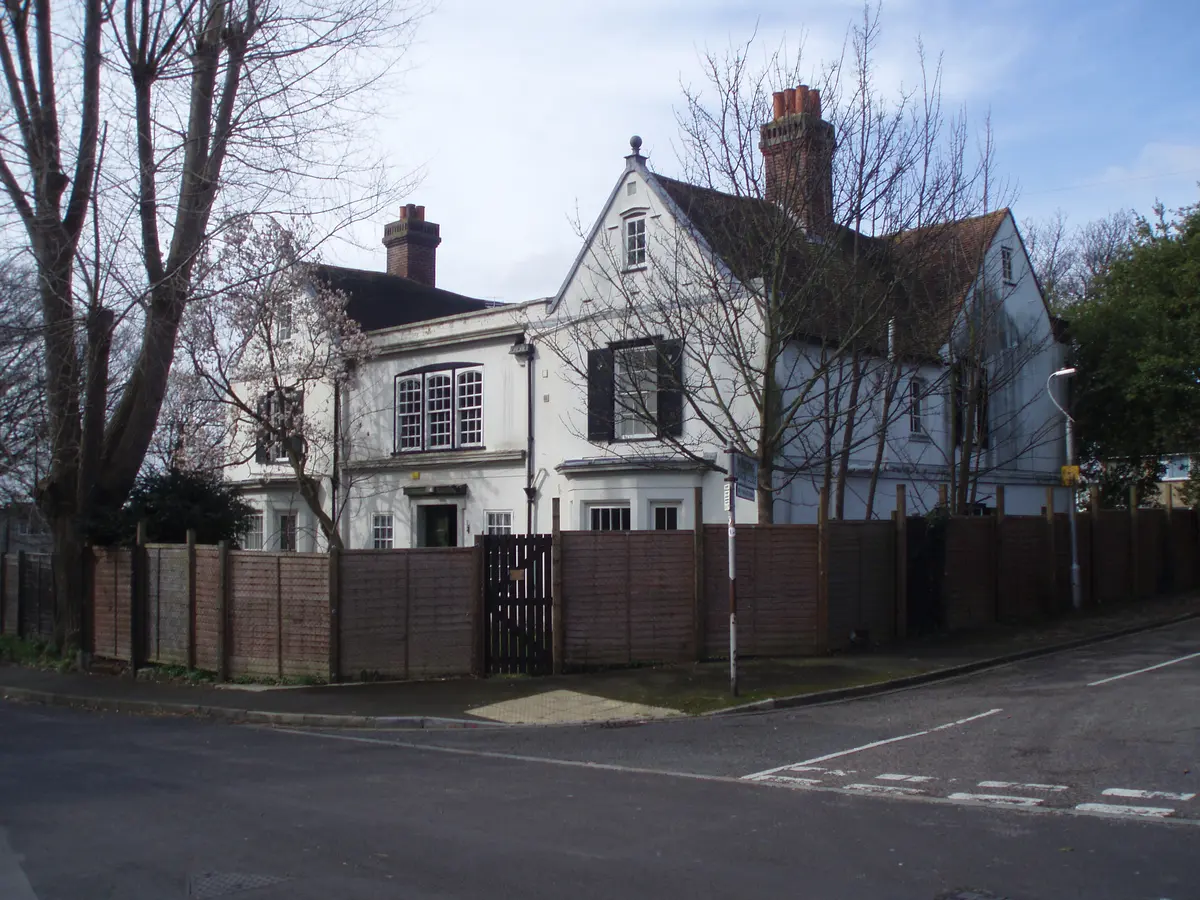
The manor of Wymering is Domesday-old, an estate held by the crown before the Conquest — but the house standing on it was framed from oaks felled in the spring of 1581, a date fixed by tree-ring analysis of seven core samples taken in 2008, and Historic England calls the fabric "some mediaeval masonry but mainly C17". Its most famous feature, the galleried hall with two curved staircases where the ghosts are traditionally placed, is younger still: Georgian joinery of about 1730, salvaged from a demolished Lancashire mansion and reassembled here between 1900 and 1908. The reputation grew during forty-six years as a youth hostel, which closed in 2006. Since 2013 the house has belonged to a volunteer charity, the Wymering Manor Trust, and it remains on the Heritage at Risk Register — empty, propped, and open only for occasional events.
What is the history of Wymering Manor?
Two different things are called Wymering — a manor and a house — and confusing them is where almost every account of this place goes wrong.
The manor is genuinely ancient. The Victoria County History of Hampshire, published in 1908, opens its account flatly: "At the time of the Domesday Survey WYMERING was ancient demesne of the crown. Land in Cosham and Portchester belonged to this manor." Historic England's statutory list entry says the same thing in six words — "A Pre-Conquest manor belonging to the crown". What Domesday records in 1086 is an estate, its hides and its rents. It is not a description of a building, and no building is described. The VCH then follows the lordship through four centuries of inheritance and litigation: the earls of Albemarle in the thirteenth century, a grant by Edward I to John le Botiller in 1281, the Waytes from 1390, and in 1561 the splitting of the manor between the six daughters of William Wayte, after which one of their families — the Brunings — spent a century and a half putting it back together.
The house standing today is far younger than that, and its age is known to the season. On Monday 25 February 2008 Dr Martin Bridge, of the Oxford Dendrochronology Laboratory, took seven core samples from beams inside the manor for a survey commissioned by Hampshire's Historic Buildings Survey Group and the Friends of Old Wymering. Several cores still carried their outermost rings — the ones that fix the year a tree stopped growing. Bridge's finding was that the timbers were most probably felled in the spring of 1581, which puts construction in 1581 or within a year or two, while the oak was still green enough to work. The house went up in the reign of Elizabeth I, a few years before the Armada, and it was built to impress: close-studded timber framing on at least two storeys, meant to be seen.
It was built by the Brunings, who held the manor from 1562 to 1707 and were Roman Catholic in a century when that was dangerous. Historic England's list entry notes that there is "reputed to be a small Priest's hole under the floor of a cupboard". The original plan was a half-H, two projecting wings enclosing an open courtyard on the entrance side.
After 1761 the house served as the parish vicarage for over a century. Its most consequential resident arrived in 1859: the Reverend George Nugee, a wealthy High Church clergyman of the Oxford Movement, who lived here until 1872, ran a small college training men for overseas missions, and built a chapel onto the north-east end — the mid-nineteenth-century single-storey extension with the rounded end still described in the listing. Its tower has since been demolished. Nugee also rebuilt the parish church across the lane, employing G. E. Street. According to the manor's trustees, Queen Emma of Hawaii stayed in the house during this period.
The building we see was finished by an Edwardian. Thomas Knollys Parr, a descendant of Katherine Parr, lived here from 1900 to 1938 and turned a manor house into a country house. He roofed over the courtyard to make a square plan, raised the entrance hall to full height, and filled it with joinery bought from the wreck of Bold Hall in Lancashire — a Palladian mansion of about 1730 by Giacomo Leoni, demolished in 1900 because coal mines had closed in around it. Two curved staircases, a gallery, turned balusters and newel posts, panelling, doorcases and pilasters all travelled south. The work was complete by 1908, when the VCH recorded "a fine stone chimney-piece from Bold Hall" in the new garden room.
After Parr died the army took the house for the Second World War. Local builders bought it in 1946 and sold off garden land for housing; the Airspeed designer Leonard Metcalfe lived here until 1958. It was listed on 10 January 1953. Scheduled for demolition in 1959, it was saved by a local campaign and bought by Portsmouth City Council in 1960, which leased it to the Youth Hostels Association. Wymering Manor was a youth hostel for forty-six years — and that, far more than the Middle Ages, is where its ghosts come from.
Timeline: the documented record of Wymering Manor
- 1086 The Domesday Survey records Wymering as ancient demesne of the crown, with land in Cosham and Portchester attached. It is an entry about an estate and its rents; no building is described.
- 1561 William Wayte dies and the manor is divided among his six daughters and coheirs. One of them, Eleanor, had married Richard Bruning; the Brunings would spend the next century and a half reassembling the whole.
- Spring 1581 The oaks used to frame the present house are felled. The date comes from tree-ring analysis of seven core samples, not from a document, and it places the building in the reign of Elizabeth I — five centuries after the manor first appears in the record.
- 1761 The house begins more than a century of service as the parish vicarage, a use it keeps until 1873.
- 1859 The Reverend George Nugee moves in and stays until 1872, running a small college training men for overseas missions and building a chapel onto the north-east end of the house. Its tower has since been demolished. This High Church community, not any medieval monastery, is the documented religious use of the building.
- 1900–1908 Thomas Knollys Parr roofs over the courtyard, raises the entrance hall to full height and fits it with two curved staircases, a gallery, balusters and panelling of about 1730 salvaged from Bold Hall in Lancashire, demolished that same year. The work is finished by 1908, when the Victoria County History records the Bold Hall chimney-piece in the new garden room.
- 10 January 1953 The house is added to the statutory list. It is now Grade II*, list entry 1245180; the current text is dated 30 October 2003 and describes the fabric as "some mediaeval masonry but mainly C17".
- 1960 Saved from a 1959 demolition scheme by a local campaign, the manor is bought by Portsmouth City Council and leased to the Youth Hostels Association. It will be a hostel for forty-six years.
- 2006 The youth hostel closes and the house falls empty. The same year Most Haunted Live! films its "Panic in Portsmouth" run here, alongside Southsea Castle and the Royal Marines Museum; sources disagree over the exact night, giving 5 May and 24 June 2006.
- 25 February 2008 Dr Martin Bridge of the Oxford Dendrochronology Laboratory takes seven core samples from the beams, in a survey paid for jointly by Hampshire's Historic Buildings Survey Group and the Friends of Old Wymering. The result moves the house from "early seventeenth century" to 1581.
- 21 September 2010 The manor fails to sell at auction at the Grand Connaught Rooms in London, stopping short of a £375,000 reserve. This, and not a television broadcast, is what happened at Wymering Manor in 2010.
- 7 January 2013 The Wymering Manor Trust is incorporated as company 08349936, later registered charity 1151919. Portsmouth City Council transfers the house to it free of charge with a £30,000 start-up grant.
- 13 January 2014 A survey finds death watch beetle in the old oak frame on top of known structural problems. Trustee Andy Mason calls it "worse than we were expecting"; full restoration is costed at about £2.5 million.
- 2024 Wymering Manor is still on Historic England's Heritage at Risk Register, where it was first placed in 2011. The 2024 edition is the most recent published when this entry was written.
Is there a rational explanation for Wymering Manor?
Start with the date on the front of the story. "First recorded in 1042, when it was owned by King Edward the Confessor" is a sentence about a lordship dressed up as a sentence about a house, and 1042 is not a date from any document: it is the year Edward became king. Domesday's formula is that a manor was held "in the time of King Edward", and somewhere that turned into a record with a year on it. The building underneath the claim was, on the evidence of its own timbers, felled and framed in 1581 — five centuries later. Historic England's own summary of the fabric is blunt: "Some mediaeval masonry but mainly C17, extended early C19 and c1900."
"The oldest building in Portsmouth" fails on a straight comparison. Portsmouth Cathedral, about four miles south in the old town, is a Grade I listed chapel founded about 1180 for Jean de Gisors, with a choir of c.1180–90 and transepts of c.1190–1220 still standing. The Royal Garrison Church on Grand Parade was founded as the Domus Dei by Bishop Peter des Roches about 1212. Both are four centuries older than Wymering's oak. It is worth noting who does not make the claim: the Friends of Old Wymering, the local group that paid for the tree-ring dating, call the house "one of the oldest houses in Portsmouth and the oldest in Old Wymering Conservation Area" — carefully, and correctly.
The staircase is the sharpest problem, because it is where the ghosts are put. Wymering's best-known apparitions are staged on the stairs and the galleried hall: a figure at the top of the flight, a group heard on the steps. That hall did not exist until Thomas Knollys Parr roofed over the courtyard after 1900, and the Friends of Old Wymering make the point themselves — the two staircases "must have been fitted at the same time as they would not have been needed before". Historic England dates their balusters and newel posts to about 1730 and identifies them as salvage from Bold Hall in Lancashire. The most haunted feature of the house is Georgian joinery from another county, reassembled in Portsmouth in the first decade of the twentieth century.
The monks and nuns have an origin too, and it is Victorian rather than medieval. There was no monastery at Wymering Manor. There was the Reverend George Nugee, who between 1859 and 1872 ran a High Church missionary college in the house, built a chapel onto it and was examined by his diocese over ritual practice. Men in habits at Wymering are documented; they are 1860s Anglicans.
As for the named ghosts — "Reckless Roddy", Sir Roderick of Portchester — the printed trail is remarkably thin. Searched inside the Internet Archive's full-text book corpus in August 2026, "Reckless Roddy" and "Sir Roderick of Portchester" each return zero results, twice. The control run in the same corpus and the same session: "Borley Rectory" returns 678 books. Of the forty-seven volumes that do mention Wymering Manor by name, the great majority are Youth Hostels Association handbooks and budget travel guides published between 1986 and 2006. That is the shape of the evidence: a house famous among ghost hunters and effectively absent from the ghost literature, whose reputation grew during forty-six years as a hostel where young strangers slept in an unheated Elizabethan building with twisting stairs. The earliest dated account naming Sir Roderick that this review could read in full is a BBC News report of 15 February 2013.
One last correction, of our own error. The claim that Most Haunted broadcast live from the manor in 2010 does not survive checking. When the BBC covered the manor on 21 September 2010, the news was an auction: the house failed to reach its £375,000 reserve at the Grand Connaught Rooms in London, and the report mentions the programme only in the past tense, as something that had already happened. The Most Haunted Live! run at Wymering was the "Panic in Portsmouth" strand of 2006, alongside Southsea Castle and the Royal Marines Museum; secondary sources disagree on the night, giving 5 May and 24 June 2006. The year 2010 belongs to the auction, not to the television.
Can you visit Wymering Manor?
Wymering Manor stands in Old Wymering Lane, Portsmouth PO6 3NL, which is the statutory address in its list entry, at national grid reference SU 64993 05588. It has been listed since 10 January 1953 and is Grade II* (list entry 1245180); the current text is dated 30 October 2003, and a minor amendment of 28 September 2023 changed the name and the address. Seven core samples taken from its beams on 25 February 2008 date the felling of the timber to the spring of 1581.
The house has stood empty since 2006, when its time as a youth hostel, which the BBC dates from 1960, came to an end. The Wymering Manor Trust's account of its history says the YHA left "because the timber frame had deteriorated and was not repaired, making some rooms uninhabitable". Portsmouth City Council offered it at auction on 21 September 2010, where it failed to meet its reserve of £375,000, and the BBC reported in January 2013 that "two attempts to auction it also failed" and that ownership had passed to a trust of volunteers. The Trust was incorporated on 7 January 2013 as company 08349936 and is registered charity 1151919. On 24 September 2026 Companies House listed it as active, with accounts filed to 31 March 2025 and a registered office at Larch House, Forest Road, Denmead, Waterlooville PO7 6XP.
In January 2014 the BBC reported that a survey had found death watch beetle damage in the old oak frame "on top of known existing structural problems"; the trustee Andy Mason said "It was worse than we were expecting". Parts of the ceilings in a few rooms were held up with scaffolding, and a full restoration was estimated at about £2.5m. A £50,000 Big Lottery grant was being spent on new glazing and asbestos removal in the Victorian parts of the house. The manor is on Historic England's Heritage at Risk Register as entry 50113, and the government's planning data service holds it in its heritage-at-risk dataset with an entry date of 26 September 2024.
Access is by event. On 24 September 2026 the "What's on" page of the Trust's website had as its newest item a visit by Amanda Martin MP on 24 February 2026, with no later date; the earlier entries were a Heritage Open Day on 14 September 2024, a quiz and two theatre productions, one of them performed in the Great Hall. Ghost hunts in the house are sold by outside companies, such as the one Paranormal Presence ran from 8pm to 2am on 31 January 2026. Mason told the BBC in 2013 that "there's been a lot of interest in the paranormal and a lot of tours in here".
The parish church of St Peter and St Paul, which George Nugee had rebuilt during his years at the manor, stands across the lane.
Sources consulted
- Historic England, «Wymering Manor, Old Wymering Lane, Cosham — National Heritage List for England, list entry 1245180 (Grade II*, listed 10 January 1953; text of 30 October 2003, minor amendment 28 September 2023)» — National Heritage List for England, 2023 report
- William Page (ed.), «Parishes: Wymering» — A History of the County of Hampshire, Volume 3 (Victoria County History), pp. 165–170, 1908 book
- BBC News, «Portsmouth's 'haunted' manor house fails to sell» — BBC News, Hampshire & Isle of Wight, 2010 newspaper archive
- BBC News, «Restoration hopes despite decay of 'haunted' Wymering Manor» — BBC News, Hampshire & Isle of Wight, 2014 newspaper archive
- J. G. Hird and I. Hird, Friends of Old Wymering, «Wymering Manor — Dendrochronology: seven core samples taken by Dr Martin Bridge (Oxford Dendrochronology Laboratory) on 25 February 2008, felling date spring 1581» — friendsofoldwymering.org.uk, archived by the Internet Archive on 15 August 2013, 2013 archive
- Companies House, «WYMERING MANOR TRUST, company number 08349936 — incorporated 7 January 2013, status active, last accounts to 31 March 2025» — UK register of companies, 2026 archive
- Historic England, «Heritage at Risk Register 2024, entry 50113: Wymering Manor, Old Wymering Lane, Cosham» — Heritage at Risk Register (open data), 2024 report
- BBC News, «Volunteers' hopes for 'haunted' Wymering Manor» — BBC News, Hampshire & Isle of Wight, 2013 newspaper archive
- Historic England, «Cathedral Church of St Thomas, Portsmouth — National Heritage List for England, list entry 1333198 (Grade I; chapel founded c.1180, choir c.1180–90, transepts c.1190–1220)» — National Heritage List for England, 1953 report
- Wikipedia contributor 'Nuttah', «Wymering Manor — first version of the Wikipedia article, created 8 July 2006 [oldid 62719804], source of the unsourced claims "the oldest building in the city of Portsmouth" and "first recorded in 1042"» — English Wikipedia, revision history, 2006 archive
- Wymering Manor Trust, «The story — history of Wymering Manor and of the Trust (YHA departure in 2006, transfer in January 2013)» — wymeringmanortrust.org, 2026 web
- Wymering Manor Trust, «What's on — events at Wymering Manor (latest item: visit by Amanda Martin MP, 24 February 2026)» — wymeringmanortrust.org, 2026 web
- Paranormal Presence, «Wymering Manor Ghost Hunt, Saturday 31 January 2026, 8pm-2am (event listing)» — Eventbrite, 2026 web
- Historic England, via planning.data.gov.uk, «Wymering Manor, Old Wymering Lane, Cosham — heritage-at-risk dataset entity 7503982 (entry date 26 September 2024)» — Planning Data (UK government), 2024 report
Reviewed by V. Serrano on 2026-08-14 · How we verify our content
💬 Field testimonies (0)
No testimonies yet. Add the first.
Add your testimony
🔒 Log in to add a testimony