📜 LEGEND · EXP. Nº3657
ACTIVE
The Moor's Sigh
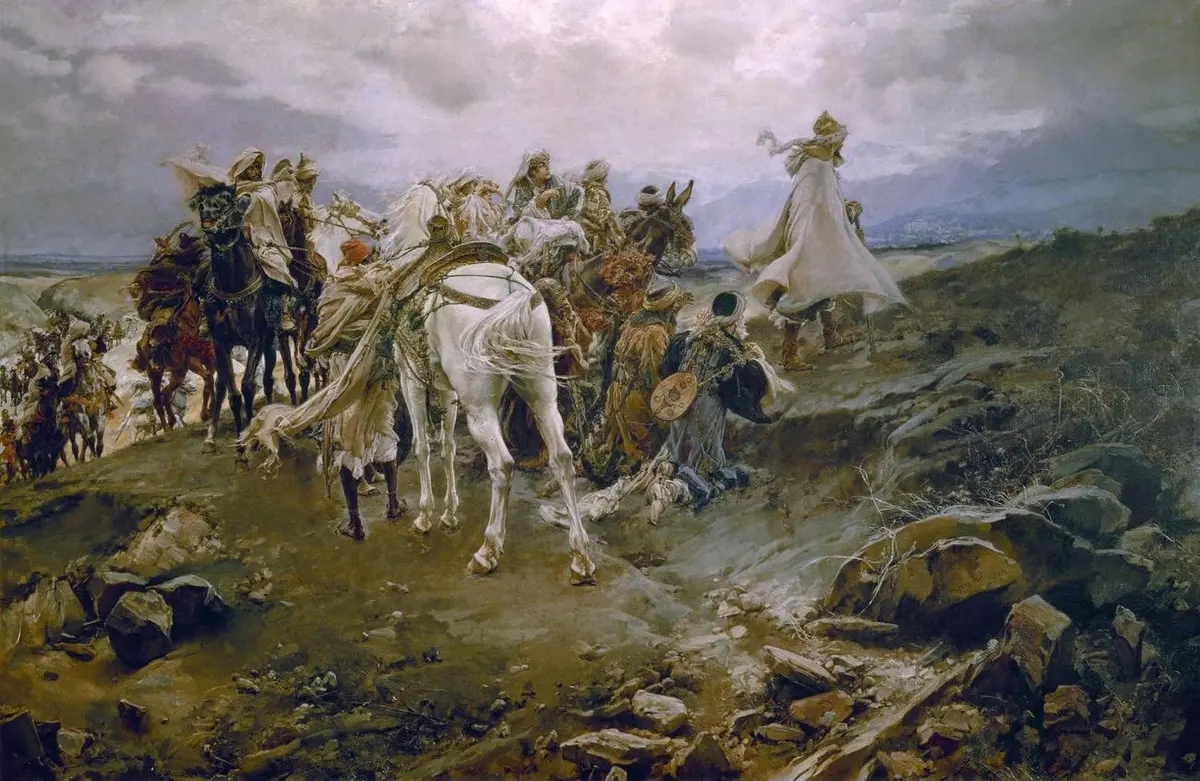
A pass at 865 metres south of Granada, on the old road to the Alpujarras, is called El Suspiro del Moro, the Moor's Sigh: the spot where Boabdil, last Nasrid sultan of Granada, is said to have looked back at the Alhambra for the last time and wept, and where his mother is said to have answered him with the most famous rebuke in Spanish folklore.
Where does the legend of The Moor's Sigh come from?
- Location
- Granada, Andalucía, Spain
- Kind of legend
- Folk tale
- Coordinates
- 37.07, -3.65
- Last updated
LOCATION
What is the legend of The Moor's Sigh?
The story is not an invention, but almost nothing about it survives verification in the form we tell it. The oldest datable printed version is a letter by Fray Antonio de Guevara, bishop of Guadix, printed in 1539 — and there the rebuke is collective, aimed at the king and his knights together, and spoken by his mother to those around her while she rode on ahead, so that Boabdil never heard it. The line we actually quote first appears in Luis del Mármol Carvajal in 1600, attributed to old moriscos who claimed to have been present. The Arabic historian usually credited with the story, al-Maqqari, narrates the departure in detail and has no sigh in it at all. And the name of the pass itself cannot be documented in Castilian until the 1620s.
What is the history of The Moor's Sigh?
The pass called El Suspiro del Moro sits at 865 metres in the municipality of Villa de Otura, on the old road from Granada to the coast, at the watershed where the Vega of Granada disappears behind the traveller and the Valle de Lecrín opens ahead. The legend attached to it is one of the most repeated in Spain: Boabdil, Muhammad XII, last Nasrid sultan of Granada, stops here on his way into exile, looks back at the Alhambra, weeps, and is cut down by his mother with a single sentence. As literature the sentence is real enough. What follows is an attempt to date it.
The hard chronology first. The capitulations for the surrender of Granada were signed at Santa Fe on 25 November 1491; Christian troops entered the city on 2 January 1492. On the date Boabdil actually left, the sources disagree, and the disagreement matters, because the legend welds the two days into one. Mármol Carvajal puts handover and departure on the same 2 January. The Arabic narrative Pascual de Gayangos translated from al-Maqqarī's Nafḥ al-ṭīb says the sultan left the Alhambra on 2 Rabīʿ I of the year 897, which Gayangos renders as 3 January 1492. Guevara, earliest of the three, says flatly that Boabdil set out "the day after the city and the Alhambra were handed over to King Ferdinand". Two of the three oldest witnesses put the departure on the day after the surrender, not on it.
Now the scene. Its oldest datable printed appearance that I have been able to read is neither Arabic nor a chronicle. It is a letter by Fray Antonio de Guevara, bishop of Guadix and later of Mondoñedo, court preacher and chronicler to Charles V, addressed to the courtier Garci Sánchez de la Vega and printed among his Epístolas familiares from 1539. Guevara sets it in his own present: riding through the newly baptised morisco districts on an inquisitorial visitation, he climbs "a rise, above which the view of Granada is lost and that of the Valle de Lecrín begins" — a precise description of this pass — and an old morisco riding with him asks him to stop and tells the story in the broken stage-Spanish Guevara transcribes for comic effect.
Three things in Guevara's version have since been lost, and they are not small. The rebuke is collective: "It is just that the king and the knights should weep like women, since they did not fight like knights." It is not addressed to Boabdil at all — the mother was riding ahead, was told the king and his knights had stopped to weep, struck her mare, and said it to those around her. And Boabdil only learned of it later: Guevara's morisco adds that his master often said that had he known at the time, "either we would have killed one another there, or we would have gone back to Granada to fight the Christians". Guevara closes by reporting that he told the story to Charles V the next day, and that the Emperor answered that the mother had been entirely right and the son entirely wrong, "for if I were he, or he were I, I would sooner have taken this Alhambra for my tomb". Charles V and Isabella of Portugal were resident in the Alhambra from 4 June 1526 to December of that year, which places the episode.
Sixty-one years later Luis del Mármol Carvajal, in the first book of his Historia del rebelión y castigo de los moriscos del reyno de Granada (Málaga, 1600), gives the version we actually quote — and he is careful about sourcing in a way his repeaters are not. He first reports an account in which Boabdil went back into the city, then says that "some very old moriscos, who said they were present that day, certified to us" the other. In theirs, Boabdil reaches "a viso near the village of El Padul, which is where the city is last seen", looks back, "began to sigh heavily, and said Alauaquibar", and "his mother, seeing him sigh and weep, said to him: You do well, my son, to weep like a woman for what you were not man enough to defend." Mármol then records the place-name, and it is not ours: "Afterwards the Moors called that viso the Fex de Alauaquibar in memory of this event" — the pass of God is Great.
The rest of the chain is short and traceable. José Antonio Conde (1820) keeps Mármol's rebuke and the Arabic name Feg Allah huakbar, and adds a consoling speech by the vizier Yusuf Aben Comixa. Washington Irving, in chapter XCIX of A Chronicle of the Conquest of Granada (1829), fuses the two: Mármol's wording, Conde's vizier, and both place-names welded into a single sentence. Irving in translation is the version that travelled, and from there the scene passes into the Spanish romantic novel, where Manuel Fernández y González used it in at least three books between 1849 and 1860.
The place-name can be dated apart from the story. According to the Granada journalist Gabriel Pozo Felguera, "Suspiro del Moro" first appears in Castilian in the Anales de Granada of Francisco Henríquez de Jorquera, compiled roughly between 1620 and 1643, and is fixed administratively in 1752, when the secretary of Otura, drawing up the Catastro del Marqués de la Ensenada, records the Venta del Suspiro standing three leagues from Granada. The pass was an inn on the coast road before it was a monument to anything.
Timeline: the documented record of The Moor's Sigh
- 25 November 1491 The capitulations for the surrender of Granada are signed at Santa Fe by Boabdil and the Catholic Monarchs. The Arabic account translated by Gayangos counts sixty-seven articles in the treaty; the Castilian tradition counts seventy-seven.
- 2 January 1492 The handover of Granada. Mármol Carvajal dates it precisely and, unlike later retellings, has Boabdil ride straight for Andarax the same day, having sent his household ahead.
- 3 January 1492 The Arabic narrative translated by Gayangos dates the sultan's departure from the Alhambra to 2 Rabīʿ I, 897 — the day after the handover. Guevara agrees: Boabdil left 'the day after'. Neither text contains a sigh, a backward glance or a rebuke.
- 1526 Fray Antonio de Guevara, on an inquisitorial visitation of the morisco districts, crosses the rise 'above which the view of Granada is lost and that of the Valle de Lecrín begins', and an old morisco tells him the story. Charles V and Isabella of Portugal were resident in the Alhambra from 4 June to December of that year; Guevara says he repeated the tale to the Emperor the next day.
- 1539 Guevara's letter to Garci Sánchez de la Vega goes into print among the Epístolas familiares — the oldest datable printed version of the scene. The rebuke is collective, is spoken by the mother to those around her while riding ahead, and never reaches Boabdil's ears until much later.
- 1600 Luis del Mármol Carvajal prints the version we actually quote, attributed to 'some very old moriscos who said they were present that day'. He also gives the pass its name — and it is Arabic: the Fex de Alauaquibar, the pass of God is Great.
- c. 1620-1643 Francisco Henríquez de Jorquera compiles his Anales de Granada, in which, according to the journalist Gabriel Pozo Felguera, the name 'Suspiro del Moro' appears in Castilian for the first time — more than a century after the event it commemorates.
- 1752 Drawing up the Catastro del Marqués de la Ensenada, the secretary of Otura records the Venta del Suspiro standing three leagues from Granada. The place-name is now administrative: the pass was a working roadside inn before it was a memorial.
- 1820 José Antonio Conde keeps Mármol's rebuke and the Arabic place-name Feg Allah huakbar, and adds something new: a consoling speech by the vizier Yusuf Aben Comixa, telling the king that great misfortunes make men as famous as great successes.
- 1829 Washington Irving fuses the chain in chapter XCIX of A Chronicle of the Conquest of Granada: Mármol's wording, Conde's vizier, and both place-names welded into one sentence. This is the version, in translation, that carried the legend worldwide.
- 1863 and 1868 Hernando de Baeza's account is published at last — by Joseph Müller in Munich, then by the Sociedad de Bibliófilos Españoles in Madrid. The only writer who lived alongside Boabdil's mother turns out to have left a scene in which she weeps and begs her son not to die fighting. His text breaks off there, unfinished.
- 3 December 2025 The Diputación de Granada presents the master plan for the Ruta de Boabdil: 32 municipalities, 27 in Granada and 5 in Almería, a budget of 16,119,620 euros with FEDER funds, and full accessibility as its organising principle. Otura, and this pass, are the starting point.
Is there a rational explanation for The Moor's Sigh?
The sceptical case here is not a matter of opinion. It can be laid out by reading, in order, the people who were actually there.
Hernando de Baeza is the closest witness the story has: a Castilian who served Boabdil as interpreter and go-between, lived four years in Granada in daily contact with the king, his mother, his wife and his daughter, and wrote his account well into the sixteenth century. It stayed in manuscript until Joseph Müller published it in Munich in 1863 and the Sociedad de Bibliófilos Españoles printed it in Madrid in 1868. His narrative breaks off unfinished — both surviving manuscripts, the Escorial and the Osuna, stop at the same point — and where it stops is a scene between Boabdil and his mother in which the roles are the exact reverse of the legend. Boabdil has armed himself to ride out and die fighting rather than let the city be taken by a stratagem; his mother seizes him, weeps, and argues him out of it. He says "it is far better to die once than, living, to die many times." She answers: "That is true, my son, if only you were to die and everyone else were saved and the city set free; but so great a ruin is very ill done." The one writer who knew her has her pleading for the city against a suicidal last stand.
She is also, in his pages, nameless. In the whole 1868 volume the name "Aixa" occurs exactly twice, both times in the nineteenth-century editor's prologue and never in Baeza's own text; Baeza writes "his mother", "the king's mother", "the queen". The name our description put in her mouth was supplied to her by editors and novelists.
Second, al-Maqqarī. It is often said that the Arabic origin of the story is his Nafḥ al-ṭīb. It is not. In Gayangos's translation, volume II, the narrative runs continuously from the famine and the negotiations through the sultan leaving the Alhambra on 3 January 1492, Ferdinand ordering him to settle at Andarax, the ruse that got him to Africa, his landing at Melilla, his life at Fez, his death there in the year 940 of the Hijra, and his descendants reduced to begging. There is no sigh, no backward glance, no mother and no rebuke in any of it. Searched across the whole 378,000-word volume, "sighed", "like a woman" and "looked back" return zero, and Boabdil's mother never appears. The control on the same pages is dense — Andarax, Melilla, Purchena, the Alpuxarras, the Hijra date, the names of both sons — so the passage is present and complete, and the absence is real.
Third, a widely repeated attribution that fails. The scene is often credited to Hernando del Pulgar, chronicler of the Catholic Monarchs. The text printed under his name does contain it, and it is worth reading, because there too it is different: Boabdil, on the day of the handover, refuses two customary honours, goes to his house in the alcazaba, "went in weeping for what he had lost, and his mother told him that since he had not been man enough to defend it, he should not weep like a woman." Inside the city; no pass; and the rebuke is a prohibition — do not weep — rather than the sarcastic invitation everyone quotes. But those chapters are not Pulgar's, and the 1780 editor says so on the page: they are missing from the Escorial manuscript, "in truth they do not look like Pulgar's", they are probably part of an Adición that follows in several manuscripts, and Dr. Galíndez de Carvajal, who held the original chronicle, "states expressly that Pulgar wrote only as far as the year ninety". The chronicle stops in 1490 and never reaches the siege.
What is left is not a hoax but a documented literary migration with a mechanism. The scene moves from inside Granada to a mountain pass with Guevara in 1539; the rebuke turns from a prohibition into a taunt; in Guevara it is still collective and spoken behind the king's back, and only with Mármol in 1600 does it become the face-to-face line we quote. Even the wording printed today — an imperative, "weep like a woman for what you did not know how to defend like a man" — is a modern compression: every version we can read from the sixteenth to the nineteenth century is a sarcastic concession, "you do well to weep", not a command. The old sentence gives the mother contempt; the modern one gives her an order.
Whether this is even the right pass is a separate and still-open question. Local historians have argued for other routes out of the Vega, over the Manar by way of Dílar or west through La Malahá, and Mármol's own text says only "a viso near El Padul". What Guevara gives is not a name but a topographical test: the rise where Granada is lost from view and the Valle de Lecrín begins. That test fits this pass. It also fits the fact that nobody had to invent the place — it was a working inn on the road to the coast, and the road in its present layout was not traced until 1839.
Can you visit The Moor's Sigh?
El Suspiro del Moro is a mountain pass on the old Bailén-Motril road, in the municipality of Villa de Otura in Granada province, at the point where the road leaves the Vega for the Valle de Lecrín. It is public and costs nothing at any hour. The A-44 motorway runs alongside and now carries the through traffic.
What exists on the ground can be checked against the town hall's own inventory. The heritage page of the Ayuntamiento de Villa de Otura, read on 9 September 2026, lists the pass among its "Lugares de interés" and describes it in one line — "Es un paso de montaña situado en el término municipal de la Villa de Otura" — before retelling the legend and printing Aixa's reproach in the form the town hall gives it: "Llora como mujer lo que no has sabido defender como un hombre". The same page fixes the altitude at 865 metres and mentions no viewpoint on the pass and no monument, nor any sculpture or interpretation centre. The other entries on that page are a thirteenth-century Almohad capital now deposited in the Museo de la Alhambra, plus a house in calle Acequia that held the village schools in the 1940s. A roadside restaurant carries the name of the pass. No visitor facility is dedicated to the legend.
A larger project has a date, a budget and a published trace. On 3 December 2025 the Diputación de Granada presented the Plan Director de la Ruta de Boabdil, an itinerary through 32 municipalities — 27 in Granada province, 5 in Almería — costed at 16,119,620 euros against FEDER funds with provincial co-financing, and with full physical, sensory and cognitive accessibility as its stated organising principle. The starting point is the Alhambra rather than Otura: the Junta de Andalucía's viceconsejera de Cultura described it at the presentation as "una ruta que enlaza la Alhambra de Granada con la costa de Adra". Villa de Otura appears on the main trace between Alhendín and Dílar. Signage and the upgrading of historic paths are in the plan's first line of works, so the pass may not stay unequipped.
What the site itself offers is the geography that produced the story, and that has not changed shape. Granada and the Vega lie behind; the Valle de Lecrín opens ahead; the crossing is the moment one view replaces the other. At 865 metres the pass is cold and exposed in winter.
Sources consulted
- Fray Antonio de Guevara, «Libro primero de las epístolas familiares (epístola a Garci Sánchez de la Vega)» — Impresa por primera vez en 1539; consultada en la edición de Madrid, 1732, epístola LXVI, 1539 book
- Luis del Mármol Carvajal, «Historia del rebelión y castigo de los moriscos del reyno de Granada» — Málaga, Juan René (edición príncipe, ejemplar digitalizado), 1600 book
- Hernando de Baeza; prólogo y edición de la Sociedad de Bibliófilos Españoles, «Relaciones de algunos sucesos de los últimos tiempos del reino de Granada» — Madrid, M. Rivadeneyra, 1868 book
- Ahmad al-Maqqarī, traducido por Pascual de Gayangos, «The History of the Mohammedan Dynasties in Spain, vol. II (extraído del Nafḥ al-ṭīb de al-Maqqarī)» — Londres, Oriental Translation Fund, 1843 book
- Hernando del Pulgar; edición anotada de Benito Monfort, «Crónica de los señores Reyes Católicos don Fernando y doña Isabel» — Valencia (capítulos CXXXIII-CXXXIV y notas del editor), 1780 book
- Washington Irving, «A Chronicle of the Conquest of Granada» — Filadelfia y Londres (capítulo XCIX), 1829 book
- José Antonio Conde, «Historia de la dominación de los árabes en España» — París, Baudry, 1820 book
- María Teresa del Préstamo Landín, «Reescrituras decimonónicas del siglo XV español: el Suspiro del Moro en la narrativa de Manuel Fernández y González» — Lectura y Signo, n.º 11, Universidade de Vigo, 2016 academic
- Gabriel Pozo Felguera, «El último Suspiro del Moro que se inventó un obispo de Guadix» — El Independiente de Granada, 4 de febrero de 2018, 2018 newspaper archive
- Diputación de Granada, «Presentado el Plan Director de la Ruta de Boabdil que conectará 32 municipios en un itinerario turístico plenamente accesible» — Nota oficial, 3 de diciembre de 2025, 2025 report
- Ayuntamiento de Villa de Otura, «Patrimonio histórico: el Suspiro del Moro» — Web municipal, consultada en agosto de 2026, 2026 web
- Ahora Granada, «Otura impulsa un proyecto cultural y turístico sobre Boabdil el Chico» — Prensa local, 20 de febrero de 2022, 2022 newspaper archive
Reviewed by V. Serrano on 2026-08-16 · How we verify our content
📎 Source: Enigma Atlas
💬 Field testimonies (0)
No testimonies yet. Add the first.
Add your testimony
🔒 Log in to add a testimony