📜 LEGEND · EXP. Nº3657
ACTIVE
The House of the Seven Chimneys
The Casa de las Siete Chimeneas stands on Plaza del Rey in central Madrid, one of the few pieces of sixteenth-century domestic architecture left in the city: the decree that protected it in 1948 dates it to 1574 and names Juan de Ledesma, Secretary of the Indies, as the man who built it.
Where does the legend of The House of the Seven Chimneys come from?
- Location
- Plaza del Rey, Madrid, Spain
- Kind of legend
- Ghost story
- Coordinates
- 40.42, -3.697
- Last updated
LOCATION
What is the legend of The House of the Seven Chimneys?
The ghost attached to it is much younger, and it can be dated too. Ramón de Mesonero Romanos described the house at length in 1861 and told no legend at all. The story reaches print in 1882, the year after the banker Jaime Girona bought the house for the Banco de Castilla and had it restored: Ricardo Sepúlveda's illustrated monograph, and a set of engravings in La Ilustración Española y Americana of 15 October 1882. When the Real Academia de la Historia read that book in 1945 in order to get the house protected, it warned in writing that Sepúlveda gave no sources at all, and the decree of 1948 repeated the warning. No woman called Elena appears in any of those documents. The house, however, is entirely real, and it has been the seat of Spain's Ministry of Culture since the early 1980s.
What is the history of The House of the Seven Chimneys?
The building is real, it is standing, and it has a postal address: Plaza del Rey 1, on the corner of calle de las Infantas and calle de Colmenares, in the Justicia quarter of central Madrid. That is more than most legends can offer, and it means the tale can be dated instead of admired.
The decree that made it a protected monument states the hard facts. "Trazado su primitivo proyecto en el siglo XVI y construida la casa por el Secretario de Indias Juan de Ledesma, en mil quinientos setenta y cuatro" — designed in the sixteenth century and built in 1574 by Juan de Ledesma, Secretary of the Indies. The familiar attribution to Juan Bautista de Toledo and his assistant Juan de Herrera is in the same decree, and so is the warning attached to it: the interventions are "creíbles… aunque no tengan confirmación documental", credible but without documentary confirmation. The Ministry of Culture, which works inside the house today, still says the same thing in its own words: those points "todavía no han podido ser comprobados con absoluta certeza". What is documented is the paperwork. Juan de Ledesma sold the house to the perulero Arias Maldonado on 25 January 1578; Baltasar de Rivera bought it on 26 February of that same year and passed it to the Genoese merchant Baltasar Cataño on 4 October 1581. It later carried the entail founded by Doctor Francisco Sandi y Mesa, and stayed with the Colmenares family, counts of Polentinos, until 1881.
Along the way it collected history that needs no ghost. On Friday 17 March 1623, between ten and eleven at night, two cloaked gentlemen knocked at its door: the Prince of Wales, the future Charles I of England, and his favourite the Duke of Buckingham, arriving unannounced at the residence of John Digby, Earl of Bristol, ambassador of England, on the escapade meant to win the hand of a Spanish infanta. On Palm Sunday, 23 March 1766, the crowd of the Esquilache riot came for the marquis of Esquilache, who lived here, and Mesonero Romanos noted a century later that the marks left on the walls survived into his own day. Between 1926 and 1936 the house was the first home of the Lyceum Club Femenino, the pioneering women's association of María de Maeztu, Victoria Kent, Clara Campoamor, Zenobia Camprubí and Ernestina de Champourcín; after the Civil War its premises were confiscated and the Falange's Sección Femenina turned them into the Círculo Cultural Medina. In March 2026 the Ministry of Culture presented the centenary programme of that club in the square outside.
Now the legend itself, and the point where it can be pinned down. Ramón de Mesonero Romanos devoted a full paragraph to this house on page 259 of El antiguo Madrid (1861): a fine country house among gardens and orchards, the taste of Juan de Herrera, the Sandi y Mesa entail, the Polentinos, Esquilache, the ambassadors of Naples, France and Austria. He tells no legend at all. There is no woman, no lover, no apparition, and in the whole book — some 191,000 words — the word fantasma does not occur once.
The story surfaces in print immediately after a change of ownership. At the end of September 1881 Jaime Girona, later first count of Eleta, bought the house from the Polentinos for the Banco de Castilla and the Crédito General de Ferrocarriles, and put the architect Manuel Antonio Capo in charge of restoring it. In 1882 the house was suddenly everywhere: La Ilustración Española y Americana printed it in its issue 38 of 15 October 1882, in engravings by Tomás Carlos Capuz after drawings by Manuel Nao, captioned "in the sixteenth century and in 1882"; and Ricardo Sepúlveda published his monograph La casa de las siete chimeneas, whose illustrated second edition (Madrid, 1882, 62 pages) is the version everyone afterwards worked from. In the prologue to his later Madrid viejo (1887), Sepúlveda's own friends describe that booklet as having been published "después que la transformó y se estableció en ella el actual Banco de Castilla" — after the bank moved in.
What did Sepúlveda actually tell? The best account of it is not ours: it is the reasoned petition that Francisco Javier Sánchez Cantón wrote for the Real Academia de la Historia on 31 October 1945, asking that the house be protected. He summarises the book and cannot verify it. A montero — or a physician — of Philip II buys the ground to dower a daughter, or a ward, very beautiful, "en la que el Rey había puesto ojos y deseos", and is in a hurry to marry her to a captain of the yellow guard named Zapata. The wedding is at San Martín; the following year, 1570, the house is finished, showing "por capricho, superstición o mandato, siete gallardas chimeneas". In 1571 Zapata dies in Flanders. The couple die childless — "sin que falte nota de misterio en la muerte de la mujer" — and the property reverts to the King.
That is the whole of it, and both the Academy and, three years later, the Council of Ministers said in writing what they thought of the sourcing. Sánchez Cantón: the monograph "aporta numerosos datos; mas por la índole del autor y por los malos hábitos del tiempo no se señala la procedencia de ellos", and "la carencia de citas concretas resta valor a muchas de las afirmaciones del curioso libro". The decree of 9 July 1948, declaring the house a historic-artistic monument, repeats it almost word for word and draws the conclusion: Sepúlveda contributes many data "de interés relativo, por no citar procedencias, por lo que conviene ceñirse a los conocidos con certeza" — stick to what is known for certain.
Timeline: the documented record of The House of the Seven Chimneys
- 1574 The decree of 1948 that protected the house states that its original design dates from the sixteenth century and that it was built in 1574 by Juan de Ledesma, Secretary of the Indies. The same decree records the attribution of the design to Juan Bautista de Toledo and the work to Juan de Herrera, assisted by Antonio Sillero, and adds that these interventions are credible "aunque no tengan confirmación documental".
- 25 January 1578 The one paragraph of Sepúlveda's monograph that Sánchez Cantón considered trustworthy gives the deeds: Juan de Ledesma sold the house to Arias Maldonado on 25 January 1578, Baltasar de Rivera bought it on 26 February of the same year, and it passed to the Genoese merchant Cataño on 4 October 1581.
- 17 March 1623 On a Friday night, between ten and eleven, two cloaked gentlemen arrived at the door: the Prince of Wales, the future Charles I of England, and the Duke of Buckingham, calling on John Digby, Earl of Bristol, the English ambassador, who lived in the house. The date and the hour are given in the 1948 decree.
- 23 March 1766 Palm Sunday: the Esquilache riot broke out in front of the house, where the marquis of Esquilache, Charles III's minister, was living. Mesonero Romanos wrote in 1861 that the marks of the assault "se han conservado hasta nuestros días".
- 1861 Ramón de Mesonero Romanos describes the house on page 259 of El antiguo Madrid: a country house among gardens, the taste of Juan de Herrera, the entail of Doctor Francisco Sandi y Mesa, the counts of Polentinos, Esquilache, and the ambassadors of Naples, France and Austria. He tells no legend, names no woman, and the word fantasma does not appear anywhere in the volume.
- End of September 1881 Jaime Girona, later first count of Eleta, bought the house from the Colmenares family, counts of Polentinos, for the Banco de Castilla and the Crédito General de Ferrocarriles, and commissioned the architect Manuel Antonio Capo to restore it. The doorway still carries the dates 1570 and 1881.
- 15 October 1882 La Ilustración Española y Americana devoted issue 38 of that date to the house, with engravings by Tomás Carlos Capuz after drawings by Manuel Nao showing it "in the sixteenth century and in 1882". The same year Ricardo Sepúlveda published the illustrated second edition of his monograph La casa de las siete chimeneas (Madrid, 1882, 62 pages). This is the earliest written form of the legend that this review has been able to name and date.
- 1926 The Lyceum Club Femenino, the pioneering Spanish women's association presided over by María de Maeztu, took the house as its first headquarters and kept it until 1936. Clara Campoamor, Victoria Kent, Zenobia Camprubí, Ernestina de Champourcín and Concha Espina were members. After the Civil War the premises were confiscated and the Falange's Sección Femenina converted them into the Círculo Cultural Medina.
- 31 October 1945 Francisco Javier Sánchez Cantón signed the reasoned petition asking that the house be declared a historic-artistic monument; the Real Academia de la Historia approved it on 2 November. His report summarises Sepúlveda's book and states that it "no se señala la procedencia" of its data and that "la carencia de citas concretas resta valor a muchas de las afirmaciones".
- 9 July 1948 The decree declaring the house a historic-artistic monument was signed; it appeared in the Boletín Oficial del Estado of 21 July 1948, number 203, page 3344. Its preamble says that "otras múltiples historias y leyendas la esmaltan" and then names the Esquilache riot. It mentions no ghost, no skeleton and no woman called Elena.
- 3 February 1995 Real Decreto 192/1995 declared the building a Bien de Interés Cultural with the category of monument, at calle Infantas 31, recording 857.52 square metres of plot and 5,399 built, and noting that it then housed the central services of the Ministry of Culture. The file had been opened on 4 June 1977.
- 18 March 2026 The Ministry of Culture presented in Plaza del Rey, beside the house, the programme for the centenary of the Lyceum Club Femenino, including research that has enlarged the documented census of its members.
Is there a rational explanation for The House of the Seven Chimneys?
The strongest evidence against this legend is not a debunking: it is a date and two official documents that say the same thing.
The date is 1882. Before it, the house is described at length and no one tells the story. Mesonero Romanos gives it a full paragraph on page 259 of El antiguo Madrid (1861) with the entail, the owners, Esquilache and the ambassadors, and no woman and no apparition; a search of the whole volume returns zero occurrences of fantasma against twelve for Esquilache, thirty-one for Herrera and two for Polentinos, so the silence is the book's and not the search's. The story appears in print in the year after a bank bought the house, restored it and needed people to look at it, and it appears twice in the same season: in an illustrated national magazine and in a 62-page monograph.
The two official documents are the reasoned petition Sánchez Cantón wrote for the Real Academia de la Historia in 1945 and the decree of 9 July 1948 that granted it. Both praise Sepúlveda's book and both refuse to rely on it, in almost the same words, because it cites no sources. The decree is worth reading carefully on one further point: it says that "otras múltiples historias y leyendas la esmaltan" — many other stories and legends adorn the house — and the example it then gives is the Esquilache riot. In the very document that catalogues the legends of this building, in 1948, there is no ghost, no walled-up skeleton and no woman called Elena. Neither is there one on the page the Ministry of Culture publishes today about its own headquarters.
The modern retellings do not survive arithmetic either. The version Spanish Wikipedia attributes to Pedro de Répide has the daughter married in 1569 to a captain of the tercios who then dies at the battle of San Quintín — a battle fought on 10 August 1557, twelve years before the wedding it is supposed to follow. Sepúlveda's own account puts Zapata's death in Flanders in 1571, which at least fits the house.
And the house you would go to see is not the house of 1574. It was partly rebuilt by the count of Polentinos in 1840 when the Circo Olímpico went up beside it, reformed by Agustín Ortiz de Villajos in 1877, restored by Manuel Antonio Capo for the bank in 1881-82, bought by the Banco Urquijo in 1957 and reworked in 1958 by José Antonio Domínguez Salazar and Fernando Chueca Goitia, and touched again by Chueca around 1980. Sánchez Cantón, comparing Sepúlveda's plates with the building in front of him, observed that even the illustration of the finished 1881 restoration differed from reality "hasta en la distribución de las chimeneas" — down to the arrangement of the chimneys themselves.
Can you visit The House of the Seven Chimneys?
The house is a working government building with no ticket office. It has been the headquarters of Spain's Ministry of Culture since the early 1980s — the ministry's own postal address is Plaza del Rey 1, 28004 Madrid — and the city's heritage catalogue lists its access as restricted. There are no guided tours of the legend, no "Elena's window" to be pointed out, and no interior visit for the general public.
The protection order gives a second address for the same building: Real Decreto 192/1995 of 3 February declares it a Bien de Interés Cultural with the category of monument at calle Infantas 31, and traces the perimeter along calle Infantas, calle Colmenares and the wall meeting Plaza del Rey 1. The plot measures 857.52 square metres, with 5,399 square metres built.
There is one legitimate way in, and it is not for tourists: the reading and consultation rooms of the Archivo Central de Cultura are on the ground floor of the Casa de las Siete Chimeneas, and the archive's deposit occupies basements 0, 2 and 3, in what used to be the vaults and counters of the Banco Urquijo. The Ministry's Biblioteca de Cultura is in the building too. Access is for researchers and runs through the archive or the library by prior arrangement.
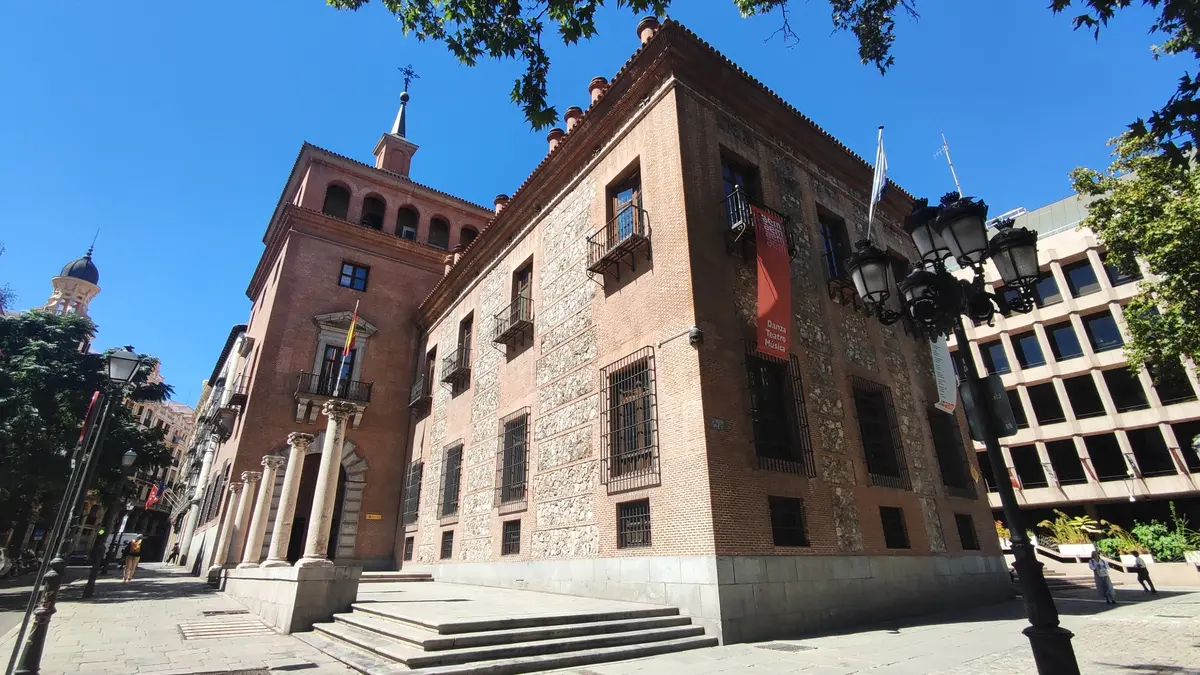
From outside there is plenty to see, and the square is public at all hours. The main front faces Plaza del Rey, with its granite doorway between paired columns and the balcony above; the flanks run down calle de las Infantas and calle de Colmenares. The chimney stacks sit on the four-slope roof, and no single street corner takes in all seven: the photograph on this page, taken from the square in September 2024, catches only part of the row.
Getting there is easy. Distances measured on OpenStreetMap from the centre of the building: Banco de España (metro line 2) 195 m, Chueca (line 5) 285 m, Sevilla (line 2) 392 m. The house stands between calle de Alcalá and Gran Vía, a few minutes on foot from either.
Sources consulted
- Ministerio de Educación Nacional, «Decreto de 9 de julio de 1948 por el que se declara Monumento Histórico-Artístico la casa llamada de «las siete chimeneas» de Madrid (BOE núm. 203, 21 de julio de 1948, p. 3344)» — Boletín Oficial del Estado, 1948 archive
- Francisco Javier Sánchez Cantón, «La Casa de las Siete Chimeneas (solicitud razonada de declaración, fechada el 31 de octubre de 1945 y aprobada por la Academia el 2 de noviembre), pp. 165-169» — Boletín de la Real Academia de la Historia, tomo 117, 1945 academic
- Ramón de Mesonero Romanos, «El antiguo Madrid: paseos histórico-anecdóticos por las calles y casas de esta villa (p. 259, «Las Siete Chimeneas»)» — Madrid, 1861 book
- Ministerio de Cultura, «Real Decreto 192/1995, de 3 de febrero, por el que se declara bien de interés cultural, con categoría de monumento, el edificio denominado «Casa de las Siete Chimeneas», en calle Infantas, número 31, de Madrid (BOE núm. 50, 28 de febrero de 1995)» — Boletín Oficial del Estado, 1995 archive
- Ricardo Sepúlveda, «Madrid viejo: crónicas, avisos, costumbres, leyendas y descripciones de la villa y corte en los siglos pasados (prólogo, pp. IX-XII, donde se data el folleto La casa de las siete chimeneas después de instalarse en ella el Banco de Castilla)» — Madrid, 1887 book
- Manuel Nao y Tomás Carlos Capuz, «La Casa de las Siete Chimeneas en el siglo XVI y en 1882: grabados de Tomás Carlos Capuz sobre dibujos de Manuel Nao, año XXVI, n.º 38, 15 de octubre de 1882 (ficha del ejemplar digitalizado en Wikimedia Commons)» — La Ilustración Española y Americana, 1882 newspaper archive
- Ministerio de Cultura, «El Ministerio de Cultura celebra en 2026 el centenario del Lyceum Club Femenino con un amplio programa de actividades (nota de prensa, 18 de marzo de 2026)» — cultura.gob.es, 2026 report
- Ministerio de Cultura, «Edificio del Archivo Central de Cultura (historia del inmueble, propietarios, reformas de 1840, 1881, 1957-58, y uso actual de la planta baja y los sótanos)» — cultura.gob.es, 2026 web
- Ayuntamiento de Madrid, «Casa de las Siete Chimeneas (ficha del catálogo Monumenta: autores, fechas de reforma, nivel de protección y acceso restringido)» — Patrimonio cultural y paisaje urbano, 2026 web
Reviewed by V. Serrano on 2026-08-17 · How we verify our content
📎 Source: Enigma Atlas
💬 Field testimonies (0)
No testimonies yet. Add the first.
Add your testimony
🔒 Log in to add a testimony