📜 LEGEND · EXP. Nº3657
ACTIVE
The Mountain Woman of La Vera
The Mountain Woman of La Vera is a legend from Garganta la Olla, Cáceres, Extremadura, ES — a folk story passed down over generations. This file collects its origins, its meaning and how it has been retold.
Where does the legend of The Mountain Woman of La Vera come from?
- Location
- Garganta la Olla, Cáceres, Extremadura, ES
- Kind of legend
- Folk tale
- Coordinates
- 40.167, -5.778
- Testimonies
- 0
- Last updated
LOCATION
What is the legend of The Mountain Woman of La Vera?
La Serrana de la Vera is the mountain woman of Garganta la Olla, in Cáceres, who in a traditional ballad takes a young man in and leads him to her cave, where they eat and drink; he escapes at dawn on realising what awaits him. Lope de Vega put her on stage before 1603, and Vélez de Guevara made her Gila Giralda in a play of 1613 or later, written for the actress Jusepa Vaca. In 1916 Ramón Menéndez Pidal and María Goyri knew twenty-one versions of the ballad and examined the names proposed for a real serrana, a Carvajal and a María de Zúñiga among them; they found none of them supported. The stock scene of a mountain woman who waylays travellers is older than La Vera: it is already in the fourteenth-century Libro de buen amor.
What is the history of The Mountain Woman of La Vera?
In the Extremaduran district of La Vera, at the foot of the Gredos mountains, people have told for centuries the story of a woman who lived alone on the mountain, lured travellers and killed them. They call her the Serrana de la Vera, and her village is Garganta la Olla.
The foundation of it all is a traditional narrative ballad. In 1916 Ramón Menéndez Pidal and María Goyri knew twenty-one versions of it: some from the seventeenth century and others collected in their own day; Catalonia and Extremadura are among the places they cite. The ballad tells of a young man's encounter with the highwaywoman: she takes him in, leads him to her cave, they eat and drink, and he escapes at dawn on realising what awaits him.
From the ballad it leapt to the stage, and there it became a major figure of the Spanish Golden Age. Lope de Vega wrote a Serrana de la Vera before 1603, since it appears in the first list of his plays in El Peregrino; it was printed in 1617. Luis Vélez de Guevara wrote his own in 1613 or later — the version that has become canonical — with a named protagonist, Gila Giralda. Menéndez Pidal and Goyri took Vélez to be imitating Lope while restoring traditional features of the ballad that Lope had left without logical force. José de Valdivielso turned the subject a lo divino in La serrana de Plasencia, which was staged in Seville in 1619.
Vélez's Gila is no ordinary killer: she is a woman of superhuman strength who commands the mountain, rejects the female role assigned to her and behaves with what the period called "virility". She kills the men who come up into her territory after having herself been seduced and abandoned. Vélez wrote the part for the actress Jusepa Vaca and dedicated the play to her; she was famous for her figure in men's clothes. One of his stage directions reads "que lo hará muy bien la señora Jusepa".
Timeline: the documented record of The Mountain Woman of La Vera
- 14th century The Arcipreste de Hita includes in the Libro de buen amor the scene of the mountain woman who waylays the traveller — "salteóme una serrana", stanza 959b. The narrative mould already exists, two centuries before the Serrana de la Vera.
- 15th century The Marqués de Santillana fixes in his serranillas the type of the strong, sexually aggressive mountain woman, especially close to the Arcipreste's first: a powerfully built shepherdess who ambushes travellers.
- Before 1603 Lope de Vega writes a Serrana de la Vera, the first known stage version of the subject.
- 1613 Luis Vélez de Guevara writes his Serrana de la Vera, with the protagonist named Gila Giralda. It becomes the canonical version and fixes the character in the Spanish imagination.
- 1916 Ramón Menéndez Pidal and María Goyri count twenty-one versions of the traditional ballad, some from the seventeenth century and others contemporary, including versions from Catalonia and Extremadura.
Is there a rational explanation for The Mountain Woman of La Vera?
Whether a murderess really lived on the mountain above Garganta la Olla is an old question. Ramón Menéndez Pidal and María Goyri took it up in 1916, in the study that closes their edition of Vélez de Guevara's play, and went through the documents that had been put forward for her.
The cleanest argument is one of dates and formula. The scene of the wild mountain woman who waylays the traveller does not originate in La Vera: it is a commonplace of the serranillas from very early on. It is in the Arcipreste de Hita's Libro de buen amor — "salteóme una serrana", stanza 959b — with a powerfully built shepherdess who ambushes the traveller, and it reappears in the Marqués de Santillana's serranillas with those strong, sexually aggressive mountain women; Menéndez Pidal and Goyri set a serranilla sung in Lope's play beside "the first and second" serranillas of the Arcipreste and "the first and fourth" of the Marqués de Santillana. All of that is fourteenth and fifteenth century, long before any crime attributed to anyone in Garganta la Olla.
María José Osuna Cabezas, of the University of Seville, traced in 2004 the influence of the Arcipreste's serranas on Vélez's Gila: violence and superhuman strength, command of mountain territory, transgression of the female role and masculinised behaviour. She notes that some scholars have defended the real existence of a serrana between Garganta la Olla and Plasencia, and treats that possible real background as something that time turned into legend. Her own reading makes the Arcipreste's serranas and Gila symbols of women who "luchan por su libertad".
The attempts to attach the legend to real people are listed by the 1916 editors. Barrantes took the "bishop already dead" who is the seducer's uncle in Lope's play for a Gutierre de Vargas y Carvajal; Menéndez Pidal and Goyri answered that among so many dead bishops of Plasencia there was no reason to fix on that one, and that Carvajal was a very common surname in Plasencia — in Vélez's own play the officer of the Santa Hermandad who arrests the Serrana is a Don Juan de Carvajal. Vicente Paredes believed he had found her name, Doña María de Zúñiga, a natural daughter of the Duke of Béjar; of his book Orígenes históricos de la leyenda La Serrana de la Vera (Plasencia, 1915) the editors wrote that they had been unable to find in it anything related to the legend. On the name Vélez gives the seducer, Don Lucas de Carvajal, their verdict is that the belief in its historical value "carece de fundamento". The Garganta la Olla tourism website, a privately owned site, names her today as Isabel de Carvajal and credits the identification to "diversos documentos y estudios", none of them named.
A date inside the sources needs the same care. Vélez's autograph manuscript in the Biblioteca Nacional is dated in Valladolid "a 7 [sin mes] de 1603", and that year led his biographers to place him in Valladolid in 1603 and to date his change of surname by it. Menéndez Pidal and Goyri showed from the names Vélez wrote at the head of each act — his own, his second wife's and his children's, the last of them baptised on 1 January 1613 — that the play cannot be earlier than 1613, and read the 1603 as a slip of the pen.
Can you visit The Mountain Woman of La Vera?
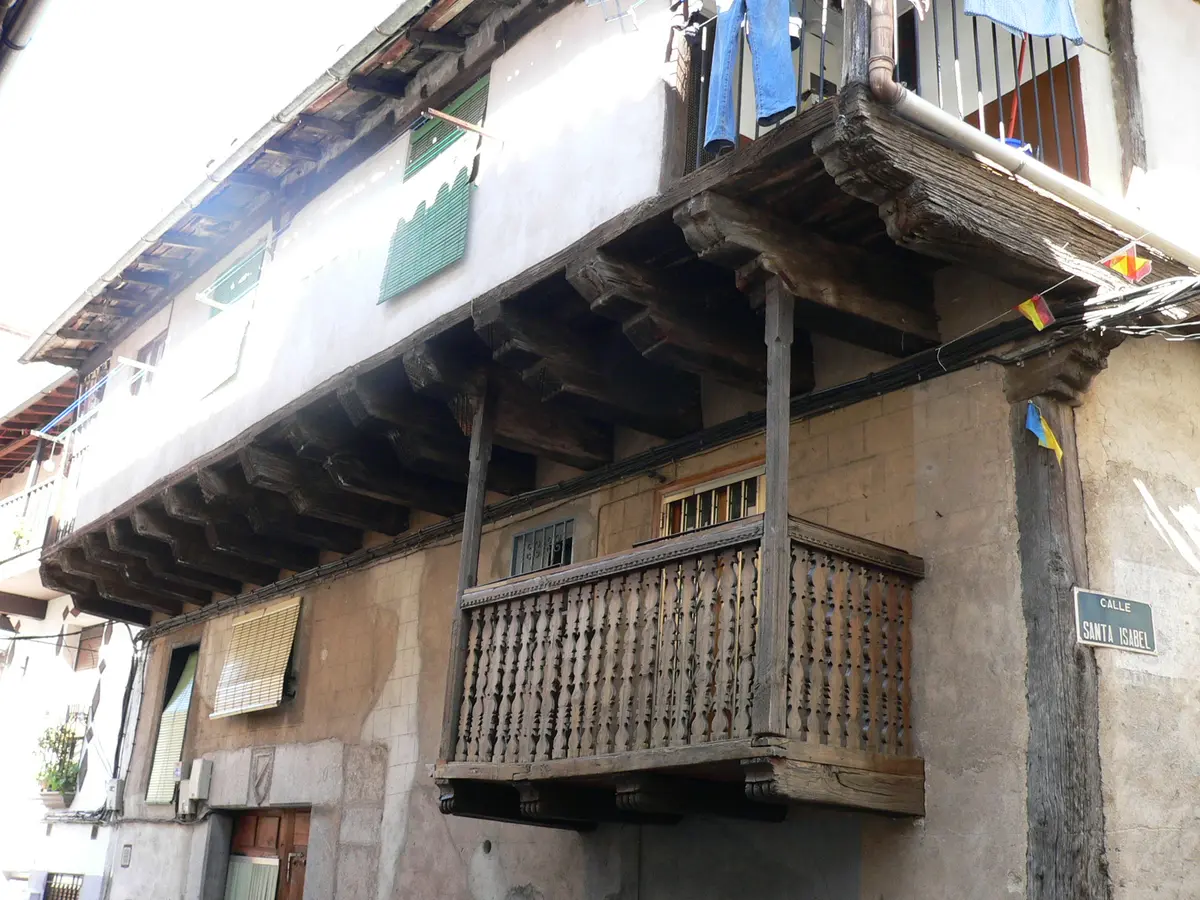
Garganta la Olla is in the district of La Vera, province of Cáceres, on the southern side of the Gredos range. The municipal tourism office calls the village a declared Conjunto Histórico-Artístico and lists what a walk through it passes: the church of San Lorenzo Mártir, with its baroque organ and its small room of religious art; the Casa de las Muñecas; the adobe and timber of the Barrio de La Huerta; the Casa la Peña; the Casa de Postas; the Casa del Almotacén.
Two entries on that list touch the ballad, and one of them is the Casa Carvajal, which still carries the family arms carved on the lintel of its door; the same office repeats the local identification of Isabel de Carvajal as the Serrana and places her in that house "hasta el momento de su deshonra". The other is one of the village viewpoints, listed as the Mirador de la Serrana. The office also records a cross raised on top of the village tower in memory of the victims the Serrana was said to have killed.
The one of them fitted out as a museum is the Museo de la Inquisición, a seventeenth-century house on a street off the square. About 265 m² of it is open to visitors. A guided route goes through the cell and the torture room, and the granite column of its porch carries a cut inscription: "Esta cruz se hizo siendo capitán Iván Muñoz, oficial del santo oficio y familiar Rafael Martín, en el año 1606".
The village has no interpretation centre for the Serrana and no signposted route to the cave of the ballad. Everything above comes from gargantalaollaturismo.es, the municipal tourism site, consulted on 9 September 2026; it publishes no opening hours or prices for any of these buildings.
Sources consulted
- Biblioteca Virtual Miguel de Cervantes, «Las serranas de la Vera (Lope de Vega, Vélez de Guevara y Valdivielso), edición de Jesús Majada y Antonio Merino» — Edición crítica, 2000 book
- María José Osuna Cabezas, «Las serranas del Arcipreste de Hita como antecedentes de «La serrana de la Vera» de Vélez de Guevara» — Actas del III Congreso Internacional sobre Juan Ruiz, Centro Virtual Cervantes, 2004 academic
- Ramón Menéndez Pidal y María Goyri de Menéndez Pidal, «Luis Vélez de Guevara, La serrana de la Vera — «Observaciones» de la edición de 1916 (págs. 125-169), en la edición digital de la Fundación Ramón Menéndez Pidal» — Teatro antiguo español I, Centro de Estudios Históricos, Madrid, 1916; edición digital de la Fundación Ramón Menéndez Pidal (2013), 1916 book
- Juan Ruiz, Arcipreste de Hita, «Libro de buen amor, copla 959b («salteóme una serrana»)» — c. 1330-1343, 1343 book
- Garganta la Olla Turismo (sitio privado), «La Serrana de la Vera — tradición local y lugares del pueblo» — gargantalaollaturismo.es, web turística de titularidad privada, 2026 web
Reviewed by V. Serrano on 2026-07-28 · How we verify our content
📎 Source: Enigma Atlas
💬 Field testimonies (0)
No testimonies yet. Add the first.
Add your testimony
🔒 Log in to add a testimony