📜 LEGEND · EXP. Nº3657
ACTIVE
Mari of Anboto
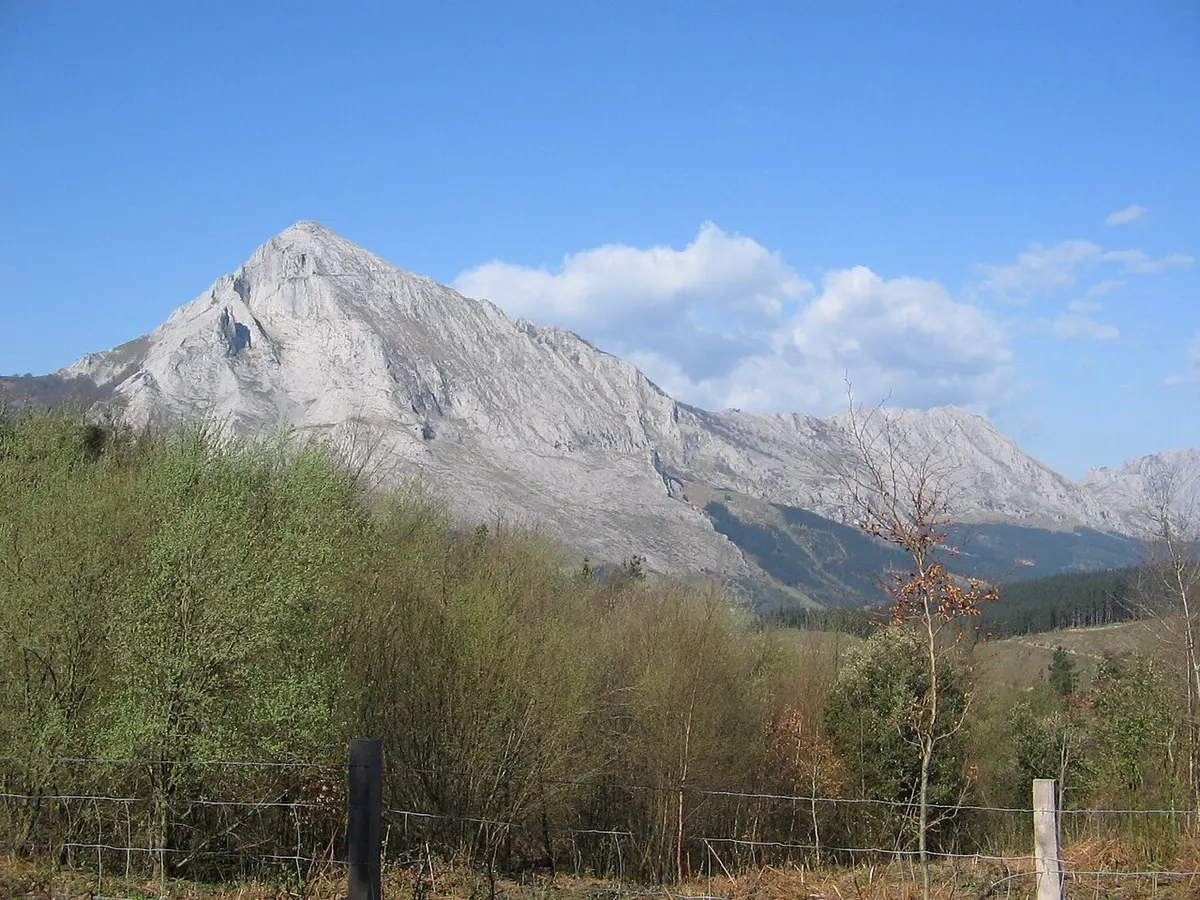
Mari of Anboto is the great lady of Basque mythology, said to live in a cave high on the east wall of Anboto, a 1,331-metre limestone ridge in the Urkiola Natural Park, on the boundary between Bizkaia and Araba.
Where does the legend of Mari of Anboto come from?
- Location
- Anboto, Bizkaia/Álava, Spain
- Kind of legend
- Myth
- Coordinates
- 43.089, -2.595
- Last updated
LOCATION
What is the legend of Mari of Anboto?
The single name under which the world knows her was fixed in the twentieth century: it was Jose Miguel de Barandiaran who gathered the Lady of Anboto, the Lady of Aralar, the Witch of Aketegi and other local figures under the single word Mari, and who wrote in 1972 that he felt inclined to consider her a symbol, perhaps a personification, of the Earth. The oldest datable text behind the story is neither Basque nor about a goddess: a Portuguese genealogy of about 1340 in which a woman with a cloven foot marries the lord of Biscay on condition that he never cross himself. Anboto itself reaches print around 1516 as a place of witches, not of a lady. The tales were told by named shepherds, ironworkers and millers between 1920 and 1985, and the cloud that sits on the summit has an explanation.
What is the history of Mari of Anboto?
The oldest document behind this legend is Portuguese, and it names neither Mari nor Anboto.
Between about 1340 and 1344, Pedro Afonso, Count of Barcelos, compiled the Livro de Linhagens. Title IX tells how Diego López, lord of Biscay, waiting at a hunting stand for the boar, heard "cantar muita alta voz ũa molher" — a woman singing very loudly — and left his post for the crag where she stood. She was "mui fermosa" and "mui bem vistida", and one foot was cloven: "pee forcado". He offered marriage as soon as she told him she was "ũa molher de muito alto linhagem", and she accepted on one condition, "que nunca se santificasse": that he never cross himself. They lived together a long time and had two children, a son called Enheguez Guerra and a daughter. The pact broke over a dog fight: a wolfhound killed a smaller hound over a bone, Diego crossed himself and cried "Santa Maria val, quem vio nunca tal cousa!", and she "foi-se pera as montanhas, em guisa que a nom virom mais, nem a filha" — went to the mountains and was never seen again, taking the daughter, while the father held on to the son. Years later, with Diego a prisoner in Toledo, Enheguez went alone to the crag and his mother spoke before he could — "Filho, Enheguez Guerra, vem a mim ca bem sei eu ao que vẽes" — and gave him a horse that carried him to Toledo and back before nightfall. She remains, on her rock, an oracle you go up to consult; that much survives into the twentieth-century tales. (Quoted from José Mattoso's edition through Ana Maria Soares's 2011 study.)
That text is a charter of dynastic legitimacy for the Haro lords of Biscay, not a piece of mountain religion. The mountain has no name in it and the word Mari does not appear: in the twenty-four pages Soares devotes to the legend, "Amboto"/"Anboto" occurs zero times and "Mari" zero times, against thirty-eight occurrences of "Biscaia". Medievalists file the lady with Melusine, and José Ramón Prieto Lasa gave the Biscayan legends and the Melusinian tradition a book of their own in 1995.
Anboto enters print as a place of witches, and there is no lady in it
The mountain reaches paper some 175 years later, in a different register. Around 1516-1517 a guide written so that the young Charles I might know the people he was to rule mentions in passing "una seta y eregia a que llamaron la caridad de los de Anboto". In 1518 Juan de Padilla, the Carthusian, rhymes "las Durangas de embote" among the sorcerers of his Doze triumphos de los doze Apóstoles. In 1535 Gonzalo Fernández de Oviedo drops "esotros herejes de la peña de Amboto e sus secuaces de la condenada secta de fray Alonso de Mella" into his Historia general y natural de las Indias. In 1543 fray Juan de Zumárraga — born in Durango in 1468, by then bishop of Mexico — writes of "las bruxas o sorguinas que dizen que hay en nuestra tierra", and that que dizen que hay is his own scepticism showing: he thought the business delusion and wanted preachers sent, not inquisitors. All four texts are about heresy and witchcraft in the Duranguesado. Not one mentions a goddess, a cave-dweller or the weather. Iñaki Bazán Díaz gathered them in 2011 precisely in order to ask whether the famous "witches of Amboto of 1507" happened at all, and he left the question mark in his title.
Meanwhile the Basque chronicler who did write down the origin of the lordship told something else. Lope García de Salazar composed his Bienandanzas e fortunas between 1471 and 1476, imprisoned by his own sons in the tower of Muñatones. Book XX opens the dynasty not with a fairy but with Jaun Zuria, the battle of Arrigorriaga and the two wolves carrying lambs that became the arms of Biscay. Sweeping the digital edition of all twenty-five books, the string a[nm]boto returns zero hits; the control run in the same pass on "Vizcaya" returns 98 in Book XX alone.
The people who actually told these stories
Everything quotable about Mari as a living belief was told by named country people in the twentieth century, in a handful of Biscayan and Gipuzkoan valleys.
The first printed version of the best-known tale — go in facing forward, come out walking backwards — was taken down by José Miguel de Barandiarán from Pedro Sudupe, at Azkoitia, in 1920, under the title "Un rito extraño": the Lady of Amboto steals a shepherd's ram, a friar tells him how to walk in her cave, and he hauls the animal out backwards by the horns while she says he would otherwise have had to stay. In 1927 Fermín Garbayo had a countryman of Bergara write down and send Barandiarán the fullest early text: an ironmaster from Zubillaga, in Oñati, whose forge has stopped goes up to the Lady, finds her combing her hair in a fine room, and is told to have a friar bless the works. The narrator adds that many men have seen her in the air "with fire in the shape of a heap of straw", that "when she goes into the cave of Amboto she leaves cloud and makes a dull thunder", and that the cave is on the Elorrio side and as big as a house door.
Later, Juan Manuel Etxebarria collected around the Gorbeia: from Juan Akesolo, 64, of Bertzuten in Zeberio, in 1979, the miller who cursed the Lady and had his mill stopped until he knelt to apologise; from Simón Goyoaga, 77, of Ipiñaburu in Zeanuri, in 1979, the tenant sent to the cave of Supelegor because his master was afraid to go, who found her spinning with a bullock lying beside her; from Petra Etxebarria, 86, of lower Orozko, in 1983, four sentences in Biscayan Basque about the Lady combing her hair and the sun rising when she had finished; from Txomin Aretxaga, 75, of Santa Cruz in Zeberio, in 1985, the seminarian ordered out of the cave with a gold cup he had blessed. Resurrección María de Azkue had printed his own harvest as Euskalerriaren Yakintza with Espasa-Calpe in 1935 and 1942, where she appears as Anbotoko Mari and as Muruko Damea, the Lady of Muru.
The moment a scatter of local ladies became one goddess
She had no single name. She was the Lady of Anboto, the Lady of Aralar, the Witch of Aketegi, the Lady of Murumendi. The name under which the world now knows her was chosen for her. In his Diccionario ilustrado de mitología vasca (1972) Barandiarán wrote that among the components of her present names "the oldest seems to be Mari", grouped the local figures under that word, counted more than forty caves credited to her across the Basque Country, and concluded — far more carefully than the use later made of it — that attending to her attributes "we feel inclined to consider her a symbol, perhaps a personification, of the Earth" (pp. 423 and 430). Juan Inazio Hartsuaga states the operation plainly in the Auñamendi encyclopaedia: it was Barandiarán who established the unified name Mari over the Lady of Anboto, the Lady of Aralar, the Witch of Aketegi and the rest. That is the decisive date in this file, and it is 1972.
Timeline: the documented record of Mari of Anboto
- c. 1340-1344 Pedro Afonso, Count of Barcelos, compiles the Livro de Linhagens. Title IX marries Diego López, lord of Biscay, to a woman found singing on a crag, beautiful, richly dressed and with a cloven foot, on condition that he never cross himself. It is the oldest datable text behind the legend, and it names neither the mountain nor Mari.
- 1471-1476 Lope García de Salazar writes the Bienandanzas e fortunas while imprisoned by his sons in the tower of Muñatones. Book XX opens the lordship of Biscay with Jaun Zuria and the battle of Arrigorriaga, not with a fairy: a sweep of the digital edition of all twenty-five books returns zero occurrences of Amboto or Anboto, with 98 hits for Vizcaya in Book XX alone as a control.
- c. 1516-1517 A guide written so that the young Charles I might know the people he was to rule mentions in passing "una seta y eregia a que llamaron la caridad de los de Anboto". It is the earliest datable appearance of the toponym in this context, and it is about a sect, not about a lady.
- 1518 and 1535 Juan de Padilla, the Carthusian, rhymes "las Durangas de embote" among the sorcerers of Los doze triumphos de los doze Apóstoles. Seventeen years later Gonzalo Fernández de Oviedo cites "esotros herejes de la peña de Amboto e sus secuaces de la condenada secta de fray Alonso de Mella" in his Historia general y natural de las Indias, conflating the Durango heretics with the Amboto witches — an error many later historians repeated.
- 1543 Fray Juan de Zumárraga, born in Durango in 1468 and by then bishop of Mexico, writes in his Regla cristiana breve about "las bruxas o sorguinas que dizen que hay en nuestra tierra". That "they say there are" is his own scepticism: he held the business to be delusion and asked for preachers rather than inquisitors.
- 1869 and 1871 The Lady of Amboto becomes literature: Sotero Manteli publishes La dama de Amboto: leyenda escrita sobre tradiciones vascongadas at Vitoria in 1869, and Gertrudis Gómez de Avellaneda prints La dama de Amboto. Tradición vasca in Madrid in 1871. Both precede by half a century the first tale collected from a named informant.
- 1920 José Miguel de Barandiarán takes down from Pedro Sudupe, at Azkoitia, the tale he printed as "Un rito extraño": the Lady of Amboto steals a shepherd's ram, a friar teaches him to enter facing forward and leave walking backwards, and he hauls the ram out by the horns while she tells him he would otherwise have had to stay.
- 1927 At Fermín Garbayo's request a countryman of Bergara writes down and sends Barandiarán the fullest early text: an ironmaster of Zubillaga, in Oñati, whose forge has stopped consults the Lady, who is combing her hair. The narrator adds that men have seen her in the air "with fire in the shape of a heap of straw" and that "when she goes into the cave of Amboto she leaves cloud and makes a dull thunder", the cave being on the Elorrio side and as big as a house door.
- 1968 The documentary Ama Lur, by Fernando Larruquert and Néstor Basterretxea, makes the word Amalur famous. It has no attestation in the collected oral tradition; Andrés Ortiz-Osés later fuses it with Mari and writes in Antropología simbólica vasca (1985: 85) that "in the beginning was Amalur, and Amalur was Mari, and Mari was all things".
- 1972 In the Diccionario ilustrado de mitología vasca Barandiarán writes that among the components of her present names "the oldest seems to be Mari", groups the Lady of Anboto, the Lady of Aralar, the Witch of Aketegi and the rest under that single word, counts more than forty caves attributed to her, and concludes that he feels inclined to consider her a symbol, perhaps a personification, of the Earth (pp. 423 and 430). This is the date on which a scatter of local ladies becomes one goddess.
- 1981 Juan Aranzadi argues in Milenarismo vasco that the surviving witchcraft trials give no ground for inferring that anyone prosecuted practised a cult of Mari or of any other prehistoric numen. Bazán Díaz endorses the point in 2011: a diffuse ancestral substrate, yes; a stable and coherent pagan cult, no.
- 1979-1985 Juan Manuel Etxebarria records four Mari tales from named neighbours of the Gorbeia country: Juan Akesolo (64, Bertzuten, Zeberio, 1979), Simón Goyoaga (77, Ipiñaburu, Zeanuri, 1979), Petra Etxebarria (86, lower Orozko, 1983) and Txomin Aretxaga (75, Santa Cruz, Zeberio, 1985). They are the last named voices in this file, and the only woman's voice in it is Petra Etxebarria's.
Is there a rational explanation for Mari of Anboto?
The cloud on the summit
Anboto is a compact grey limestone ridge, full of fossil coral and shells, rising to 1,331 m with 734 m of prominence and falling on its north side in cliffs of more than 300 m straight above the Arrazola valley, some twenty-five kilometres from the Bay of Biscay. Damp Atlantic air driven against a wall like that has nowhere to go but up; it cools as it rises, reaches saturation near the crest and condenses there. A cap of cloud can therefore sit on the summit for hours while the valleys stay dry and lit, because the air forming it is continually replaced from below. No tenant is required. What deserves saying is that the tradition never separated the two things either: in the Bergara text of 1927 the cloud is not evidence that Mari exists, it is the sign that she has just gone in — "when she goes into the cave of Amboto she leaves cloud and makes a dull thunder". Hartsuaga's comparative reading (2004) arrives at the same place from the other end and treats Mari as the personification of the weather itself.
"Pre-Roman", "pre-Christian" and what the documents will bear
The claim that Mari is a pre-Roman deity worshipped in unbroken continuity is the one thing here that no document supports. Juan Aranzadi argued in Milenarismo vasco (1981) that from the surviving witchcraft trials it cannot be inferred that anybody prosecuted practised a cult of Mari or of any other prehistoric numen. Bazán Díaz, reviewing the medieval and early modern record in 2011, sets the limit of the evidence in one sentence: a more or less diffuse survival of an ancestral cultural substrate, yes, but no stable and coherent pagan cult. Even the name is disputed among the people best placed to judge. Barandiarán denied that Mari is a shortening of María and connected it to old Basque forms such as Mairi, Maide and Maindi; Emeterio Sorazu (1980) thought a Christian origin possible; and the question is live enough that Jesús Huarte titled a 2005 paper "Marirengandik Mariarengana" — from Mari towards María.
A word that was born in a cinema
The cleanest measurement of how recent some of this is concerns Amalur, "mother earth", now routinely given as Mari's true name. Jon Mentxakatorre points out that Amalur has no attestation whatever in the collected tradition: it owes its fame to the 1968 documentary Ama Lur by Fernando Larruquert and Néstor Basterretxea, after which Andrés Ortiz-Osés fused it with Mari and wrote, in Antropología simbólica vasca (1985: 85), "in the beginning was Amalur (Mother Earth), and Amalur was Mari (the Great Mother Goddess), and Mari was all things". That is a 1985 sentence about a 1968 word, not an echo of the Neolithic.
What is documented is a good deal: six named informants between 1920 and 1985, a body of tales with a strict internal rule about how to walk inside her cave, hail understood as the return of goods their owners had lied about, and a mountain that makes its own cloud. None of it needs a goddess older than the Romans in order to be worth reading.
Can you visit Mari of Anboto?
Anboto rises to 1,331 m on the boundary between Bizkaia and Araba, inside the Urkiola Natural Park, and the coordinate this entry carries falls 67 m from the summit cairn. The gentlest side starts at the Urkiola pass on the BI-623 between Durango and Vitoria-Gasteiz, where the sanctuary of San Antonio and the car parks sit. The north side is approached from Arrazola and Axpe in the Atxondo valley, over about a thousand metres of ascent on exposed ground; a third start is Aramaio, on the Araba side.
The Toki Alai visitor centre of the park stands at Urkiolako mendatea 8, 48211 Abadiño, about 200 metres above the pass up a concrete track that leaves the car park of the Bizkarra restaurant, with the whole crest from Alluitz to Anboto in front of it. Cars can drive up to the door; coaches longer than ten metres have to reach the pass from Otxandio, because the Durango approach is closed to them. The provincial council published these hours on 22 September 2026: November to March, 10:30-14:30 and 15:30-17:30; April to October, 10:00-14:00 and 16:00-18:00. The telephone is 946 814 155 and the address for enquiries is [email protected]. The park's own older site, whose pages carry a 2006-2007 copyright line, adds that the centre opens every day except 25 December, 1 January and 6 January, and that the changeover between the two timetables follows the official clock change.
Mari's cave, Mariurrika kobea or Mariren koba, opens in the vertical east wall a short way below the summit; Bazán Díaz places it at 1,200 m. Reaching it is a climb on exposed limestone rather than a walk, and the valley of Arrazola lies some 800 metres below the openings.
Two of those openings are famous in their own right. The astronomer Jorge Hernández Bernal spent three years modelling them for the article "El sol mira a Arrazola a través de los ojos del Anboto" in Astola 14 (2020), and found that from the hermitage of San Roke down in Arrazola the sun passes behind the ojo de Bentanetan around 11 March and 1 October, and behind the ojo de Azkilar around 6 March and 7 October. His published table of passes for 2020 to 2025 gives each one a duration of between 30 and 130 seconds. The hermitage was built between the seventeenth and eighteenth centuries, and the article closes by saying that its position and orientation cannot be shown to have been chosen for the phenomenon. The same page warns that watching the sun with the naked eye needs the precautions of an eclipse.
Supelegor, the other cave in these stories, is on a different mountain. It lies at 981 m in the Itxina massif of the Gorbeia Natural Park, in the municipality of Orozko, and from the Anboto summit it is 17.9 km, or 11.1 miles, due west. The tradition has the Lady moving between the two, which is how they came to be confused.
Sources consulted
- Ana Maria Soares, «A Lenda da Dama do Pé de Cabra: do Livro de Linhagens do Conde D. Pedro de Barcelos a Alexandre Herculano (cita la edición de José Mattoso, 2001: 204-205)» — Limite. Revista de Estudios Portugueses y de la Lusofonía, n.º 5, pp. 7-30, 2011 academic
- Iñaki Bazán Díaz, «Superstición y brujería en el Duranguesado a fines de la Edad Media: ¿Amboto 1507?» — Clio & Crimen. Revista del Centro de Historia del Crimen de Durango, n.º 8, pp. 191-224, 2011 academic
- Jon Mentxakatorre Odriozola, «La Dama de Amboto y el infierno. Mito y fórmula (versión ampliada de «Anbotoko Dama eta infernua», Euskera 60/2, 2015)» — Revista de Folklore (Fundación Joaquín Díaz), n.º 430, pp. 4-34, 2017 academic
- José Miguel de Barandiarán, «Diccionario ilustrado de mitología vasca (Obras completas, vol. 1), pp. 338-339, 423, 425 y 430» — La Gran Enciclopedia Vasca, Bilbao (consultado a través de Mentxakatorre 2017 y de la Auñamendi), 1972 book
- José Miguel de Barandiarán, «Eusko Folklore (Obras completas, vol. 2): «Un rito extraño», p. 16, recogido de Pedro Sudupe en Azkoitia en 1920, y el texto de Bergara de 1927, p. 407, con sus notas» — La Gran Enciclopedia Vasca, Bilbao (citado a través de Mentxakatorre 2017), 1973 book
- Juan Manuel Etxebarria, «Gorbeia inguruko etno-ipuin eta esaundak (textos 19.4, 22.1, 25.5 y 33.1: Juan Akesolo 1979, Txomin Aretxaga 1985, Simón Goyoaga 1979 y Petra Etxebarria 1983)» — Instituto Labayru – BBK, Bilbao (citado a través de Mentxakatorre 2017), 1995 book
- Resurrección María de Azkue, «Euskalerriaren Yakintza / Literatura popular del País Vasco, vol. 1 (Costumbres y supersticiones, 1935) y vol. 2 (Cuentos y leyendas, 1942)» — Espasa-Calpe, Madrid, 1935 book
- Juan Inazio Hartsuaga Uranga, «Mari: concepto, textos e interpretación en la enciclopedia Auñamendi» — Auñamendi Eusko Entziklopedia, Eusko Ikaskuntza, 2002 web
- Juan Aranzadi, «Milenarismo vasco: edad de oro, etnia y nativismo (3.ª parte, cap. I)» — Taurus, Madrid (citado a través de Bazán Díaz 2011), 1981 book
- José Ramón Prieto Lasa, «Las leyendas de los señores de Vizcaya y la tradición melusiniana (tesis, Universidad Complutense de Madrid, 1992)» — Fundación Ramón Menéndez Pidal / UAM / Universidad del País Vasco, Madrid, 1995 book
- Lope García de Salazar, «Las bienandanzas e fortunas, libros I-XXV (edición digital; barrido propio: cero apariciones de «Amboto/Anboto», control «Vizcaya» = 98 solo en el libro XX)» — Lemir / Parnaseo, Universitat de València (obra compuesta entre 1471 y 1476), 1476 archive
- Turismo Euskadi (Gobierno Vasco), «Toki Alai, Centro de Acogida e Interpretación del Parque Natural de Urkiola: acceso, horarios y teléfono» — Museos y centros de interpretación de Euskadi, 2026 web
Reviewed by V. Serrano on 2026-08-16 · How we verify our content
📎 Source: Enigma Atlas
💬 Field testimonies (0)
No testimonies yet. Add the first.
Add your testimony
🔒 Log in to add a testimony