🦶 CRYPTID SIGHTING · EXP. Nº6501
ACTIVE
Altamaha-ha
Altamaha-ha — “Altie” — is a serpent-shaped river monster said to live in the tidal creeks and abandoned rice canals at the mouth of the Altamaha River, near Darien on the Georgia coast.
Where and when was Altamaha-ha sighted?
- Location
- Darien, Georgia, United States
- Date sighted
- Unknown
- Coordinates
- 31.37, -81.43
- Last updated
LOCATION
What is Altamaha-ha?
Its documentary record begins in a newspaper, and it begins in Charleston. On Monday 22 March 1830, Captain Delano of the schooner Eagle told the Charleston press that a grey, eel-shaped animal upwards of seventy feet long, its back “full of joints or bunches” and its head like an alligator's, had struck his vessel a mile inside St Simons Bar. Five crewmen offered to swear to it. Within weeks the same Georgia papers were reporting that planters watching a large animal in St Simons Sound through telescopes took it for a grampus whale, and that none of them had seen bunches or an alligator's head. No name was attached to the creature for another century and a half: the earliest datable appearance of “Altamaha-ha” in print we have located is a 1987 novel, and Altie became the county's mascot only in 2009, when the sculptor Rick Spears — who had found the legend in an internet search in 2000 — installed a model of it in the Darien welcome centre. The claim that the legend descends from an Indigenous river spirit is repeated everywhere and supported nowhere.
What is the history of Altamaha-ha?
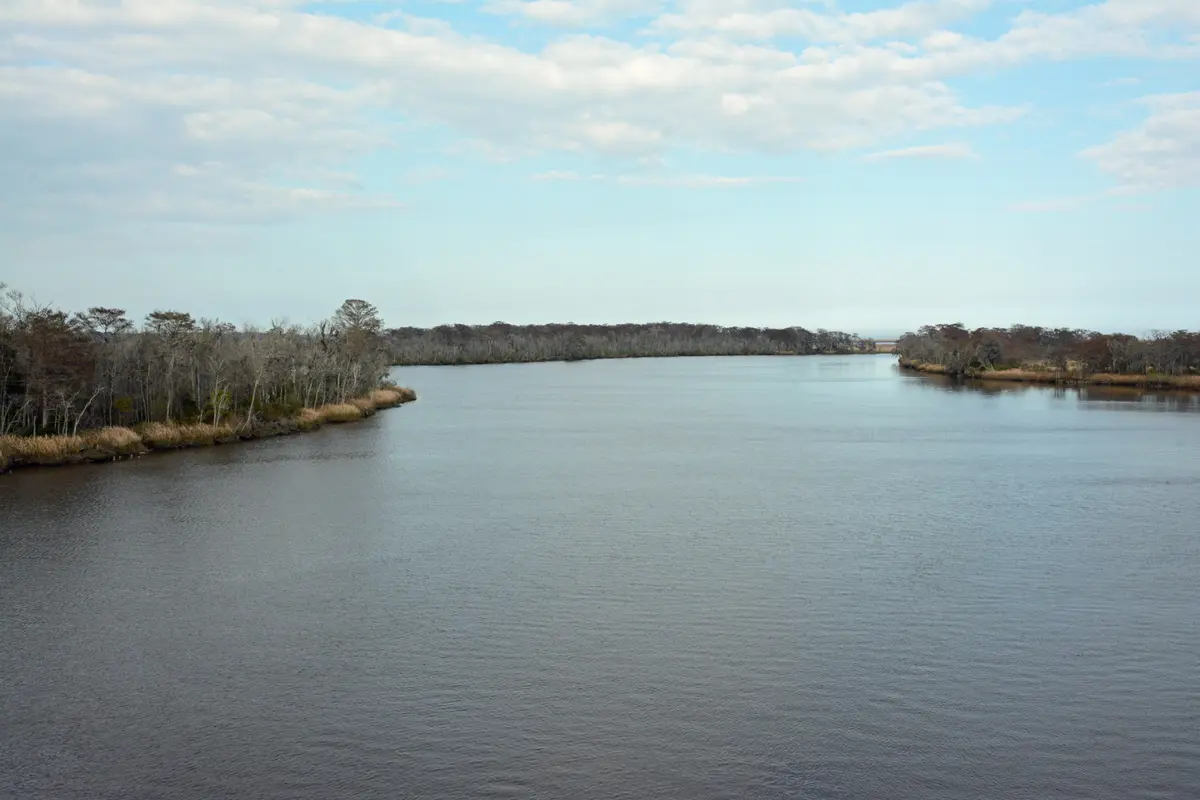
The Altamaha is not a small river. It gathers the Oconee and the Ocmulgee and runs more than 130 straight-line miles to the Atlantic without a single dam on its main stem, draining a 14,000-square-mile basin — close to a quarter of Georgia. Near the sea it stops behaving like a river at all and breaks into a maze of tidal creeks, marsh and abandoned rice canals. The Nature Conservancy has listed it among America's Last Great Places, and more than 120 rare or endangered species live in the system.
The town at its mouth has a documented history that needs no monster. Fort King George, a cypress blockhouse and palisaded earthwork raised in 1721 by scoutmen under Colonel John "Tuscarora Jack" Barnwell, was the southernmost outpost of the British Empire in North America until it was abandoned in 1727. In 1736 General James Oglethorpe settled Scottish Highlanders recruited around Inverness on the same bluff, led by John McIntosh Mohr and Hugh Mackay; they called the place New Inverness before renaming it Darien. In June 1863 Union troops — the Fifty-fourth Massachusetts Volunteers under Colonel Robert Gould Shaw and the Second South Carolina Infantry under Colonel James Montgomery — burned the undefended town. It came back as a timber port: by 1900 Darien was shipping over 100 million board feet a year, the last big mill closed in 1916, and by the 1960s the town had Georgia's largest shrimp fleet.
The creature's own documentary record begins in a newspaper, and it begins in Charleston rather than Darien. On Monday 22 March 1830 — the day of the week checks out — Captain Delano of the schooner Eagle, running cotton from Turtle River, was beating out about a mile inside St Simons Bar when he saw a large object "resembling an alligator" lying on the surface three hundred yards off. He loaded a musket, tacked to within twenty-five yards and shot it in the head. The animal turned, made for the vessel and struck the stern hard enough that everyone aboard felt it. Delano climbed onto his deck cargo of cotton. He and his crew described a grey creature upwards of seventy feet long, shaped like an eel, without visible fins, apparently scaled, its back "full of joints or bunches", with an alligator-like head some ten feet long. A smaller one of the same kind was in company. Five men offered to swear an affidavit. The Charleston Courier and the Charleston Mercury printed it on 29 March under the headline "Sea Serpent in Georgia!", and Georgia papers reprinted it from 3 April onwards.
Everything else came later, and can be dated. A correspondent writing from Darien on 18 April 1830 found Delano at Brunswick and judged him "a steady, industrious man". Emily Ellison's Liars & Legends dates the modern cycle to 1969, when two young boys fishing from their father's houseboat on the Altamaha reported something in the water. In 1981 a former newspaper publisher, Larry Gwin, and his friend Steven Wilson reported a two-humped animal that left a wake like a speedboat, and the national coverage brought other witnesses forward. The earliest datable appearance of the name Altamaha-ha we have been able to locate in print is Doris Buchanan Smith's coastal-Georgia novel Karate Dancer, published in 1987. In June 2000 the Forsyth County News ran a syndicated piece by Kelly Milner Halls in which Rick Spears, then an exhibit designer at the Rock Eagle Museum of Natural History, explained how he met the legend: "I did an Internet search for 'cryptozoology,' and the first site listed was for a creature called the Altamaha-Ha." Nine years later Spears built the sculpture that stands in the Darien–McIntosh welcome centre, and Altie became the county's mascot.
Timeline: the documented record of Altamaha-ha
- 1721–1727 Scoutmen under Colonel John “Tuscarora Jack” Barnwell build Fort King George on the Altamaha bluff, the southernmost British outpost in North America; it is abandoned in 1727.
- 1736 General James Oglethorpe settles Scottish Highlanders recruited around Inverness, led by John McIntosh Mohr and Hugh Mackay, on the same bluff. They name the town New Inverness, later Darien.
- c. 1826 Captain Delano later states that he had seen a similar animal once before, “about 4 years since, off Doboy bar”, and that he is acquainted with all kinds of whale. The claim is retrospective: it is known only from his 1830 account.
- 22 March 1830 Captain Delano of the schooner Eagle shoots at a grey, eel-shaped animal some 70 feet long a mile inside St Simons Bar; it strikes his stern. He describes its back as “full of joints or bunches” and its head as an alligator's. Five crewmen offer to swear an affidavit.
- 29 March 1830 The Charleston Courier and the Charleston Mercury publish Delano's account under the headline “Sea Serpent in Georgia!”. Georgia papers reprint it from 3 April onwards. It is the earliest printed record of the legend we have located.
- April–July 1830 A correspondent writing from Darien reports that planters on St Simons have watched a large animal for weeks, some through telescopes; a sea captain among them is “positive it is nothing more than a Grampus Whale” and none of them saw bunches or an alligator's head. By July a reader sends the Georgian a sketch of a stranded specimen, “no more like a serpent than a horse”.
- June 1863 Union troops — the Fifty-fourth Massachusetts under Colonel Robert Gould Shaw and the Second South Carolina under Colonel James Montgomery — burn the undefended town of Darien.
- 1969 Emily Ellison dates the modern cycle of sightings to this year, when two young boys fishing from their father's houseboat on the Altamaha reported something in the water. Our previous version of this entry described them as two commercial fishermen; that is not what the source says.
- 1981 Larry Gwin, a former newspaper publisher, and Steven Wilson report a two-humped animal leaving a wake like a speedboat. National coverage brings forward other witnesses, including Harvey Blackman of Brunswick, who says he saw it in the 1970s.
- 1987 Doris Buchanan Smith's novel Karate Dancer, set on the Georgia coast, uses the name Altamaha-ha. It is the earliest datable appearance of the name in print that we have been able to locate; the 1830 witnesses called it only a sea serpent.
- 15 June 2000 In a syndicated feature by Kelly Milner Halls, Rick Spears — then an exhibit designer at the Rock Eagle Museum of Natural History — explains that he found the legend online: “I did an Internet search for 'cryptozoology,' and the first site listed was for a creature called the Altamaha-Ha.”
- 2009 Spears builds an adult Altamaha-ha from eyewitness descriptions. It goes on display in the Darien–McIntosh welcome centre and Altie becomes the county's mascot.
- March 2018 Decomposing remains photographed by Jeff Warren at the Wolf Island National Wildlife Refuge circulate worldwide as a possible baby Altamaha-ha. Quinton White (Jacksonville University) says “we think someone's playing a joke on us”; John “Crawfish” Crawford (University of Georgia) calls it a constructed model. Georgia DNR sends photographs to the Smithsonian and finds no trace of the remains.
- 26 September 2018 The New York performance artist Zardulu claims authorship of the Wolf Island remains, made from a stuffed shark and papier-mâché.
Is there a rational explanation for Altamaha-ha?
The claim that most needs checking is the one repeated most often: that the legend descends from an Indigenous tradition of a river spirit. The Darien–McIntosh visitor bureau states on its own website that the legend "predates British-English colonization and is said to have originated with the Lower Muskogee Creek Tribe". No source is given, and the same page says Oglethorpe brought the Highlanders in 1763 — the correct year, on the Georgia state historic site's own page for Fort King George, is 1736.
We went to the ethnographic record rather than to the tourism copy, and the result is worth stating precisely, because a search that finds nothing is worthless without a control. In John R. Swanton's Myths and Tales of the Southeastern Indians (Bureau of American Ethnology, Bulletin 88, 1929), 776,000 characters of Creek, Hitchiti, Alabama, Koasati and Natchez narrative, the word "Altamaha" appears zero times. The control in the same file: "tie-snake" appears 76 times and "snake" 315. In Swanton's Early History of the Creek Indians and Their Neighbors (Bulletin 73, 1922), 1.83 million characters, the balance inverts: "Altamaha" appears 14 times, "Tama" 135, "Yamasee" 191 and "Guale" 155, while "tie-snake", "water serpent" and "water monster" appear zero times.
So both halves of the claim are documented separately and never together. Creek water-serpent tradition is real and rich — the tie-snake or Strong-snake (Stahwanaia) lives in deep water, coils around its victims and wrestles with Thunder — and the Tama were a real Hitchiti-speaking people whom Spanish records place on the Altamaha in the 1590s. What is missing is any link between them. The regional historian Dale Cox, who is sympathetic to the legend, reaches the same conclusion in print: of the claim that the Tama told of a giant snake in the river, he writes that "no documentation has been found to verify the claim". Attributing an invented story to a real people is not a harmless embellishment, and on the evidence we can find, that is what this is.
The 1830 sighting, by contrast, is genuine as a document — and its contemporaries settled it themselves. Within a month, Georgia readers were told that several respectable planters of St Simons Island had been watching a large animal in the sound for two or three weeks, some of them through telescopes; a sea captain among them was "positive it is nothing more than a Grampus Whale", and the correspondent noted that "none of these gentlemen saw any thing resembling bunches on the back or an Alligator's head". His verdict, borrowing from Hamlet: "I suspect the latter will turn out to be very like a whale." By July a subscriber had sent the Georgian a sketch of a stranded specimen, concluding it was "no more like a serpent than a horse" and that an old whaler took it for a sperm whale.
The local candidates remain excellent. The Altamaha holds one of the best-studied Atlantic sturgeon (Acipenser oxyrinchus) spawning populations on the coast; NOAA Fisheries gives the species a maximum of about 14 feet and 800 pounds and describes five rows of bony plates, called scutes, running the length of the body — armour that at a distance in tannin-stained water reads convincingly as a row of humps on a dark back. Sturgeon also leap clear of the water. The shortnose sturgeon (Acipenser brevirostrum), federally endangered since 1967, is in the river too. In 2014 the Tulane fish biologist Hank Bart argued on the Discovery Channel that the sightings were large alligator gar, noting that the largest gar on record was about 20 feet; the crew hunting the monster on that episode turned up a manatee. And the explanation is not new or imported: in a 2001 Forsyth County News column, fishermen at an Altamaha camp debating a huge splash after dark ran through catfish, dolphin and "one of the two hundred pound sturgeon that run the river on rare occasions" before anyone mentioned Altie.
Finally, the register of the invention. In March 2018 decomposing remains photographed on a beach in the Wolf Island National Wildlife Refuge by Jeff Warren went round the world as a possible baby Altamaha-ha. Scientists were divided in public: Quinton White of Jacksonville University said "we think someone's playing a joke on us", and John "Crawfish" Crawford of the University of Georgia Marine Extension said he was "convinced the 'sea creature' is a constructed model of a baby Altamaha-ha Monster". The Georgia Department of Natural Resources sent photographs to the Smithsonian, and by the time its staff reached the island the remains were gone. In September 2018 the New York performance artist Zardulu claimed authorship: a stuffed shark and papier-mâché.
Can you visit Altamaha-ha?
Darien sits at the mouth of the Altamaha, and the sightings are placed in the tidal creeks and abandoned rice canals of the delta around it, so the addresses below belong to the town rather than to the animal.
The one Altamaha-ha that can be photographed is a model. Rick Spears built an adult version of it in 2009 from eyewitness accounts, and the Darien–McIntosh welcome centre at 1074 Magnolia Bluff Way, Darien, GA 31305, keeps it in the lobby; the chamber of commerce page that describes it invites the public to “take a selfie with Mr. Altie”. That page gave no admission price and no opening hours when it was read on 22 September 2026.
Fort King George State Historic Site, 302 McIntosh Road SE, Darien, GA 31305, telephone 912-437-4770, stands on the river itself. Georgia State Parks published on 22 September 2026 that it opens Tuesday to Sunday from 9 a.m. to 5 p.m. and closes on Mondays, Thanksgiving, Christmas and New Year's Day. Admission on the same date was $8.25 for adults aged 18 to 61, $6.25 for those of 62 and over, $4.75 for youths aged 6 to 17 and $2.75 for children under 6, all plus tax; a group tour needs 15 people or more and a reservation at least two weeks ahead. Inside the stockade stand a reconstructed blockhouse, officers' quarters, barracks, a guardhouse, a moat and palisades, with the tabby remains of three sawmills alongside and a museum and film in the visitor building.
The delta channels around Butler Island and the Altamaha Waterfowl Area are the water the reports describe. It is a working tidal estuary carrying commercial shrimp traffic, and much of the marsh is unmarked. The fish most often proposed as the source of the sightings is the Atlantic sturgeon, which NOAA Fisheries records as listed under the US Endangered Species Act since 2012 in five distinct population segments; the South Atlantic segment, which covers the Georgia rivers, falls in the endangered category. Darien's own annual event on the water is the Blessing of the Fleet, held for the shrimping industry.
Sources consulted
- Charleston Courier, «Sea Serpent in Georgia! [Charleston Courier dispatch of 29 March]» — Southern Recorder (Milledgeville, Ga.), 3 April 1830, p. 3, 1830 newspaper archive
- Charleston Mercury, «Sea Serpent [Charleston Mercury of 29 March 1830, reprinted]» — Augusta Chronicle and Georgia Advertiser, 10 April 1830, p. 1, 1830 newspaper archive
- Unsigned correspondent, «Correspondent's dispatch datelined Darien, 18 April, and the St Simons Sound follow-up» — The Georgian (Savannah), 22 April 1830, p. 2, and Savannah Georgian, 23 April 1830, p. 4, 1830 newspaper archive
- John R. Swanton, «Myths and Tales of the Southeastern Indians (Bureau of American Ethnology, Bulletin 88)» — Smithsonian Institution, Washington, 1929 academic
- Kelly Milner Halls, «Cryptozoologists are always on the lookout for unknown creatures» — Forsyth County News, 15 June 2000, p. 10A, 2000 newspaper archive
- Emily Ellison, «Liars & Legends (Altamaha-ha, pp. 91–92)» — Rutledge Hill Press, Nashville, 2005 book
- Doris Buchanan Smith, «Karate Dancer» — G. P. Putnam's Sons, New York, 1987 book
- Dale Cox, «The Altamaha-ha — Sea Monster of the Georgia Coast» — ExploreSouthernHistory.com, 2017 web
- Georgia State Parks & Historic Sites, «Fort King George State Historic Site — history, hours and admission» — Georgia Department of Natural Resources, 2026 web
- New Georgia Encyclopedia, «Darien» — Georgia Humanities and the University of Georgia Press, 2026 web
- Darien–McIntosh Chamber of Commerce & Darien CVB, «Our Sea Monster» — DiscoverDarien.com, 2021 web
- Sarah Gibbens, «Strange Sea Creature Washes Ashore, Stumps Scientists» — National Geographic, 21 March 2018, 2018 web
- Valdosta Today, «Georgia Coast Altamaha-Ha Monster Discovery a Hoax» — Valdosta Today, 26 September 2018, 2018 web
- John R. Swanton, «Early History of the Creek Indians and Their Neighbors (Bureau of American Ethnology, Bulletin 73)» — Smithsonian Institution, Washington, 1922 academic
- NOAA Fisheries, «Atlantic Sturgeon (Acipenser oxyrinchus) — species directory» — US National Oceanic and Atmospheric Administration, 2026 report
- Arthur Nead, «Is the “Altie” a monster or fish?» — Tulane News, Tulane University, 16 July 2014, 2014 web
- New Georgia Encyclopedia, «Altamaha River» — Georgia Humanities and the University of Georgia Press, 2026 web
- Phill Bettis, «Life's worry snakes slither into dark, shadowy places [Altamaha fish-camp column]» — Forsyth County News, 13 June 2001, p. 11, 2001 newspaper archive
- Blake Smith and Karen Stollznow, «Altie History Part 1: An Interview with Rick Spears (episode 308)» — MonsterTalk, 3 September 2023, 2023 interview
Reviewed by V. Serrano on 2026-08-11 · How we verify our content
📎 Source: Enigma Atlas
💬 Field testimonies (0)
No testimonies yet. Add the first.
Add your testimony
🔒 Log in to add a testimony