🦶 CRYPTID SIGHTING · EXP. Nº0555
ACTIVE
Rougarou
The rougarou of French Louisiana is not an animal waiting to be described.
Where and when was Rougarou sighted?
- Location
- Lafourche and Terrebonne Parishes, Louisiana, United States
- Date sighted
- Unknown
- Coordinates
- 29.59, -90.72
- Last updated
LOCATION
What is Rougarou?
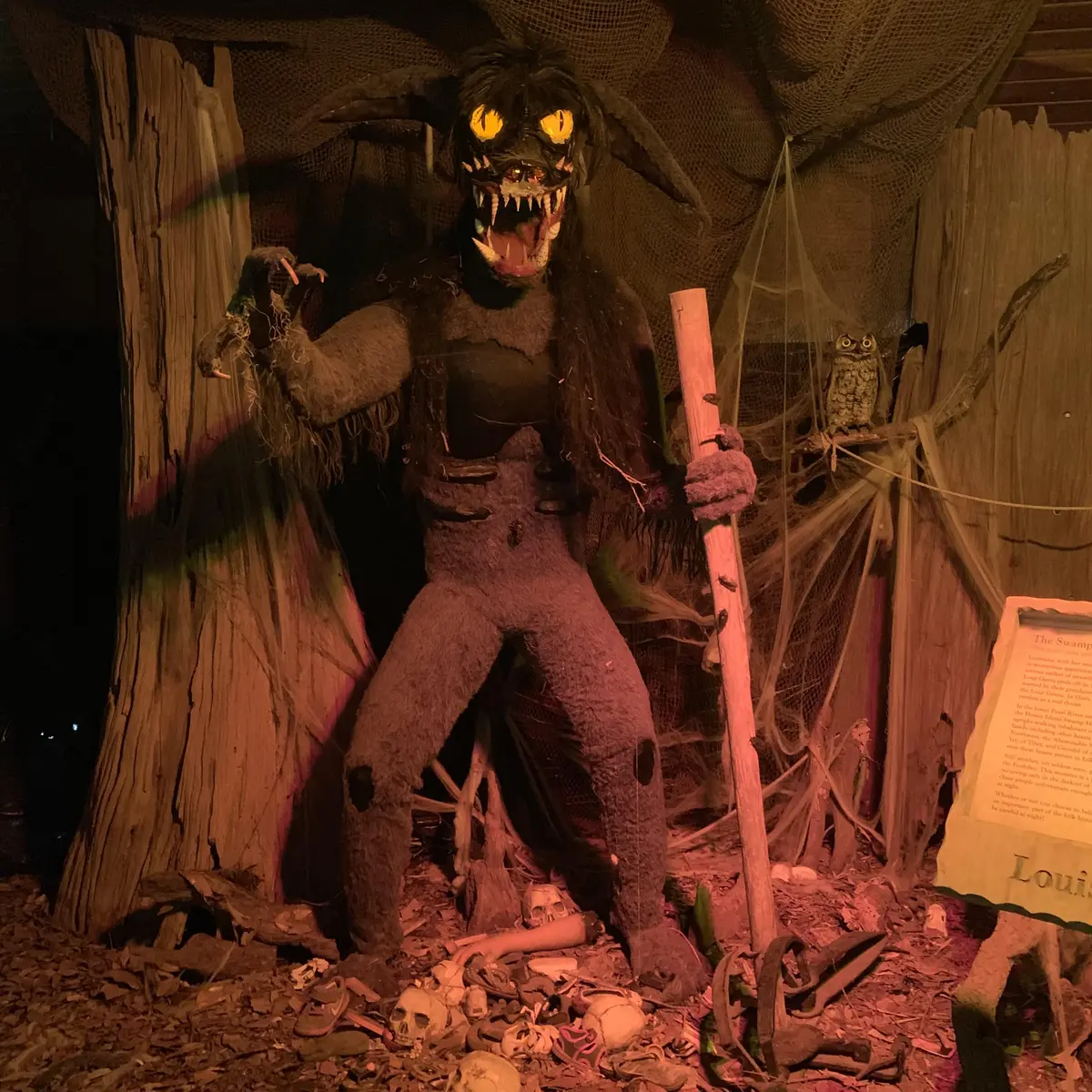
It is a person: someone bitten, cursed or condemned for his own conduct, who takes a beast's shape at night and can only be freed by drawing another person's blood and passing the affliction on. The word is an oral variant of the French loup-garou, whose second half is itself a borrowing from the Frankish werwolf; the folklorist Nathan Rabalais explains the shift as the ordinary drift of the liquid consonants l and r, the same drift that gives plarine for praline in Louisiana French. Despite the wolf inside the word, Rabalais notes that accounts resembling a wolf are exceedingly rare: witnesses describe a dog, an owl, or a shape they cannot resolve, and the wolf-headed poster figure is a back-formation drawn by artists who knew the etymology. The oldest substantial Louisiana account we could read is in Gumbo Ya-Ya (1945), where the informant is introduced only as "A Cajun" and never named. No naturalist has ever proposed a species behind the rougarou. Today it funds a wetlands charity in Houma, sells king cake and names a rugby team.
What is the history of Rougarou?
In the Louisiana tradition the rougarou is a person — someone with a name, under a curse — and in Nathan Rabalais's account the curse passes to whoever the creature bites or otherwise draws blood from.
The word arrived from France already made. Loup-garou is the ordinary French for werewolf: loup is "wolf", and garou is itself an old borrowing from the Frankish werwolf, so the compound says "wolf" twice. The Louisiana form comes from a shift in pronunciation. Rabalais, who wrote the rougarou entry for 64 Parishes, the encyclopedia of the Louisiana Endowment for the Humanities, published on 31 July 2024, explains that when the liquid consonants l and r fall near each other in a word carried orally, "their placement can shift over time" — the same shift that gives plarine for praline and garlie for galerie in Louisiana French, and that turns up in the Laurentians of Quebec and among the Métis of Manitoba. Both forms are current in south Louisiana, and Rabalais places the densest body of stories among Cajun and Houma communities in Lafourche and Terrebonne Parishes.
Rabalais himself calls it paradoxical that "few examples of rougarou stories are available in archives and folktale collections despite the creature's notoriety", and the early printed record bears him out. Alcée Fortier, the Tulane professor who founded the state's folklore scholarship, published "Customs and Superstitions in Louisiana" in the Journal of American Folk-Lore in 1888: it covers the Voudoux, charms, sorcery and ghosts in a few pages, and in the Internet Archive text of the article, searched on 25 September 2026, garou does not occur while Voudoux occurs five times. His Louisiana Folk-Tales of 1895 — the Creole corpus, 59,000 words, with the trickster Compair appearing 638 times — does not contain the word either.
The fullest early printed Louisiana account is in Gumbo Ya-Ya, compiled in 1945 by Lyle Saxon, Edward Dreyer and Robert Tallant from material gathered by workers of the Louisiana Writers' Project of the WPA. On pages 190 and 191 it reports that Cajun children "are constantly warned, 'The loup-garous will get you, yes! You better be good.'" Then it prints a long first-person description introduced with four words that are the whole problem of the book: "A Cajun will explain." The speaker has no name, no parish and no date. What the anonymous speaker says is that loup-garous are "them people what wants to do bad work, and changes themselves into wolves", that they hold balls on Bayou Goula, that a thrown frog drives them off and bullets do not, and that a new sifter hung outside the house makes one stop to count every hole, long enough to be caught and sprinkled with salt. Between those quotations the compilers add, in their own voice, that loup-garous arrive by bat, bite and suck blood, and so turn their victims into loup-garous.
That missing name is not a detail. Rabalais notes that what was "probably the most extensive set of rougarou accounts", collected by Cheryl Cannon, "was either lost or discarded before researchers could access it" — so the fullest record of the tradition is gone, and the famous one is anonymous. The named voices are recent and they are local: Glen Pitre, the filmmaker from Cut Off, who told The Advocate in 2023 that his father had the story from his grandfather, and remembered the creature as "as big as a man, covered with hair, and with big teeth but the saddest eyes"; and Jonathan Foret, raised in Chauvin in the 1980s on his French-speaking grandparents' warning that "if you don't behave, the Rougarou's gonna get you."
Timeline: the documented record of Rougarou
- 1888 Alcée Fortier publishes "Customs and Superstitions in Louisiana" in the Journal of American Folk-Lore. It covers the Voudoux, charms, sorcery and ghosts and does not mention the loup-garou once.
- 1895 Fortier's Louisiana Folk-Tales appears as volume II of the Memoirs of the American Folk-Lore Society. In 59,000 words the trickster Compair is named 638 times; the word garou does not occur.
- 1945 Gumbo Ya-Ya, compiled from Louisiana Writers' Project fieldwork, prints the fullest early Louisiana account, on pages 190-191. The informant is introduced only as "A Cajun" and is never named. The book uses the spelling loup-garou throughout and rougarou not once.
- 1979 Bruce Duthu, of the Houma Nation, publishes "Folklore of the Louisiana Houma Indians" in Louisiana Folklife 4 — the collection Rabalais lists first among the readings for the rougarou, and the point where the tradition is documented by someone from inside the community.
- 22 April 2005 The English Wikipedia article Rougarou is created. Across all 565 revisions to 13 August 2026 no category containing the root "crypt" ever appears; Category:Werewolves is present in 542 of them.
- 29 May 2006 An editor adds to the same article the caution that the identification of the northern rugaru with Bigfoot has "little evidence in the indigenous folklore" behind it — the warning that later cryptozoological write-ups ignore.
- 2011 or 2012 Jonathan Foret founds Rougarou Fest in Houma to fund the South Louisiana Wetlands Discovery Center, after finding that bayou children no longer knew the word. Sources disagree on the year: Foret is quoted saying 2012, other accounts print 2011.
- 14 March 2014 The word "cryptid" enters the Wikipedia article for the first time — not as a category but as the title of a History Channel series, Cryptid: The Swamp Beast, added by an editor citing IMDb.
- 9 October 2021 A single-purpose account uploads to Wikimedia Commons the photograph of a wolf-headed exhibit mannequin that becomes the illustration of the rougarou on the English, French and Catalan Wikipedias — a museum prop standing in for a tradition that rarely describes a wolf.
- 18 and 23 October 2023 Gambit and The Advocate publish long reports in the same week. Barry Jean Ancelet tells the latter: "There is not 'a legend' of the rougarou/loup-garou. There are a number of stories that feature this legendary character in various ways."
- 31 July 2024 Nathan Rabalais publishes the rougarou entry in 64 Parishes, noting that the fullest set of accounts ever collected, by Cheryl Cannon, was lost or discarded before researchers could reach it.
- 14 July 2026 This record enters the Enigma Atlas catalogue as a cryptid, in a batch of fifty that also filed Krampus, Kuchisake-onna, Black Annis and the skinwalker under the same heading. No naturalist was involved: the conversion was ours, and it was a filing decision.
Is there a rational explanation for Rougarou?
The belief concerns a human being, which leaves a zoologist nothing to examine.
In Rabalais's account a rougarou is made: it must "transform a victim by biting them (or otherwise draw blood) and pass the malediction on", or it bears the curse as punishment for sin. A condition caught by a bite or earned by a sin has no habitat, population or type specimen. The cryptid label on this record is this atlas's own. A sweep of all 565 revisions of the English Wikipedia article, from the first on 22 April 2005 to 13 August 2026, found no category containing the root "crypt" in any of them, while the control in the same sweep, Category:Werewolves, was present in 542. On 25 September 2026 the article's content categories were werewolves, American legendary creatures, Canadian legendary creatures, Cajun culture and culture of Quebec.
The wolf is the second inherited error, and Rabalais says so plainly: "despite the etymology of the rougarou and popular depictions of the creature (by artists who are aware of the term's etymology), accounts resembling a wolf seem exceedingly rare." People who believe they have seen it describe a dog, sometimes an owl, often a shape they cannot resolve; Ancelet records hibou-garou and chien-garou alongside it. The wolf-headed figure of every poster and mask is a back-formation from the word, drawn by people who looked the word up.
The third is the rugaru, an Ojibwe word that cryptozoological writing has used to weld the Cajun rougarou onto Bigfoot, and the book usually cited for it, Peter Matthiessen's In the Spirit of Crazy Horse (1983), carries both halves of the confusion. In its text Turtle Mountain is "among the many Indian communities that had been visited in recent years by the 'rugaru,' as the Ojibwa call the hairy man who appears in symptom of danger or psychic disruption in the community", and Leonard Peltier is quoted saying of Canada that "the people up there just take 'Bigfoot' for granted". Its chapter notes then give the etymology that undoes the link: "Rugaru is not an Ojibwa word; possibly it is a corruption of loup-garou, or 'werewolf,' which French Canadian trappers may have called this spirit-being." Wikipedia itself carried the caution as early as 29 May 2006, in a sentence noting that the identification with Bigfoot has "little evidence in the indigenous folklore" behind it.
What the story does is social. Asked by The Advocate in 2023, Ancelet refused the premise of a single legend: "There is not 'a legend' of the rougarou/loup-garou. There are a number of stories that feature this legendary character in various ways." He has used the figure himself as a way of describing life with a foot in two worlds, Anglo-American and French. The same report gives Glen Pitre's memory that the tales passed around like small-town gossip: "If a stranger was feared or had done someone wrong, the rougarou was a way to tell a story about them." A curse that can be passed on serves that purpose.
The Lenten version — that the beast hunts Catholics who break the fast, or that seven years without Easter communion turn a person into one — belongs to the French and Canadian tradition and is repeated for Louisiana without a source: The Advocate's 2023 report says one variation has the beast "hunt down and kill Catholics who do not follow the rules of Lent". Gumbo Ya-Ya does not have it: in the Internet Archive text of the book, searched on 25 September 2026, the word Lent occurs twice, both times about Saint Joseph's Day, against more than a dozen of loup-garou and its plural. Rabalais puts it more carefully than the newspapers do, as "punishment for one's sins, most often failing to fulfill one's obligations as a parishioner", and adds that in Louisiana the creature is not typically evil and there seem to be no accounts of it killing anyone.
The conversion that did happen is commercial, and it has a date and an author. Jonathan Foret, teaching children about coastal erosion, found that bayou kids no longer knew the word; he built a festival around it to fund the South Louisiana Wetlands Discovery Center, with the tagline "If the Rougarou doesn't have a place to live, then neither will we." The sources disagree on the year — the founder is quoted in Gambit saying 2012, and other write-ups say 2011 — but everything after it is documented: a Home Depot animatronic, a rugby club spelt Rougaroux, a king cake called Rougagooey, a plush toy, a roller coaster in Ohio and a minor-league baseball team.
Can you visit Rougarou?
The rougarou is not tied to a single site. Nathan Rabalais, in his 2024 entry for 64 Parishes, the encyclopedia of the Louisiana Endowment for the Humanities, describes the stories as "prevalent among Cajun and Houma communities in Lafourche and Terrebonne Parishes". Houma, the seat of Terrebonne Parish, is about 74 km (46 miles) west-south-west of New Orleans in a straight line, and it is where the South Louisiana Wetlands Discovery Center, the non-profit that receives the proceeds of Rougarou Fest, has its museum and holds the festival.
The centre runs the Bayou Terrebonne Waterlife Museum at 7910 Park Avenue, Houma, LA 70364 (985-580-7289). Its own page says the museum "celebrates the industries and traditions that collectively comprise our unique culture" and houses a monument to the deportation of the Acadians from Canada in 1755. On 24 September 2026 that page gave opening hours of 10:00 to 17:00 from Tuesday to Sunday, with Mondays closed. Admission was $3 for adults, $2.50 for over-65s and $2 for children aged 2 to 12; groups of fifteen or more paid $2.50 per adult and $1 per child. The page links to the festival and does not describe a rougarou exhibit.
Rougarou Fest is announced on its official site for 23 to 25 October 2026 at 86 Valhi Boulevard, near the Houma-Terrebonne Civic Center (Houma, LA 70360), open on the Friday from 17:00 to 22:00, on the Saturday from 10:00 to 22:00 and on the Sunday from 10:00 to 17:00. The organisers call it "a FREE family-friendly festival" and state that "all proceeds go to the South Louisiana Wetlands Discovery Center". The programme on the fest-info page includes the Krewe Ga Rou parade, costume and howling contests and a Folklife Village. The home page lists the Louisiana Endowment for the Humanities, publisher of the Rabalais entry, among the sponsors of the festival's Narrative Stage.
Sources consulted
- Nathan J. Rabalais, «Rougarou» — 64 Parishes (Louisiana Endowment for the Humanities), 2024 academic
- Lyle Saxon, Edward Dreyer and Robert Tallant (comps.), Louisiana Writers' Project, «Gumbo Ya-Ya: A Collection of Louisiana Folk Tales» — Houghton Mifflin, 1945 book
- Alcée Fortier, «Customs and Superstitions in Louisiana» — Journal of American Folk-Lore, vol. I, 1888 academic
- Alcée Fortier, «Louisiana Folk-Tales, in French Dialect and English Translation» — Memoirs of the American Folk-Lore Society, vol. II, 1895 book
- Katherine Frazer, «Curious Louisiana: Where exactly did the rougarou come from?» — The Advocate, 2023 newspaper archive
- Kaylee Poche, «The Rougarou's comin': How tales of the Cajun folklore creature have endured for centuries» — Gambit / NOLA.com, 2023 newspaper archive
- English Wikipedia contributors, «Rougarou — full revision history, 565 revisions (2005-2026)» — Wikipedia page history, swept in full, 2026 archive
- XxxJohnDoExxxx (uploader), «File:Rougarou.jpg — description page, file history and uploader contributions» — Wikimedia Commons, 2021 archive
- South Louisiana Wetlands Discovery Center, «Bayou Terrebonne Waterlife Museum — hours and admission» — Official visitor information, 2026 web
- South Louisiana Wetlands Discovery Center, «Rougarou Fest — Fest Info» — Official festival site, 2026 web
- Lillian LeCompte, Reference Department, «Rougarou: The Swamp Werewolf» — Terrebonne Parish Library System, 2022 web
- Peter Matthiessen, «In the Spirit of Crazy Horse — the rugaru as the Ojibwe 'hairy man', Leonard Peltier on 'Bigfoot', and the chapter note deriving rugaru from loup-garou» — Penguin Books, New York, 1992 (first published by Viking, 1983); Internet Archive lending copy, 1992 book
Reviewed by V. Serrano on 2026-08-15 · How we verify our content
📎 Source: Enigma Atlas
💬 Field testimonies (0)
No testimonies yet. Add the first.
Add your testimony
🔒 Log in to add a testimony