🦶 CRYPTID SIGHTING · EXP. Nº6501
ACTIVE
Wendigo
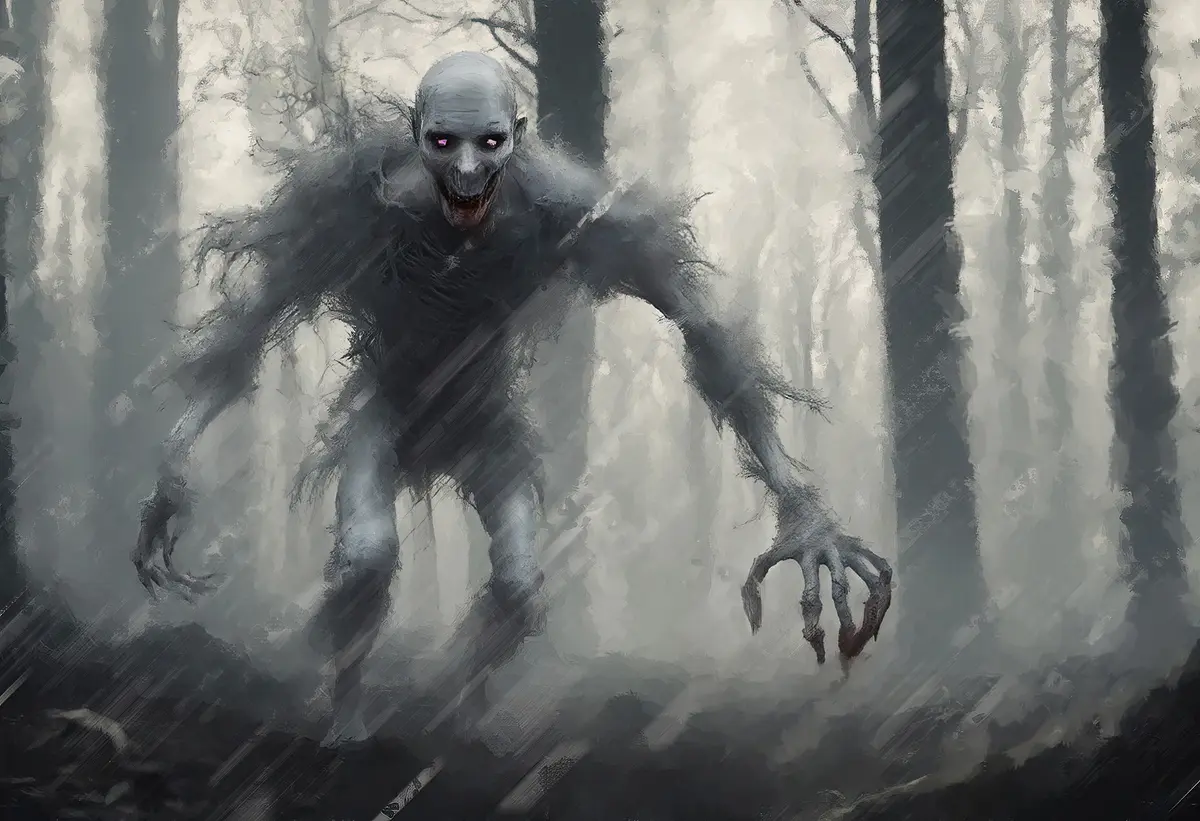
The Wendigo is a gaunt, emaciated humanoid of Algonquian folklore, said to stand far taller than a man, with grey or ash-colored skin stretched tight over a skeletal frame, sunken eyes, and an insatiable hunger for human flesh.
Where and when was Wendigo sighted?
- Location
- Great Lakes region (Algonquian peoples), United States
- Date sighted
- Unknown
- Coordinates
- 46.8, -87.6
- Last updated
LOCATION
What is Wendigo?
Rooted in the oral traditions of Algonquian-speaking peoples around the Great Lakes and boreal forests of Canada and the northern United States, the legend served as both spiritual warning and survival lesson: a person who resorted to cannibalism during a harsh winter, or who succumbed to greed and excess, risked transforming into a Wendigo, becoming ever more monstrous and never satisfied no matter how much it consumed. The Anishinaabe writer Basil Johnston described weendigoes as eternally starving, because their hunger grew with their size. Two cases reached the courts: in 1879 the Cree man Swift Runner was hanged at Fort Saskatchewan after confessing to killing and eating members of his family, and in 1907 the Sandy Lake headman Jack Fiddler and his brother Joseph were arrested for the death of a woman their community believed was turning windigo. The anthropologist Lou Marano later showed that none of the seventy-odd cases behind the textbook diagnosis of windigo psychosis rests on a first-hand account of cannibalism, and argued that the condition probably never existed as behaviour. The horned and antlered wendigo of modern horror comes from Stephen King's Pet Sematary and the films that followed it.
What is the history of Wendigo?
The word usually written in English as “wendigo” belongs to the Algonquian languages of the northern Great Lakes and the subarctic: wiindigoo in Anishinaabemowin, wihtikow or witiko among the Cree, with dozens of spellings in between. It is not the name of a film monster. It names a being that has held a precise moral position in the thought of living peoples — Anishinaabe, Cree, Innu, Naskapi, Saulteaux — for as long as there are written records, and for very much longer than that.
The Anishinaabe writer Basil Johnston described the Weendigoes as beings that came into existence in winter, that beset wanderers, and that could be sustained by nothing except human flesh. The cruelty of that condition is the whole point of the story: having eaten, they grew, so their hunger grew with them and remained in exact proportion to their size. They were, in Johnston's words, “eternally starving”: an appetite that eating cannot close.
Johnston was equally clear that the figure was not only a threat. In Ojibway Heritage he observed that although the Weendigo punished those who committed excesses, it also conferred rewards on the moderate — that it was excess who encouraged moderation. The being marks the outer edge of what a community can bear, and the taboo it enforces is the one taboo that a boreal winter could make horribly literal: killing and eating one's own kin. In Cree accounts the transformation is a failure of the balance between the individual and the group, and the victims are typically the ones nearest at hand — spouses, children, close kin.
Europeans began writing the figure down early. Bacqueville de la Potherie's travel narrative of 1722 carries what is generally taken as the first recorded mention, and Hudson's Bay Company journals record cases from the 1770s onward. Two of those records ended in courtrooms. In December 1879 a Cree man known as Swift Runner (Ka-Ki-Si-Kutchin) was hanged at Fort Saskatchewan after confessing that he had killed and eaten members of his own family during the previous winter; accounts differ on how many died, so no figure is repeated here. In June 1907 the Royal North-West Mounted Police arrested Zhauwuno-geezhigo-gaubow — Jack Fiddler, shaman and headman of the Sucker people at Sandy Lake, in northwestern Ontario — together with his brother Pesequan, Joseph Fiddler, for the death of Joseph's daughter-in-law Wahsakapeequay, whom the community held to be turning into a windigo. Jack Fiddler took his own life after fifteen weeks in custody. Joseph was tried at Norway House, sentenced to death, and died of consumption in prison in 1909.
Timeline: the documented record of Wendigo
- 1722 Bacqueville de la Potherie's travel narrative carries what is generally identified as the first recorded European mention of the windigo; Hudson's Bay Company journals begin documenting cases from the 1770s.
- December 1879 Swift Runner (Ka-Ki-Si-Kutchin), a Cree man who confessed to killing and eating members of his family the previous winter, is hanged at Fort Saskatchewan. It is the only windigo incident for which archival records evidence cannibalism at all; Marano, who obtained the 48-page Department of Justice capital case file, reads it as famine cannibalism.
- 15 June 1907 The Royal North-West Mounted Police arrest Zhauwuno-geezhigo-gaubow (Jack Fiddler), shaman and headman of the Sucker people at Sandy Lake, and his brother Pesequan (Joseph Fiddler) for the death of Wahsakapeequay. Jack Fiddler dies by suicide on 30 September after fifteen weeks in custody; Joseph is tried at Norway House on 7 October, sentenced to death, and dies of consumption in prison in 1909.
- 1910 Algernon Blackwood publishes “The Wendigo” in The Lost Valley and Other Stories (Eveleigh Nash). His creature is barely described — an immense stride, a foul odour, feet that catch fire — and it has no antlers. The story becomes the template for Western horror's version of the figure.
- 1960 Morton I. Teicher's monograph for the American Ethnological Society compiles the case list that turns “windigo psychosis” into anthropology's textbook example of a culture-bound syndrome. None of the roughly seventy cases contains a first-hand account of cannibalism.
- 1982 Lou Marano dismantles the category in Current Anthropology, arguing that there probably never were windigo psychotics in a behavioural sense and that those killed as windigos were victims of triage homicide or witch-hunts in communities under fur-trade stress.
- 1983 Stephen King's Pet Sematary gives the windigo a body with curving ram's horns. It is the moment the figure acquires the horned silhouette that the tradition never gave it.
- 2001 Larry Fessenden's film Wendigo starts a run of antlered screen creatures — The Last Winter (2006), Hannibal (2013-2015), Over the Garden Wall (2014), Devil in the Dark (2017) — which Kallie Hunchman groups together as Western depictions of a horned windigo.
- 2009 Nathan D. Carlson publishes an ethnohistory of witiko cases in the Athabasca district built on archival records and the oral traditions of Cree and Métis elders, arguing that the phenomenon is historically verifiable and can only be analysed from within northern Algonquian cosmologies.
Is there a rational explanation for Wendigo?
The wendigo's scientific reputation rests on “windigo psychosis”, and that category has been taken apart from inside anthropology.
The anthropologist Lou Marano, after five years among northern Algonquians and a long trawl through the archives, found that none of the seventy-odd “cases of windigo psychosis” tabulated in the literature provides a first-hand account of cannibalism, and that only about 10% can be checked against court records, trial transcripts and police reports. Swift Runner's is the only incident for which archival records show cannibalism, and Marano read it as “an instance of famine cannibalism”. In the Sandy Lake papers — police, missionary, trader and court documents alike — what struck him was “the total absence of cannibalism”.
That led him to reverse the question: rather than ask what turns a person into a cannibal maniac, he asked under what circumstances a northern Algonquian was likely to be accused of becoming one, and answered that those executed were victims of triage homicide or witch-hunts in communities strained by faunal depletion, imported epidemics and dependence on the fur trade. The medical anthropologist James Waldram, quoted by Grace Dillon, put it more bluntly: “no actual cases of windigo psychosis have ever been studied”, and the diagnosis “may well be the most perfect example of the construction of an Aboriginal mental disorder by the scholarly professions”. Not everyone agrees: the ethnohistorian Nathan Carlson, working from Athabasca Cree and Métis oral history alongside the documents, argues that something real was being described and can only be understood from inside Algonquian cosmology.
The antlers are not traditional either. Blackwood's creature of 1910 has almost no body — a vast stride, a foul smell, feet that burn. The horns arrive with Stephen King's Pet Sematary in 1983 — “curving horns… ram's horns” — and the antlers with the cinema, from Larry Fessenden's Wendigo (2001) onwards; Kallie Hunchman traces that film and his The Last Winter (2006) to Blackwood's story.
Can you visit Wendigo?
The wendigo has no site of its own, and the places named in this file are inhabited. Sandy Lake, where Jack Fiddler was headman of the Sucker people, lies on the upper reaches of the Severn River in northwestern Ontario. The Dictionary of Canadian Biography records that in 1989 Chief Josias Fiddler told the Manitoba native justice inquiry of the ordeal of Jack Fiddler and his brother Pesequan after their arrest in 1907. Fort Saskatchewan, where Swift Runner was hanged in December 1879, is today a city in Alberta.
Three institutions tell Anishinaabe history from inside it. The Ojibwe Cultural Foundation was founded in 1974 to preserve and renew Anishinabek culture and language. It is at 15 Highway 551 in M'Chigeeng First Nation, on Manitoulin Island in Ontario (postcode P0P 1G0, telephone +1 705-377-4902). Anishinabek News described it in April 2020 as housing a museum and art gallery, an Ojibwe immersion kindergarten, Canada's first radio station broadcasting entirely in Anishinaabemowin, language resources and a healing lodge. The Foundation's own site gives its admission as "By Donation". The Mille Lacs Indian Museum and Trading Post, run by the Minnesota Historical Society at 43411 Oodena Drive, Onamia, Minnesota. It opened in May 1996 and follows the Mille Lacs Band of Ojibwe from their settlement in Minnesota to the present; its exhibit text is in Ojibwe and English. Its Four Seasons Room holds life-size dioramas modelled on band members, first installed in the old museum in 1964. On 24 September 2026 the Society's page gave admission as $12 for adults, $10 for seniors, veterans, serving military and college students and $8 for children aged 5 to 17, with free entry for younger children, Society members and Native Americans. The Thunder Bay Art Gallery, at 1080 Keewatin Street on the Confederation College campus in Thunder Bay, Ontario, states that contemporary Indigenous art has been the focus of its collection since it acquired its first painting in 1981; the collection now numbers more than 1,800 works. Its site, read on the same day, gave opening hours of noon to 8pm from Tuesday to Thursday and noon to 5pm from Friday to Sunday. Adult admission was $5, entry is free on Wednesdays, and the gallery reports that a new waterfront building has been under construction since 2023.
The Anishinaabe account of the Weendigo most often quoted in the scholarship is Basil Johnston's in Ojibway Heritage and The Manitous; Grace Dillon's encyclopedia entry of 2014 builds on both. In Ojibwe tradition the sacred stories also have a season. The Ojibwe author James Vukelich Kaagegaabaw told MPR News in January 2024 that people wait until the lakes have frozen, the reptiles, amphibians and bears are hibernating and "there's also a blanket of snow on the ground" before they "begin speaking about the sacred stories", because those spirits are thought to be sleeping and "you wouldn't want to be thought of as gossiping about them".
Sources consulted
- Lou Marano, «Windigo Psychosis: The Anatomy of an Emic-Etic Confusion» — Ph.D. thesis, University of Florida, digitised by the Internet Archive (the article of the same title appeared in Current Anthropology, vol. 23, no. 4, 1982), 1981 academic
- James R. Stevens, «Zhauwuno-geezhigo-gaubow (Jack Fiddler)» — Dictionary of Canadian Biography, vol. 13 (1901-1910), University of Toronto / Université Laval, 1994 academic
- Nathan D. Carlson, «Reviving Witiko (Windigo): An Ethnohistory of “Cannibal Monsters” in the Athabasca District of Northern Alberta, 1878-1910» — Ethnohistory, vol. 56, no. 3, 2009 academic
- Grace L. Dillon, «Windigo» — The Ashgate Encyclopedia of Literary and Cinematic Monsters, ed. Jeffrey Andrew Weinstock, Ashgate, 2014 academic
- Kallie Hunchman, «Stolen Spirits: The Appropriation of the Windigo Spirit in Horror Literature» — Digital Literature Review, vol. 7, Ball State University, 2020 academic
- Algernon Blackwood, «The Lost Valley and Other Stories (containing “The Wendigo”)» — Eveleigh Nash, London, 1910 book
- Leah Lemm and Melissa Olson, «In Ojibwe tradition, snow on the ground means it's sacred storytelling season - interview with James Vukelich Kaagegaabaw» — MPR News, 2024 newspaper archive
- Laurie Leclair, «Visit to the Ojibwe Cultural Foundation - founded 1974; museum, art gallery, immersion kindergarten, Anishinaabemowin radio, healing lodge» — Anishinabek News, 2020 newspaper archive
- Ojibwe Cultural Foundation, «About Us - address, telephone and admission (by donation)» — Official shop and information site of the Foundation, 2026 web
- Minnesota Historical Society, «Mille Lacs Indian Museum and Trading Post - Museum (Four Seasons Room, opened May 1996) and Hours and Admission» — mnhs.org, official site, 2026 web
- Thunder Bay Art Gallery, «The Permanent Collection - contemporary Indigenous art since 1981, over 1,800 works» — theag.ca, official site, 2026 web
Reviewed by V. Serrano on 2026-07-29 · How we verify our content
📎 Source: Enigma Atlas
💬 Field testimonies (0)
No testimonies yet. Add the first.
Add your testimony
🔒 Log in to add a testimony