👻 HAUNTED PLACE · EXP. Nº9476
ACTIVE
Balgonie Castle
Balgonie Castle stands above the River Leven at Milton of Balgonie, in Fife, and its ghost has a name: Green Jeanie.
Where is Balgonie Castle?
- Location
- Fife, Scotland, United Kingdom
- Type
- Castle
- Coordinates
- 56.194, -3.109
- Last updated
LOCATION
Why is Balgonie Castle said to be haunted?
Popular ghost books say she was reported as early as 1842 and identify her as a daughter of the Lundie family, who held Balgonie from the end of the fifteenth century. Neither claim names a text of 1842. The parish minister who described the castle room by room in June 1840 wrote instead that no siege, no feat of arms and no deed of blood or torture had ever stained the place; the architects MacGibbon and Ross surveyed it in 1887 without a word of a ghost; and the standard collection of printed Fife folklore, published in 1914, gives Green Jean to Wemyss Castle, several miles away, and never to Balgonie. What is documented here is better than the legend: a Lord High Treasurer's tower of about 1500, an earthwork gun battery raised in the 1640s by one of the most experienced soldiers in Europe, two centuries of decay, and a rescue begun in 1971 by David Maxwell and carried on from 1985 by Raymond Morris, who died in the castle in 2022.
What is the history of Balgonie Castle?
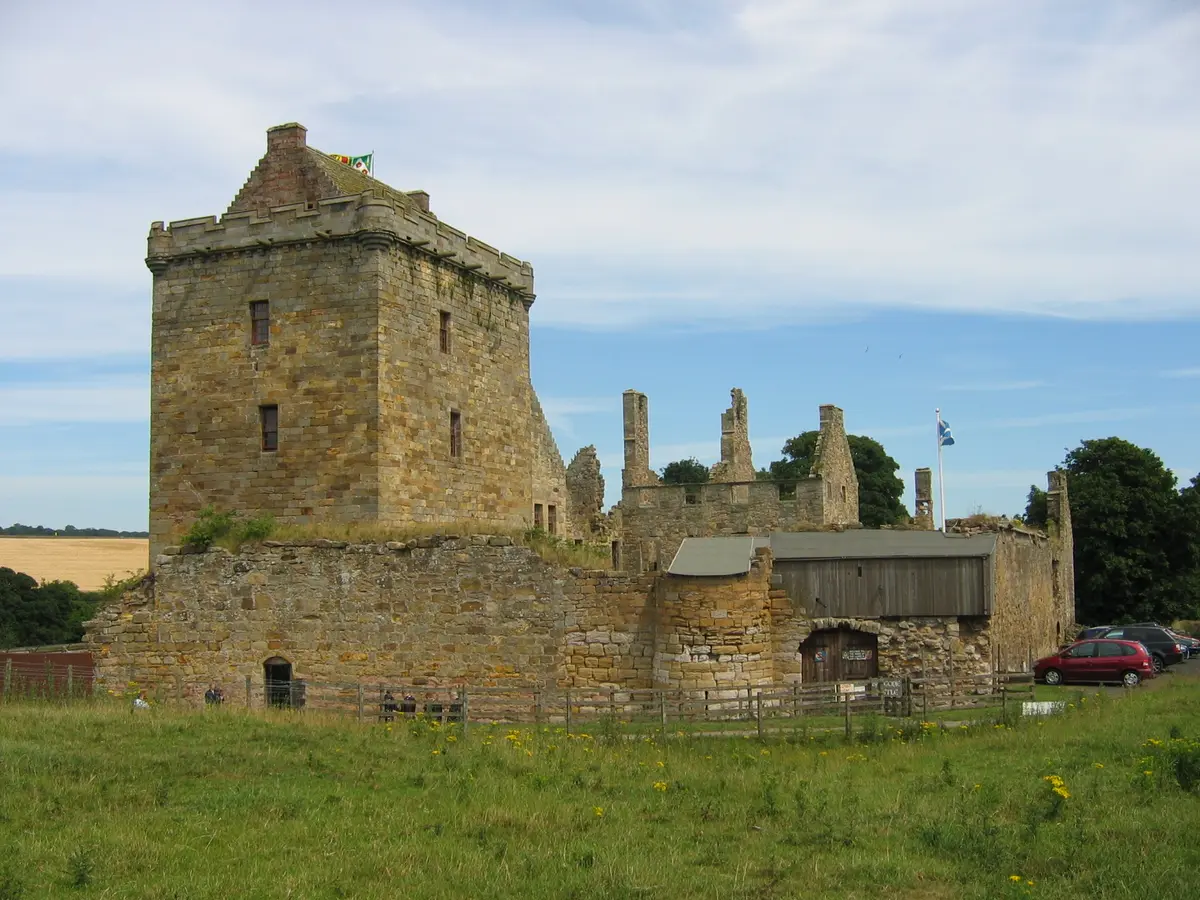
Balgonie sits on a bank above the River Leven, protected on the north by a steep drop and on the other sides, when MacGibbon and Ross surveyed it in 1887, by "a double moat, with a large mound between". Historic Environment Scotland dates the courtyard castle to the late 14th or early 15th century; MacGibbon and Ross were more specific and thought the Sibbald family built the keep and its enclosure "earlier in the fifteenth century". The castle's own website has given two different answers in two decades: an older version dated the tower to about 1360 and attributed it to Sir Thomas Sibbald, while the version online in 2026 pushes it back to "around 1296-1300" and a Sir Robert Sibbald. The state record and the family record do not agree.
The Sibbalds held Balgonie until the end of the 15th century. For want of male heirs the estate passed by marriage to Robert de Lundin — Lundie — Lord High Treasurer of Scotland, who carried out extensions in 1496. That family matters here for a reason that has nothing to do with architecture: every modern ghost book identifies Balgonie's Green Lady as a Lundie.
In 1635 the castle was bought by Sir Alexander Leslie, known as Crookback. Leslie had served in the Dutch and Swedish armies, where, Historic Environment Scotland notes, he was knighted and reached the rank of field marshal, and he had taken part in sieges during the Thirty Years' War. He came home in 1638 to command the Army of the Covenant, and Charles I — the king he had just faced down — created him Lord Balgonie and Earl of Leven in 1641. He rebuilt at Balgonie on the scale of a man who had watched artillery reduce continental fortresses: he raised the north range between 1635 and 1641, added a block at the south-east corner, and, in the 1640s, probably threw up the earthen gun emplacement that still survives beyond the south-west corner. Historic Environment Scotland calls it a ravelin, scheduled it in 1996 as a rare Scottish survival of its date, and links it directly to "Leslie's experience in Europe". He died in the castle in 1661.
Work continued after him. John Mylne junior, of the family of hereditary king's master masons, built the great scale-and-platt stair between tower and hall in 1666. The 3rd Earl of Leven completed the east range by 1706, joining the north range to the early 17th-century south-east block. David, Lord Balgonie, put sash windows in during 1755. Eight Earls of Leven lived there in all.
Then it stopped. The Rev. J. Sieveright, minister of Markinch, wrote his parish account in June 1840 and recorded that the estate had been bought in 1823 for £104,000 by James Balfour of Whittingehame, "who, it is understood, designs to rebuild the castle, at present fast hastening to decay, on a scale answerable to his ample fortune". Balfour — grandfather of a future prime minister — never did it. Historic Environment Scotland notes the castle was no longer inhabited and in poor condition by 1840, and the roofs came off the ranges that are roofless today. By 1887 MacGibbon and Ross were writing an epitaph: "Balgonie has been a fine residence and has not long been abandoned. The keep in particular is one of the best of its class in Scotland."
The rescue came in two stages: David Maxwell bought the castle in 1971 and had the tower partly restored by the firm of Cunningham, Jack, Fisher and Purdom; the building was listed category A on 24 November 1972. Maxwell sold in 1985 to Raymond Morris, an Englishman from Walsall who had come north as a National Serviceman in the Gordon Highlanders and stayed to become a leather carver, armourer and heraldic painter. He, his wife Margaret and their son Stuart took the castle on knowing it would not be finished in his lifetime. In the Scots tradition of territorial designation he was already Morris of Eddergoll, after the derelict mill near Aberfeldy that he and Margaret had restored as a home, and at Balgonie he became Morris of Balgonie; Margaret was styled Lady Balgonie, and a Morris of Balgonie tartan was recorded in 1987. Within four years the chapel was back in use, and the first wedding was held there on 12 August 1989. Raymond Morris died at Balgonie on 28 August 2022, aged 92, and is survived by Stuart and his wife Kelly, who were living in the castle when a television crew filmed there in 2018.
Timeline: the documented record of Balgonie Castle
- Late 14th–early 15th century Historic Environment Scotland dates the courtyard castle to this period. MacGibbon and Ross, surveying it in 1887, judged that the Sibbald family built the keep and its enclosure "earlier in the fifteenth century"; the castle's own website has claimed both about 1360 and, in its 2026 version, 1296-1300.
- 1496 For want of male Sibbald heirs the estate passes by marriage to Robert de Lundin, or Lundie, Lord High Treasurer of Scotland, who extends the castle. Every modern account of the ghost identifies her as a member of this family.
- 1635 Sir Alexander Leslie, "Crookback", buys Balgonie. A field marshal in Swedish service during the Thirty Years' War, he had returned to Scotland in 1638 to command the Army of the Covenant; Charles I created him Lord Balgonie and Earl of Leven in 1641.
- 1640s During the wars of the three kingdoms Leslie remodels the castle and, Historic Environment Scotland concludes, raises the earthen ravelin beyond the south-west corner — an artillery work influenced by what he had seen in continental sieges.
- 1661 Alexander Leslie, 1st Earl of Leven, dies at Balgonie. The castle stays with the Leven line; eight earls live there in all.
- 1666 John Mylne junior, of the family of hereditary king's master masons, builds the scale-and-platt stair linking the tower and the hall. Vandals destroy the stone stair in the 1960s; it is later rebuilt in timber.
- 1706 The 3rd Earl of Leven completes the east range, linking the north range to the early 17th-century south-east block. David, Lord Balgonie, adds sash windows in 1755.
- 1716 Balgonie is said to have been captured and plundered in a raid by Rob Roy MacGregor after the Jacobite rising of 1715. The claim is made by Martin Coventry's castle gazetteer; the castle's own website, in a version archived in 2010, said more mildly that Rob Roy "paid Balgonie a visit" with some 200 clansmen and 20 Hanoverian prisoners. It is the only Jacobite-era episode attached to the site.
- 1823 James Balfour of Whittingehame buys the Balgonie estate for £104,000. Writing in June 1840, the parish minister records that Balfour "designs to rebuild the castle, at present fast hastening to decay". He never does; the heritage record dates the sale to 1824 and notes the castle was uninhabited and in poor condition by 1840.
- June 1840 The Rev. J. Sieveright signs the Markinch parish account, two pages of close description of the castle. It contains no ghost. He writes that "history records no tale of siege sustained" at Balgonie and that its precincts are not "stained by any of those deeds of blood or torture" that darken comparable feudal monuments.
- 1887 MacGibbon and Ross publish their survey: "Balgonie has been a fine residence and has not long been abandoned. The keep in particular is one of the best of its class in Scotland." They record the Sibbald, Lundin and Leslie succession and mention no ghost.
- 1914 The Folk-Lore Society publishes County Folk-Lore VII, the printed folklore of Fife. Its four appearances of "Green Jean" all belong to Wemyss Castle, from the Countess of Munster's memoir. Balgonie appears once in the volume, in a witchcraft deposition, with no ghost.
- 1971 David Maxwell buys the castle and has the tower partly restored by Cunningham, Jack, Fisher and Purdom.
- 24 November 1972 Balgonie Castle, with its curtain walls, boundary walls, gatepiers and well, is listed category A (LB16664).
- 1985 Maxwell sells to Raymond Morris, who moves in with his wife Margaret and son Stuart. In the Scots tradition of territorial designation he becomes Morris of Balgonie and Eddergoll; a Morris of Balgonie tartan is recorded in 1987.
- 12 August 1989 Four years after the purchase the chapel is back in use and hosts its first wedding, on the Glorious Twelfth. Margaret Morris's own funeral is held in the same chapel on the 25th anniversary of that day, in August 2014.
- 22 February 1996 The earthen artillery emplacement beyond the south-west corner is scheduled as SM6411. The scheduling covers the ravelin only — not, despite what is often written, the castle.
- 30 October 2007 A Fife Free Press Halloween round-up reports that Balgonie is credited with nine ghosts, "like part of the family", among them a dog, a disembodied head and the first Earl of Leven. It gives Green Jean to Wemyss Castle, not to Balgonie — although Wikipedia later cites this article for the opposite.
- 21 September 2018 The REALLY channel broadcasts an episode of Help! My House Is Haunted filmed at Balgonie. The owners, Stuart and Kelly Morris, describe voices, shadow figures and a floating head; Steve Higgins's review of the episode repeats that Green Jeanie "has been reported as long back as 1842", without naming a source.
- 28 August 2022 Raymond Morris dies at Balgonie, aged 92, thirty-seven years after buying the ruin. His son Stuart, a historian, and daughter-in-law Kelly survive him. The castle's website has not been substantially updated since 2018 and now carries injected gambling spam.
Is there a rational explanation for Balgonie Castle?
The ghost has a name — Green Jeanie — and modern books add a date: Richard Jones, in Haunted Castles of Britain and Ireland (2003), writes that she was "described in 1842 as being a 'well-known phantom'", and Steve Higgins's review of the 2018 television episode repeated that "her apparition has been reported as long back as 1842"; neither names the 1842 text.
The most detailed printed description of Balgonie from that decade is the Markinch parish account in the New Statistical Account of Scotland, signed by the Rev. J. Sieveright in June 1840. It devotes two pages to the castle, down to the thickness of the walls and the paving of the roof terrace. The account names Balgonie twenty times, and once more as Balgony; the words "Jeanie", "Green Jean", "phantom", "apparition", "spectre" and "haunted" do not occur in it. Sieveright went further: he wrote that "history records no tale of siege sustained, nor doughty feats of arms performed under its walls", and that its precincts were not "stained by any of those deeds of blood or torture which throw an interesting gloom over so many similar monuments of feudal times". The parish minister said, in print, that Balgonie had no dark past.
The same result holds in four other nineteenth-century books on Fife, read in their full text on archive.org. MacGibbon and Ross (1887): "Balgonie" 16 times, "ghost" and "apparition" zero. Matthew Forster Conolly's Fifiana (1869): Balgonie twice, no ghost. Walter Wood's The East Neuk of Fife (1887): Balgonie 17 times, "apparition" 4 times elsewhere in the book, Green Jean never. Aeneas Mackay's History of Fife and Kinross (1896): Balgonie 10 times, "ghost" 3 times elsewhere, Jeanie never. These books do contain ghosts, and they do contain Balgonie, and they never contain both in the same place.
The decisive one is the folklorists' own compendium. County Folk-Lore, volume VII, Examples of Printed Folk-Lore Concerning Fife (1914), collects the printed ghost material of the county. "Green Jean" appears in it four times — and every one of them belongs to Wemyss Castle, a few miles down the coast, where the Countess of Munster's memoir places the family's own famous green lady. Balgonie appears once in the whole volume, in a witchcraft deposition, with no ghost attached. Dane Love's Scottish Ghosts (2009) calls Pinkie House, in East Lothian, the "home of another Green Lady, known as Green Jean", so the name travels between Scottish houses.
There is also a traceable break in the chain of citation. The Wikipedia article on Balgonie attributes Green Jeanie, her identification as a Lundie, and a skeleton found in the great hall floor in 1912 to a single source: a Fife Free Press Halloween round-up of 30 October 2007. The archived article says none of it. The words "Jeanie", "Lundie", "skeleton" and "1912" do not appear in it; its two mentions of Green Jean are about Wemyss Castle; and all it says about Balgonie is that the castle is credited with nine ghosts, "like part of the family", among them a dog, a disembodied head and the first Earl of Leven. The one Jacobite-era episode attached to Balgonie is a raid of January 1716. Martin Coventry's gazetteer The Castles of Scotland (1997) says the castle "was captured and sacked by Rob Roy MacGregor and 200 clansmen"; the castle's own website, in a version archived in 2010, said more mildly that Rob Roy "paid Balgonie a visit with some 200 clansmen and 20 Hanoverian prisoners".
The modern reports come from named people: on the 2018 REALLY channel programme, Stuart and Kelly Morris described disembodied voices, a boy seen in the courtyard, shadow figures and a head. The investigators' best exhibit was a photograph of a pale mass in the great hall which the reviewer of the episode noted "could just be Barri's own breath caught on camera" — the great hall has no fireplace, a detail Historic Environment Scotland records, and the chapel and hall next to it are lit by candles by the owners' own design. Cold, unheated stone rooms lit by flame, in a building that is half occupied home and half roofless ruin, will produce moving light and unplaceable sound without any help. And the castle is a business as well as a home: the notice advertising that television appearance has been the first thing on its front page since September 2018.
Can you visit Balgonie Castle?
Balgonie Castle stands at Milton of Balgonie, Glenrothes, Fife KY7 6HQ, beside the A911, about 4.3 km (2.7 miles) east of the centre of Glenrothes; Historic Environment Scotland gives its grid reference as NO 31250 00692. It is the home of the Morris family, who bought it in 1985. Markinch station, on the Edinburgh–Aberdeen line, is 1.5 km (just under a mile) to the west-north-west.
On 23 September 2026 the domain balgoniecastle.co.uk served, in place of the castle's pages, a comparison guide to casinos not on GamStop, dated that same day. The last capture with castle content in the Internet Archive, of 14 June 2026, already had casino links set among the menu items, and it described the castle as "open to the public for tourism & education". Its practical details dated from 2018. The opening hours read "1st April 2018, Wednesday to Sunday, 1:00 to 5:00pm", the footer "copyright of Balgonie Castle Enterprises 1990-2018", and the front page announced a television broadcast on Friday 21 September, which was 2018. That capture gives the telephone number 01592 750119, to be called between 12:00 and 13:00 or after 17:00, and a mobile number printed as 0788293381, one digit short of a British mobile.
Historic Environment Scotland's listing (LB16664, category A since 24 November 1972) describes a courtyard castle of the late 14th or early 15th century. The north-west tower house has four storeys and a crowstepped attic, vaulted at ground and first floor. The great hall on the first floor keeps its cusped windows and window seats but has no fireplace, only two small ventilation shafts, and a turnpike stair rises in the north-east angle. The north range is roofless over a vaulted ground floor that holds the chapel, where the first wedding of the Morris years was held on 12 August 1989. The east range stands complete to the wallhead with its gables and stacks. The stair between tower and hall is by John Mylne junior, 1666, and the stair tower holds a timber scale-and-platt stair.
The scheduled monument SM6411, designated in 1996, covers only the earthen artillery emplacement just beyond the south-west corner, most likely a ravelin of the 1640s: a grass-covered mound about 75 m east–west by 25 m north–south at its widest, with a wide ditch along its south and west sides. Works on a scheduled monument, the use of a metal detector included, need consent from Historic Environment Scotland. Category A listing controls alterations to the castle and carries no right of public access.
Sources consulted
- Historic Environment Scotland, «Balgonie Castle with Curtain Walls, Boundary Walls, Gatepiers and Well (LB16664), category A listed building record» — Historic Environment Scotland Portal, 1972 report
- Historic Environment Scotland, «Balgonie Castle, artillery fortification (SM6411), scheduled monument record» — Historic Environment Scotland Portal, 1996 report
- Rev. J. Sieveright, «Parish of Markinch, in The New Statistical Account of Scotland, vol. IX: Fife–Kinross» — William Blackwood and Sons, Edinburgh (account signed June 1840), 1845 book
- David MacGibbon and Thomas Ross, «The Castellated and Domestic Architecture of Scotland, vol. I (Balgonie Castle, pp. 377–382)» — David Douglas, Edinburgh, 1887 book
- John Ewart Simpkins (ed.), «County Folk-Lore, vol. VII: Examples of Printed Folk-Lore Concerning Fife, with some notes on Clackmannan and Kinross-shires» — The Folk-Lore Society, London, 1914 book
- The Scotsman, «Obituaries: Raymond Morris, Englishman who became Scots medievalist» — The Scotsman, 21 September 2022, 2022 newspaper archive
- Matthew Forster Conolly, «Fifiana, or, Memorials of the East of Fife (searched for Balgonie ghost material: none found)» — John Tweed, Glasgow, 1869 book
- Rev. Walter Wood, «The East Neuk of Fife: its History and Antiquities (searched for Balgonie ghost material: none found)» — David Douglas, Edinburgh, 1887 book
- Aeneas J. G. Mackay, «A History of Fife and Kinross (searched for Balgonie ghost material: none found)» — William Blackwood and Sons, Edinburgh, 1896 book
- Fife Free Press, «Beware the witching hour» — Fife Today / Fife Free Press, 30 October 2007 (archived copy), 2007 newspaper archive
- Steve Higgins, «Help! My House Is Haunted: Balgonie Castle – Series 1, Episode 11 review» — Higgypop, 22 September 2018, 2018 web
- Balgonie Castle Enterprises, «Balgonie Castle official website, home and history pages (archived captures of 2009 and June 2026; the live domain now carries injected gambling spam and should not be used)» — Internet Archive Wayback Machine, 2026 web
- Martin Coventry, «The Castles of Scotland: a comprehensive reference and gazetteer to more than 2000 castles (Balgonie: captured and sacked by Rob Roy MacGregor and 200 clansmen in 1716)» — Goblinshead, Edinburgh, 1997 book
- Richard Jones, «Haunted Castles of Britain and Ireland (Balgonie Castle: Green Jeanie 'described in 1842 as being a well-known phantom')» — New Holland Publishers, London, 2003 book
- Dane Love, «Scottish Ghosts (Pinkie House, 'home of another Green Lady, known as Green Jean')» — Amberley, Stroud, 2009 book
Reviewed by V. Serrano on 2026-08-11 · How we verify our content
💬 Field testimonies (0)
No testimonies yet. Add the first.
Add your testimony
🔒 Log in to add a testimony