👻 HAUNTED PLACE · EXP. Nº9476
ACTIVE
Belgrave Hall
Belgrave Hall is a plain Queen Anne house on the northern edge of Leicester, built for Edmund and Ann Craddock between 1709 and 1713 - a date the building supplies itself, in the years and initials cast into its lead rainwater heads.
Where is Belgrave Hall?
- Location
- Leicester, England, United Kingdom
- Type
- House / mansion
- Coordinates
- 52.659, -1.125
- Last updated
LOCATION
Why is Belgrave Hall said to be haunted?
It passed to the Vann family, then in 1845 to the railway chairman John Ellis, whose daughters lived there until 1923, and Leicester Corporation opened it as a museum of the eighteenth century in 1937. Its worldwide reputation is far more recent and can be dated to the week. In December 1998 the security cameras behind the hall filmed two pale shapes in the garden, and on 2 February 1999 BBC News carried the story, with curator Stuart Warburton saying the hall was haunted and museum gardener Michael Snuggs describing a woman who came down the stairs, looked out at the garden and smiled. The investigators the council then invited explained the film as a leaf caught on the camera lens on a stormy night. Neither John Throsby's tour of the county in 1790 nor the Victoria County History's account of Belgrave in 1958 records a ghost here.
What is the history of Belgrave Hall?
Belgrave Hall is a small Queen Anne country house that a city grew around.
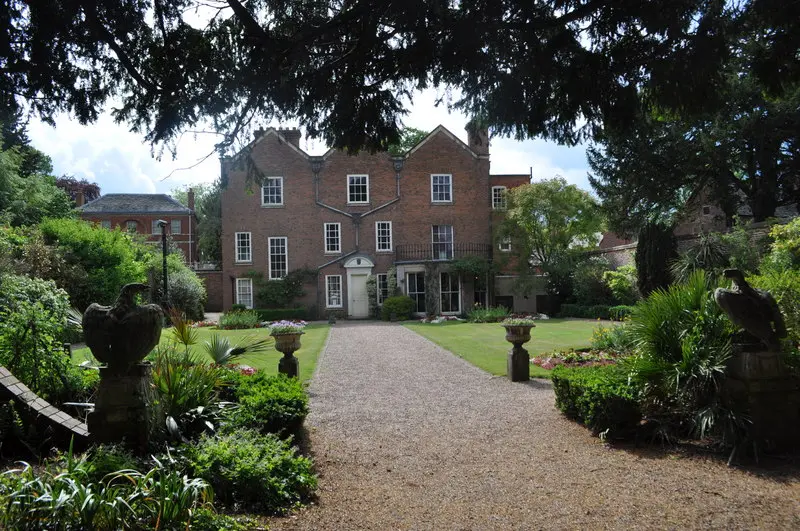
The Victoria County History dates it precisely and says how it knows. The house was built for Edmund and Ann Craddock between 1709 and 1713, and the evidence is not a document but the building: the dates and initials cast into the lead rainwater heads. The stable block that adjoins it can be dated more exactly still, to 1710, by a date in its brickwork, and the wrought-iron gates on Church Road carry an 'EC' monogram. The VCH describes the result as "a small country house of the Queen Anne period, severely plain in style", and records that the only important later addition is the large bay window put into the drawing room, probably between 1820 and 1840. Much of the interior panelling is the original.
Later accounts call Edmund Craddock a Leicester hosiery merchant; the VCH does not name his trade, but it is precise about what his house meant. Belgrave was then a farming village outside the borough, and the building of the Hall in 1709-13 "marked the beginning of the village's life as a residential suburb for the wealthier of the Leicester tradespeople". Craddock himself had very little of it: he and his wife were both dead within a few years of moving in.
About 1740 the house passed to William Vann, later High Sheriff of Leicestershire. When the Vanns built the grander Belgrave House across the road in 1776 they kept the Hall, and members of the family lived in it until the last Mrs Vann died in 1844. In 1845 it was bought by John Ellis, chairman of the Midland Counties Railway and one of the men behind the Leicester and Swannington line. He died at the Hall in 1862, and his family stayed on for another sixty-one years, until the death of his last surviving daughter, Margaret Ellis, in 1923. That is seventy-eight years of one family in one house, and the VCH's footnote is unusually warm about them: "Margaret Ellis and her sisters were well-known and much-loved figures in Belgrave and Leicester." The Ellises largely paid for the infants' school added to Belgrave's National school around 1848.
The last private owner was T. A. Morley. Leicester Corporation bought the Hall from him - the purchase runs through the council minutes for 1935-6 - and opened it in 1937 as a museum of the eighteenth century. The scheme was not universally popular: the VCH sends its readers to the Leicester Mercury of 22 May 1936 and the Illustrated Leicester Chronicle of 16 May 1936 "for opposition to the scheme". A refit in 2005 added the servants' quarters to the story the museum told.
Belgrave Hall stopped being a museum in the ordinary sense in the following decade. On 1 May 2013 a Leicester City Council scrutiny commission considered a revised project for Belgrave Hall and Gardens under which the site would be marketed as a heritage site rather than a museum, with the number of days open and events raised to around forty a year and the stables, gardens and a marquee let commercially. That is what the house is today: a listed building with a two-acre walled garden, opened on selected days, hired out on the rest.
Timeline: the documented record of Belgrave Hall
- 1709-1713 Belgrave Hall is built for Edmund and Ann Craddock. The Victoria County History dates it from the building itself: the years and initials cast into the lead rainwater heads. The adjoining stable is dated 1710 by a date in its brickwork.
- 1845 John Ellis, chairman of the Midland Counties Railway, buys the Hall. He dies there in 1862 and his family stays on until 1923.
- 1923 Margaret Ellis, the last surviving daughter, dies, ending seventy-eight years of Ellis occupation. The VCH notes that she and her sisters were “well-known and much-loved figures in Belgrave and Leicester”.
- 1937 Leicester Corporation, having bought the house from its last private owner T. A. Morley, opens it as a museum of the eighteenth century. The VCH points to the Leicester Mercury of 22 May 1936 and the Illustrated Leicester Chronicle of 16 May 1936 for local opposition to the purchase.
- 5 January 1950 Belgrave Hall, with the railings and gates in front of it, is listed Grade II* (National Heritage List for England, entry 1074030).
- December 1998 The security cameras behind the hall record two pale shapes in the garden at about 4.50 am. BBC Leicester later dated the recording to December 1998; the curator gave the time in his first interview.
- 2 February 1999 BBC News publishes “Museum gives up the ghost” at 16:41 GMT, quoting curator Stuart Warburton (“The hall is haunted, there is no question about that”) and museum gardener Michael Snuggs, who describes a woman coming down the stairs. This is the report that made the house internationally famous.
- 1999 The International Society for Paranormal Research examines the footage at the council's invitation. It reports presences throughout the house but finds the corner of the garden where the images were taken to be the least haunted spot on the grounds, and explains the figure as a leaf caught on the lens on a stormy night. A video of the investigation is released the same year.
- 1 May 2013 A Leicester City Council scrutiny commission considers the revised Belgrave Hall and Gardens project: the site is to be marketed as a heritage site rather than a museum, opening around forty days a year, with commercial hire of the stables, gardens and marquee.
- 27 March - 25 September 2024 Leicester Museums runs a season of free guided tours of the hall and gardens led by named volunteers, on Wednesdays and first weekends, booking essential - the form the site's public opening now takes.
Is there a rational explanation for Belgrave Hall?
The fame of Belgrave Hall can be dated to the week, and it is much more recent than most retellings suggest.
In December 1998 the security cameras at the back of the hall recorded two pale shapes in the garden. On Tuesday 2 February 1999, at 16:41 GMT, BBC News published the story under the headline "Museum gives up the ghost", and the wire coverage that followed is what took the house around the world. The curator, Stuart Warburton, is quoted in that report and his words are worth having exactly: "The security cameras at the back of the hall triggered off one night at about 4.50am, and then suddenly ... two figures appear on the film. The camera freezes for about five seconds and then the figures disappear. And then we have a mist that swirls along the top of the wall, which we cannot explain." He added: "The hall is haunted, there is no question about that." The same report names a second witness, the museum gardener Michael Snuggs: "I was standing in the house and from the top of the stairs, this figure appeared and walked down the stairs. At the bottom, she looked through the window at the garden, and then just turned and smiled, and walked through to the kitchen."
The council then invited the International Society for Paranormal Research to examine the footage, and the ISPR is the source of the debunking, not of the claim. As BBC Leicester summarised it in 2007, the team reported presences all over the house - previous residents, children, servants, even spirits older than the building - but found that the corner of the garden where the images had been recorded was the least haunted area of the grounds, and dismissed the image as a leaf caught on the camera lens on a stormy night. The popular identification of the figure as Charlotte Ellis, one of John Ellis's seven daughters, has no evidence behind it at all, and the BBC's own feature says so: "why Charlotte has been named as the ghost rather than any of her six sisters remains unknown."
Anything older than 1998 is much harder to find than the story implies. John Throsby toured Leicestershire in 1790 and printed the result in a volume of roughly 295,000 words. He was not squeamish about the subject: at Sileby he wrote that "I have heard of ghosts and hobgoblins, on my excursions, who sometimes leave the church or church-yard, to affrighten children and women big with child", and at Brooksby he printed a full apparition narrative, the ghost of Sir George Villiers warning the Duke of Buckingham. He names Belgrave thirty-one times and the Cradocks twelve. He tells no ghost story there. The Victoria County History's account of Belgrave, published in 1958, runs to about 10,250 words, mentions Belgrave Hall seven times and the Ellis family twelve - and contains the words ghost, haunt, apparition and spirit exactly zero times.
The institution that made the reputation has also quietly let it go. In August 2026 Leicester Museums & Galleries still sells Ghost Nights, at Leicester Guildhall, Abbey Pumping Station and Newarke Houses, with the resident ghosts listed by name. Belgrave Hall is not among them. It appears nowhere in the 543 addresses of the museum service's sitemap, in which Abbey Pumping Station appears ten times, Newarke Houses nine and Jewry Wall seven, and it is not one of the six venues in the site's own navigation. The building whose cameras started the whole business is no longer sold as a haunted house by its owner.
One detail worth keeping straight, because it drifts: the smells reported by staff and visitors in the published accounts are of cooking - fresh bread, stewed fruit, gingerbread - and the figure on the lower stairs is called the Victorian Lady, the White Lady or the Grey Lady, depending on who is retelling it.
Can you visit Belgrave Hall?
Belgrave Hall stands on Church Road, Belgrave, Leicester LE4 5PE. It sits beside St Peter's church about two kilometres (1.2 miles) north of the city centre, at grid reference SK 592 072, and Belgrave House, put up by the same family in 1776, faces it from the far side of the road. The Hall together with the railings and gates in front of it forms a single Grade II* entry on the National Heritage List for England, number 1074030, first listed on 5 January 1950. A Geograph photograph of 14 May 2011 shows how much of the front can be seen from the public road.
The site stopped being a staffed museum after 2013, when the city council's Overview Select Committee took the Belgrave Hall and Gardens Revised Project to scrutiny on 1 May and the Hall was reclassified as a heritage venue. Since then the two acres of walled garden and the house have opened on selected days across the summer season. In 2024 Leicester Museums ran free guided tours led by volunteers between 27 March and 25 September, on Wednesdays and on the first full weekend of each month, with booking essential. On 11 September 2026 the museum service's What's On listing, filtered to Belgrave Hall, carried no entry for the venue.
For the rest of the year the stable block and the gardens are let for weddings and for meetings, and former outbuildings were converted into a craft village of six workshop units. Overnight paranormal vigils inside the Hall are sold by outside companies. The museum service's own Ghost Nights are advertised at Leicester Guildhall, at Abbey Pumping Station and at Newarke Houses.
Sources consulted
- R. A. McKinley (ed.), «Parishes added since 1892: Belgrave, in A History of the County of Leicester, Volume 4: The City of Leicester, pp. 420-428 (build dates from the lead rainwater heads, the Vann and Ellis occupations, and the 1937 museum opening)» — Victoria County History, 1958 academic
- BBC News, «Museum gives up the ghost (published 16:41 GMT; quotes curator Stuart Warburton and museum gardener Michael Snuggs)» — BBC News Online, 1999 newspaper archive
- Claire Davies, Bethan Lewis, Nick Allen, Kevin Fowler and Philip Tweddle, «Haunted hall? - Haunted Leicester feature (dates the CCTV to December 1998 and reports the ISPR verdict of a leaf on the lens)» — BBC Leicester, 2007 web
- John Throsby, «The Supplementary Volume to the Leicestershire Views: Containing a Series of Excursions in the Year 1790 (Belgrave named 31 times, the Cradocks 12; ghost narratives printed for Sileby and Brooksby, none for Belgrave)» — Printed for the author, Leicester, 1790 book
- Historic England, «National Heritage List for England, entry 1074030: Belgrave Hall and railings and gates in front of the Hall (Grade II*, first listed 5 January 1950); record and point geometry as published in the government listed-building dataset» — National Heritage List for England / planning.data.gov.uk, 1950 report
- Leicester City Council, «Belgrave Hall and Gardens Revised Project - agenda item, Overview Select Committee scrutiny commission, 1 May 2013 (reclassification from museum to heritage site, around forty open days a year, commercial hire)» — Leicester City Council committee papers, 2013 report
- Leicester Museums & Galleries, «Belgrave Hall Guided Tours, 27 March - 25 September 2024 (free volunteer-led tours, Wednesdays and first weekends, booking essential)» — leicestermuseums.org, 2024 web
- Leicester Museums & Galleries, «Ghost Nights (venue hire): the museum service's own haunted-venue offer, listing Leicester Guildhall, Abbey Pumping Station and Newarke Houses - Belgrave Hall is not included» — leicestermuseums.org, 2026 web
- Ashley Dace, «Belgrave Hall, photograph SK5907 : Belgrave Hall, taken 14 May 2011, grid reference SK 592 072 (CC BY-SA 2.0)» — Geograph Britain and Ireland, 2011 web
Reviewed by V. Serrano on 2026-08-17 · How we verify our content
💬 Field testimonies (0)
No testimonies yet. Add the first.
Add your testimony
🔒 Log in to add a testimony