👻 HAUNTED PLACE · EXP. Nº9476
ACTIVE
Leicester Guildhall
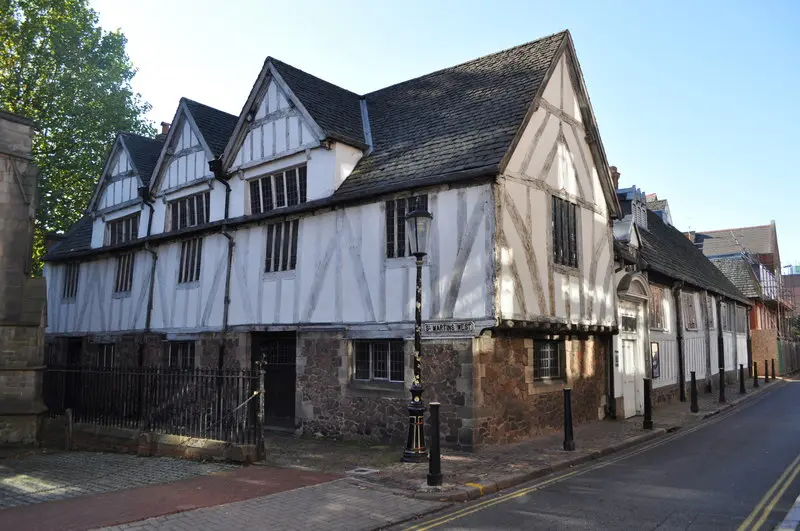
Leicester's Guildhall began around 1390 as the meeting hall of the Guild of Corpus Christi and spent the next five centuries as the town's courtroom, council chamber, library and, from 1836, its first police station, with three cells fitted into the medieval east wing.
Where is Leicester Guildhall?
- Location
- Leicester, England, United Kingdom
- Type
- Public building
- Coordinates
- 52.635, -1.138
- Last updated
LOCATION
Why is Leicester Guildhall said to be haunted?
Prince Rupert's ultimatum was read to the corporation here in May 1645, and when the Royalists sacked Leicester they broke into the little room where the borough kept its charters; the town bought them back for £100. The ghost story is far younger than the building. The claim that this is Leicester's most haunted building, with five ghosts, was published by Leicester City Council's own museum service, which markets the hall for ghost nights to this day; the council's 2008 page described a White Lady who moved the library furniture, while its 2026 page lists a man in the library instead, plus a surgeon, a child called Sarah and a Victorian prostitute named Lucy. No trace of any of it appears in the Victorian antiquarian literature of the town. Entry is free.
What is the history of Leicester Guildhall?
Leicester Guildhall is not one building but four centuries of accumulated decisions, each of which left a room behind.
The Great Hall came first, raised around 1390 for the Guild of Corpus Christi, an association of merchants and gentry whose altar stood in St Martin's church next door. Historic England's list entry traces the growth precisely: two further bays added at the west end around 1450, wings thrown out to east and west around 1490, and a brick range closing the courtyard in 1836. Ordinances of 1477 gave the guild's masters precedence over the mayor and council, which tells you where power sat in medieval Leicester. From around 1495 the Corporation met in the guild's hall; after the religious guilds were dissolved it bought the place outright — the city council's museum service dates the purchase to 1548 and prices it at £25 15s 4d, while the Leicestershire Architectural and Archaeological Society's report of 1877 says the mayor and his brethren became possessors in 1562. The two dates have never been reconciled in print.
The ground floor of the west wing became the Mayor's Parlour in 1563 and was expensively remodelled in 1637: oak panelling, a carved overmantel with mythical creatures in the frieze, a raised ceremonial seat, and the mayor's chair given by Richard Inge with the arms of Charles I above it. The room above became a Jury Room the same year, because the Great Hall was where the Borough Quarter Sessions sat. In 1632 the town library was moved from St Martin's into the first floor of the east wing, into rooms that had housed the guild's chantry priests; the council calls it the third oldest public library in the country, and Historic England's 2021 list entry records that the collection is still in the room.
The Civil War reached the door twice. First came the money: Prince Rupert demanded a loan, six dragoons collected £500 the following day, Charles I wrote from Nottingham disavowing his nephew's warrant, and, as Thompson records, the sum was never repaid to the town. Then came the army. Rupert's summons to surrender was laid before the Corporation in the Mayor's Parlour on 30 May 1645, and the committee sat there in permanence, playing for time, until the artillery breaching the Newarke wall was heard inside the hall and ended the debate. Thompson describes the townsmen falling back street by street and firing on the Royalists from St Martin's church and churchyard, immediately next door, before the survivors laid down their arms at the High Cross; the city council's heritage site puts the last stand "outside Leicester Guildhall and St Martins". The Royalists looted the town's archives, mace and seal. The best evidence of what that meant is bureaucratic. The borough kept its charters in a little room off the Mayor's Parlour, first called "the Study" — in 1608-9 the chamberlains paid William Sheene 13s 4d for "a nest of Boxes sett up in the Studye to keepe drye the Towne's Wrytinges". In 1645 the Study was broken open by the soldiery and the documents carried off; the town redeemed them for £100, and nobody knows how many were destroyed first. Two weeks after the sack, the Royalist army was beaten at Naseby.
The building went on making history in a minor key. Thompson reports as tradition — his word — that in early December 1745 the mayor and part of the Corporation, Jacobites at heart, waited in the old Guildhall with a warm address of welcome ready for the Young Pretender, and that when news came of the rebel retreat from Derby the address was quietly smuggled away. In 1836 the kitchen block was pulled down for a house for Leicester's first Chief Constable, and three cells and a charge room were fitted into the east wing — the town's first police station. Then, in 1876, the Corporation walked out to Francis Holmes's new town hall and the Guildhall was left to schools, policemen and damp. The old Muniment Room was described to the town council as disgraceful, its documents suffering "from damp, rain, and the ravages of rats"; the archives were rescued in 1877-78 and reported on for the government by J. Cordy Jeaffreson of the Historical Manuscripts Commission. The last antiquarian article James Thompson wrote before his death in 1877 was a protest in the local newspapers against the destruction of the Guildhall, and at a Society meeting that same year Captain Whitby closed a paper on German town halls by urging its restoration.
It took another half century. In 1922 the town council commissioned a full restoration after representations from the Society; the Leicester architect T. H. Fosbrooke stripped away the accretions, and the work finished in 1926 with a celebratory meeting in the Great Hall and the opening of a museum. The Guildhall was listed at Grade I on 5 January 1950 (list entry 1361405) and repaired again between 1991 and 1993.
Timeline: the documented record of Leicester Guildhall
- c. 1390 The Great Hall is built for the Guild of Corpus Christi, a body of merchants and gentry whose chapel stood in St Martin's church next door; it is enlarged around 1450 and given east and west wings around 1490.
- 1477 Ordinances give the guild's masters precedence over the mayor and council; from around 1495 the Corporation of Leicester meets in the guild's hall.
- 1632 The town library is moved from St Martin's into the first floor of the east wing, into rooms built for the guild's chantry priests. Historic England records in 2021 that the collection is still there.
- 30 May 1645 Prince Rupert's summons to surrender is laid before the Corporation in the Mayor's Parlour; the committee sits there playing for time until the artillery breaching the Newarke wall is heard inside the hall. The town is stormed, the defenders fire on the Royalists from St Martin's church and churchyard next door, and the archives, mace and seal are looted. Naseby follows a fortnight later.
- 1645-46 The borough's muniment room, the little chamber off the Mayor's Parlour known as 'the Study', is broken open by the soldiery and its charters carried away; the town buys them back for £100. The episode is set out in the archaeological society's report on the borough records.
- 1836 The kitchen block is demolished for a house for Leicester's first Chief Constable, and three cells and a charge room are fitted into the ground floor of the east wing: the town's first police station.
- 1876 The Corporation moves to Francis Holmes's new town hall. The Guildhall is left to schools and policemen, and its muniment room is reported to the council as disgraceful, the documents suffering 'from damp, rain, and the ravages of rats'.
- 1877 The last antiquarian article written by James Thompson, the historian of Leicester, is a protest in the local press against the destruction of the Guildhall; at a society meeting that year Captain Whitby urges its restoration.
- 1922-1926 After representations by the Leicestershire Archaeological and Historical Society the town council commissions a full restoration under the architect T. H. Fosbrooke; the work ends in 1926 and the building opens as a museum. It is listed at Grade I on 5 January 1950.
- December 1998 Security cameras at the council's Belgrave Hall film two luminous shapes. By its own account the arts and museums service turned that publicity into a Haunted Sites section covering six of its buildings, the Guildhall among them.
- 2004 Living TV's Most Haunted films at the Guildhall with the mediums Derek Acorah and David Wells. The same year a travel guide by Sarah Valente Kettler repeats the reputation and the number of five ghosts: these are the earliest printed appearances of the claim that can be dated.
- 2008 The council's own page, archived in April, gives the fullest early account: a 'White Lady' in the library, footsteps in the police roof space, and a medium's cavalier and dog, of which it says 'no record of this phenomena has been recorded'.
- 12 August 2026 The museum service's ghost nights page lists a different five: a surgeon, a child called Sarah accused of stealing apples, a dog, a man in the library and a Victorian prostitute called Lucy. The library ghost has changed sex since 2008.
Is there a rational explanation for Leicester Guildhall?
The famous line about this building is not folklore. It is a sentence written by its owner.
"The Guildhall is reputedly Leicester's most haunted building — five ghosts have been reported in total" appeared on Leicester City Council's own museum pages, archived in 2008, under a section called Haunted Sites that the council's arts and museums service had built after two luminous shapes were filmed by security cameras at its Belgrave Hall in December 1998. The superlative belongs to the operator, and the operator is not a neutral witness: in 2026 the same service still markets the Guildhall for ghost nights on its venue hire pages, and its visitor FAQ answers "Is Leicester Guildhall Haunted?" by inviting you to book one of the regular vigils, which it notes are run by outside paranormal companies.
The cast has not held still, and that is the strongest argument against it. The council's 2008 page described a "White Lady" who is "very rarely seen" and known instead by heavy Tudor furniture moved in the library, doors found open, burglar alarms tripped and a Bible left open on the table; heavy footsteps at the constable's cottage and in the roof space where Victorian officers slept; and a cavalier and a phantom dog reported by a visiting medium, of which the council itself wrote that "no record of this phenomena has been recorded". The 2026 ghost nights page lists a different five: a powerfully-built surgeon, a child called Sarah accused of stealing apples, a dog, a man in the library with its moving bible, and a Victorian prostitute called Lucy. In eighteen years the library ghost changed sex and two of the figures acquired names and biographies. Stories that gain detail with age are being composed, not remembered.
How old is the story? Older sources should carry it and do not. Across 835,517 words of Victorian Leicester antiquarianism — James Thompson's History of Leicester (1876) and four volumes of the Transactions of the Leicestershire Architectural and Archaeological Society covering 1855 to 1887 — the Guildhall is named 41 times, and the Society held its annual meetings in the very library where the furniture is supposed to move. The words ghost, haunted, spectre, apparition and phantom appear five times in that corpus, and not one of them refers to this building: they belong to a manor called Hobgoblin Hall elsewhere in the county, to a Protestant dread of Popish invasion, to a simile about white hands, to the title of a play, and to a child's spirit in a churchyard. The vocabulary is there; the tradition is not. The earliest printed appearances of the five-ghost claim that can be dated are from 2004: a travel guide by Sarah Valente Kettler, which repeats the reputation and the number, and the Living TV programme Most Haunted, which filmed at the Guildhall that year with the mediums Derek Acorah and David Wells. Andrew James Wright's county gazetteer of 2006 handles it at arm's length, quoting "Leicester's most haunted building" as a claim the museum makes.
The television evidence aged badly. In August 2005 The Guardian reported that two spirits named on Most Haunted, Kreed Kafer and Rik Eedles, were anagrams of Derek Faker and Derek Lies, and that Living TV could not explain them while flatly denying any plant by its team. A séance is not a survey of a building in any case.
None of which makes the place ordinary. It is a heavy oak frame six centuries old that shrinks and shifts, a dark cell block, a first-floor library reached by stairs, and a venue that empties late at night with alarms armed. Every effect in the 2008 account is an object found out of place the next morning, and the council was careful to say that the woman herself is almost never seen.
Can you visit Leicester Guildhall?
Leicester Guildhall is on Guildhall Lane, Leicester LE1 5FQ, next to Leicester Cathedral and opposite the King Richard III Visitor Centre; the museum service's page gives the telephone number as 0116 454 4554. On 24 September 2026 that page listed the opening hours as Monday to Sunday, 11am to 4.30pm, and general entry as free. The site's access statement of September 2025 adds that it closes on Christmas Day and Boxing Day. The council's page archived in April 2008 shows a shorter season at that date: February to November, Saturday to Wednesday from 11.00am to 4.30pm, with Sundays from 1pm.
The access statement puts the railway station on London Road a ten-minute walk away and the nearest car park, The Lanes, five minutes away. The museum has no car park of its own and Guildhall Lane is pedestrianised; the statement suggests dropping passengers on Peacock Lane, behind the building, where the St Martins car park gives a level route to the entrance. The approach path is cobbled and the statement warns that wheelchair users may have slight difficulty on it. The automatic entrance doors are 50 inches, 127 cm, wide.
Inside, the ground floor has no steps. It takes in reception, the two rooms of the Medieval Galleries, which take about thirty minutes to view, the courtyard, the Mayor's Parlour, the Great Hall and the Victorian cells, described in the statement as fairly dark. The library upstairs is the only room that cannot be reached without stairs. The statement lists an accessible toilet with a grab rail and an emergency alarm, a wheelchair for loan inside the museum and a complimentary ticket for a carer; it records that there is no hearing loop system and no audio guide. Assistance dogs are admitted and water is provided on request.
The Guildhall is also a performance and wedding venue, and the access statement notes that the Great Hall may occasionally be set up for a wedding, a performance or a temporary exhibition, with staff able to advise by telephone. The museum's FAQ says that the ghost vigils held in the building are organised by external professional paranormal groups, and it sends visitors to the What's On calendar both for those and for tours of the building. The council advertises ghost nights at the Guildhall on its venue hire pages.
Sources consulted
- Historic England, «National Heritage List for England, entry 1361405: The Guildhall, Leicester (Grade I; listed 5 January 1950, entry amended 10 June 2021)» — National Heritage List for England (official list text consulted via the British Listed Buildings mirror), 2021 report
- Leicestershire Architectural and Archaeological Society, «Annual report of the committee for 1877: 'The Ancient Records of Leicester', with the obituary of James Thompson and the proceedings of meetings held in the Guildhall library» — Transactions of the Leicestershire Architectural and Archaeological Society, vol. V, 1879 academic
- James Thompson, «The History of Leicester» — Leicester (digitised by the Internet Archive), 1876 book
- Leicester City Council, «The Guildhall — haunted sites (museum service page describing the White Lady, the police footsteps and the 2004 Most Haunted visit)» — leicester.gov.uk, archived by the Wayback Machine on 3 April 2008, 2008 archive
- Leicester City Council, «Haunted Sites (index page: Belgrave Hall, the Guildhall, Abbey Pumping Station, Newarke Houses, Leicester Castle, Wygston's House)» — leicester.gov.uk, archived by the Wayback Machine in 2008, 2008 archive
- Leicester Museums & Galleries, Leicester City Council, «Ghost Nights (venue hire)» — leicestermuseums.org, consulted 12 August 2026, 2026 web
- Leicester Museums & Galleries, Leicester City Council, «Frequently Asked Questions: Leicester Guildhall ('Is Leicester Guildhall Haunted?')» — leicestermuseums.org, consulted 12 August 2026, 2026 web
- Leicester Museums & Galleries, Leicester City Council, «Leicester Guildhall Access Statement» — PDF, September 2025, 2025 report
- Charles Nevin, «Psychic Derek» — The Guardian, 27 August 2005, 2005 newspaper archive
- Sarah Valente Kettler, «The Amateur Historian's Guide to the Heart of England» — Capital Books (text located by full-text search), 2004 book
- Andrew James Wright, «Ghosts and Hauntings in and around Leicestershire (the Guildhall at pp. 84-85, quoting the museum's claim)» — Heart of Albion Press (text located by full-text search), 2006 book
- Leicester City Council, «Leicester Guildhall» — The Story of Leicester, consulted 12 August 2026, 2026 web
- Leicester City Council, «The Guildhall (museum page: history, 1548 purchase for £25 15s 4d, opening times and the line 'reputedly Leicester's most haunted building')» — leicester.gov.uk, archived by the Wayback Machine on 27 April 2008, 2008 archive
Reviewed by V. Serrano on 2026-08-12 · How we verify our content
💬 Field testimonies (0)
No testimonies yet. Add the first.
Add your testimony
🔒 Log in to add a testimony