👻 HAUNTED PLACE · EXP. Nº9478
ACTIVE
Bethesda Presbyterian Church (Camden, South Carolina)
Robert Mills designed this Camden church, dedicated in 1822, and also the white marble obelisk that stands in front of its portico.
Where is Bethesda Presbyterian Church (Camden, South Carolina)?
- Location
- South Carolina, United States
- Type
- Church / religious site
- Coordinates
- 34.246, -80.605
- Last updated
LOCATION
Why is Bethesda Presbyterian Church (Camden, South Carolina) said to be haunted?
Under that obelisk lies Major General Johann de Kalb, who fell at the Battle of Camden on 16 August 1780 and died of eleven wounds three days later — forty-two years before the building existed. The gap is the story. De Kalb was buried beside the old Presbyterian meeting house on Meeting Street; in 1825 the town dug him up and brought him here, and on 9 March that year the Marquis de Lafayette, near the end of his farewell tour of the United States, laid the cornerstone of the monument and kept his hand on the covering stone as it descended. Lafayette's secretary watched and wrote it down. The ghost usually attached to this churchyard is not its own: Agnes of Glasgow, the Scottish girl said to have crossed an ocean looking for a soldier, lies just under a mile to the south, in the old burying ground now called the Quaker Cemetery, where every printed account since 1893 has put her.
What is the history of Bethesda Presbyterian Church (Camden, South Carolina)?
Presbyterians were meeting in Camden before the Revolution, but not where the church stands today. A marker erected in 1954 by the Cemetery Association of Camden records that their meeting house stood on Meeting Street, built about 1774 on land given by Colonel Joseph Kershaw and confirmed in his will of 1778; the British destroyed it, it was rebuilt after the war, and a third church went up on the same ground and took the name Bethesda. The marker dates that third building to 1805; the 1984 National Park Service nomination says 1806. Either way, it stood on Meeting Street, and the burying ground lay around it.
That detail decides everything else. On 16 August 1780 the Continental army under Horatio Gates was broken a few miles north of town, and Major General Johann de Kalb went down at the head of the Delaware and Maryland troops. Robert Mills, writing six years later, counted eleven wounds and noted that de Kalb expired in a short time "though he received the most particular assistance from the enemy". The marker on Meeting Street adds that he was treated at the British military hospital by Lord Cornwallis's own surgeons, died on 19 August, and was buried on that spot with full military honours.
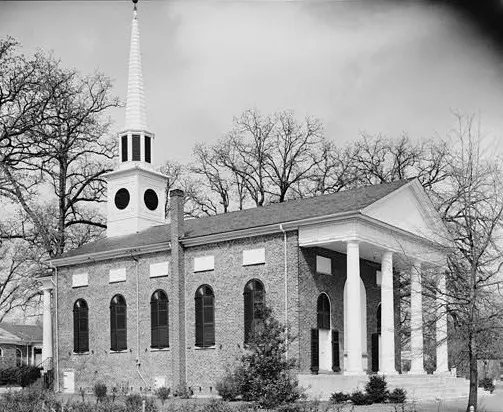
By the early 1820s the congregation had prospered and wanted a building in a more central location. It chose Robert Mills, a South Carolinian who had trained under James Hoban, Thomas Jefferson and Benjamin Latrobe and who would later design the Washington Monument; the master builder is believed to have been David Bartling, who came from Philadelphia. The new church was dedicated in 1822 on what is now DeKalb Street. Mills described his own building in his Statistics of South Carolina of 1826: "A handsome church has been erected in the upper part of the town, with a portico of four Doric columns in front, and a neat spire in the rear, containing a bell. The interior is arranged so that the floor and pews rise as they recede from the pulpit, giving every advantage to the audience, both in seeing and hearing."
Then the town moved its general. On 9 March 1825, in front of that portico, de Kalb's remains were reinterred and the cornerstone of a monument was laid in the presence of the Marquis de Lafayette, who was then near the end of his farewell tour of the United States. Mills gives the date; Lafayette's secretary, Auguste Levasseur, gives the scene. A procession formed chiefly of freemasons collected the general from his lodgings; after the remains were deposited and had received military honours, Lafayette laid the covering stone, cut with the words "This stone was placed over the remains of Baron De Kalb by General Lafayette, 1825". Levasseur watched the old man keep his hand on the stone as it descended, "whilst the multitude, in religious silence, contemplated the French veteran, after almost half a century, rendering the last offices to the German soldier". The party left Camden two days later.
Mills designed the monument too, and it was finished in 1827: a white marble obelisk on a pedestal, resting on granite blocks stepped outward and ringed by an iron balustrade. Its four faces were transcribed in full in a 1918 guidebook to the town. The south face reads "Here Lie the Remains of Baron De Kalb, A German by Birth but In Principle A Citizen of the World"; the west face records that he "There Nobly Fell, Covered With Wounds" in the battle fought near Camden on 16 August 1780; the north face credits the monument to the citizens of Camden.
The church itself has been repaired more than it has been changed. Services were suspended for two Sundays in August 1849 for repairs; the 1886 Charleston earthquake cracked the brick walls and earthquake bolts were installed; an 1890 renovation replaced Mills's pulpit and pews and laid a new floor over the original. In 1937 the Charleston firm of Simons & Lapham reversed most of that, rebuilding the north stair, putting back box pews and lifting the 1890 floor to find the first one underneath. The steeple was repaired in 1982-83. The church and the monument — and only those two, by the terms of the boundary description — were designated a National Historic Landmark in 1985.
Timeline: the documented record of Bethesda Presbyterian Church (Camden, South Carolina)
- c. 1774 The Presbyterian meeting house is built on Meeting Street on land given by Colonel Joseph Kershaw and confirmed in his will of 1778. The British destroy it during the war; it is rebuilt afterwards, and a third church on the same ground takes the name Bethesda.
- 16 August 1780 Horatio Gates's army is routed a few miles north of town. Major General Johann de Kalb falls at the head of the Delaware and Maryland troops; Robert Mills, writing in 1826, counts eleven wounds.
- 19 August 1780 De Kalb dies of his wounds after treatment by Lord Cornwallis's surgeons at the British military hospital, and is buried with full military honours beside the meeting house on Meeting Street — not at the church that today bears his story.
- 1822 The present church, designed by Robert Mills with David Bartling of Philadelphia believed to be the master builder, is dedicated on what is now DeKalb Street.
- 9 March 1825 De Kalb's remains are disinterred and reburied in front of the portico, and the cornerstone of his monument is laid in the presence of the Marquis de Lafayette. Mills, who designed the monument, records the date; Lafayette's secretary Auguste Levasseur describes the masonic procession, the military honours and the general keeping his hand on the covering stone as it descended.
- 1827 The monument is completed: a white marble obelisk on a pedestal, on a granite base of expanding blocks, ringed by an iron balustrade.
- 1886 The Charleston earthquake cracks the church's brick walls; earthquake bolts are installed, and a renovation follows in 1890 that replaces Mills's pulpit and pews.
- 10 April 1893 A northern visitor kneels at the Agnes of Glasgow stone in the old Presbyterian churchyard and reads its inscription. His unsigned letter to the Columbia State of 24 April 1893, reprinted in 1905, is the earliest printed appearance of the Camden legend I have been able to date. It describes a romance, not a haunting.
- 1905 Kirkland and Kennedy devote a chapter of Historic Camden to Agnes of Glasgow, placing her grave in the old Presbyterian churchyard. The only haunting the book records in Camden is the Revolutionary headquarters on Magazine Hill: "The spot was reported to be haunted." Bethesda is not mentioned.
- 1918 Edward Boltwood Hull's Guide-Book of Camden gives the churchyard on DeKalb Street a full entry for de Kalb's grave and transcribes all four faces of the monument. It also notes that the date on Agnes's stone falls months before the British entered Camden. The words ghost and haunted do not appear in the book.
- 1937 The Charleston firm of Simons & Lapham restores the church, undoing much of the 1890 work: the north stair is rebuilt, box pews go back in, and the 1890 floor is lifted to reveal the original beneath.
- 1954 The Cemetery Association of Camden erects the metal marker over Agnes's grave, on Meeting Street, crediting her burial to King Haigler — a Catawba chief killed in 1763, seventeen years before her recorded death.
- 1985 The church and the de Kalb monument are designated a National Historic Landmark, on a nomination prepared for the National Park Service by historian Mary Ann Eaddy on 29 June 1984. The designated boundary covers the church and monument only.
- 2013 Sherman Carmichael's Eerie South Carolina gives the modern haunted version of the legend and places it, explicitly, "around the old Quaker graveyard in Camden" — a mile from Bethesda.
- 24 August 2024 A "Folklore" section is added to the English Wikipedia article on the church, stating that it is haunted by Agnes of Glasgow, "who was supposedly buried in the graveyard". Both sources it cites place her in the Quaker Cemetery instead. This is the traceable origin of the claim that reached this catalogue.
Is there a rational explanation for Bethesda Presbyterian Church (Camden, South Carolina)?
The ghost usually attached to this churchyard belongs to another one, and the mistake can be dated to the day.
On 24 August 2024 an editor de-orphaning the English Wikipedia article added a "Folklore" section stating that the church is haunted by Agnes of Glasgow, "who was supposedly buried in the graveyard and remains searching for her lost lover". Two sources are cited. Neither of them puts her here. The first, a newspaper column, opens by saying the writer "visited Camden's Old Quaker Cemetery" and paid his respects at Agnes's grave. The second is the photograph and transcription of her marker, which the Historical Marker Database locates at 34°13.992'N, 80°36.441'W, on Meeting Street near Church Street. The church is at 502 DeKalb Street, about 1.4 kilometres — just under a mile — to the north. The two are not the same ground, and the grave marker for de Kalb's original burial place stands about 300 feet from Agnes's stone, in that same old burying ground.
Dating the story rather than the event settles the rest. The earliest printed appearance I have been able to fix is an unsigned letter sent to the Columbia State from Stamford, Connecticut, on 24 April 1893, reprinted at length in Kirkland and Kennedy's Historic Camden of 1905: the writer describes kneeling at the stone on 10 April 1893 and deciphering "Here lies the body of Agnes of Glasgow, who departed this life February 12, 1780, aged 20". The 1905 chapter and the 1918 Guide-Book of Camden both place the grave in "the old Presbyterian Churchyard". And in none of the three is Agnes a ghost. She is a romance and a curiosity — "many a pilgrim finds his way to the ancient tomb", wrote Kirkland and Kennedy, "and pauses there in a sort of fascination born of mystery". The haunting is modern: in the 2013 collection Eerie South Carolina the still-searching Agnes is placed, in so many words, "around the old Quaker graveyard in Camden".
The negative needs a control, so here it is. Historic Camden (1905) does record haunting lore in the town: of the Revolutionary headquarters on Magazine Hill it says flatly, "The spot was reported to be haunted", and describes the ghostly reputation that made children dare each other to climb to its bullseye window. So the book was willing to print such things. It never mentions Bethesda at all. The 1918 Guide-Book is a better test still, because it does cover the churchyard: it gives "Grave of De Kalb" a full entry, states that "the yard of the Presbyterian Church on De Kalb street holds a grave and monument of peculiar interest", and transcribes all four faces of the obelisk. In that book the words ghost and haunted appear zero times; Kalb appears 25 times and Agnes five.
Even the legend that does belong to Camden was being taken apart in print more than a century ago. The 1918 guidebook noted that "a too accurate modern historian" had pointed out that the date on Agnes's own gravestone falls several months before the British entered Camden. The 1954 marker credits her burial to King Haigler, chief of the Catawba, who was killed by a Shawnee raiding party on 30 August 1763 — seventeen years before she is supposed to have died. Even the date on the stone is unstable: February 12, 1780 as read in 1893 and 1905, "Feber 1780" as printed in 1918.
What that leaves for Bethesda is nothing, and the honest version of this page says so. The cold spots between old headstones and the figure in old-fashioned dress glimpsed near dusk that this entry carried until August 2026 were not attributed to anyone, are in no source I could find, and have been withdrawn. The congregation's own history page mentions Mills, the monument and the 1985 landmark designation, and says nothing about a ghost.
Can you visit Bethesda Presbyterian Church (Camden, South Carolina)?
Bethesda Presbyterian Church (PC-USA) is a working congregation at 502 East DeKalb Street, Camden, South Carolina 29020. The sanctuary Robert Mills designed in 1822 entered the National Register of Historic Places and was designated a National Historic Landmark on the same day, 4 February 1985, under reference 85003258; Mary Ann Eaddy wrote the nomination in 1984.
The congregation's own site, read on 9 September 2026, gives the Sunday pattern as fellowship in Westminster Hall at 9:45; Sunday School at 10:00; worship at 11:00; the youth group from 17:30 to 19:30. The telephone number is (803) 432-4593, and the same site carries the line "Our Senior Pastor Search Page is on-line!", so the church was still without an installed senior pastor on that date.
The de Kalb monument stands in front of the south portico facing DeKalb Street and is visible from the public pavement. The obelisk, its stepped granite base and the reconstructed iron balustrade are what Mills described in 1826. Access to the churchyard and to the sanctuary goes through the church office in office hours, as at any other place where people are buried and married. There is no ghost tour here; the site has no night access and no visitor programme of any kind.
The Doric portico on DeKalb Street is the front Mills designed; the working entrance is on the north side, which Mills himself called the rear; its brick porch and double stair are later work. The Historic American Buildings Survey photograph most often reproduced, this page included, shows that north front.
The Revolutionary burials are about 1.4 kilometres to the south, on Meeting Street near Church Street, in the old burying ground now generally called the Quaker Cemetery: de Kalb's original grave, the site of the eighteenth-century Presbyterian meeting house and the grave of Agnes of Glasgow, each with its own historical marker. Camden's Confederate dead lie in that same public ground.
Sources consulted
- Robert Mills, «Statistics of South Carolina, including a view of its natural, civil, and military history» — Hurlbut and Lloyd, Charleston (pp. 591-592), 1826 book
- Auguste Levasseur, trans. John D. Godman, «Lafayette in America in 1824 and 1825, or Journal of a Voyage to the United States (chapter IV, the Camden ceremony)» — Carey and Lea, Philadelphia, 1829 book
- Mary Ann Eaddy, «National Register of Historic Places Inventory-Nomination Form: Bethesda Presbyterian Church (ref. 85003258)» — National Park Service, 1984 report
- Edward Boltwood Hull, «Guide-Book of Camden: points of interest, historical sketch, pioneer and revolutionary scenes (pp. 33-36)» — E. B. Hull, Camden, S.C., 1918 book
- Thomas J. Kirkland and Robert M. Kennedy, «Historic Camden, Part One: Colonial and Revolutionary (chapter XIII, Agnes of Glasgow)» — The State Company, Columbia, S.C., 1905 book
- Historical Marker Database, «Maj. Gen. Baron Johann de Kalb's Original Gravesite (historical marker, Meeting Street at Church Street, Camden)» — Marker transcription and photographs, 2011 archive
- Historical Marker Database, «Presbyterian Meeting House (historical marker erected 1954 by the Cemetery Association of Camden)» — Marker transcription and photographs, 2011 archive
- Historical Marker Database, «Agnes of Glasgow 1760~1780 (historical marker, Cemetery Association of Camden), with coordinates and photographs of the grave» — Marker transcription and photographs, 2011 archive
- Bethesda Presbyterian Church, Camden, «History» — Official website of the congregation, 2026 web
- Sherman Carmichael, «Eerie South Carolina: True Chilling Stories from the Palmetto Past (located by full-text search)» — The History Press, Charleston, 2013 book
- English Wikipedia, «Revision history of the article Bethesda Presbyterian Church (Camden, South Carolina)» — Edit of 24 August 2024 adding the Folklore section, 2024 web
- Bethesda Presbyterian Church, Camden, «Service times and contact details» — Official website of the congregation, consulted August 2026, 2026 web
Reviewed by V. Serrano on 2026-08-11 · How we verify our content
💬 Field testimonies (0)
No testimonies yet. Add the first.
Add your testimony
🔒 Log in to add a testimony