👻 HAUNTED PLACE · EXP. Nº0482
ACTIVE
Church of St. Barnabas
Two ghosts are reported at this Episcopal church above the Hudson, and both of them have names that our own catalogue had lost.
Where is Church of St. Barnabas?
- Location
- New York, United States
- Type
- Church / religious site
- Coordinates
- 41.04, -73.865
- Last updated
LOCATION
Why is Church of St. Barnabas said to be haunted?
The first is Isabel Benjamin, wife of the second rector, who lived in the rectory at Irvington from 1867 to 1907; the youngest daughter of a twentieth-century rector said she was the woman who sat knitting in the corner of her bedroom at night, and picked her out of a sepia photograph in the church's own archive. The second was seen on an October evening in 2000 by one of two men installing a new organ, watching them from the back of the nave; both left the building in a hurry, and the source declines to say who it was. All of it descends from one article in a local newspaper, The Hudson Independent of 2 October 2011, which is also the only account that names its witnesses and marks what is unknown. The twenty-six-page National Register nomination of 1999 mentions no ghosts, and neither does anything the parish publishes today. Nobody in Irvington charges for the story. What the church does have on paper is Washington Irving, James Renwick Jr., and a general buried in 1906 from a building too small to hold his mourners.
What is the history of Church of St. Barnabas?
The church at 15 North Broadway exists because two men liked the same view.
The Rev. Dr John McVickar, professor at Columbia College, bought thirty acres at the top of Main Street in the village then called Dearman in order to live near his friend Washington Irving, whose estate Sunnyside lay just to the south. The National Register nomination records that the idea of a chapel and school came out of their evening conversations on McVickar's veranda, watching the sun set over the Hudson. McVickar raised the money from his own circle: Irving himself, John Jay's grandson, a grandson of Alexander Hamilton, Dr John Bard, Robert B. Minturn, Franklin C. Field and Trinity Church in Manhattan.
McVickar had been studying church architecture since 1804 and believed the beauty of a church lay in its proportions rather than its materials. He is credited with the design, said to be copied after St Martin's Church in Canterbury. The cornerstone was laid in 1852; the Chapel-School was dedicated on St Barnabas Day 1853. In 1858 the school venture was given up, the parish was incorporated — the first Episcopal parish in the village — and McVickar's son, the Rev. William Augustus McVickar, became its first rector. His father built him a house nearby, the McVickar House, itself now on the National Register.
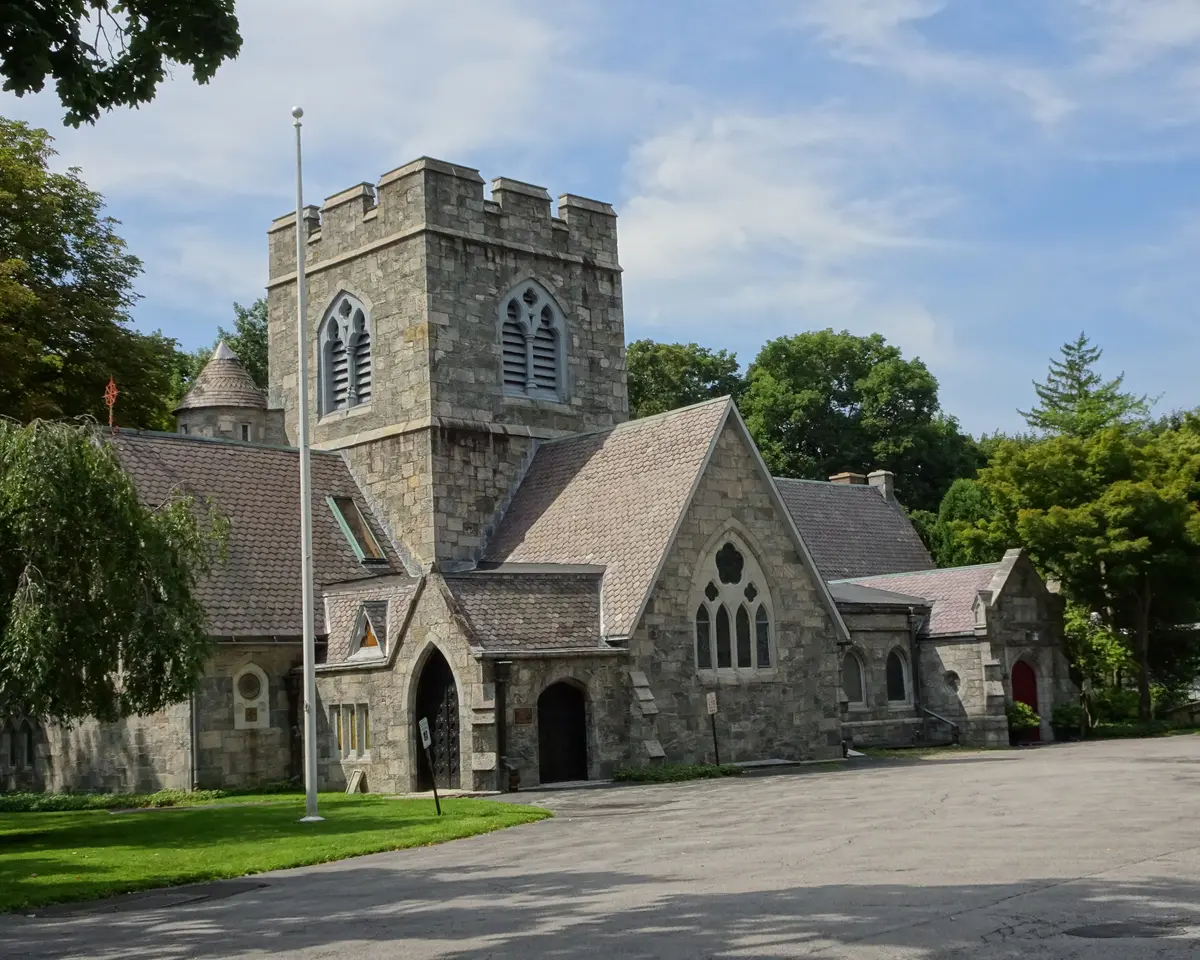
By 1863 the chapel was too small. The commission for the enlargement went to Renwick & Sands, the firm of James Renwick Jr., then busy finishing St Patrick's Cathedral. They added the crenellated tower, the transepts and the chancel; the original chapel survives inside as the nave, and whole logs from its framing are still visible in the basement. The McVickar family sold the rectory to the parish in 1876; Jay Gould, whose Lyndhurst estate stands to the north, gave the remaining land in 1890. The lych gate went up in 1899 and the parish hall, by the local architect A. J. Manning, in 1902.
The second rector was the Rev. William Henry Benjamin, and the parish's own account has his wife living in the rectory from 1867 to 1907 — forty years. It is his name, not McVickar's, that appears in the one contemporary newspaper record of the church's most public day. On 1 December 1906 St Barnabas buried Gen. Philip Schuyler, killed with the president of the Southern Railway in a wreck near Lawyers, Virginia. The New York Times reported that the church "was not large enough to accommodate those who attended", that a special train of six coaches brought two hundred mourners from the city, that J. Pierpont Morgan arrived in his private car behind a special engine, and that "the services were conducted by the Rev. W. H. Benjamin, the rector of St Barnabas's Church".
The Benjamins' only child, Isabel K. Benjamin, grew up in that rectory. She founded the Irvington Girl Scouts in 1924, was known in the village as its "First Lady", and at her death in 1961 left a trust that still supports the Girl Scouts and the St Barnabas Altar Guild. The village's Recreation and Parks headquarters on Main Street carries her name.
Timeline: the documented record of Church of St. Barnabas
- 1852 The Rev. John McVickar, professor at Columbia and a friend of Washington Irving, laid the cornerstone of a chapel and school on thirty acres he had bought at the top of Main Street in Dearman, the village later renamed Irvington. Irving, a grandson of John Jay, a grandson of Alexander Hamilton and Trinity Church in Manhattan were among the subscribers.
- 11 June 1853 The Chapel-School was dedicated on St Barnabas Day, according to the parish's own history. The National Register nomination gives the date as 2 June 1853 and calls it St Barnabas Day as well; the feast of St Barnabas is 11 June, so the two documents cannot both be right and the internal contradiction is in the nomination.
- 1858 The school venture was given up and the Parish of St Barnabas was incorporated, the first Episcopal parish in the village. McVickar's son, the Rev. William Augustus McVickar, became its first rector.
- 1863 Renwick & Sands, the firm of James Renwick Jr., then finishing St Patrick's Cathedral in Manhattan, enlarged the chapel with the crenellated tower, the transepts and the chancel. The original 1853 building survives inside as the nave.
- 1867 Isabel Benjamin moved into the rectory with her husband, the Rev. William Henry Benjamin, second rector of St Barnabas. She lived there for forty years, until 1907. Hers is the figure later reported in the rectory; the National Register nomination never mentions the Benjamins at all.
- 1870 Isabel K. Benjamin, the couple's only child, was born and grew up in that rectory. The Irvington Historical Society gives her dates as 1870-1961; the parish's own history page gives 1871.
- 1 December 1906 St Barnabas held the funeral of Gen. Philip Schuyler, killed two days earlier with the president of the Southern Railway in a wreck near Lawyers, Virginia. The New York Times reported that the church could not hold the crowd, that a special train of six coaches carried two hundred mourners from the city and that J. Pierpont Morgan came in his private car; the services, it said, were conducted by the Rev. W. H. Benjamin, the rector.
- 1924 Isabel K. Benjamin founded the Irvington Girl Scouts, which by the 1950s had more than two hundred members. The same year a bowling alley and a rifle range were installed in the basement of the parish hall.
- 1961 Isabel K. Benjamin died childless, leaving a trust that still supports the Irvington Girl Scouts and the St Barnabas Altar Guild and that helped the village buy the building on Main Street now named the Isabel K. Benjamin Community Center.
- 24 March 2000 The church complex was listed on the National Register of Historic Places, reference 00000241, on a nomination prepared by Peter D. Shaver of the New York State historic preservation office in August 1999. Its twenty-six pages say nothing about ghosts.
- October 2000 On an October evening two men installing the church's new organ were at work when, according to the account published eleven years later, one of them saw a figure watching from the back of the nave and both left the building in a hurry. Whose it was, the source declines to say. No further sightings were reported after this.
- 2 October 2011 Barrett Seaman published the article in The Hudson Independent from which every later account of the ghosts descends. It names the witnesses, quotes the rector of the day saying the parish celebrates ghosts because All Hallows' Eve precedes All Saints' Day, and states that nothing had been seen since 2000.
- 14 December 2011 A Wikipedia editor summarised Seaman's article in three sentences and added a haunted-locations category to the page. That summary, not the newspaper, is what the ghost directories and this catalogue inherited: it added a rocking chair, turned two men into several workers and replaced the source's 'unknown' with a named ghost.
Is there a rational explanation for Church of St. Barnabas?
Everything published about the ghosts of St Barnabas descends from one local newspaper article, and it can be dated exactly: Barrett Seaman, "Parishioners Embrace Ghosts at Church of St. Barnabas in Irvington", in The Hudson Independent of 2 October 2011. Read against what came after it, that article is the most sceptical document in the file, because it is the only one that names its witnesses and marks what is not known.
Seaman's account is second-hand and retrospective. The rectory sightings belong to the thirty-six years of the Rev. Charles Colwell, who retired in 2008; the identification of the figure was made by his youngest daughter Amanda, pointing at a sepia photograph in the church's own archive and saying, "That's her!" That is retro-identification: the picture supplies the name, and the encounter is fitted to it afterwards. Seaman also reports that there had been no sightings since 2000, and he declines to say whose apparition the organ installers saw — "or some other spirit with an interest in St Barnabas, is unknown".
What happened next is documented deformation. On 14 December 2011 the article was written up on Wikipedia, and in three sentences the account acquired a rocking chair that is not in the source, turned two men into "several workers", moved the sighting from the back of the nave to the sanctuary, converted "unknown" into "believed by some members of the church to be the ghost of William McVickar", and dropped both women's names. Ghost-listing sites then added material of their own: that the woman "seems to be especially drawn to the children of pastors who live in the rectory", and a reader's story of a figure in white whose eyes turned pitch black. None of that is in Seaman.
The institutional record is silent and the silence is clean. The 1999 National Register nomination by Peter D. Shaver runs to 26 pages; its thirteen pages of text — 3,792 words — contain no instance of ghost, haunt, spirit, apparition or legend, while the same sweep returns Irving 13 times, McVickar 11, Renwick 10 and rector 10. A crawl of the parish's fourteen public web pages on 20 August 2026, about 1.5 MB, returns the same zero, with Barnabas 1,938 times and rector 115. There is no ghost tour, no ticket and no gift shop: the church is a working parish, the doors are free, and nobody in Irvington makes money from any of this. That matters, because it removes the commercial motive that explains many similar stories in the Hudson Valley.
The one voice on the other side is also institutional. In 2011 the then rector, the Rev. Nora Smith, told Seaman: "At St. Barnabas, we celebrate ghosts, literally! Halloween (All Hallow's Eve) precedes All Saint's Day on November 1, which is one of the Church's seven Principal Feasts." A parish that answers a ghost story with the liturgical calendar is not selling anything.
Two checks remain open, and I would rather say so than close them with a zero. Seaman credits the story to "Linda Lee Macken's book Ghosts of the Hudson Valley": no book of that title exists. Lynda Lee Macken — with a Y — published Haunted Houses of the Hudson Valley (Black Cat Press, 2006, 80 pages), and I could not obtain a copy to see whether St Barnabas is in it; Google Books returned quota-exhausted errors that day, so its silence proves nothing. The parish's own history, Carolyn G. Stifel's The Church of St. Barnabas of Irvington, New York: Its History and Windows (2008, 112 pages), exists and is catalogued, but the scanned copy is lending-restricted and refused access, so the one book that could show whether these stories circulated before 2011 is the one I could not open.
Can you visit Church of St. Barnabas?
St Barnabas is a working Episcopal parish at 15 North Broadway (US Route 9), Irvington, New York 10533, on a 2.74-acre lot on the west side of the road just north of Main Street; the parish office number is (914) 591-8194. It has been on the National Register of Historic Places since 24 March 2000 (reference 00000241). A driveway from Broadway opens into a ring-shaped car park north-east of the church, and a walkway runs in from the lych gate on the street; the parish's visitor page adds that on Sunday mornings cars may also use the rectory driveway and the kerb along Broadway.
As listed on the parish site on 23 September 2026, there are two Sunday services from September to June: 8:00, which lasts about 45 minutes, and the main Holy Eucharist at 10:00, about an hour and ten minutes, followed by a coffee hour open to all. In July and August there is one service at 9:00, at St Barnabas in July and in August as an ecumenical service at Irvington Presbyterian Church next door. The Rev. Gareth Evans, fourteenth rector since December 2018, keeps drop-in hours on Wednesdays from 13:00 to 15:00. A Ship of Fools "Mystery Worshipper" at the 9:00 service on 26 June 2016 counted thirty-eight people and was invited to coffee and cake afterwards.
Most of the sightings in the story belong to the rectory, the granite house with a slate roof south of the church, which is the rector's residence. The ghosts do not appear on the parish's fourteen public web pages, crawled on 20 August 2026.
The Old Croton Aqueduct trailway, a National Historic Landmark, follows the western boundary of the property. Immediately south stands the McVickar House, built in 1853 by John McVickar and first lived in by his son William, the first rector, before he moved to the rectory; it is on the National Register (03001398) and houses the Irvington Historical Society at 131 Main Street. At 71 Main Street, the Isabel K. Benjamin Community Center carries the name of the second rector's daughter, who grew up in the rectory. Washington Irving's Sunnyside, run by Historic Hudson Valley, which charges admission, is 1.0 km (0.6 miles) north-north-west of the pin in a straight line, and Jay Gould's Lyndhurst, a National Trust property, 1.6 km (1.0 mile) north.
Sources consulted
- Peter D. Shaver, «National Register of Historic Places Registration Form: Church of St. Barnabas, Irvington, Westchester County, New York (reference 00000241, listed 24 March 2000)» — New York State Office of Parks, Recreation and Historic Preservation / National Park Service, 1999 report
- Special to The New York Times, «Gen. Schuyler Buried from Irvington Home» — The New York Times, 1906 newspaper archive
- The New York Times, «Gen. Schuyler, Veteran, Sporting and Clubman» — The New York Times, 1906 newspaper archive
- Barrett Seaman, «Parishioners Embrace Ghosts at Church of St. Barnabas in Irvington» — The Hudson Independent (Tarrytown, NY), 2011 newspaper archive
- Church of St. Barnabas, «Parish History» — stbarnabaschurch.org (archived 12 December 2011), 2011 web
- Church of St. Barnabas, «History & Architecture» — stbarnabaschurch.org, 2026 web
- Irvington Historical Society, «Isabel K. Benjamin, First Lady of Irvington» — irvingtonhistoricalsociety.org, 2024 web
- Irvington Historical Society, «Church of St. Barnabas (National Register of Historic Places page, archived 5 January 2009)» — irvingtonhistoricalsociety.org, 2009 web
- English Wikipedia contributors, «Revision history of the article 'Church of St. Barnabas (Irvington, New York)', revisions 465765320 and 465816471 of 14 December 2011» — en.wikipedia.org, 2011 archive
- Carolyn G. Stifel, «The Church of St. Barnabas of Irvington, New York: Its History and Windows» — Church of St. Barnabas, Irvington, NY (112 pp., ISBN 978-0-615-22251-6); catalogued but lending-restricted, not read, 2008 book
- Lynda Lee Macken, «Haunted Houses of the Hudson Valley (the book The Hudson Independent cites, under a title that does not exist: 'Linda Lee Macken, Ghosts of the Hudson Valley')» — Black Cat Press (80 pp., ISBN 978-0-9755244-4-2); not obtained, 2006 book
- Ship of Fools, «Mystery Worshipper report no. 2947: St Barnabas, Irvington, New York, service of 26 June 2016» — shipoffools.com, 2016 web
- HauntedPlaces.org, «Church of St. Barnabas entry (aggregator; contains material found in no earlier source)» — hauntedplaces.org, 2026 web
Reviewed by V. Serrano on 2026-08-21 · How we verify our content
📎 Source: Wikipedia (CC BY-SA)
💬 Field testimonies (0)
No testimonies yet. Add the first.
Add your testimony
🔒 Log in to add a testimony