👻 HAUNTED PLACE · EXP. Nº9477
ACTIVE
Eloise (psychiatric hospital)
Eloise began in 1839 as the Wayne County Poor House, when thirty-five people were moved out from Detroit into a log stagecoach inn on the Chicago Road.
Where is Eloise (psychiatric hospital)?
- Location
- Michigan, United States
- Type
- Hospital / asylum
- Coordinates
- 42.287, -83.343
- Last updated
LOCATION
Why is Eloise (psychiatric hospital) said to be haunted?
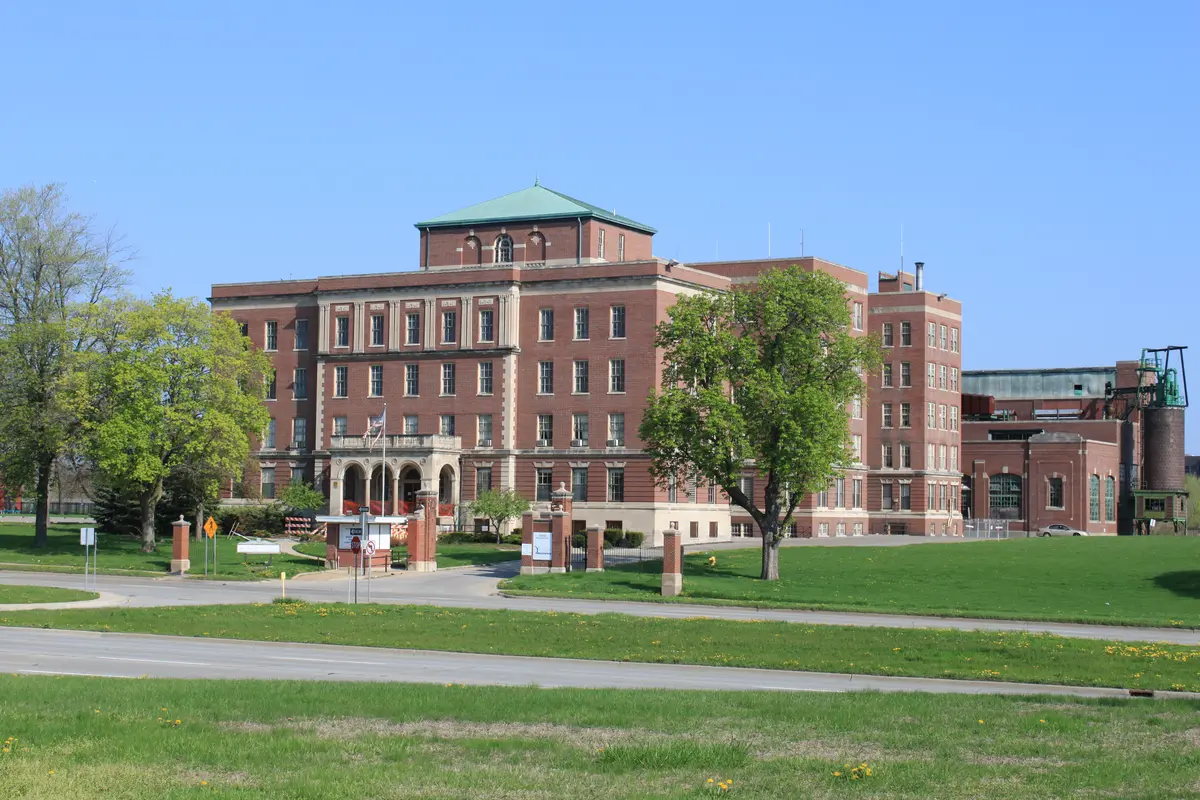
It took its name in 1894 from Eloise Dickerson, the four-year-old daughter of the board's president, because the Post Office Department had just ruled that it would only grant one-word names. By the late 1920s it was a small city: 10,000 patients and 2,000 staff on 902 acres and some 75 buildings, with its own farm, bakery, police force, rail spur and post office, and a potter's field where about 7,100 unclaimed patients lie under numbered concrete blocks. Nothing here closed in a single year. The large psychiatric wards were vacated in 1973, the State of Michigan took the hospital over in 1977, the general hospital closed in 1984, and Wayne County kept using the 1931 Kay Beard Building until it sold the site for one dollar in 2018. Almost the whole campus has since been demolished. The ghost stories are absent from the institution's own 1913 history and arrived with the ruin; one surviving building now sells them as a haunted attraction.
What is the history of Eloise (psychiatric hospital)?
Eloise was never one building and never had one purpose, which is why almost everything written about it is slightly wrong.
It began as the Wayne County Poor House, created in Detroit by a vote of the people on 8 March 1832. Seven years later the county moved it into the woods. On 22 February 1839 the county commissioners Reynold Gillett, Jonathan Shearer and Benjamin F. Fox signed two warranty deeds with the Torbert family, father and son, paying 800 dollars for each of two adjoining farms: 280 acres on the Chicago Road, sixteen miles west of Detroit. On the northern farm stood a log building that Samuel Torbert had raised in November 1829 and run as a stagecoach inn, the Black Horse Tavern. On 11 April 1839 thirty-five people were moved out from the Detroit poorhouse into a two-storey frame addition built beside it. The county register had counted 111 residents in Detroit the month before; the institution's own historian assumed that many had simply refused to go into what he called the "awful wilderness".
The name arrived fifty-five years later and had nothing to do with a patient. In 1894 the board wanted its own post office, and Postmaster General Wilson S. Bissell had just ruled, on 9 April, that new offices would only be granted "short names or names of one word". The board's first choice, County House, was rejected; so were lists of the superintendents' surnames and of their wives' names. Freeman B. Dickerson, a former postmaster of Detroit, was president of the board at the time, and his only living child was a four-year-old called Eloise. Washington accepted it at once. The post office opened as Eloise on 20 July 1894; the Michigan Central station, the American Express office and the interurban stop took the same name, and eventually the institution did too. Eloise Dickerson grew up to marry Harlow N. Davock of Detroit.
What grew on those 280 acres became a small municipality. At its peak in the late 1920s, according to the state historical marker on the site, Eloise held 10,000 patients and 2,000 staff across 902 acres and some 75 buildings, with a farm, bakery, cannery, laundry, power plant, morgue, its own fire department and police force, a rail spur and a trolley stop.
Three institutions shared that ground and are constantly confused with one another. Eloise Infirmary was the poorhouse, renamed on 2 June 1913 to comply with the state constitution. Eloise Sanatorium was the open-air hospital for tuberculosis. Eloise Hospital was the mental-illness complex, called Wayne County Asylum until the board renamed it on 18 August 1911.
The county's own literature is the best guide to what was actually done there. A leaflet the Wayne County Board of County Institutions handed to families in 1945, under medical superintendent Dr T. K. Gruber, lists the treatments plainly: "shock treatment and malarial treatment or therapy", occupational therapy in the greenhouse and the shoe-repair shop, a patients' orchestra, weekly films in the auditorium, a branch of the Wayne County Library. Visiting hours were one to four in the afternoon on Tuesdays, Thursdays, Saturdays, Sundays and holidays; the bus from the Barium Tower in Detroit cost thirty cents each way; mail was addressed simply to Eloise, Michigan. The same leaflet told relatives that "mental illness is not a disgrace".
The people are easier to lose than the buildings. Annie Cohen was born in Detroit in 1919 with a deformed leg that was later amputated. In April 1940 her mother petitioned the Wayne County Probate Court alleging that she was insane, and a judge ordered her detained at Eloise. She spent more than thirty years there and died in 1972. Her nephew, the journalist Steve Luxenberg, grew up believing his mother had been an only child; he reconstructed Annie from probate files, hospital records and a 1940 social worker's report, and published the result in 2009.
The ending came in instalments, and that is the single fact most often got wrong. Large psychiatric buildings were vacated in 1973. The State of Michigan took over the psychiatric hospital in 1977 and psychiatric care wound down over the following years, reported variously as ending in 1979 and as continuing until the last patients were transferred out in 1982. The general hospital closed in 1984, the date Patricia Ibbotson used to close the title of her history of the place. Wayne County kept using the 1931 "D" building, renamed for commissioner Kay Beard, for county offices and programmes until 2018. Nothing at Eloise closed in a single year.
Timeline: the documented record of Eloise (psychiatric hospital)
- November 1829 Samuel Torbert builds a log inn on the Chicago Road sixteen miles west of Detroit and runs it as the Black Horse Tavern, the building the county will later buy as a poorhouse.
- 22 February and 11 April 1839 Wayne County commissioners buy two adjoining farms from the Torberts for 800 dollars each, 280 acres in all. On 11 April thirty-five residents are transferred from the Detroit poorhouse; the county register had counted 111 in Detroit the month before.
- 20 July 1894 The post office opens as Eloise. The name is chosen because the Postmaster General had ordered on 9 April that only one-word names be accepted; board president Freeman B. Dickerson, a former Detroit postmaster, had a four-year-old daughter of that name.
- 18 August 1911 The Board of Superintendents of the Poor renames the Wayne County Asylum as Eloise Hospital, following a state act that turned Michigan's asylums into hospitals.
- 1913 Stanislas M. Keenan publishes the institution's own 446-page History of Eloise in Detroit. It describes the wards, the farm, the cemetery and even the body-snatching of the 1880s, and never once uses the words ghost or haunted.
- Late 1920s Eloise reaches its peak: 10,000 patients and 2,000 staff on 902 acres and some 75 buildings, according to the state historical marker on the site.
- April 1940 Annie Cohen, 20, born in Detroit with a deformed leg later amputated, is committed to Eloise after her mother petitions the Wayne County Probate Court. She stays more than thirty years and dies in 1972; her nephew Steve Luxenberg, who grew up believing his mother was an only child, published her story in 2009.
- 1945 The Wayne County Board of County Institutions issues a leaflet for patients' families under superintendent Dr T. K. Gruber. It lists shock treatment and malarial therapy, occupational and music therapy, visiting hours of 1 to 4 p.m., a thirty-cent bus fare, and the sentence "mental illness is not a disgrace".
- 1948 Burials stop in the Eloise potter's field after about 7,100 graves, marked only with numbered blocks. Unclaimed bodies go instead to the medical school in Detroit, as a Wayne County law had allowed since 1895.
- 1973-1984 The complex closes in stages: the large psychiatric buildings are vacated in 1973, the State of Michigan takes over the psychiatric hospital in 1977, psychiatric care ends between 1979 and 1982 depending on the account, and the general hospital closes in 1984. No single date closes Eloise.
- 2006 The brick smokestack with ELOISE spelled out on it is demolished as a hazard. A state historical marker is placed on the site the same year.
- End of March 2016 Fire destroys the old bakery, one of the last original buildings, which is then demolished. The Detroit News reports it on 30 March under the headline "Fire hits one of last buildings at Eloise".
- 3 February 2017 Vertical Entertainment releases Eloise, directed by Robert Legato and shot partly on the real site. The film opens by telling the audience that a fire destroyed the hospital in 1982 — an event that never happened, and which is still repeated online as history.
- 21 June 2018 Wayne County sells the remaining 28 acres, including the Kay Beard Building, to a Southfield development team for one dollar against a commitment to invest 20 million. The Eloise Museum opens the same year at Westland Historic Village Park.
- October 2021 The Eloise Asylum haunted attraction opens in the ground floor and basement of the Kay Beard Building; escape rooms and year-round paranormal investigations follow.
- October 2023 Ryan Eberhart, president of the Westland Historic Village, tells WDIV that of the 7,100 people buried in the potter's field, "less than a percent" have been identified; the surviving death ledgers cover only 1926 to 1948.
Is there a rational explanation for Eloise (psychiatric hospital)?
The first thing to say about Eloise's ghosts is that the institution itself never mentioned them.
Stanislas M. Keenan's History of Eloise, printed in Detroit in 1913 and running to 446 pages, is the in-house account of the place, written while it was still filling up. Searched end to end, it contains no instance of the words ghost, haunt, haunted or apparition. The word spirit appears sixteen times, every one of them meaning morale, temperament or religious care. As a control on the same text: asylum appears 327 times, insane 151, cemetery nine. The 1945 leaflet the county gave to patients' families contains the word patient thirty-one times and no ghost words at all. The haunting is not in the historical record; it arrived with the ruin.
What it arrived with is easy to date. The wards emptied from 1973, the county demolished most of the campus, and the survivors stood open on 900 acres for a generation. Trespassing by urban explorers and amateur ghost hunters became routine, to the point that the current owners have said they work with Westland police on citations for trespass and vandalism, and that fittings were stripped from the buildings during the abandoned years. As of August 2026 I have not been able to date any printed claim that Eloise is haunted earlier than the 2000s, and every datable milestone in its fame is recent: a feature film in 2016, a haunted attraction in 2021, two Discovery episodes of Expedition X in August 2023.
That film is worth pausing on, because it looks like the source of the most repeated false fact about the place. Eloise, directed by Robert Legato and released by Vertical Entertainment on 3 February 2017, was shot partly on the real site and opens by telling the audience that a fire destroyed the building in 1982. No such fire happened. The complex was emptied over a decade and knocked down by its owner; the only fire that took a major Eloise building came much later, at the end of March 2016, when the old bakery burned and had to be demolished. The invented 1982 fire now circulates in film synopses and review sites as though it were the history of the hospital.
There is also a commercial incentive, and it is not hidden. The owner of the surviving building sells the reputation directly: the site advertises areas "known for having high paranormal energy", public paranormal investigations, and private night investigations from 8 p.m. to 2 a.m. starting at 1,350 dollars for groups of up to ten. That is an excellent source for what the operator claims and no evidence at all that the claim is true.
The physical conditions do the rest. The Kay Beard Building is a five-storey block of 1931 that once held some 400 patients, largely unheated, stripped, dark and full of long corridors and stairwells that carry sound between floors; visitors walk into it having been told in advance what they are there to experience.
Meanwhile the people who work on Eloise's actual history talk about names, not spirits. Ryan Eberhart, president of the Westland Historic Village, has spent years matching the numbered markers in the cemetery to the death ledgers that survive for 1926 to 1948, and summed up the result in 2023 as "less than a percent" identified. Seven thousand one hundred people are buried there and almost none of them has a name attached. That is the genuinely disturbing fact about Eloise, and it needs no ghost.
Can you visit Eloise (psychiatric hospital)?
Most of Eloise is gone. Of roughly seventy-five buildings, Wayne County demolished all but a handful after the hospital closed: the brick smokestack lettered ELOISE came down in 2006, and the bakery of 1905 burned on 30 March 2016 and was reduced to its foundation. Wayne County sold the remaining twenty-eight acres to a Southfield development team for one dollar on 21 June 2018, against a contractual commitment to invest twenty million dollars in the site. The firehouse and the power plant are still standing; the power plant is condemned and slated for demolition.
The building that admits visitors is the Kay Beard Building, the five-storey "D" building of 1931, at 30712 Michigan Avenue, Westland, Michigan 48186. Its ground floor and basement hold the Eloise Asylum attraction, which opened in October 2021 and now runs alongside two escape rooms, a three-hour history tour of the building and the grounds, and paranormal investigations. On 22 September 2026 the operator's site listed public investigations on Friday from 19:00 to 23:00, on Saturday from 19:00 to midnight and on Sunday from 19:00 to 22:30, with check-in at the Kay Beard Building; private investigations run from 20:00 to 02:00 on any available day, are restricted to people over 18, and start at 1,350 dollars for a group of up to ten. Tickets for the 2026 Halloween season went on sale on 25 September.
The rest of the property is private and occupied. The old commissary is an emergency shelter for homeless families, run by Samaritas with Wayne County, with residents living in it. The owners have said publicly that they pursue trespass citations through the Westland police.
Eloise Cemetery, the potter's field south of Michigan Avenue off Henry Ruff Road, holds about 7,100 burials made between 1910 and 1948, marked only with numbered blocks and screened by a grove of pines. Fewer than one per cent of the dead have been matched to a name, and many grave positions have been lost; the ground is fenced and posted against trespass.
What survives of the hospital's paperwork is in a museum. The Eloise exhibit opened in 2018 at Westland Historic Village Park, 857 North Wayne Road, Westland, Michigan 48185, about five kilometres (three miles) north-west of the Kay Beard Building, and holds hospital files, timelines and objects taken from the complex, among them a barber's chair and seats from the Gruber auditorium. The park opens on Saturdays from 13:00 to 16:00. Admission and parking are free and the telephone is (734) 326-3870.
Sources consulted
- Stanislas M. Keenan, «History of Eloise: Wayne County House, Wayne County Asylum» — Thos. Smith Press, Detroit, 1913 book
- Wayne County Board of County Institutions, «The Patient: Wayne County General Hospital and Infirmary, Eloise, Michigan» — Detroit, 1945 report
- Michigan Historical Commission, «Eloise (Michigan state historical marker, Westland)» — The Historical Marker Database, 2006 archive
- Darlene Hawley, «History of Eloise» — The Wayne Dispatch, 2014 newspaper archive
- WDIV / ClickOnDetroit, «Here's why Wayne County sold the old Eloise complex for just a dollar» — WDIV Local 4 Detroit, 2018 newspaper archive
- FOX 2 Detroit, «A history of Eloise as haunted attraction opens in historic former Westland psychiatric hospital» — FOX 2 Detroit, 2021 newspaper archive
- WDIV / ClickOnDetroit, «Ghosts of Eloise: Thousands buried near former Westland mental hospital remain unidentified» — WDIV Local 4 Detroit, 2023 newspaper archive
- Steve Luxenberg, «Annie's Ghosts: A Journey Into a Family Secret» — Hyperion, New York, 2009 book
- Eloise Asylum LLC, «Eloise Asylum — official site (haunted attraction, escape rooms and paranormal investigations)» — eloiseasylum.com, 2026 web
- Wikipedia contributors, «Eloise (2016 film)» — Wikipedia, 2026 web
- The Detroit News, «Fire hits one of last buildings at Eloise» — The Detroit News, 2016 newspaper archive
- City of Westland, «Westland Historic Village Park (home of the Eloise Museum)» — cityofwestland.com, 2026 web
Reviewed by V. Serrano on 2026-08-12 · How we verify our content
💬 Field testimonies (0)
No testimonies yet. Add the first.
Add your testimony
🔒 Log in to add a testimony