👻 HAUNTED PLACE · EXP. Nº9478
ACTIVE
General Nathanael Greene Homestead
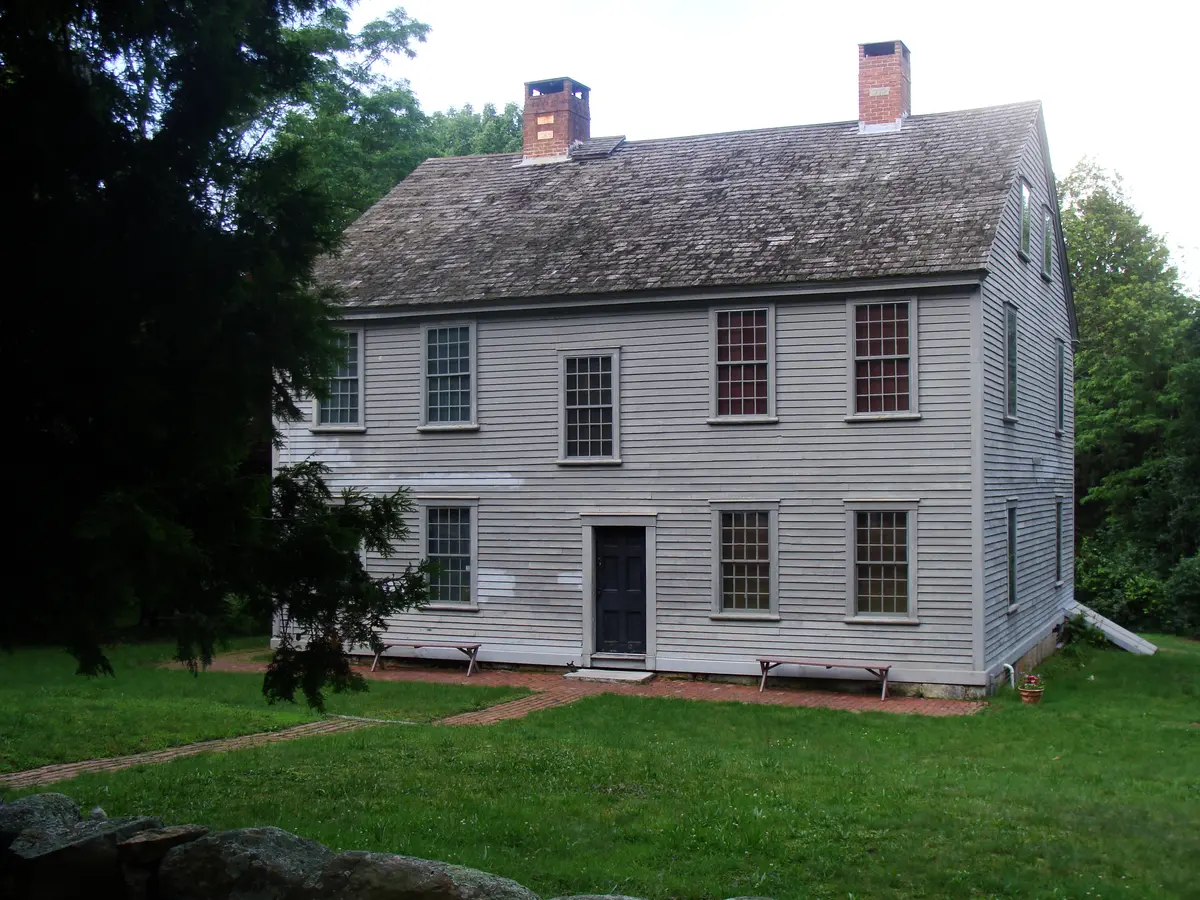
The house Nathanael Greene built at Coventry in 1770 and called Spell Hall is a National Historic Landmark, and its ghost story is neither old nor anonymous.
Where is General Nathanael Greene Homestead?
- Location
- Rhode Island, United States
- Type
- House / mansion
- Coordinates
- 41.694, -71.544
- Last updated
LOCATION
Why is General Nathanael Greene Homestead said to be haunted?
It went public on 20 June 2012, when the Warwick Beacon reported that the Homestead Association had agreed to let a paranormal group in after turning every previous request down. The candidate the house's own people name is not the general, who rode off to the war in April 1775 and died in Georgia in 1786. It is Elizabeth Margaret Greene, born in the house in November 1814 and dead there in December 1899, the last of the family to live in it: she married three times, and buried two husbands and three small daughters in the cemetery down the hill. Richard Seimbab, a docent of forty years, told the Beacon he had once found a baby carriage moved to the door of her room; volunteers describe door latches lifting and the smell of baking bread in an empty kitchen. The Association's own website, in some four thousand words, has never mentioned a ghost at all.
What is the history of General Nathanael Greene Homestead?
Nathanael Greene was born at Potowomut, in Warwick, on 27 July 1742, the son of a Quaker preacher of the same name who trained his boys as ironmasters. The family forge prospered enough to open a second works ten miles away, at Coventry, on the south branch of the Pawtuxet River, and by 1768 more than a hundred families were living around it. In 1770 Nathanael moved there to run the business and built himself a house on the hillside above the water, sheltered by woods to the west, with the land falling away in front of it as a terrace down to the river.
He called it Spell Hall. The name has nothing supernatural in it: Greene, who had almost no formal schooling and read compulsively, brought a teacher in for the children of the men at the forge and had them taught in his own house. David Procaccini, president of the Homestead Association, put it bluntly to Rhode Island Monthly in 2023 — everyone assumes the name is a ghost word, and it is a spelling word. The works itself made ship anchors and chains and employed something like a hundred men; Josh Wojnar, now the Association's vice president, told NBC 10 News in July 2026 that this, and not any battlefield, is where Greene learned the logistics that made him a general. A fire destroyed the Coventry forge in 1772. It was rebuilt, slowly, and today nothing of it survives above ground.
The rest happened fast. In 1773 a Quaker meeting expelled him for attending a military parade. In July 1774 he married Katharine Littlefield of Block Island — Caty — in her uncle William Greene's house on Division Street in Warwick, a Baptist elder officiating; she was nineteen and he was thirty-two. That October he helped organise the Kentish Guards, and his fellow members refused to let a man with a stiff knee serve as an officer, so he drilled in the ranks as a private. On the night of 19 April 1775 the news from Lexington reached Coventry, and he rode for East Greenwich and then Boston. In May the Rhode Island Assembly made him a brigadier of its Army of Observation; on 22 June 1775 Congress made him a brigadier general of the Continental Army. He was thirty-two and had been a private eight months earlier.
The house's own war is the part that matters here. In the first winter of the fighting, with smallpox raging in the American camp outside Boston, Caty Greene had convalescent soldiers brought back to Coventry and nursed at Spell Hall. Four of them died in the house. They are the four unmarked fieldstones in the cemetery down the hill.
Greene moved the family to Newport in the autumn of 1783 and sold the house to his brother Jacob; from Newport they went to Georgia, to the plantation at Mulberry Grove that the state had given him, and he died there of sunstroke in 1786, forty-four years old. Caty lived until 1814 and is buried on Cumberland Island. Neither of them ever came back to Coventry.
Jacob and his wife Margaret — Peggy — stayed, and so did the next two generations. Their daughter Margaret was the first burial in the family plot, on 7 March 1786, aged thirteen or fourteen depending on which of the two published lists you trust. Their son Jacob Varnum Greene had a daughter, Elizabeth Margaret, born in the house on 23 November 1814, who married three times, buried two of her husbands in the cemetery behind the house along with three of her small daughters, and died in the house on 4 December 1899 at the age of eighty-five years and eleven days. She was the last of the family to live there.
By then the place was worn out. It had been divided into apartments — six rooms were carved out of the attic — a fire had burned up to the second floor near the front door in the 1870s, and the entrance had been fitted with a bracketed Victorian hood. The property passed to the children of Elizabeth Margaret's first marriage and was sold out of the family in 1915; the barn was pulled down and the land subdivided. On 30 June 1919 four members of the Kent County chapter of the Rhode Island Sons of the American Revolution — Henry Greene Jackson, Herbert M. Clarke, Dr Frank B. Smith and Dr Benjamin Franklin Tefft — bought it from Adelard Loranger. There is a photograph of the four of them on signing day. What had been eighty-three acres was by then thirteen. They restored the house, put an eighteenth-century door back on the front, and opened it as a museum in 1924.
Charles W. Snell of the National Park Service wrote the nomination on 16 February 1972; the house was entered on the National Register on 7 October 1971 and declared a National Historic Landmark on 28 November 1972, and it was folded into the Anthony Village Historic District in 2010. A second major restoration in 1990 included a paint analysis that recovered the original eighteenth-century colours. One warning about dates: Snell's nomination says the house was built in 1774 on a two-thousand-acre tract and gives Greene's residence as 1774 to 1783, while the Association and the current Wikipedia article say 1770 — Wikipedia was corrected from one to the other on 8 July 2025 and still carries a category that says 1774.
Timeline: the documented record of General Nathanael Greene Homestead
- 1770 Nathanael Greene moves from Potowomut to Coventry to run the family's second iron forge and builds the house he calls Spell Hall, named for the school he set up in it for the forge workers' children.
- 1772 Fire destroys the Coventry forge. It is rebuilt slowly and nothing of it survives above ground today.
- 1773 A Quaker meeting expels Greene after he attends a military parade.
- July 1774 Greene marries Katharine Littlefield of Block Island in her uncle William Greene's house in Warwick; that October he helps organise the Kentish Guards and drills in the ranks as a private.
- 1775 With smallpox raging in the camp outside Boston, Caty Greene has convalescent soldiers brought to Spell Hall and nursed there. Four of them die in the house. On 22 June Congress makes Greene a brigadier general of the Continental Army.
- Autumn 1783 Greene moves his family to Newport and sells the Coventry house to his brother Jacob. The general never lives in it again.
- 7 March 1786 Margaret Greene, daughter of Jacob and Margaret, is the first burial in the family cemetery, aged thirteen or fourteen depending on the list consulted. Nathanael Greene dies of sunstroke at Mulberry Grove, Georgia, later the same year.
- 1814 Caty Greene dies at Dungeness, on Cumberland Island, on 2 September. Elizabeth Margaret Greene is born in the Coventry house on 23 November.
- 1859 A Providence Journal article identifies the four unmarked fieldstones in the cemetery as Revolutionary War soldiers who died of smallpox at the house. The interpretive panel that repeats the claim adds that no other documentation supports it.
- 4 December 1899 Elizabeth Margaret Greene dies in the house at eighty-five years and eleven days, the last of the family to live there. She had married three times and buried two husbands and three small daughters in the cemetery behind it.
- 30 June 1919 Four members of the Kent County chapter of the Rhode Island Sons of the American Revolution buy the run-down house from Adelard Loranger. It had been sold out of the family in 1915 and divided into apartments; the museum opens in 1924.
- 28 November 1972 The house is declared a National Historic Landmark on the nomination Charles W. Snell filed on 16 February. It had entered the National Register on 7 October 1971.
- 20 June 2012 The Warwick Beacon publishes the earliest substantial account of the haunting we have been able to date, built around a press release announcing that the Association has agreed to public paranormal investigations after refusing every previous request. Docent Richard Seimbab, forty years on the property, describes a baby carriage moved to the door of Elizabeth Margaret's room and says he has heard things but never seen anything.
- October 2023 Rhode Island Monthly runs the house in a Halloween feature, quoting Association president David Procaccini and trustee Josh Wojnar by name: rattling door latches when alcohol is brought in, the smell of baking bread, an older woman glimpsed in a bedroom mirror, and a thermal-camera apparition never published.
- 21 August 2024 An editor adds Category:Reportedly haunted locations in Rhode Island to the Wikipedia article in a fifty-eight-byte edit summarised only as "Add category", having created the category twelve minutes earlier and going on to apply it to fourteen more Rhode Island articles in the next thirty-four minutes. No source is added. The article's own text mentions no ghost anywhere.
- 19 May 2025 The New England Legends podcast devotes episode 707 to the house. Its blurb — phantom footsteps, the smell of smoke with no fire, shadows that move — is repeated almost word for word by the aggregator sites that list the place today.
Is there a rational explanation for General Nathanael Greene Homestead?
Start with the question nobody asks: why is this house on lists of haunted places at all? Its English Wikipedia article contains no ghost, no haunting, no apparition and no spirit anywhere in its text — zero occurrences in 6,735 bytes, with "Greene" appearing thirty-two times and "Coventry" nine as a control. The only paranormal thing in it is a category line at the bottom. That line was added at 23:59 on 21 August 2024 by an editor called Nayyn, in an edit of fifty-eight bytes whose entire summary was "Add category". Twelve minutes earlier the same editor had created the category itself, and over the following thirty-four minutes they applied it to fourteen more Rhode Island articles with the same three-word summary and the same fifty-eight bytes, at roughly one every two minutes. No source was added to any of them. Two days before that, the same editor had cited a Rhode Island Monthly listicle, "16 Real-Life Haunted Places in Rhode Island", in a different article; nine of the fifteen buildings they tagged are named in it.
So the label is worth nothing. What is underneath it, however, is worth quite a lot, because unlike most such places this one can be dated almost to the day.
The Warwick Beacon of 20 June 2012 is the earliest substantial published account we have been able to find, and it opens by quoting a press release: RISEUP Paranormal announced a series of public investigations at the Homestead, adding that the house "has always been a much-sought after location for paranormal investigators all over the Northeast" and that "to date, all requests have been denied … until now." That sentence dates the business exactly. Whatever volunteers had been saying among themselves, the ghost of Spell Hall became a public, visitable thing in June 2012, when the Association stopped saying no. Eleven years later Rhode Island Monthly ran the house in a Halloween feature; in May 2025 the New England Legends podcast devoted episode 707 to it; and RTS Paranormal has advertised a night investigation there, listed at thirty-six dollars a head, though no dates are currently scheduled.
The Association itself says nothing. Its website runs to about four thousand words of history, genealogy, cemetery records and opening hours, and the words ghost, haunted, apparition, spirit, paranormal and Halloween appear in it exactly zero times; the same search on archived copies from 2015, 2019, 2022 and 2025 returns zero every time, with "Greene" running between sixty-eight and eighty-seven occurrences as a control. When NBC 10 News filmed at the house on 30 July 2026, Josh Wojnar talked about anchor chains and logistics and not about ghosts — the same man who three years earlier had described a thermal-imaging apparition to Rhode Island Monthly. That footage has never been published, and as of August 2026 no recording of it is publicly available. This is not a contradiction to catch anybody out in; it is simply how the house works. The institution keeps its own counsel and its people talk when a reporter asks about ghosts.
The interpretive marker at the cemetery is more sceptical than anything we could write. Having repeated the claim that a Providence Journal article of 1859 identified the four fieldstones as Revolutionary soldiers who died of smallpox at the house, it adds, in its own text: "There is no other documentation to substantiate this claim." An institution that puts that sentence on a sign is not selling anything.
And there is one substitution worth naming. The story as told to Rhode Island Monthly includes two little girls "said to have died on the property", of whom the Association "doesn't have many details", thought to be aged between seven and ten and the children of workers, buried in an unmarked plot next to the family cemetery. Seven children are buried in the marked plot, with names and dates: Margaret Greene in 1786; Elizabeth C. Randall in 1810, aged six; Samuel Randall in 1813, aged one; Gilbert Smith in 1821, aged eleven days; and Almy Cooper Arnold in 1848, Emma Jane Arnold in 1857 and Lavina Arnold in 1859, the first two at about six months and the third at fourteen — all three daughters of Elizabeth Margaret. The anonymous girls of the legend stand where a documented list of dead children already stood.
The conventional explanations apply as they always do. A wood-frame house of 1770 with panelled fireplace walls, no heating and no one living in it moves and settles; iron thumb latches on interior doors lift with a change of pressure when a door somewhere else in the house opens; and the smell of baking bread — reported at Christmas in the Beacon piece in 2012 and again to Rhode Island Monthly in 2023 — is the one detail in the whole file that has stayed constant for eleven years and has never been shown to come from inside the building. Richard Seimbab, the docent who gave the Beacon its best material after forty years on the property, was careful to say that he had heard things and never seen anything, and that the Coventry Greenes were undone by bad luck and bad business rather than by murder or madness: none of the usual motives for a haunting, as he put it, are present here.
Can you visit General Nathanael Greene Homestead?
Spell Hall is a house museum at 50 Taft Street, Coventry, Rhode Island 02816. It opened to visitors in 1924 and is run by the General Nathanael Greene Homestead Association. The telephone is (401) 821-8630 and it takes messages; the association also asks for email.
Its website on 9 September 2026 announced a 2026 season opening on Saturday 11 April, with hours of 10am to 5pm on Thursday to Monday. Admission was posted at $12 for adults and $6 for children. Tour groups of ten or more booked in advance pay $10 and $5. The closing date is the one thing the site cannot keep straight: the front page said the season runs "until October 31st" while the Visit Us panel a screen below said "starting April 6th until October 27th". Members of the association are given unlimited free tours.
That website is served properly only over unencrypted http. Over https the domain answered on 9 September 2026 with a certificate issued to hellogreedo.com, a Star Wars fan site, valid from 15 December 2020 to 15 December 2021, which every current browser rejects.
The grounds are what is left of the farm. The association's appeal for the rebuilt colonial barn puts them at "the remaining 11 acres of the original Homestead", down from 83 acres at the start and from the 13 acres bought in 1919; the barn appeal stands at $75,000. The family cemetery lies down the hill behind the house, its first burial Margaret Greene in 1786. Beside the seventeen identified graves are four fieldstones which the association traces to an 1859 Providence Journal article naming them as Revolutionary War soldiers nursed for smallpox at the homestead, where they died. The Historical Marker Database transcribed the interpretive panel there as marker 83400.
Nothing paranormal was advertised on the association's own site on 9 September 2026.
Sources consulted
- Charles W. Snell, «National Register of Historic Places Inventory-Nomination: Gen. Nathanel Greene Homestead» — National Park Service, Division of History, 1972 report
- Joe Kernan, «Greene homestead's mysteries explored» — Warwick Beacon, 2012 newspaper archive
- Kaitlyn Murray, «16 Real-Life Haunted Places in Rhode Island» — Rhode Island Monthly, 2024 newspaper archive
- Nathanael Greene Homestead Association, «Major General Nathanael Greene Homestead: history, homestead cemetery and visitor information» — nathanaelgreenehomestead.org, 2026 web
- Bill Coughlin (transcription), «The Nathanael Greene Homestead Cemetery (interpretive marker, transcribed and photographed on site)» — The Historical Marker Database, marker 83400, 2015 archive
- Abbey Buttacavoli, «Nathanael Greene Homestead preserves the legacy of Rhode Island's Revolutionary War hero» — NBC 10 News (WJAR), 2026 newspaper archive
- Jeff Belanger and Ray Auger, «Haunting of the Nathanael Greene Homestead (episode 707)» — New England Legends podcast, 2025 interview
- Natalie D. Saba, «Nathanael Greene (1742-1786)» — New Georgia Encyclopedia, 2018 academic
- English Wikipedia revision history, «Revision 1241577133: the edit that added Category:Reportedly haunted locations in Rhode Island» — Wikipedia, 2024 archive
Reviewed by V. Serrano on 2026-08-20 · How we verify our content
💬 Field testimonies (0)
No testimonies yet. Add the first.
Add your testimony
🔒 Log in to add a testimony