👻 HAUNTED PLACE · EXP. Nº9478
ACTIVE
Gracie Mansion
Two houses have stood on this bluff over Hell Gate. The first, Jacob Walton's Belview, was seized by Washington's troops in 1776, fortified, and burned down that September by a British shell.
Where is Gracie Mansion?
- Location
- New York, United States
- Type
- House / mansion
- Coordinates
- 40.776, -73.943
- Last updated
LOCATION
Why is Gracie Mansion said to be haunted?
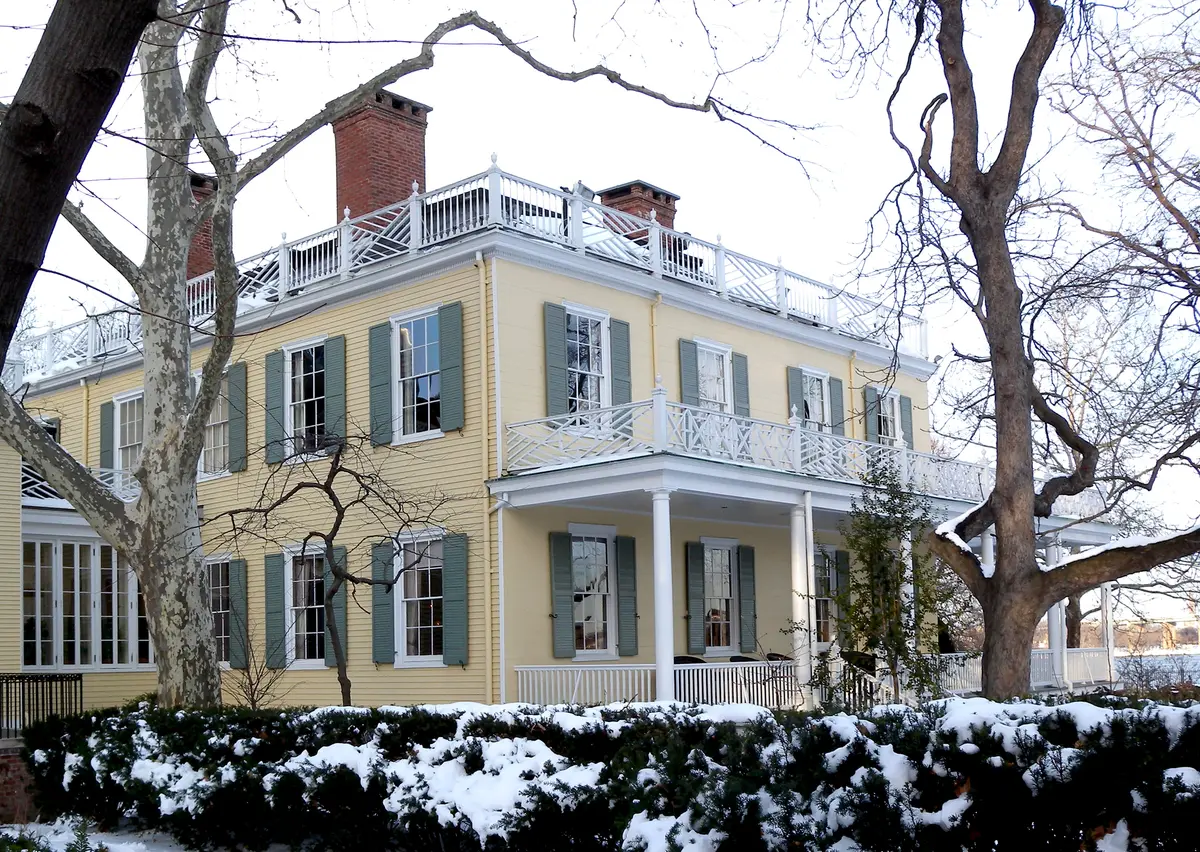
The second is the one you see: the country seat the shipping merchant Archibald Gracie built in 1799 on the ruins, lost to the War of 1812, and which after decades as a park concession, a museum and a WPA restoration became in 1942 the official residence of New York City's mayors. Its ghost story, unusually, can be dated. In 2017 first lady Chirlane McCray told Metro that doors opened by themselves and that she had heard whispers from Archibald Gracie's daughter; from 2022 Mayor Eric Adams told anyone who asked there were ghosts in the house. When the New York Post went looking for the tradition behind the claims, historians, ghost hunters and former staff said they had never heard of one. The woman usually named as the ghost, Elizabeth Stoughton Wolcott, died here in 1819 — as Gracie's daughter-in-law, not his daughter.
What is the history of Gracie Mansion?
The house New Yorkers call Gracie Mansion is the second one to stand on this bluff. The first was burned down by a British shell.
The promontory was known as Hoorn's Hook, after the Dutch town of Hoorn, and the land around it was granted to the settler Sybout Claessan in 1646. In 1770 the Walton family bought roughly eleven acres of it. Jacob Walton, a merchant and a British Loyalist, built a large house there for his wife Polly and their children and called it Belview; anticipating trouble between Loyalists and Patriots, he had tunnels dug from the cellar down toward the East River as an escape route. The Waltons never used them. In early 1776 George Washington's troops appropriated the house and fortified the bluff, mounting a battery above the channel where the East River narrows into Hell Gate. That September, after days of exchanged fire with British positions across the water, the house inside the fort was set alight by a British shell and burned down — the Landmarks Preservation Commission's 1966 designation report quotes a contemporary account to exactly that effect. British troops held the site until 1783. Belview was never rebuilt, and a Revolutionary War cannonball dug out of the grounds during a 1980s excavation is still shown to visitors.
Archibald Gracie, a Scottish-born shipping merchant who had landed in New York from Liverpool in 1784 and become one of the city's richest men, bought the land back from the Walton heirs in two parcels in December 1798 and January 1799, paying $5,625 for the eleven acres. He levelled what was left of the earthworks and built his country seat. The Conservancy's own teaching materials say he built on the Walton foundation, and preservationists have argued ever since about how much of Belview survives inside the present walls. Between 1805 and 1810 Gracie enlarged the house and turned its entrance around to face Hell Gate, which is why the front door now looks at the water. He entertained lavishly: Alexander Hamilton, the future French king Louis Philippe, John Quincy Adams, Governor DeWitt Clinton and Washington Irving all passed through. In 1801 Gracie was among the founders of the New-York Evening Post.
Then he lost it. Jefferson's Embargo Act of 1807 and the War of 1812 ruined a fortune built on open ports; in 1819 he wound up his business interests, and in 1823 the family signed the house over to Rufus King, who sold it on to the Foulkes. Noah Wheaton bought it in 1857 for $25,000. When Wheaton died in 1896 the Parks Department appropriated the estate and folded it into the park later renamed for Carl Schurz. For the next quarter century the finest Federal country seat left on Manhattan served as a park concession: an ice-cream stand, storerooms, classrooms and a public toilet.
Its rescue came in stages. From 1923 to 1932 the house was the first home of the Museum of the City of New York. From 1934 the parks commissioner Robert Moses had Works Progress Administration crews rebuild it, and in 1942 — Moses's idea, not the mayor's — Fiorello La Guardia and his wife Marie moved in, making it the mayoral residence it has been ever since. The Susan E. Wagner reception wing was added in 1966, the same year the Landmarks Preservation Commission designated the original house a New York City landmark; the National Register of Historic Places followed in 1975.
Timeline: the documented record of Gracie Mansion
- 1770 Jacob Walton, a merchant and British Loyalist, buys about eleven acres at Hoorn's Hook and builds a house he calls Belview for his wife Polly and their children. He has escape tunnels dug from the cellar toward the East River; the family never uses them.
- February–September 1776 George Washington's troops appropriate the Walton house and fortify the bluff. In September, after days of exchanged fire with British positions across the channel, the house inside the fort is set on fire by a British shell and burns down. The Landmarks Preservation Commission's designation report quotes the contemporary account verbatim. Belview is never rebuilt.
- December 1798 – 1799 The shipping merchant Archibald Gracie buys the land back from the Walton heirs in two parcels for $5,625, razes the remains of the fort and builds the country seat that still stands. The Conservancy's own teaching materials say he built on the Walton foundation.
- 24 June 1819 Elizabeth Stoughton Wolcott Gracie — daughter of Connecticut governor Oliver Wolcott Jr. and wife of Archibald Gracie's son William — dies suddenly of apoplexy at the house, aged twenty-four. The Litchfield Historical Society dates the death from the Litchfield Republican of 1 July 1819 and rejects a rival legend that she died hours after her wedding: she had been married six years.
- 1896 Noah Wheaton, the last private owner, dies, and the Parks Department appropriates the estate for the park later renamed after Carl Schurz. For the next quarter century the house serves as a concession stand, storeroom, classroom and public toilet.
- 1923–1932 Gracie Mansion serves as the first home of the Museum of the City of New York, until the museum outgrows it and moves to its new Fifth Avenue building.
- 1942 At the urging of parks commissioner Robert Moses, Gracie Mansion becomes the official residence of the mayor of New York City. Fiorello La Guardia moves in with his wife Marie — the first mayor to live there.
- 20 September 1966 The Landmarks Preservation Commission designates the original house a New York City landmark (LP-0179), calling it the only one of Manhattan's original country seats still occupied as a home. The Susan E. Wagner reception wing opens the same month. The National Register of Historic Places follows in 1975; Gracie Mansion is not a National Historic Landmark.
- 2017 First lady Chirlane McCray tells Metro that doors open and close by themselves and the floorboards creak as though someone were walking through the rooms, and says she has heard whispers from Archibald Gracie's daughter, adding that she has never seen her. It is the earliest first-hand claim of a haunting the record shows.
- 11 May 2022 After Mayor Eric Adams tells Yankees broadcasters there are ghosts in the house, the New York Post canvasses historians, ghost hunters and former employees and finds no one who knows of any haunting tradition. Anna Maria Santorelli, chef and event manager under Dinkins, Giuliani and Bloomberg, dismisses the idea outright.
- 28 April 2023 Adams tells Marcia Kramer on CBS2's The Point: "People think I'm joking, but there's a ghost that runs around here", and describes hearing squeaks and doors closing as he walks the house at night, framing it as "an energy that you feel in here".
- 12 January 2026 Mayor Zohran Mamdani moves into Gracie Mansion. Asked about the ghost stories that had followed his predecessor out of the door, he says he has not met them yet.
Is there a rational explanation for Gracie Mansion?
Gracie Mansion has a ghost story, but it is a young one, and almost every strand of it can be traced back to two named people.
When Mayor Eric Adams began telling reporters the house was haunted, the New York Post went looking for the tradition behind the claim and did not find one. Its report of 11 May 2022 opened by noting that a haunted Gracie Mansion "would be news to historians, ghost hunters and former employees who spoke to The Post". Among them was Anna Maria Santorelli, who had worked at the house as chef and event manager under David Dinkins, Rudolph Giuliani and Michael Bloomberg; she flatly denied ever hearing such a story during her years there. For a building that has been photographed, surveyed, restored, written about and lived in by mayors since 1942, that is a striking silence. There is no nineteenth- or twentieth-century press tradition of a Gracie Mansion haunting to point to.
What there is, is recent and attributable. In 2017 the first lady Chirlane McCray told Metro that doors opened and closed by themselves and the floorboards creaked as though someone were walking through the rooms, and said she had heard whispers from Archibald Gracie's daughter — though she added that she had never seen her. From May 2022 Adams repeated and expanded the claim.
The identification does not survive checking. The woman usually named as the ghost is Elizabeth Stoughton Wolcott, and she was not Archibald Gracie's daughter but his daughter-in-law, married to his son William. The record kept by the Litchfield Historical Society, drawn from the Litchfield Republican of 1 July 1819, has her dying suddenly of apoplexy at the Gracie house on 24 June 1819, aged twenty-four. That record also flags — and rejects — a separate legend that she died within hours of her wedding: she had been married six years. A ghost story whose central figure is misidentified in the telling is a story travelling by repetition rather than by testimony.
The prosaic explanations are the ones the house itself supplies. This is a timber-framed clapboard building begun in 1799, enlarged twice before 1811, gutted and re-floored by WPA crews in the 1930s and restored again in the 1980s and in 2002. Wooden floors in a two-hundred-year-old frame house move, settle and creak; doors in reworked frames swing; and the mansion sits on an exposed bluff above Hell Gate, one of the windiest points in Manhattan, a few metres above a buried section of the FDR Drive. Nobody needs a ghost to explain a door closing at night.
The most recent occupant offers the cleanest control. Mayor Zohran Mamdani moved in on 12 January 2026 and, asked about the stories, said he had not met the ghosts or heard from them.
Can you visit Gracie Mansion?
Gracie Mansion is the working official residence of the mayor of New York City. Mayor Zohran Mamdani and his family moved in on 12 January 2026, and on 22 September 2026 the Conservancy's Experience page still opened with a single line in capitals: "ALL TOURS HAVE BEEN PAUSED UNTIL FURTHER NOTICE, AS WE TAKE TIME TO WELCOME THE NEW ADMINISTRATION AND PLAN OUR NEXT ERA OF PROGRAMMING HERE AT THE CONSERVANCY." The home page carries the same notice in lower case, and the words "ALL TOURS HAVE BEEN PAUSED" are printed again above every individual listing.
The house sits on the bluff over Hell Gate inside Carl Schurz Park, at East End Avenue and 88th Street in Yorkville. The Conservancy prints its address in the footer of every page: 181 East End Avenue, New York, NY 10128, telephone (212) 570-4751, [email protected]. The coordinate on this file, 40.7761 N and 73.9431 W, falls on the building itself; a reverse lookup against OpenStreetMap on 22 September 2026 returned "Gracie Mansion, 181, East End Avenue, Yorkville, Manhattan", with the postcode 10028 where the Conservancy writes 10128. The park is city parkland and takes no ticket. Its esplanade runs along the top of the bluff, directly over the covered stretch of the FDR Drive, and faces the water Archibald Gracie turned his front door towards. The Q stops at 86th Street a few blocks west; the Lexington Avenue 4/5/6 stop at their own 86th Street further west again; the M86 crosstown bus ends at East End Avenue.
The programme that is paused reads, in the Conservancy's own listing, like this. Public tours on select Mondays at 10:30 and 12:00, $10 an attendee, "contingent on house availability and closed on Federal Holidays". Group tours only on Wednesdays at the same two times, $25 a person, minimum ten people. School tours on Wednesdays at 10:30 and 12:00; special tours "reserved for Saturdays". Every listing repeats the same two conditions: "Tours are for ages 10+ (due to the educational curriculum and safety requirements)" and "ID is required for entry". The tea tour lasts two hours, an hour of docent-led house followed by an hour sitting down, at $115 a person; $105 for seniors; a floor of ten people; a ceiling of fifty; a reservation a month in advance. What is served is described as "sweet and savory vegan bites paired with Gracie Mansion proprietary tea". The room that holds it has a date of its own. The Susan E. Wagner Wing was added in 1966 to give the house space for large public functions, and Susan Wagner raised the money for it after concluding that Gracie Mansion belonged to the residents of New York City.
Sources consulted
- New York City Landmarks Preservation Commission, «Gracie Mansion — Landmark Designation Report, LP-0179» — City of New York, 1966 report
- Gracie Mansion Conservancy, «A Visit to Gracie Mansion, the People's House — A Resource Guide for Teachers and Docents» — City of New York report
- Litchfield Historical Society, «Elizabeth Wolcott Gracie — The Litchfield Ledger» — Litchfield Historical Society, 1819 archive
- Marcia Kramer, «Is Gracie Mansion haunted? Mayor Eric Adams tells CBS2 "there's an energy"» — CBS New York, 2023 interview
- «Is Gracie Mansion haunted? Mayor Adams says 'there's ghosts in there'» — New York Post, 2022 newspaper archive
- «Mayor Adams Thinks Gracie Mansion is Haunted» — East Side Feed, 2022 newspaper archive
- «Mayor Mamdani moves into Gracie Mansion, promising public access — along with bidets and a cat» — amNewYork, 2026 newspaper archive
- Gracie Mansion Conservancy, «History» — graciemansion.org web
- Gracie Mansion Conservancy, «Experience — public, group, school and tea tours» — graciemansion.org web
Reviewed by V. Serrano on 2026-08-11 · How we verify our content
💬 Field testimonies (0)
No testimonies yet. Add the first.
Add your testimony
🔒 Log in to add a testimony