👻 HAUNTED PLACE · EXP. Nº9477
ACTIVE
Heady Cemetery
Heady Cemetery is a fenced square of grass on a residential street in Fishers, Indiana, with about a hundred graves in it: the Heady family and the neighbours who settled Delaware Township with them from 1825 onwards.
Where is Heady Cemetery?
- Location
- Indiana, United States
- Type
- Cemetery
- Coordinates
- 39.964, -86.033
- Last updated
LOCATION
Why is Heady Cemetery said to be haunted?
The legend attached to it belongs to the wooded dip half a mile away, known locally as Heady Hollow, where Allisonville Road drops to its lowest point and fogs. Three stories are told there — a district schoolhouse that burned with children inside, robbers who ambushed travellers on the Noblesville–Indianapolis road, and Ebenezer Heady, a grave-robber said to have sold cadavers until the night he dug up his own son. The school was real: it is drawn on the 1866 surveyor's map of the township, on the north-east corner of the crossroads. The fire is not in either county history, which record school fires elsewhere; what those books record here is consolidation, ten district schools falling to two by 1915. Ebenezer leaves no trace in the Library of Congress's digitised newspapers. The stones, meanwhile, hold real children who died in clusters in 1854, 1864 and 1866 — and nobody tells their story.
What is the history of Heady Cemetery?
Nothing could have been buried on this ground in 1812, because in 1812 there was nobody here to do the burying. The land belonged to the Lenape, and the county history published in 1880 records that their village on the White River was burned during the War of 1812; the charred remains of the houses were still the only mark of the site when the first white family arrived in 1818. That family, the Shirts, came from Connersville on pack horses. The wife died shortly after they got here and was buried by the Delaware in their own burying ground, in a coffin of puncheons the Delaware made for her. She was, the 1880 history says, the first white person buried in Hamilton County.
The county commissioners first met on Monday 12 May 1823, at William Conner's house, and one of their first acts was to cut the county into two townships, Delaware and White River. Abraham Williams entered land in Delaware Township in October 1825. "The next settler after Mr. Williams was James Heady, who came later in the same year."
James Heady was born in 1775. The community transcription of this burying ground records his death in 1827, which makes him the earliest death anyone has recorded on the site — two years after he arrived, and six years before the ground has any second date. Dorothy Heady appears on the township's roll of pioneers in September 1827, and in 1829 a Methodist preacher named Ray held the township's first religious services in her house; both the 1880 and the 1915 county histories say so. Mark Heady followed on 18 July 1833, Vincent Heady on 22 November 1834, their neighbour David Redwine in December 1833. Redwines, Ellers, Tuckers, Castetters, Wises and Roberts are all on the stones here, and all on that roll.
By 1866 the family held land across four sections. The surveyor's map of Delaware Township for that year — still published by the Hamilton County Surveyor's Office — shows M., F. M., N., J., A. H., A. J., T. and C. W. Heady as landowners around the crossroads that is now 126th Street and Allisonville Road, and a small black square on the north-east corner of it labelled School No 2.
The burying ground itself is smaller than its legend. Hamilton County's own cemetery register lists it simply as "Heady", county number 85, state survey number CR-29-67, on Heady Lane in the south-east quarter of the south-east quarter of the north-east quarter of Section 35, Township 18 North, Range 4 East. The columns for year established, first burial, last burial and number of stones are all blank. Roughly a hundred graves have been transcribed, and they read as the record of a rural nineteenth century: Jacob Heady, five, and Martha Heady, one, both dated 3 May 1854; Manda Heady, six, and Thomas Heady, thirty-seven, both dated 10 November 1854; Anna Heady Brandom and John W. Heady both on 6 February 1864; four deaths between 9 February and 7 March 1866, two of them the Reinier children, Ruth and David. The record does not say what killed any of them.
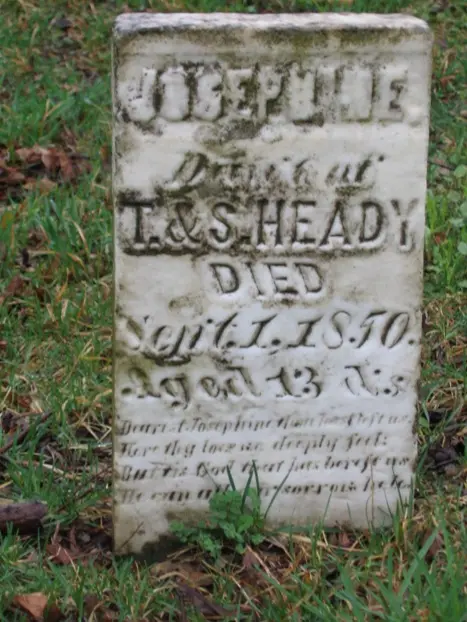
The photograph of this place that circulates online is a single stone: JOSEPHINE, daughter of T. & S. Heady, died 1 September 1850, with four lines cut underneath — "Dearest Josephine thou hast left us, / Here thy loss we deeply feel; / But 'tis God that has bereft us, / He can all our sorrows heal." The line giving her age is worn and the abbreviation is no longer legible in the only published photograph; the transcription records her born and dead in the same year. The subdivision called Sunblest grew around the plot in the twentieth century, and it is now a fenced square of grass between private houses.
Timeline: the documented record of Heady Cemetery
- 1812 The Lenape village on the White River is burned during the War of 1812. Its charred houses are still the only mark of the site when white settlers arrive six years later; this is the only fire the 1880 county history attaches to Delaware Township.
- 1818 The Shirts family, the first white settlers in what becomes Hamilton County, arrive from Connersville. The wife dies soon after and the Delaware bury her in their own ground, in a puncheon coffin they make for her — the first white burial recorded in the county, and not at Heady.
- 12 May 1823 The Hamilton County commissioners hold their first session at William Conner's house and divide the county into two townships, Delaware and White River.
- Late 1825 James Heady, born 1775, settles in Delaware Township immediately after Abraham Williams. The 1880 county history names him as the next settler after Williams, who entered his land in October of that year.
- 1827 James Heady dies, two years after arriving. The community transcription of the burying ground records no earlier death; no stone photograph exists for his grave.
- 1829 A Methodist preacher named Ray holds the township's first religious services at the house of Mrs Dorothy Heady, on the east side of the river. Both the 1880 and the 1915 county histories record it.
- 1 September 1850 Josephine, daughter of T. and S. Heady, dies. Her stone — the one photograph of this cemetery that circulates online — carries the verse "Dearest Josephine thou hast left us, / Here thy loss we deeply feel". The line giving her age is now illegible.
- 1854 Five burials are recorded in a single year, twice in pairs on the same day: Jacob Heady, five, and Martha Heady, one, on 3 May; Manda Heady, six, and Thomas Heady, thirty-seven, on 10 November; Martha J. Heady, two, on 14 November. The record does not say what killed them.
- 1866 The Delaware Township surveyor's map is drawn. It shows Delaware Township School No 2 on the north-east corner of what is now 126th Street and Allisonville Road, with Heady land on every side. The same February and March, four more burials are recorded here, including the Reinier children Ruth and David.
- 1915 The second county history records what became of the district schools: "At one time there were ten district schools in the township. At present there are only two district schools and only one one-roomed building." The rest of the children now go to the graded schools at Carmel and Fishers.
- 1979 Georgianne Neal publishes a feature on the hollow in the Noblesville Ledger, calling it "a strange blend of fact and folklore". This is the earliest telling of the legend that can be dated; Conner Prairie's historian keeps it in a clippings file.
- 28 January 2005 Dan McFeely reports the legend for the Indianapolis Star, interviewing the owners of the house on the corner and Conner Prairie historian Tim Crumrin, and noting that Ebenezer Heady's existence "has not been proved by census records".
- 4 October 2021 Wikipedia removes the claim, added in October 2008, that the Hamilton County Historical Society had no record of a school at the site. The edit summary reads: "Book has been revised and now acknowledges the schoolhouse".
Is there a rational explanation for Heady Cemetery?
The legend of Heady Hollow comes in three versions, and the county's own records answer two of them.
The first is the burned schoolhouse full of children. The school existed: the 1866 surveyor's map of Delaware Township, which the Hamilton County Surveyor's Office still publishes, draws School No 2 on the north-east corner of the crossroads, where the story puts it. The fire is another matter. The 1880 county history devotes a long chapter to Delaware Township — the first school taught in the winter of 1830 in a cabin on Abraham Williams's farm, a schoolhouse built in 1832 under a Mr Lynch, the Farley schoolhouse in 1837, Joseph Gore teaching in a cabin on George Wise's land in 1838, ten school districts by 1880 — and in the Internet Archive's text of that chapter, about fifty thousand characters with its biographical sketches, the word "burn" appears once, for the Lenape village in 1812, while "school" appears about a dozen times, so the book is legible and it is talking about schools. The 1915 county history records school buildings burning elsewhere in the county: the high school at Westfield in January 1904, and a log-cabin school north of the site of Bethel church that burned "during the second term of school". What it records for Delaware Township is consolidation: "At one time there were ten district schools in the township. At present there are only two district schools and only one one-roomed building." It gives the township's district schools that end, and no other.
The second version is Ebenezer Heady, the resurrectionist who is said to have sold cadavers to medical schools until he dug up his own son. Georgianne Neal's 1979 telling already gave him "dark, nocturnal journeys . . . his grisly cadavers . . . his creaking cart". In a search of Chronicling America, the Library of Congress's digitised newspaper corpus, in August 2026, the phrase "Ebenezer Heady" returned zero hits; the control, "Mark Heady", a real man buried here, returned 26. He is also absent from the hundred-odd transcribed graves, where a dozen other Headys are present. The Indianapolis Star said as much in 2005: Ebenezer's "actual existence has not been proved by census records".
The third version, the roadside robbers who ambushed travellers between Noblesville and Indianapolis, cannot be checked against any record. In the oldest dated telling the ghosts are the robbers' victims, whose "cries, it is said, can still be heard on the passing wind", as Neal wrote.
That telling is the feature Neal published in the Noblesville Ledger in 1979, which the Conner Prairie historian Tim Crumrin keeps in a file of old clippings, according to the Star; it already called the hollow "a strange blend of fact and folklore", a century and a half after the Headys arrived. The name itself left no trace in the same August 2026 search of Chronicling America: "Heady Hollow" returned zero hits in Indiana newspapers, against 501 for Heady plus Fishers plus Indiana, and two hits nationwide, one in Pennsylvania in 1863 and one in New Jersey in 1925. Chronicling America does not include the Noblesville Ledger, where the 1979 feature appeared.
The setting supplies the rest. Allisonville Road dips to its lowest point at this crossroads, over a stream, in a wooded stretch that the Star described in 2005 as "an area prone to fog and spooky scenes".
Can you visit Heady Cemetery?
Heady Cemetery is a small fenced plot on Heady Lane, in the Sunblest subdivision of Fishers, Indiana 46038, with private houses on every side of it. The Hamilton County Cemetery List and Legend carries it as entry 85, SHAARD number CR-29-67, in Delaware Township. The coordinates on that list are 39.9647 N, 86.0331 W, in the SE quarter of the SE quarter of the NE quarter of Section 35, Township 18 North, Range 4 East. Several neighbouring entries in the same list carry the note "Destroyed"; this one does not. Find a Grave holds 103 memorials for the ground.
The plot has neither a car park nor a path nor lighting, and no opening time is posted anywhere on it, because the ground is a burial place that a neighbourhood was built around. Indiana's Division of Historic Preservation and Archaeology states on its cemetery law page that a landowner is not required to give public access to a cemetery on private land, and that the rules for a public cemetery are set by whichever body maintains it. Damaging a cemetery is prosecuted as criminal mischief under IC 35-43. Under IC 14-21-1-28 it is unlawful to disturb the ground to find or remove grave markers without a plan approved by the division; the same provision covers burial objects and human remains, and probing for fallen stones requires a state licence.
The body that looks after the plot is the Hamilton County Cemetery Commission. Created in 1976 under IC 23-14-67, it is five volunteers appointed by the county commissioners to staggered five-year terms, one appointment a year. Its remit, in the county's own wording, is "neglected pioneer cemeteries established before 1850 whose care and maintenance are not otherwise funded". It meets on the fourth Wednesday of the month from March to October. On 9 September 2026 the county listed Chris Renner as president, on (317) 508-2583; Dottie Young as vice-president; Robert Goode as treasurer; Nancy Massey as secretary.
The point that ghost-hunting sites actually send people to is a different one: the junction of 126th Street and Allisonville Road, a signalised crossroads on a busy road. The house on its south-east corner was a family home when the Indianapolis Star wrote about the legend in 2005.
Sources consulted
- Thomas B. Helm (ed.), «History of Hamilton County, Indiana: with illustrations and biographical sketches of some of its prominent men and pioneers» — Kingman Brothers, Chicago, 1880 book
- John F. Haines, «History of Hamilton County, Indiana» — B. F. Bowen & Company, Indianapolis, 1915 book
- Hamilton County Surveyor's Office, «Delaware Township, 1866 (surveyor's map showing Delaware Township School No 2)» — Hamilton County, Indiana — Document Center, 1866 archive
- Dan McFeely, «Heady Hollow is haunt for spirits» — The Indianapolis Star (archived reprint, proofparanormal.com), 2005 newspaper archive
- Find a Grave contributors, «Heady Cemetery, Fishers, Hamilton County, Indiana — memorial index (103 records)» — Find a Grave, 2026 web
- Hamilton County Cemetery Commission, «Hamilton County Cemetery List and Legend (entry 85, Heady, SHAARD CR-29-67)» — Hamilton County, Indiana, 2026 report
- Division of Historic Preservation & Archaeology, «Cemetery Laws & FAQs» — Indiana Department of Natural Resources, 2026 web
- Wikipedia contributors, «Heady Lane Cemetery — revision history (revisions 246581807 of 20 Oct 2008 and 1048215168 of 4 Oct 2021)» — English Wikipedia, 2026 archive
- Library of Congress, «Search results for "Heady Hollow", "Ebenezer Heady" and "Mark Heady"» — Chronicling America: Historic American Newspapers, 2026 archive
Reviewed by V. Serrano on 2026-08-12 · How we verify our content
💬 Field testimonies (0)
No testimonies yet. Add the first.
Add your testimony
🔒 Log in to add a testimony