👻 HAUNTED PLACE · EXP. Nº9476
ACTIVE
Littleport
Littleport is a fen-edge town four miles north of Ely, and its ghost lore grew out of a riot and a public hanging.
Where is Littleport?
- Location
- Cambridgeshire, United Kingdom
- Type
- Village / settlement
- Coordinates
- 52.457, 0.305
- Last updated
LOCATION
Why is Littleport said to be haunted?
In May 1816, with the Napoleonic wars over and the harvest ruined by the summerless year that followed Tambora's eruption, labourers and discharged soldiers met at the Globe on Main Street, mounted two punt guns on a waggon and marched on Ely. The rising lasted three days. Twenty-three men and one woman were condemned to death, and five men were hanged outside Ely on 28 June 1816, then buried the next day in a single grave at St Mary's, Ely, beneath a tablet that names all five and ends "May their awful fate be a warning to others!" The town's history society records two ghosts tied to those days: a dragoon said to walk the riverbank, and whispering rioters' voices in Granby Street.
What is the history of Littleport?
The Littleport riot began in a pub and ended on a scaffold, and almost everything about it was written down at the time.
By the spring of 1816 the fen town was living on the wrong side of two disasters. The Napoleonic wars had ended the previous year and discharged soldiers were coming home to no work, while the eruption of Tambora had produced the summerless year that ruined the harvest and left grain so scarce that bread rose to what the Society calls "exorbitant prices". The Littleport Society, the town's own history society, sets out that chain plainly: a nineteenth-century cost-of-living crisis landing on a village of poor agricultural labourers.
On the evening of 22 May 1816 a group met at the Globe, a public house on Main Street, and decided to take their case to Henry Martin, a local landowner and employer. Martin was not at home. His grandmother Rebecca Waddelow, who kept the village shop, and her visitor Mary Cutlack were robbed instead. The Reverend John Vachell, vicar of St George's and also a magistrate, read the 1714 Riot Act to the crowd; the rioter Isaac Harley, carrying a pistol, threatened to shoot him. The vicarage was ransacked and the Vachell family walked the five miles to Ely in the dark.
Alfred Kingston, who wrote his account in 1901 with the calendar of prisoners open on his desk, describes what Littleport did next with unusual precision. A man named Walker carried a long pole with "some printed stuff on the end of it, like a flag". Behind him came a hundred to a hundred and fifty people with pitchforks, crowbars, a butcher's cleaver and clubs. Frightened householders stitched banknotes into their children's clothes and sent them out to hide in the orchards and hemp-fields. Overnight the town looted its own gunpowder, mounted two long punt guns — the eight-foot fowling pieces of the fens — on a waggon, put the women in behind them, and at first light marched on Ely with the cathedral towers five miles ahead.
Three-quarters of a mile outside Ely two clerical magistrates met the column and heard its terms — "Wages at 2s. a day, flour at 2s. 6d. a stone" — and promised that the overseers would examine them; the crowd went in regardless, and the looting began with £50 levied on a miller's wife. A mounted messenger had already ridden to Bury St Edmunds. Kingston says the commandant there let "a small band" of the 18th Dragoon Guards go and that the Royston troop of volunteer cavalry came as well; the Littleport Society names the Royal Dragoons, arriving on 23 May. On 24 May the soldiers, the Rev. Sir Henry Bate Dudley, a prebendary of Ely, and a body of Ely gentlemen and inhabitants marched the five miles back to Littleport, where the rioters had barricaded themselves in the George and Dragon inn. In the fight to dislodge them, the Victoria County History records, one rioter, Thomas Sindall, was killed, and another rioter and one of the militia were severely wounded. Kingston adds that one of the dragoons, a Waterloo veteran, lost an arm and "lamented the fact that he should at last receive one from his own countrymen". By his count seventy-three prisoners were lodged in Ely gaol; the Littleport Society puts the arrests in Littleport and Ely at 82.
A Special Assize opened at Ely on Monday 17 June 1816 before Mr Justice Abbott, Mr Justice Burrough and Edward Christian, Chief Justice of the Isle of Ely, and sat for six days. Twenty-three men and one woman were condemned to death, the figure the Littleport Society gives, and nineteen sentences were mitigated to transportation or gaol. Five were left for execution: John Dennis, aged 32, who in Kingston's words "reluctantly assumed the role of leader of the mob"; William Beamiss the elder, 42; Isaac Harley, 33; George Crow, 23; and Thomas South the younger, 22.
They were hanged on 28 June 1816 outside the city. Kingston records that no one in Ely would provide the cart for less than five guineas, that the men wore "white caps tied with black ribbons", and that three hundred inhabitants on horseback carrying white wands escorted them. Their bodies were given back to their friends, and the next day they were buried together in one grave in the churchyard of St Mary's, Ely, hard by the cathedral's west front. A stone tablet went up on the church tower above them.
Timeline: the documented record of Littleport
- 1815 The Napoleonic wars end; discharged soldiers return to fen villages with no work. Tambora's eruption the same year produces the summerless 1816 that ruins the harvest.
- 22 May 1816 A group meets at the Globe public house on Main Street and goes looking for the landowner Henry Martin. He is away; his grandmother Rebecca Waddelow and her visitor Mary Cutlack are robbed. The Reverend John Vachell reads the Riot Act and has his vicarage ransacked.
- 23 May 1816 At daybreak the rioters march the five miles to Ely behind a waggon carrying two punt guns and a flag made of printed paper on a pole. Two Ely magistrates meet them outside the city and promise that the overseers will examine their demands; looting follows anyway.
- 24 May 1816 Dragoons, the Royston volunteer cavalry and Ely inhabitants with the Rev. Sir Henry Bate Dudley march on Littleport. The rioters barricade themselves in the George and Dragon; in the fight one rioter, Thomas Sindall, is killed, and another rioter and one of the militia are severely wounded.
- Week of 17 June 1816 A Special Assize opens at Ely on 17 June before Justices Abbott and Burrough and Edward Christian, Chief Justice of the Isle of Ely. Twenty-three men and one woman are condemned; nineteen sentences are mitigated.
- 28 June 1816 John Dennis, William Beamiss, Isaac Harley, George Crow and Thomas South are hanged outside Ely. No one in the city will let the cart for less than five guineas; three hundred inhabitants on horseback with white wands escort the condemned.
- 29 June 1816 The five bodies, returned to their friends, are buried together in one grave in St Mary's churchyard, Ely. A tablet naming all five and ending "May their awful fate be a warning to others!" is fixed to the church tower above them.
- 1902 Charles G. Harper transcribes the tablet as one that "may still be seen" and calls the grave the most sacred place in Ely, a century before the stone was replaced and the original passed to the Littleport Society.
- 1998, reissued 2015 Deborah Curtis Watson collects Littleport's supernatural stories in Mysterious Littleport, published by the Littleport Society; the contents listed by the publisher include whispering rioters' voices in Granby Street and the ghost of a murdered dragoon.
- 2004 A BBC Legacies page by Adam Strawson states that Parliament passed the Vagrancy Act 1824 "following the riots". This appears to be the origin of the legal claim later repeated online and since softened to "may have been a factor".
Is there a rational explanation for Littleport?
The five men hanged in 1816 were buried under their own names, and the record of it is unusually good. Charles G. Harper, walking the road in 1902, transcribed the tablet then on the tower wall of St Mary's, Ely, as one that "may still be seen", and Alfred Kingston gives the same text in 1901: "Here lye in one grave the bodies of William Beamiss, George Crow, John Dennis, Isaac Harley, and Thomas South, who were all executed at Ely on the 28th day of June 1816... May their awful fate be a warning to others!" The stone at the church today is a replacement; the Littleport Society states that the original is in its own collection. Harper's verdict on the spot was "There is no place more sacred to me in the whole of Ely".
The riot's legal legacy rests on a single page. In 2004 a BBC Legacies article by Adam Strawson stated: "Following the riots, Parliament passed the Vagrancy Act of 1824, in an attempt to prevent further long term unrest." The article cites no source for the link, and a comment from a member of the public, printed below it, corrects the same page on another point, the fate of the prisoners who were not hanged. Wikipedia's article on the riots now says that unrest such as Littleport's "may have been a factor" in the Act, and its footnote for that sentence is the BBC page.
The ghost lore the town itself records is modest. The Littleport Society's Haunted Littleport page, read on 8 October 2026, lists a grey lady and other ghosts at The Grange, a headless horseman on Camel Road, Black Shuck and a phantom dog at Bulldog Bridge, three "witches" on Ely Road, and a single item tied to 1816: "The ghost of a dragoon is believed to wander the riverbank at Littleport, a victim of resentment in the aftermath of the 1816 Littleport Riots." The publisher's description of Deborah Curtis Watson's Mysterious Littleport (first published 1998, second edition 2015) adds "the whispering rioter voices in Granby Street". Neither source gives a witness or a date for a sighting.
That dragoon has no match in the casualty record. The Victoria County History lists one rioter killed, Thomas Sindall, and another rioter and one militiaman severely wounded; Kingston adds a dragoon who lost an arm; the Littleport Society counts one rioter killed and one dragoon injured. A soldier who died, by murder or otherwise, appears in none of the three. Kingston also shows how stories attach themselves to the date. He tells the tradition of an inoffensive thatcher shot off the roof of the great tithe-barn at Ely by soldiers under a German officer, notes that the old newspapers reported a verdict of "justifiable homicide" upon "the rioter who was killed" without making clear whether that meant the man killed at Littleport or "the traditional thatcher at Ely", and corrects one old newspaper's count of 75 prisoners against the calendar on his desk, which held 62.
Kingston closed the episode with a figure of speech: after the hangings, he wrote, "the ghost of the murdered Fenmen still lingered and refused to be 'laid', much to the concern of the aforesaid official mind", and the paragraph goes on to the Poor Laws and the magistrates' share of the blame; cut after the word laid, it reads like a sighting. Ely Museum, in the Old Gaol on Market Street, lists "Paranormal Investigation groups at Ely Museum" among its own pages.
Can you visit Littleport?
Littleport is a fen town about 7 km (4.4 miles) north-north-east of Ely Cathedral, bypassed by the A10, with a station on the Ely–King's Lynn line that the Victoria County History dates to 1847. The Globe, the Main Street pub where the rioters met on the evening of 22 May 1816, was demolished in 1962, according to the caption of the photograph the Littleport Society publishes of it (catalogue number LS-1634).
The Society's collection is on the first floor of The Barn, off Main Street, Littleport CB6 1PH, telephone 01353 861547. Its archive page, read on 24 September 2026, gives the opening as every Tuesday afternoon from 1 p.m. to 4 p.m. excluding public holidays, free and without appointment. Parking is free and immediately adjacent, the ground floor is step-free and a chair lift reaches the collection upstairs. The same page asks anyone who wants to see specific items to contact the Society beforehand, so that they can be brought out of storage. According to the Society's riots page, the original memorial stone from St Mary's, Ely, is in that collection with other material from 1816. The Society also sells Deborah Curtis Watson's Mysterious Littleport, a 44-page paperback reissued in 2015, for £3.50.
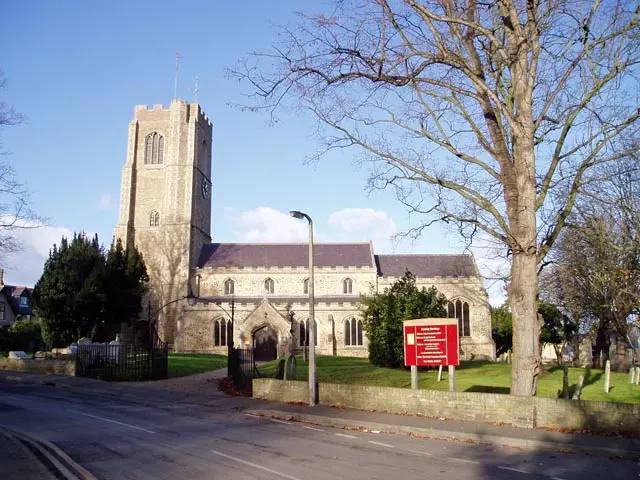
St George's Church in Littleport was John Vachell's. The Victoria County History (1953) records that its earlier registers were destroyed in the riots and that the surviving ones begin in 1754 for marriages, 1756 for burials and 1783 for baptisms.
In Ely, the five hanged men share one grave in the churchyard of St Mary's, by the west front of the cathedral; the stone there now replaces the tablet Charles Harper copied in 1902. Ely Museum occupies the Old Gaol, Market Street, Ely CB7 4LS. The building was the Bishop's Gaol from 1679 until 1836, and Kingston describes the condemned men being drawn "from the gaol to the fatal platform". The museum's visit page, read on 24 September 2026, gives opening hours of Tuesday to Saturday 10.30 a.m. to 5 p.m., Sunday noon to 5 p.m. and bank holidays 10.30 a.m. to 5 p.m. Admission is £7 for adults, £3 for children, free for under-fives and £16.50 for a family, and a ticket gives entry for a year. For schools the museum runs a Littleport Riots workshop built around a reenactment of the hearing in the Georgian courtroom, at £8 a child for the full day plus £79.20 for hire of the Courthouse; its paranormal page invites investigation groups to book under separate terms.
The Grange, where the Society's Haunted Littleport page places a grey lady on the upper floor and a troublesome ghost in the former library, was built in 1855 as St George's vicarage and is now Littleport Grange Care Home. The page itself says the grey lady has been seen only by the residents. The remaining stories are set in the open: whispering rioters in Granby Street in the description of Watson's book, and a headless horseman on Camel Road towards Apes Hall and near Ponts Hill, and a dragoon on the riverbank, on the Society's page.
Sources consulted
- Alfred Kingston, «The Romance of a Hundred Years: Remarkable Chapters in the Social and Public Life of the Nineteenth Century» — Elliot Stock, London, 1901 book
- Charles G. Harper, «The Cambridge, Ely and King's Lynn Road: The Great Fenland Highway» — Chapman & Hall, 1902 book
- The Littleport Society, «The Littleport Riots» — The Littleport Society (local history society archive, Littleport), 2026 web
- The Littleport Society, «Haunted Littleport» — The Littleport Society (local history society archive, Littleport), 2026 web
- Deborah Curtis Watson, «Mysterious Littleport: Myth, Magic and the Supernatural in a Fenland Town (publisher's listing and contents)» — The Littleport Society, 2nd edition (first published 1998), 2015 book
- Adam Strawson, «Legacies — Immigration and Emigration, Cambridgeshire: Riotous Littleport» — BBC (consulted in the Internet Archive capture of 6 December 2004, page 3 of the article), 2004 web
- Ely Museum, «The Littleport Riots schools workshop, and Paranormal Investigation groups at Ely Museum» — Ely Museum, The Old Gaol, Market Street, Ely, 2026 web
- The Littleport Society, «Our Archive: visiting information for The Barn, Main Street, Littleport» — The Littleport Society, 2026 web
- T. D. Atkinson, Ethel M. Hampson, E. T. Long, C. A. F. Meekings, Edward Miller, H. B. Wells and G. M. G. Woodgate, «Ely Hundred: Littleport — parish registers of St George's beginning 1754 (marriages), 1756 (burials) and 1783 (baptisms), the earlier ones destroyed in the 1816 riots; the Ely–Lynn railway and station of 1847» — A History of the County of Cambridge and the Isle of Ely, vol. 4, ed. R. B. Pugh (Victoria County History, London), pp. 95-102, via British History Online, 1953 book
- Ely Museum, «Plan your visit (opening hours, admission, ticket valid for a year) and Building History (the Old Gaol as the Bishop's Gaol, 1679-1836)» — elymuseum.org.uk (consulted 24 September 2026), 2026 web
Reviewed by V. Serrano on 2026-08-11 · How we verify our content
💬 Field testimonies (0)
No testimonies yet. Add the first.
Add your testimony
🔒 Log in to add a testimony