👻 HAUNTED PLACE · EXP. Nº9477
ACTIVE
Mission San Juan Capistrano
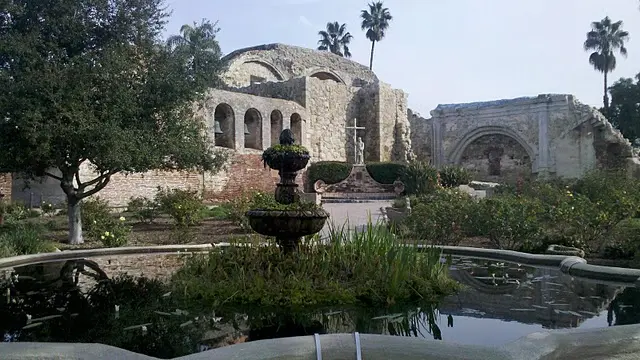
On Tuesday 8 December 1812, the feast of the Immaculate Conception, the first Mass of the day was being said at Mission San Juan Capistrano when an earthquake brought down the Great Stone Church that the Acjachemen had spent nine years building.
Where is Mission San Juan Capistrano?
- Location
- California, United States
- Type
- Church / religious site
- Coordinates
- 33.503, -117.663
- Last updated
LOCATION
Why is Mission San Juan Capistrano said to be haunted?
Fr. José Barona entered the dead in the burial register one by one, with name, age and condition: thirty-nine, of whom thirty-one were women, plus Paulina Quieran, found in the rubble eleven weeks later. All forty were Acjachemen. No Spaniard died. Six people got out. Everything that came afterwards can be dated: the robed figure and the buried treasure were village talk written down by the pastor in 1930; Magdalena and her penitent's candle began as a short story published about 1915; the bell that tolls has a timetable. The ruin still stands in the garden, and the mission tolls its bells for the forty every 8 December. This is the file on a place where the documented history is heavier than the legend built on it.
What is the history of Mission San Juan Capistrano?
The valley the Spaniards called San Juan was Acjachemen country, and the mission's own founding papers say so. When Junípero Serra wrote the title page of the baptismal register, he headed it "this Mission of San Juan Capistrano de Quanís-savit", using the local name of the place; Serra used the same form when he recorded the confirmations he administered in 1778 and 1783. On the marriage register a later hand crossed the word out and wrote Sajivit over it. Both are Acjachemen names, and they are the first thing in the archive.
The mission was founded twice. A first attempt was abandoned after about a week at the end of October 1775, when a Kumeyaay force destroyed Mission San Diego and the military escort was ordered south; Serra came back and founded it permanently on 1 November 1776, the seventh of California's twenty-one missions.
By 1797 more than a thousand baptised Acjachemen lived at the mission and Serra's small adobe church could not hold them. Fathers Vicente Fuster and Juan Norberto de Santiago resolved to build in stone, cruciform, with a vaulted concrete roof of six domes, a baptistry and a bell tower — no wood anywhere except doors and windows. The two dates in the records do not agree: the annual report for 1797 says the first stone was laid on 2 March, while the note Fr. José Faura entered in the baptismal register says the work began on 2 February, the feast of the Purification. Nine years of Acjachemen labour later, that note calls the finished church "constructed by the neophytes at the cost of supplication and labours". Fr. Estevan Tapís blessed it on the afternoon of 7 September 1806, with Governor José Joaquín de Arrillaga present; the solemn High Mass was sung on the 8th.
It stood six years and three months. On Tuesday 8 December 1812, the feast of the Immaculate Conception, the first Mass of the day was being said at about seven in the morning when an earthquake struck. Fathers Francisco Suñer and José Barona reported that the tower tottered twice and, at the second shock, fell on the portal and brought the vaulted roof down as far as the transept. Fr. Barona entered the dead one by one in the burial register on 9 and 10 December, with name, age and condition: four married men, three single men, twenty-five married women, four widows, two single women and one boy — thirty-nine. On 26 February 1813, when the rubble was finally cleared, they found Paulina Quieran, wife of Policarpo Antonio Jauro, which made forty. All forty were Acjachemen. No Spaniard died, though some were at the Mass. Six people got out. The priest at the altar escaped through the sacristy door. There was an aftermath the register also keeps: Gabriel Pajomit, widower of one of the victims, María Dolores Cuinaván, lost his reason and was found dead in the woods, buried on 8 May 1813.
The dead of 1812 were not the worst of it. Six years earlier, in January and February 1806, a measles epidemic — the first the mission had seen — added 133 burials in two months. The church was never rebuilt. After secularisation the buildings were sold at public auction by Governor Pío Pico on 4 December 1845 to his brother-in-law John Forster and to James McKinley for $710, part cash and part hides and tallow; the sale was later ruled invalid, and on 18 March 1865 Abraham Lincoln signed the patent restoring the property to Bishop Joseph Sadoc Alemany "in trust for the religious purposes and uses to which the same have been respectively appropriated". The ruin visitors photograph today is not purely the earthquake's work: George Wharton James wrote in 1905 that the domes left standing were blown up with gunpowder in the 1860s by people who meant to reuse the stone and never did. The Landmarks Club, led by Charles Fletcher Lummis, re-roofed Serra's church and rebuilt the patio corridors around the turn of the century, and Fr. St. John O'Sullivan arrived as resident pastor in 1910.
Timeline: the documented record of Mission San Juan Capistrano
- 1 November 1776 Junípero Serra founds the mission permanently, a year after a first attempt was abandoned. He heads the baptismal register "San Juan Capistrano de Quanís-savit", with the Acjachemen name of the site; on the marriage register a later hand strikes it out and writes Sajivit.
- 1797 Work begins on the Great Stone Church. The annual report dates the first stone to 2 March; the note Fr. José Faura later wrote in the baptismal register says the work began on 2 February and credits the finished building to the neophytes "at the cost of supplication and labours".
- January–February 1806 The first measles epidemic reaches the mission. Burials in the register rise from 1,234 at the end of 1805 to 1,367 by the end of February: 133 deaths in two months.
- 7–8 September 1806 Fr. Estevan Tapís blesses the new church on the afternoon of the 7th, with Governor José Joaquín de Arrillaga present; the solemn High Mass is sung on the 8th.
- Tuesday 8 December 1812 An earthquake brings the church down during the first Mass of the Immaculate Conception, at about seven in the morning. Fathers Suñer and Barona report that the tower fell on the portal at the second shock. Fr. Barona enters thirty-nine dead by name, age and condition on 9 and 10 December; Paulina Quieran is found in the rubble on 26 February 1813, making forty. All are Acjachemen; thirty-one are women. Six people escape.
- 4 December 1845 Governor Pío Pico auctions the mission buildings to his brother-in-law John Forster and to James McKinley for $710, part in cash and part in hides and tallow. The sale is later ruled invalid.
- 18 March 1865 Abraham Lincoln signs the United States patent restoring the mission property to Bishop Joseph Sadoc Alemany, in trust for religious use. Engelhardt reproduces the signature in facsimile.
- 1905 George Wharton James publishes the account of the domes that survived the earthquake being blown up with gunpowder in the 1860s by men who meant to rebuild with the stone and never did. In the same page he calls 8 December 1812 a Sunday; it was a Tuesday.
- c. 1915 Houghton Mifflin publishes "The Penance of Magdalena", a short story by J. Smeaton Chase in which a girl carrying a penitent's candle dies with her lover Teófilo under the collapsing dome. It is the earliest datable appearance of the names now attached to the mission's ghost.
- April 1930 Capistrano Nights collects the village lore gathered by the pastor Fr. St. John O'Sullivan. Damián Rios, a man working on the garden behind the bells, describes seeing a padre in a long sotana by the corner of the big church — "un espanto" — in the chapter on people digging for the padres' buried treasure; and a Juaneño man the book calls Acu repeats what his grandmother, an eyewitness, told him about the boy who was ringing the bell in the tower when it fell.
- 3 September 1971 The mission is listed on the National Register of Historic Places, reference 71000170, at state level of significance. It is not a National Historic Landmark: of the 151 California landmarks on the National Park Service list, only two are in Orange County, and neither is the mission. California registers it as Historical Landmark No. 200.
- 21 March 2011 The Bureau of Indian Affairs publishes its final determination against federal acknowledgment of the Juaneño Band of Mission Indians, Acjachemen Nation. The same document records that 1,182 of the group's 1,940 members had documented descent from the historical tribe at the mission between 1776 and 1834.
Is there a rational explanation for Mission San Juan Capistrano?
The collapse of 8 December 1812 is documented history, entered in the burial register name by name, and what has been built on top of it can be dated as well.
The figure in the Franciscan habit comes first, and no friar died in the earthquake: the missionaries' own report says that "of the whites, none were killed, though some were at the holy Mass", and the celebrant saved himself through the vestry door. Fr. Barona lived until 4 August 1831, and Fr. Suñer's last entry in the register is dated 23 April 1814. A robed ghost mourning priests who died that morning mourns deaths the register does not contain.
Four earlier books about the mission do not use the word ghost about it: Fr. St. John O'Sullivan's own Little Chapters about San Juan Capistrano (1912), J. Smeaton Chase's tales of 1915, Fr. Zephyrin Engelhardt's documentary history of 1922 and George Wharton James's In and Out of the Old Missions of California (1905), whose two hits for the word are about the ruined church of Our Lady of Solitude at Soledad. The first apparition in that run of books comes in 1930, in Capistrano Nights: Tales of a California Mission Town, collected by O'Sullivan, then pastor, and written up by Charles Francis Saunders. In the chapter on buried treasure O'Sullivan recalls Damián Rios, a man working on the garden behind the bells, who told him how people dug at night for the old padres' supposed hoard while he sat on the adobe wall and watched; just by the corner of the big church he saw "as plain as could be a padre dressed in his long sotana", who was gone when the diggers looked up; it was, he said, "un espanto — a ghost". Saunders, who spent a night alone in the ruin, described a tempest "awakening ghostly sighs and moans throughout the rambling old ruin" and wrote that only his conviction that the spirits of the old padres "were secure in a better world" kept his imagination from supplying them.
The bell has a documented ancestor too, in the same book, where a Juaneño man the authors call Acu tells O'Sullivan what his grandmother, "one of the witnesses of the tragedy of 1812", told him: that an Indian boy was up in the tower "ringing the bell for the next mass" when it began to rock, and that it fell in on him as he ran down the stairway. The mission's own pages describe two bell customs today. Since 2013 the bells have been rung every day at 9:00 a.m. in honour of Junípero Serra, and every 8 December the historic bells toll for a quarter of an hour "in remembrance of the Earthquake of 1812 and the 40 victims"; the event page read on 8 October 2026 gives 10:00 to 10:15 a.m.
Magdalena and her candle, the story most often retold as the mission's ghost, began as fiction with an author and a date. "The Penance of Magdalena" is a short story by J. Smeaton Chase, published by Houghton Mifflin in 1915 in a small book whose preface says its tales were "extracted from the larger work, The California Padres and Their Missions", written with the same Charles Francis Saunders. In it a girl walks into the Mass of the Immaculate Conception carrying a penitent's candle and dies with her lover Teófilo when the church comes down, and the Father who escaped "the death that fell that day upon twoscore of his flock" buries them in one grave. Neither name appears in the earlier literature: on 8 October 2026 a case-insensitive search of the Internet Archive text of James's 1905 book returned Capistrano 57 times, earthquake 26 times and neither Magdalena nor Teófilo; the Project Gutenberg text of his Old Franciscan Missions of California (1913) returned 39 and 26, with the same result; and Engelhardt's history of 1922, which prints the burial register entry by entry, does not use the word ghost once in about 82,000 words.
Two dates in the older books are wrong: Capistrano Nights puts the disaster on "December 12, 1812"; James, in 1905, wrote "Sunday morning, December 8", and 8 December 1812 was a Tuesday. The register gives the 8th, and so does the mission today.
The mission is now a museum run by the Mission Preservation Foundation. A search of its website on 8 October 2026 returned no results for "haunted" and one for "ghost", a page about the historic downtown and its accommodation; the same search box returned 43 results for "swallow" and 12 for "earthquake". What the site does publish is the Day of Remembrance every 8 December and, in its Mission Treasures exhibit, a tribute "to the neophytes, or baptized Native American victims who lost their lives in the 1812 earthquake".
Can you visit Mission San Juan Capistrano?
Mission San Juan Capistrano is a museum, a garden and a working chapel at 26801 Old Mission Road, San Juan Capistrano, CA 92675, at the corner of Ortega Highway and Camino Capistrano in the old town centre. Guest services: (949) 234-1300.
Hours, checked against the mission's own page as updated on 30 June 2026: closed Mondays except for booked photography sessions, and open Tuesday to Sunday from 9:00 to 17:00, with admission sold until 16:45. The Mission Store opens Tuesday to Sunday 10:00 to 17:00. The site closes at noon on Good Friday and Christmas Eve, all day on Thanksgiving and Christmas, and for its annual benefit gala. Be aware that the mission's own visitor FAQ still says 9:00 to 16:00; the hours page is the one being kept up to date.
General admission at the same date: adults 18–59 $19, seniors 60+ $16, students with valid ID $11, youth 5 and over $11, children 4 and under free, and a member's guest $10. U.S. military identification saves $1. Tickets bought online are valid only for the chosen date and are non-refundable. On 19 March, St Joseph's Day and the Return of the Swallows, admission rises to $20 / $17 / $14 and most discount vouchers are not accepted.
Getting there: public street parking downtown and a lot on the south side of Old Mission Road at El Camino Real. Metrolink and Amtrak stop at the San Juan Capistrano depot, 26701 Verdugo Street, two blocks away.
Accessibility, in the mission's own words: the grounds are "rough and irregular", some rooms — including the eighteenth-century South Wing — are not wheelchair accessible, and the mission does not lend wheelchairs. It publishes an accessibility map, provides accessible restrooms and a written script of the audio tour for deaf and hard-of-hearing visitors.
Two things to respect. The Serra Chapel is not an exhibit: Mass is celebrated there at 6:30 in the morning on weekdays, and the parish's main church is the Mission Basilica at 31520 Camino Capistrano. And on 8 December the bells toll at 10:00 for the forty dead — that tolling is private, and the mission asks visitors to leave it alone. Drones are prohibited; portrait and professional photography needs an advance booking.
Sources consulted
- Zephyrin Engelhardt, O.F.M., «San Juan Capistrano Mission (Missions and Missionaries of California)» — Standard Printing Co., Los Angeles, 1922 book
- Charles Francis Saunders and Fr. St. John O'Sullivan, «Capistrano Nights: Tales of a California Mission Town» — Robert M. McBride & Company, New York, 1930 book
- J. Smeaton Chase, «The Penance of Magdalena and Other Tales of the California Missions» — Houghton Mifflin Co., Boston and New York, 1915 book
- George Wharton James, «In and Out of the Old Missions of California» — Little, Brown & Co., Boston, 1905 book
- National Park Service, «National Register of Historic Places: listed properties data set (ref. 71000170, listed 3 September 1971) and National Historic Landmarks list» — U.S. Department of the Interior, 2026 report
- Bureau of Indian Affairs, «Final Determination Against Acknowledgment of the Juaneño Band of Mission Indians, Acjachemen Nation (76 FR 15337)» — Federal Register, 2011 report
- Fr. St. John O'Sullivan, «Little Chapters about San Juan Capistrano» — San Juan Capistrano, California, 1912 book
- Mission San Juan Capistrano, «Hours and Admission» — Official visitor information, updated 30 June 2026, 2026 web
- Mission San Juan Capistrano, «Native American History» — Institutional website, 2025 web
- Mission San Juan Capistrano, «Historic Bell Tolling: Day of Remembrance» — Institutional events calendar, 2026 web
Reviewed by V. Serrano on 2026-08-12 · How we verify our content
💬 Field testimonies (0)
No testimonies yet. Add the first.
Add your testimony
🔒 Log in to add a testimony