👻 HAUNTED PLACE · EXP. Nº9478
ACTIVE
Montgomery House Bed and Breakfast
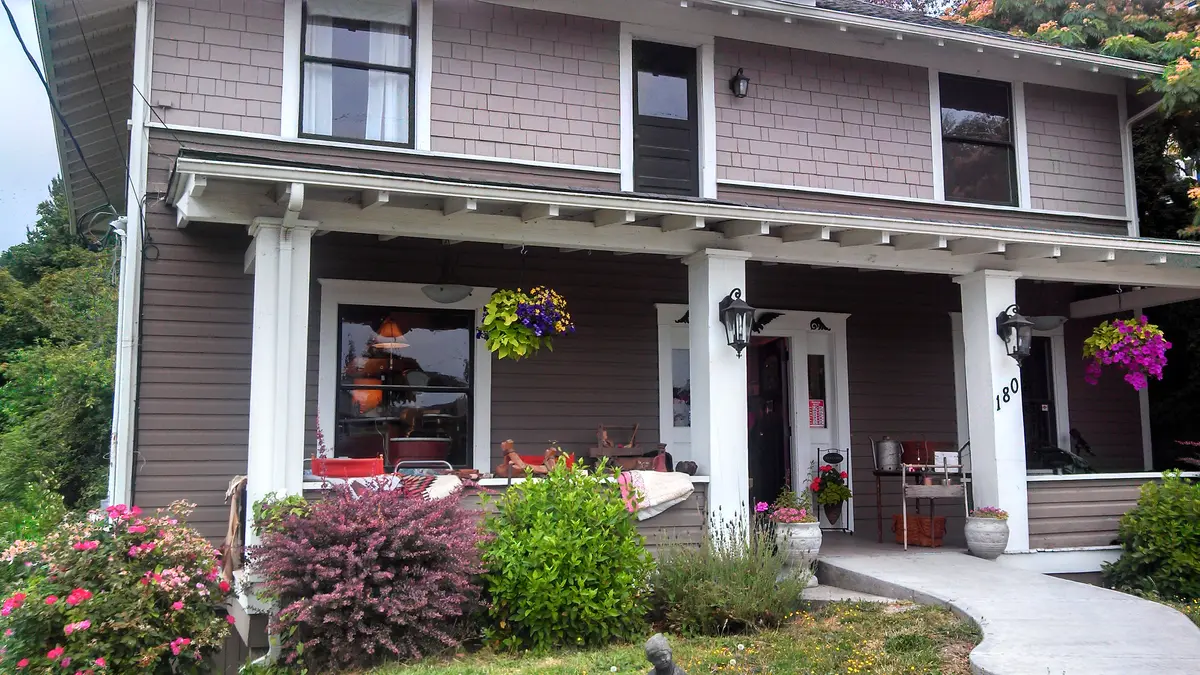
A two-storey Craftsman house of 1908 in downtown Kalama, Washington, that spent about one year as a bed and breakfast and has carried a haunted reputation ever since.
Where is Montgomery House Bed and Breakfast?
- Location
- Washington, United States
- Type
- Hotel / inn
- Coordinates
- 46.007, -122.844
- Last updated
LOCATION
Why is Montgomery House Bed and Breakfast said to be haunted?
Eric and Julianna Montgomery, both recording artists, bought the derelict building in 2006, restored three guest rooms and opened in March 2008. In November of that year the psychic and medium Danielle Egnew filmed a documentary there, Montgomery House: The Perfect Haunting, which premiered in Sheridan, Wyoming, on 21 November 2009. Egnew has said the house came to her attention because the Montgomerys were signed to the same record label as she was. The owners left in March 2009, four months after filming, and by March 2010 the Tacoma Weekly reported the house vacant with a For Sale sign back up. It is a private family home today and cannot be visited. Every paranormal claim attached to the address traces to that one film, whose own publicity states the location had never been investigated before the cameras arrived.
What is the history of Montgomery House Bed and Breakfast?
Kalama was a boom town that went bust half a century before this house existed, and that sequence explains almost everything about the building.
The first recorded white settler on the site was Ezra Meeker, who arrived in 1853, stayed about a year and sold his claim to John Davenport before moving north to Puyallup. The town that mattered came later: in March 1870 General John W. Sprague of the Northern Pacific Railway chose a spot near the mouth of the Kalama river as the starting point of the company's Pacific Division. Docks, sawmills, hotels and housing went up at speed, and between May 1870 and 1871 the population climbed to roughly 3,500, peaking near 5,000. Kalama was unofficially incorporated on 29 November 1871 and served as county seat of Cowlitz County from 1872 to 1922.
The collapse was just as fast. Rail service between Kalama and Tacoma opened on 5 January 1874, and in that same year the Northern Pacific moved its headquarters to Tacoma. By 1877 only about 700 people remained. The census recorded 129 residents in 1880, 325 in 1890 and 554 in 1900. What kept the place alive was timber and the railroad ferry that carried trains across the Columbia between 1883 and 1909.
So the two-storey Craftsman house built here in 1908 did not go up in a booming logging hub. It went up in a small county seat that had already lost its railroad, was living off sawmills and a river crossing, and would not reach 1,228 residents until 1920. That is a more interesting building than the one the legend describes.
What happened to the house between 1908 and the 1990s is where the record thins out badly. The account repeated everywhere — that it became a bordello containing a doctor's clinic, then a nine-room hospital by 1930, then a family home again in the 1960s, and was finally boarded up in the early 1990s and used as storage for a local antique shop — traces back to the promotional material for a single documentary film and to a Wikipedia article written by that film's promoters. No county or state record confirming that chain of uses could be located for this profile, and it should be read as claim rather than history.
The documented part begins in 2006, when Eric and Julianna Montgomery bought the derelict property and restored it. The Daily News of Longview covered the opening on 16 March 2008 in a piece by Tom Paulu with photographs by Bill Wagner: three restored guest rooms, one of them called the River Room, plus space for events and a gallery that would show a different artist each month. The Montgomerys were themselves recording artists, and the house carried their name — it had not been called Montgomery House before they arrived.
The business lasted about a year.
Timeline: the documented record of Montgomery House Bed and Breakfast
- 1829-30 An epidemic known as the 'gray' or 'intermittent' fever, carried in by the American ship Owyhee under Captain John Domines, devastates the lower Columbia. Hudson's Bay Company governor George Simpson put the dead near Fort Vancouver at three-quarters of the population; Dr John McLoughlin thought it closer to seven-eighths.
- 1853 Ezra Meeker becomes the first recorded white settler at Kalama. He stays about a year and sells his claim to John Davenport before moving north to Puyallup.
- 1855 At territorial governor Isaac Stevens's treaty council, the Cowlitz refuse to sign away their village sites, prairies, fishing places and burial grounds in exchange for removal to the Quinault reservation. They keep their land and their refusal, but receive no reservation of their own.
- 20 March 1863 The date the Indian Claims Commission would later fix as the moment the United States deprived the Cowlitz Indian Tribe 'of its aboriginal Indian title... without payment of any compensation therefore'. The Commission recognised 1.66 million acres and the government offered fifty cents an acre.
- March 1870 General John W. Sprague of the Northern Pacific Railway selects a spot near the mouth of the Kalama river as the starting point of the company's Pacific Division. Within a year the population climbs towards 3,500.
- 1874 Rail service to Tacoma opens on 5 January and the Northern Pacific moves its headquarters there the same year. By 1877 only about 700 people are left in Kalama; the 1880 census counts 129.
- 1908 The two-storey Craftsman house is built in downtown Kalama, in a town of some 550 people that had lost its railroad headquarters thirty-four years earlier and lived on timber and the Columbia rail ferry.
- 12 April 1973 The Indian Claims Commission issues its findings in favour of the Cowlitz Indian Tribe, 22 years after the tribe filed Docket No. 218.
- 18 February 2000 The Bureau of Indian Affairs publishes its Final Determination to acknowledge the Cowlitz Indian Tribe in the Federal Register, ending a campaign that Chief Atwin Stockum had begun with a lawsuit in 1906. A Reconsidered Final Determination follows on 4 January 2002.
- 2006 Eric and Julianna Montgomery, both recording artists, buy the derelict house and begin restoring it. The building takes their surname; it had not been called Montgomery House before.
- 16 March 2008 The Daily News of Longview announces the opening in an article by Tom Paulu with photographs by Bill Wagner: three restored guest rooms, one named the River Room, an events space and a gallery showing a different artist each month.
- November 2008 Danielle Egnew films at the house. By her own account she and her director of photography stayed there seven days, shooting two further days in Tacoma, with the paranormal investigation team present for three. She had met the owners as fellow artists on the same record label.
- March 2009 Eric and Julianna Montgomery leave the house, four months after the filming and about a year after the bed and breakfast opened.
- 21 November 2009 Montgomery House: The Perfect Haunting premieres in a single screening at the WYO Theater, 42 Main Street, Sheridan, Wyoming, at 7 p.m., tickets $10 for adults and $15 for couples, sponsored by Cloud Peak Initiatives.
- 9 January 2010 Hollywood Today runs the film's press release, billing it as the real-life Paranormal Activity and reporting that it was produced through Egnew's own company for under $10,000.
- 7 March 2010 An English Wikipedia article on the house is created in the middle of the film's publicity campaign. Within the same week it is proposed for deletion and tagged for lack of notability. Almost every later retelling of the story online derives from it.
- 31 March 2010 Matt Nagle reviews the film in the Tacoma Weekly and reports the house standing "vacant again" after the hurried exit of owners who had lived there about a year, with the For Sale sign back up.
- 2013 The property is bought by new owners in March 2013 and becomes a private residence, which it still was in the Wikipedia article's revision of 25 March 2026.
Is there a rational explanation for Montgomery House Bed and Breakfast?
Every paranormal claim attached to this address descends from one documentary, and the documentary's own publicity says so: the location was "never investigated prior to this filming". The reputation did not precede the film. The film created it.
How the film came about matters, and the clearest account is the director's own. Asked by Terra King of the Los Angeles Examiner how the house came to her attention, Danielle Egnew answered that Eric and Julianna Montgomery "were both artists signed to the same record label that I'm signed to", that the group had stopped at their home for coffee after a tour date, and that she later "expressed my interest in doing a documentary about the house". The label's chief executive, Raymond Hayden of Maurice The Fish Records, appears in the film's own cast list. The filmmaker, the subjects and the record company were commercially connected before a frame was shot. That is not proof of anything false, but it is the opposite of an independent investigation, and no version of this story told online mentions it.
The production was small and fast. Egnew described shooting seven days in the house plus two in Tacoma, with the paranormal team present for three of them; Hollywood Today reported a budget under $10,000; the premiere on 21 November 2009 was a single screening at the WYO Theater in Sheridan, Wyoming, at $10 a ticket.
The evidence claimed is largely audio. Egnew is a career audio engineer who said of herself, "I can pick an EVP out of white noise at 20 paces" — which is a fair description of the problem rather than a qualification for solving it. Recovering speech from noise is exactly the task at which a trained, motivated listener is most likely to hear what they expect, and a draughty 1908 timber-frame house that had spent years boarded up is a generous acoustic environment for it.
The historical scaffolding is also weaker than it looks. The widely repeated line that Lewis and Clark documented the epidemic deaths near the site cannot be right: the expedition passed in 1805-06, more than two decades before the 1829-30 epidemic, and the historian Judith W. Irwin notes that the earliest accounts of the Lower Cowlitz begin not with Lewis and Clark but with the Astorians in 1811. Nor could any record be found placing a specific Cowlitz village or burial ground on this particular lot. Kelso, Olequa and Toledo are the towns documented as built on Cowlitz village sites; Kalama is not among them.
Finally, the paper trail is short and self-referential. The Wikipedia article that most retellings draw on was created on 7 March 2010, in the middle of the film's publicity push, and was proposed for deletion and tagged for lack of notability within the same week. Several details that circulate widely — a woman in period dress on the staircase, a child who died in an upstairs bedroom — appear in none of the contemporary sources consulted for this profile, including the film's own website and all six press pieces reproduced on it.
Can you visit Montgomery House Bed and Breakfast?
The house is a private residence and is not open to visitors. It stands on South First Street in Kalama, Cowlitz County, Washington; in March 2008 the Daily News of Longview placed it "a half block south of Kalama's downtown". According to the English Wikipedia article on the house, in its revision of 25 March 2026, the property was bought in March 2013 by new owners and "is now a private residence".
The bed and breakfast lasted about a year. Tom Paulu's article of 16 March 2008 reports that the grand opening had taken place on the Thursday before, 13 March, after Eric and Julianna Montgomery had spent 25 months restoring the 1908 Craftsman house, which they bought in 2006 for $215,000. Wikipedia dates their departure to March 2009, four months after the documentary was filmed. Reviewing the film in the Tacoma Weekly on 31 March 2010, Matt Nagle described the house as sitting "vacant again" with the "For Sale" sign back up.
Paulu's article records the Montgomerys' hope that the B&B "will complement Kalama's antique scene", and the Wikipedia article describes Kalama as "a logging town along the Columbia River now known for its antiques". The Cowlitz Indian Tribe, whose ancestral land the film invokes, keeps its own website at cowlitz.org, which was online on 24 September 2026. The Bureau of Indian Affairs acknowledged the tribe in a Final Determination published in the Federal Register on 18 February 2000.
The film, Montgomery House: The Perfect Haunting (Ave Vox Entertainment, 2010), was sold on DVD through its own website. The Internet Archive's captures show that site carrying the film's pages without change from 2012 until at least April 2021; by October 2022 the domain no longer carried the film. IMDb catalogues the title as tt1349638.
Sources consulted
- Tom Paulu, «Montgomery House B&B debuts in Kalama» — The Daily News (Longview, Washington), 2008 newspaper archive
- Matt Nagle, «'Montgomery House: The Perfect Haunting': Chilling documentary just might make a believer out of you» — Tacoma Weekly, 2010 newspaper archive
- Terra King, «Interview with filmmaker Danielle Egnew, and DVD review of Montgomery House: The Perfect Haunting» — The Examiner (Los Angeles), 2010 interview
- Ave Vox Entertainment, «Montgomery House: The Perfect Haunting - official film website (film, cast, showings, press and contact pages)» — montgomeryhousehaunting.com, archived by the Internet Archive, 2011 archive
- Judith W. Irwin, «The Dispossessed: The Cowlitz Indians in Cowlitz Corridor» — The Columbian, reprinted by the Cowlitz Indian Tribe, 1994 newspaper archive
- Rudolph C. Ryser, «Background and History of the Cowlitz Tribe» — Center for World Indigenous Studies, 1999 report
- Bureau of Indian Affairs, US Department of the Interior, «Final Determination To Acknowledge the Cowlitz Indian Tribe» — Federal Register, vol. 65, no. 33, 2000 report
- IMDb, «Montgomery House: The Perfect Haunting (tt1349638)» — IMDb, 2010 web
- Wikipedia contributors, «Montgomery House Bed and Breakfast (article and full revision history)» — English Wikipedia, 2010 web
- Hollywood Today, «'Montgomery House: The Perfect Haunting' Film Delves Into Taboo World Of The Spiritual Realm» — Hollywood Today, 2010 newspaper archive
Reviewed by V. Serrano on 2026-08-11 · How we verify our content
💬 Field testimonies (0)
No testimonies yet. Add the first.
Add your testimony
🔒 Log in to add a testimony