👻 HAUNTED PLACE · EXP. Nº9478
ACTIVE
Morris–Jumel Mansion
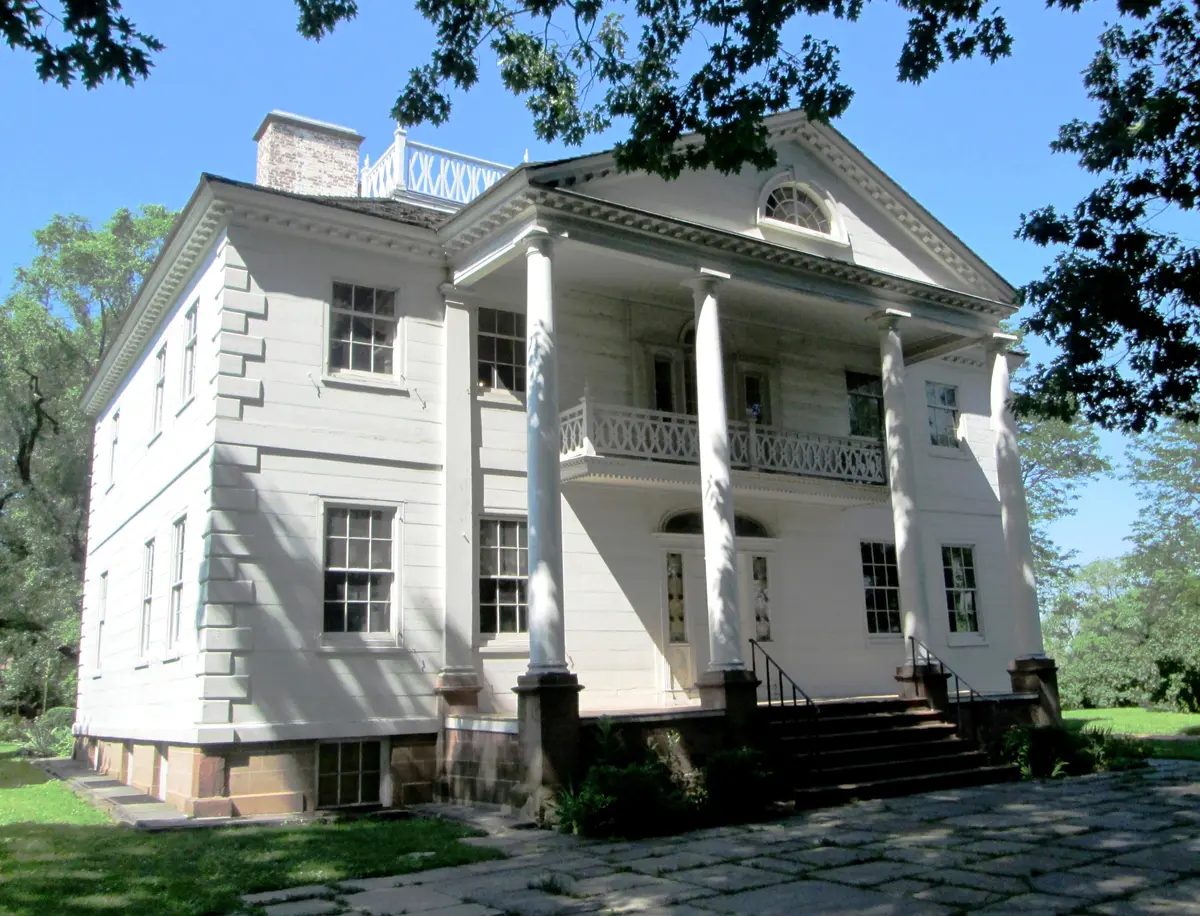
On a January morning in 1964 a class of schoolchildren was waiting outside this house in Washington Heights when, several of them said, a woman stepped onto the small balcony above the door and told them to be quiet.
Where is Morris–Jumel Mansion?
- Location
- New York, United States
- Type
- House / mansion
- Coordinates
- 40.834, -73.939
- Last updated
LOCATION
Why is Morris–Jumel Mansion said to be haunted?
The balcony door had been padlocked for years. The story reached the press that month and then reached Hans Holzer, who held a seance in the house on 19 January 1964 with the medium Ethel Johnson Meyers and the curator Emma Bingay Campbell, and wrote it up for the next thirty years. Almost everything since descends from those chapters. The house itself needs no ghost: built for the British officer Roger Morris in 1765 and, in the museum's words, Manhattan's oldest surviving residence, it was raised with enslaved labour, served as Washington's headquarters in the autumn of 1776, and was later home to Eliza Jumel, born Betsy Bowen in a Providence brothel, who married the former Vice-President Aaron Burr in the front parlour in 1833 and divorced him on the day he died.
What is the history of Morris–Jumel Mansion?
The house on the hill was built to be seen. Lieutenant Colonel Roger Morris, a British officer who had come to America in 1746 and served under Braddock in the French and Indian War and under Wolfe at Quebec, bought roughly 150 acres of Harlem Heights and set his summer villa on the highest ground on Manhattan Island, with the Hudson on one side and the Harlem River on the other. The National Park Service nomination form gives the date as 1765 and the architect as unknown, adding that the seat was "probably completed by 1768". The museum dates the construction 1758-1765 and credits the money to Morris's wife, the Anglo-Dutch heiress Mary Philipse. They called it Mount Morris.
It was built with enslaved labour. The museum says so plainly: enslaved labour "was typically engaged for residential, commercial, and infrastructure construction projects during the colonial era", while conceding that "the actual laborers are unknown". Its research pages then name the Black people, enslaved and free, who worked in the house. Among them are Hannah Till and her husband Isaac, an enslaved married couple rented out as cooks to George Washington from July 1776 and manumitted in October 1778; William Lee, whom Washington had bought in about 1768 for a recorded sixty-one pounds fifteen shillings and who was at the mansion in September and October 1776; and, decades later, Anne Hampton Northup, the free wife of Solomon Northup, hired as Eliza Jumel's cook in the summer of 1841, who signed her documents with an X.
Morris fled to England in 1775 and the estate was confiscated. Washington made the house his headquarters from 14 September to 18 October 1776, the nomination form records, and the Battle of Harlem Heights was fought nearby on 16 September - the first time in that campaign, the form notes, that "the patriots succeeded in forcing the British to give ground". Afterwards the house came down in the world. For a quarter of a century it changed hands repeatedly and spent a stretch as a tavern called Calumet Hall, the first stop on the Albany Post Road.
Then came the Jumels. Stephen Jumel, a French wine merchant, bought the neglected house in 1810; his wife stripped and refurnished it in the Empire and Federal styles. Her story is the extraordinary one. Born Betsy Bowen in Providence, Rhode Island, in about 1775, she was, in her biographer Margaret A. Oppenheimer's words, "raised in a brothel", passed through the town workhouse and reinvented herself in New York as Eliza. Stephen died on 22 May 1832 from injuries sustained in a fall. Thirteen months later, on 1 July 1833, the widow married the former Vice-President Aaron Burr in the front parlour of this house. He was seventy-seven and effectively ruined; she had the fortune. Within four months she had filed for divorce over his handling of her money, and the decree was signed on 14 September 1836, the afternoon Burr died.
Eliza stayed on for another twenty-nine years and died in the house on 16 July 1865, in her ninetieth year. Her estate was fought over for decades. In 1903, with the mansion on the market and demolition likely, the City of New York bought the house and nearly two acres for $235,000 and handed custodianship, by special act of the legislature, to the Washington Headquarters Association founded by the Daughters of the American Revolution. It has been a museum since 1904. It became a National Historic Landmark in 1961, entered the National Register in 1966, and was designated a New York City landmark in 1967, its interiors in 1975.
Timeline: the documented record of Morris–Jumel Mansion
- 1765 Lieutenant Colonel Roger Morris builds Mount Morris on some 150 acres of Harlem Heights. The National Park Service nomination gives 1765 and an unknown architect; the museum dates the work 1758-1765 and states that enslaved labour was typically used for such construction, while noting that the individual workers are unknown.
- 14 September - 18 October 1776 Washington uses the abandoned house as his headquarters after the defeat on Long Island; the Battle of Harlem Heights is fought nearby on 16 September. The museum's research names enslaved people who were there in those weeks, including William Lee, Washington's valet, and the cooks Hannah and Isaac Till.
- 22 May 1832 Stephen Jumel dies of injuries sustained in a fall. There is no contemporary record of foul play; the murder version of his death appears only from 1964 onwards, through Hans Holzer's seance.
- 1 July 1833 Eliza Jumel marries the former Vice-President Aaron Burr in the front parlour of the house. She files for divorce within four months over his handling of her fortune.
- 14 September 1836 The divorce decree is signed on the same day Aaron Burr dies, at about two in the afternoon, in his lodgings.
- 16 July 1865 Eliza Jumel dies in the house in her ninetieth year, after fifty-five years there. Her biographer's dating corrects the ninety-three or ninety-four years given in most ghost books.
- 1903 With the mansion on the market and demolition likely, the City of New York buys the house and nearly two acres for $235,000 and gives custodianship, by special act, to the Washington Headquarters Association founded by the Daughters of the American Revolution. It opens as a museum in 1904.
- 11 January 1964 A wire report by the journalist Joan Hanauer brings the reports at the mansion to public attention. Holzer, who cites the date, says the story reached him through the novelist Elizabeth Byrd, and that a group of schoolchildren had seen a woman step onto the balcony and tell them to be quiet "last Wednesday".
- 19 January 1964 Hans Holzer holds a sitting at the mansion with the medium Ethel Johnson Meyers, the curator Emma Bingay Campbell and, according to Stacy Horn, an entourage of journalists. In trance the medium produces the account, repeated ever since, that Stephen Jumel fell onto a pitchfork from a hay wagon. Holzer is a source for what was said that afternoon, not for what happened in 1832. In several later books he reuses this same date for the children's sighting itself.
- 12 July 1967 The New York City Landmarks Preservation Commission designates the mansion a landmark. Its report describes the second-floor Palladian window with "an ornamental balcony in front of this window" - the balcony of the 1964 story. The interiors are designated in 1975.
Is there a rational explanation for Morris–Jumel Mansion?
Almost everything now written about the Morris-Jumel ghost descends from the books of one man. Hans Holzer, the Austrian-born author who made a career of what he called ghost hunting, wrote the episode up at least half a dozen times between the 1960s and the 1990s, and the guidebooks, listicles and television segments that followed retell his chapters rather than any independent record.
Read those chapters side by side and the dates come apart. In his fullest account, Holzer says the story reached him through the novelist Elizabeth Byrd, who had seen a wire report by Joan Hanauer dated 11 January 1964, and that the children's sighting had happened "last Wednesday" - that is, before the article appeared. In several later books he states instead that the children saw the woman on the balcony on 19 January 1964. But 19 January 1964 is also the date Stacy Horn gives, in her history of the Duke parapsychology laboratory, for Holzer's own visit to the mansion "with an entourage of a few journalists". One of those two uses of the date must be wrong, and Holzer is the source for both.
The detail every retelling repeats is also the one that cuts against the story: the door onto the balcony had been padlocked for years. Holzer records it, and so does Susy Smith, who wrote in 1967 that the door was found padlocked and bolted. That is usually offered as proof that no living person could have been standing there. It works just as well as an argument that whatever the children saw was not on the balcony at all. The balcony in question is small and ornamental, set in front of the second-floor Palladian window - the 1967 landmark designation describes "an ornamental balcony in front of this window" - and it is seen from the street, from below and at an angle.
How the children were questioned matters too. By Holzer's own account, the teacher reassembled the group she had originally taken to the house so that he could interview them: days or weeks after the event, after the story had run in the press, and by a man who had already decided what the house contained.
The claims about Stephen Jumel behave the same way. The documented cause of death is injuries from a fall, on 22 May 1832. The murder version - the hay wagon, the boy, the pitchfork, the bandages torn off - enters through what a medium said while in trance at Holzer's 1964 sitting, and has been repeated as fact ever since. Even Eliza's age drifts as the story is passed along: her biographer has her dying in her ninetieth year, while the ghost books make her ninety, ninety-three or ninety-four.
The museum itself does not lead with any of this. Its three published "stories" are about the history of the house, its landscape, and the Black people who lived and worked in it.
Can you visit Morris–Jumel Mansion?
The mansion stands at 65 Jumel Terrace, in Roger Morris Park, Washington Heights, Manhattan. It is owned by the New York City Department of Parks & Recreation, operated by the non-profit Morris-Jumel Mansion Inc., and is a member of the Historic House Trust of New York City.
One warning first, because it changes the trip: as of August 2026 the interior is temporarily closed for tours while restoration work goes on. The park around the house is open daily from 10:00 to 17:00, and the museum is running a guided walking tour in the meantime - "Uncovering Uptown History", 90 minutes and about a mile, starting at the mansion and ending at Trinity Cemetery on Broadway at 155th Street, on Saturdays at 10:30 and 13:30 (no 13:30 tour on the second Saturday of the month), $25, or $20 a head for groups of six or more, with reservation required. There is also a free family day on second Sundays. Check the museum's site before travelling: this is a schedule in flux.
When the interior reopens, the normal pattern is a self-guided visit for $10 (free under 12), Thursdays 13:00-16:00 and Fridays to Sundays 11:00-16:00, last entry at 16:00 and no timed slots; and a guided "Mansion & Grounds" tour at $16, Friday to Sunday at 11:00, which is a 30-minute exterior tour with a docent followed by the self-guided interior. Admission is free for active military and veterans, members of the American Alliance of Museums and the Historic House Trust, Cool Culture and Culture Pass holders, and museum members. There is no senior or student discount.
By subway the closest stop is 163rd Street on the C - leave by the south-east staircase to St. Nicholas Avenue and walk one block east. The 1 to 157th Street and the A to 168th Street are both about ten minutes away. Buses M2, M3, M4, M5 and M101 stop within a couple of blocks. There is no museum car park; there is street parking on 160th, 162nd, Jumel Terrace and Edgecombe Avenue, and a garage on 161st Street between Broadway and Amsterdam.
Accessibility is the weak point and the museum says so. Roger Morris Park is physically accessible; the house is not. There are no lifts, ramps or escalators between its three floors. Visitors with limited mobility are sometimes better served by the side door, which has fewer steps - two sets of three - but no handrail. A capital project for barrier-free access to the first floor is expected to make the mansion accessible during 2026.
Sources consulted
- Richard Greenwood, «Morris-Jumel Mansion: National Register of Historic Places Inventory - Nomination Form» — National Park Service, Historic Sites Survey, 1975 report
- New York City Landmarks Preservation Commission, «Morris-Jumel Mansion, LP-0308: Landmark Designation Report» — City of New York, 1967 report
- Margaret A. Oppenheimer, «The Remarkable Rise of Eliza Jumel: A Story of Marriage and Money in the Early Republic» — Chicago Review Press, 2015 book
- Nancy Isenberg, «Fallen Founder: The Life of Aaron Burr» — Viking, 2007 book
- Meade Minnigerode, «Lives and Times: Four Informal American Biographies» — G. P. Putnam's Sons, 1925 book
- Hans Holzer, «Ghosts I've Met (chapter: The Ghosts at Jumel Mansion)» — Barnes & Noble Books (first published 1965), 2005 book
- Stacy Horn, «Unbelievable: Investigations into Ghosts, Poltergeists, Telepathy, and Other Unseen Phenomena from the Duke Parapsychology Laboratory» — Ecco / HarperCollins, 2009 book
- Susy Smith, «Prominent American Ghosts (chapter: The Jumping Jumel Mansion)» — World Publishing Co., 1967 book
- Morris-Jumel Mansion, «Our Stories: Black History at the Morris-Jumel Mansion» — Museum research pages, 2026 archive
- Morris-Jumel Mansion, «History of the House / Mission & History» — Official museum site, 2026 archive
- Morris-Jumel Mansion, «Visit: hours, admission, directions and accessibility» — Official visitor information, 2026 web
- Historic House Trust of New York City, «Morris-Jumel Mansion» — Historic House Trust, 2026 web
Reviewed by V. Serrano on 2026-08-11 · How we verify our content
💬 Field testimonies (0)
No testimonies yet. Add the first.
Add your testimony
🔒 Log in to add a testimony