👻 HAUNTED PLACE · EXP. Nº0482
ACTIVE
Mount Baker Theatre
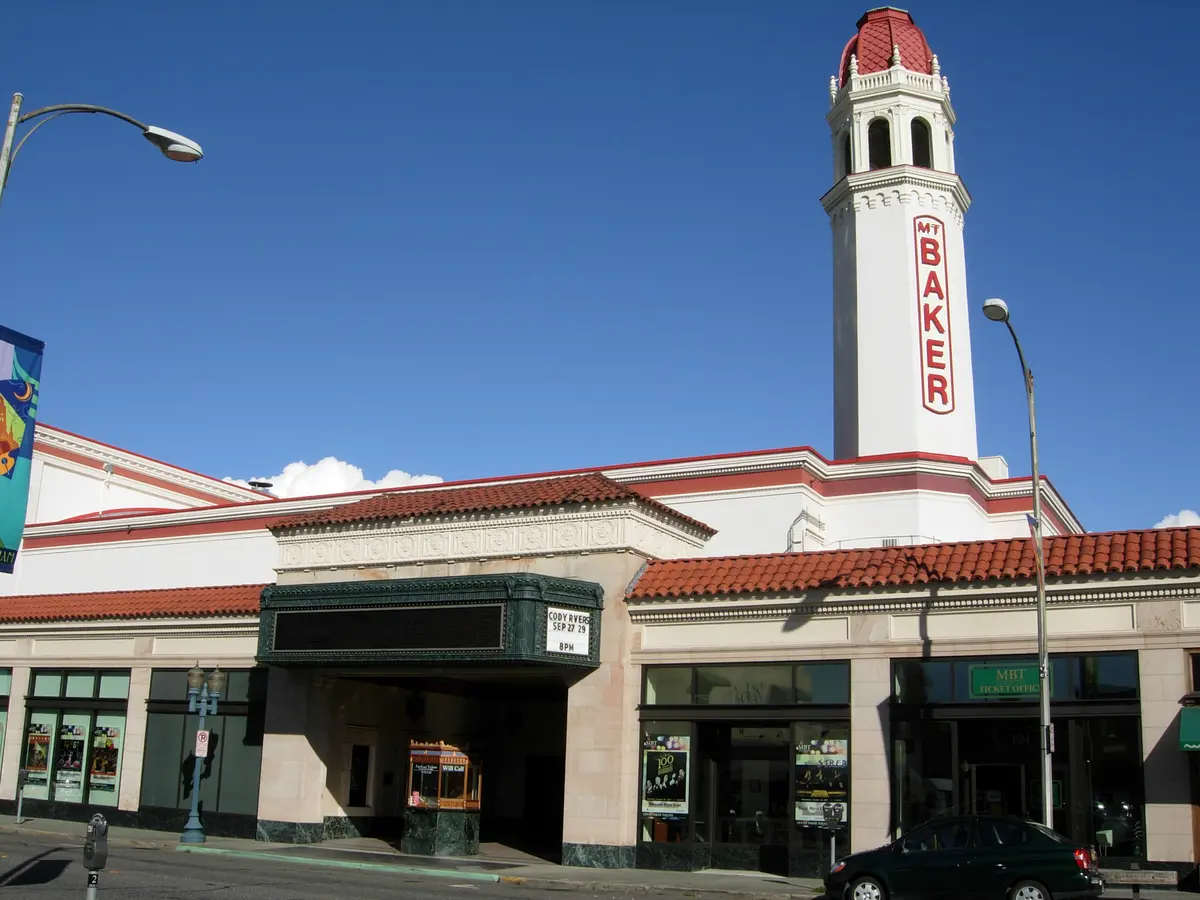
The Mount Baker Theatre is a 1,517-seat performing arts venue in Bellingham, Washington, and the largest theatrical house in the state north of Seattle.
Where is Mount Baker Theatre?
- Location
- Washington, United States
- Type
- Theater
- Coordinates
- 48.752, -122.477
- Last updated
LOCATION
Why is Mount Baker Theatre said to be haunted?
It was built in 1926-27 for West Coast Theatres, the William Fox-controlled circuit, to a Moorish and Spanish Colonial Revival design by Robert Reamer, the architect of Seattle's 5th Avenue Theatre and Yellowstone's Old Faithful Inn; the city of Bellingham owns the building today and a nonprofit runs it. Its resident ghost story concerns a woman called Judy, said to walk the corridor between the balcony and the mezzanine, and told since at least the 1970s. The versions disagree with each other: in one Judy lived in a house cleared from the site, in another she was a construction worker's daughter killed in an accident. The Wikipedia article on the theatre, citing a Bellingham Herald feature of 2002, records the clearance itself, two houses and a church demolished for the theatre, with no death attached to it. Investigators affiliated with Ghost Hunters and a group of psychics spent a night in the building in August 2010.
What is the history of Mount Baker Theatre?
The Mount Baker Theatre, on North Commercial Street in Bellingham, Washington, opened on 29 April 1927. Its nomination to the National Register of Historic Places, prepared in 1976 and certified by the state in September 1978, calls it "Washington's largest and most elaborate movie house north of Seattle": a theatre for 1,638 people with shop space for sixteen retail businesses along Commercial and Champion Streets, built of reinforced concrete on a plan of 130 by 250 feet, with a 110-foot tower that originally carried a searchlight from the Spanish-American War battleship Oregon. The architect was R. C. Reamer of Seattle, who had designed the Old Faithful Inn in Yellowstone and Seattle's Fifth Avenue Theatre, and the builder was A. W. Quist; the nomination gives the cost as $425,000.
The theatre's history page, in the version captured in 2015, says it was built for West Coast Theatres, a circuit controlled by William Fox, in a city of 35,000 whose 1914 directory listed fourteen theatres, and that it had a Style 215 Wurlitzer organ. The nomination describes the Wurlitzer as a $25,000 Hope-Jones unit on a hydraulic lift, still in good repair in 1978. By then, it says, the changes amounted to carpeting, curtains, some furnishings, acoustical tiles and the 35 mm Simplex projectors installed in 1953. The building was entered in the National Register in December 1978.
A restoration of what the theatre then counted as a 1,509-seat house ended with a grand reopening in September 1996. The Wikipedia article on the theatre gives its present capacity as 1,517 in the main house and 200 in the Walton Theatre, with the city of Bellingham as owner and the nonprofit Mount Baker Theatre as operator.
The ghost story belongs to the staff. The 2015 history page says that since the opening night ushers and projectionists "are said to have seen strange happenings", above all after the audience had left: gusts of cold air, balls of light, a rustling of skirts and a voice calling out names. Its central figure is Judy, "an amorous young woman" whose home, theatre workers say, was razed to clear the way for the building, and who haunts the corridor connecting the balcony and the mezzanine; some employees believe she is particularly interested in male projectionists and stage hands. The Wikipedia article, citing features in The Bellingham Herald of 1996 and 2002, adds a second version in which Judy was a construction worker's daughter killed in an accident, a ghost cat in the basement, a man in a pin-striped suit named Geoffry and Michael Chervenock, a theatre worker of the late 1970s who died in 1992. The same article says two houses and a church were demolished to build the theatre.
In August 2010, according to Wikipedia, which cites a report by the Bellingham radio station KGMI dated 6 August 2010, investigators affiliated with Syfy's Ghost Hunters and a group of psychics spent a night in the theatre looking for evidence of paranormal activity.
Timeline: the documented record of Mount Baker Theatre
- August 27, 1926 "Contractor to Start Work at Once": construction begins on the ~$300,000 Moorish-Spanish movie palace for West Coast Theatres (controlled by William Fox of 20th Century Fox), built by Pacific Northwest Theatres Inc. with contractor A.W. Quist and architect R.C. Reamer. The 1978 National Register nomination records the final cost as $425,000.
- 1926 A searchlight from the decommissioned battleship USS Oregon (BB-3), a veteran of the Spanish-American War, made by General Electric, is bought at auction in Bremerton while the ship lies docked there. It will top the theatre's spire, with a range of about 16 miles; on a clear night it can be seen as far as Burlington and Blaine.
- February 23-25, 1927 The Herald front-pages the searchlight's arrival ("Huge, Battle-Scarred Searchlight From Old Warship Oregon Will be Installed in Tower"); two days later it reports the hoisting boom broke under the weight and the relic crashed onto the supporting framing below without damage.
- April 25, 1927 The original electric signage is installed on the Commercial Street facade four days before opening; the Herald reports ("Music is Arranged") that a live band will play outside the theatre from 7 to 10 p.m. on opening night, with streets around the block decorated.
- April 1927 A top-of-the-line Wurlitzer theatre pipe organ is installed: a Style 215 unit costing $20,000 per the theatre's own history; the National Register nomination instead describes a $25,000 Hope-Jones concert unit on a hydraulic lift, still playable in 1978 and able to reproduce a thirty-piece orchestra.
- April 29, 1927 Grand opening fills the house: street decorations, an outdoor band playing 7-10 p.m., and the Edward Sedgwick sports comedy Slide, Kelly, Slide screening for four days ("Picture Selected," Apr 20, 1927). First manager George S. Douglas; head usher Doris Winters hires only brunette usherettes to match the Spanish decor.
- August 27, 1930 MGM's Leo the Lion appears in person at a free promotional show, heralded the previous day under the headline "Thrills Will be Offered Spectators to Free Act When $1,000,000 Insured Leo Will Perform Tricks and Eat Twenty-five Pounds of Raw Beef" (Bellingham Herald, Aug 26, 1930, pg 12).
- November 8, 1931 Manager Art Hile and cashier Olive Keener are robbed at gunpoint by two men brandishing a .45 automatic and a .38 revolver while carrying the night's $800 takings from the box office during a screening of Get-Rich-Quick Wallingford — then one of Bellingham's largest robberies ("Bold Robbery Committed by Pair," Nov 9, 1931, pg 1, 12).
- July-August 1934 Art Hile resigns after roughly five years as manager ("Art Hile Resigns," July 13, 1934, pg 12); Jack Rosenberg succeeds him ("Jack Rosenberg Becomes Manager of Mount Baker," Aug 20, 1934, pg 6).
- January 8, 1935 Bob Monaghan is promoted to the Mount Baker Theatre post ("Bob Monaghan Promoted to Mount Baker Theater Post," pg 3), managing the house into the 1950s.
- 1951 LeRoy S. Kastner era begins (manager 1951-1974 and 1977-1984); Roy Dastner runs the house for over 25 years and is interviewed in June 1978 for the National Register nomination, retained by new owner Don Rosebourne of Hy's of Canada, Ltd.
- 1953 35mm carbon-arc Simplex projectors are installed — recorded in the National Register nomination among the few alterations to an otherwise remarkably intact auditorium.
- May 6, 1976 Richard Vanerwav, education coordinator of the Whatcom Museum of History and Art, prepares the National Register nomination form; Florence K. Lentz (Washington Office of Archaeology and Historic Preservation) edits it in June 1978 and the Deputy State Historic Preservation Officer certifies it on September 18, 1978.
- December 14, 1978 The Mount Baker Theatre is entered in the National Register of Historic Places (NRIS 78002786), significant under criteria A (event) and C (architecture) in the areas of entertainment/recreation and architecture, period 1925-1949, significant year 1927.
- April 7, 1996 The Bellingham Herald publishes "Does a ghost prowl Mount Baker Theater" (Eldon Barrett & Ben Santarris, pg 13-14), documenting staff reports of Judy — said to haunt the corridor between balcony and mezzanine — and quoting the 1926 crews who disturbed "more than just the soil."
- September 1996 A community-funded restoration of the 1,509-seat facility concludes with a grand reopening; a photograph tied to the overhaul captures a ghoulish-looking haze off the balcony — "We are thinking maybe we got a picture of the ghost," says executive director Barry Bonifas.
- April 7, 2002 Aaron M. Tobiason's "Phantom of the Baker" (Bellingham Herald, pg 60) expands the lore: Judy (her house razed for the theatre, or a worker's daughter killed in a construction accident), a feral basement cat, pin-striped-suited Geoffry, and late-1970s staffer Michael Chervenock (d. 1992).
- August 2010 Paranormal investigators affiliated with Syfy's Ghost Hunters and a group of psychics spend a night in the theatre looking for evidence of paranormal activity; KGMI's Dillion Honcoop reports on it (6 August 2010).
- October 2025 Wind nearly knocks the letters "B" and "A" off the spire sign, and the fire department removes them with a ladder truck before they can fall; the Herald explains the gap (Jack Belcher, 23 October 2025), and the city says the letters will be replaced as soon as a safe solution is in place.
Is there a rational explanation for Mount Baker Theatre?
The plainest doubt comes from the theatre's own management. Ruth Shaw, manager from 1984 to 1994, is quoted on its history page as thinking that Judy is an invention: "Their theatrical imaginations, already fertile ground for ghost stories, were stirred by the sensations of a creaky, drafty old building with rich imagery painted and sculptures in the Theatres interior." She listed the "angels, nymphs, dragons, griffins, gargoyles, people, and animals" on the walls, said that from the lobby "an imaginative person looking into the orchestra pit can make out the shape of a coffin", and added with a laugh that "every old theater has to have its resident ghost."
The same page says that most longtime managers and employees have heard the stories and that "some say the stories have improved with age". Judy's origins do not agree with each other: in one her home was razed for the theatre, in another she was a worker's daughter killed during construction. The demolition the Wikipedia article records, two houses and a church, comes in that article with no occupant's name and no death attached.
According to the theatre's own history page, the restoration that ended in September 1996 stirred the legend anew with a photograph tied to the overhaul showing "a ghoulish-looking haze off the balcony", of which the executive director, Barry Bonifas, said: "We are thinking maybe we got a picture of the ghost." The house manager of the time, Margaret Mackay, said of Judy: "I don't think she's malicious." The National Register nomination, the fullest documentary description of the building, describes its ornament and equipment without mentioning a ghost.
Can you visit Mount Baker Theatre?
The Mount Baker Theatre is located at 104 North Commercial Street (historically listed as 104 N. Commercial; box office entrance on North Forest Street), Bellingham, Washington. Public tours are available by appointment through the theatre's administration office. The box office is open for performances and limited daytime hours. The theatre is wheelchair accessible and offers assisted listening devices. Parking is available in nearby city lots and on-street. The venue hosts a full season of performances including Broadway-style productions, concerts, and community events. Tickets and schedules are available at mountbakertheatre.org.
Sources consulted
- Richard Vanerwav (Whatcom Museum of History and Art); edited by Florence K. Lentz, WA Office of Archaeology and Historic Preservation, «National Register of Historic Places Inventory - Nomination Form: Mount Baker Theatre» — U.S. Department of the Interior, National Park Service (NRIS 78002786), 1978 report
- Wikipedia contributors, «Mount Baker Theatre, History section (citing "Contractor to Start Work at Once", The Bellingham Herald, August 27, 1926, pg 1, 7)» — Wikipedia, 2026 web
- Wikipedia contributors, «Mount Baker Theatre, Architecture section (citing "Huge, Battle-Scarred Searchlight From Old Warship Oregon Will be Installed in Tower of Mount Baker Theater Here", The Bellingham Herald, February 23, 1927, pg 1-2)» — Wikipedia, 2026 web
- Wikipedia contributors, «Mount Baker Theatre, Architecture section (citing "Relic Not Damaged As Hoisting Boom Breaks", The Bellingham Herald, February 25, 1927, pg 1, 5)» — Wikipedia, 2026 web
- Wikipedia contributors, «Mount Baker Theatre, History section (citing "Music is Arranged", The Bellingham Herald, April 25, 1927, pg 10)» — Wikipedia, 2026 web
- Wikipedia contributors, «Mount Baker Theatre, History section (citing "Picture Selected", The Bellingham Herald, April 20, 1927, pg 11)» — Wikipedia, 2026 web
- Wikipedia contributors, «Mount Baker Theatre, Events section (citing "Thrills Will be Offered Spectators to Free Act When $1,000,000 Insured Leo Will Perform Tricks and Eat Twenty-five Pounds of Raw Beef", The Bellingham Herald, August 26, 1930, pg 12)» — Wikipedia, 2026 web
- Wikipedia contributors, «Mount Baker Theatre, History section (citing "Bold Robbery Committed by Pair", The Bellingham Herald, November 9, 1931, pg 1, 12)» — Wikipedia, 2026 web
- Wikipedia contributors, «Mount Baker Theatre, Managers section (citing "Art Hile Resigns", The Bellingham Herald, July 13, 1934, pg 12)» — Wikipedia, 2026 web
- Wikipedia contributors, «Mount Baker Theatre, Managers section (citing "Jack Rosenberg Becomes Manager of Mount Baker", The Bellingham Herald, August 20, 1934, pg 6)» — Wikipedia, 2026 web
- Wikipedia contributors, «Mount Baker Theatre, Managers section (citing "Bob Monaghan Promoted to Mount Baker Theater Post", The Bellingham Herald, January 8, 1935, pg 3)» — Wikipedia, 2026 web
- Wikipedia contributors, «Mount Baker Theatre, Managers section (citing Steve Landau, "Mount Baker's New Manager no Stranger to the Theater", The Bellingham Herald, August 14, 1977, pg 40)» — Wikipedia, 2026 web
- Mount Baker Theatre, «A Rich History (incl. The Ghost section, Barry Bonifas, Margaret Mackay and Ruth Shaw quotes)» — Official website (via Wayback Machine, captures 2004 and 2015), 2015 web
- Wikipedia contributors, «Mount Baker Theatre, Ghosts section (citing Eldon Barrett and Ben Santarris, "Does a ghost prowl Mount Baker Theater", The Bellingham Herald, April 7, 1996, pg 13-14)» — Wikipedia, 2026 web
- Wikipedia contributors, «Mount Baker Theatre, Ghosts section (citing Aaron M. Tobiason, "Phantom of the Baker", The Bellingham Herald, April 7, 2002, pg 60)» — Wikipedia, 2026 web
- Dillion Honcoop, «Could the Mount Baker Theatre be Haunted?» — KGMI News, August 6, 2010, 2010 newspaper archive
- Jack Belcher, «Here's why two letters are missing from the Mount Baker Theatre sign in Bellingham» — The Bellingham Herald, 23 October 2025, 2025 newspaper archive
- Dorothy Koert, «A History of Whatcom County Theater» — Bellingham Public Library (local history collection), 1996 book
- Emily Krahn, «Soul Survivor» — Klipsun Magazine, Western Washington University, Fall 2006, 2006 academic
- Wikipedia contributors, «Mount Baker Theatre - Wikipedia (History, Events, Architecture, Managers, Ghosts sections)» — Wikipedia, 2026 web
Reviewed by V. Serrano on 2026-08-24 · How we verify our content
📎 Source: Wikipedia (CC BY-SA)
💬 Field testimonies (0)
No testimonies yet. Add the first.
Add your testimony
🔒 Log in to add a testimony