👻 HAUNTED PLACE · EXP. Nº9478
ACTIVE
Mudhouse Mansion
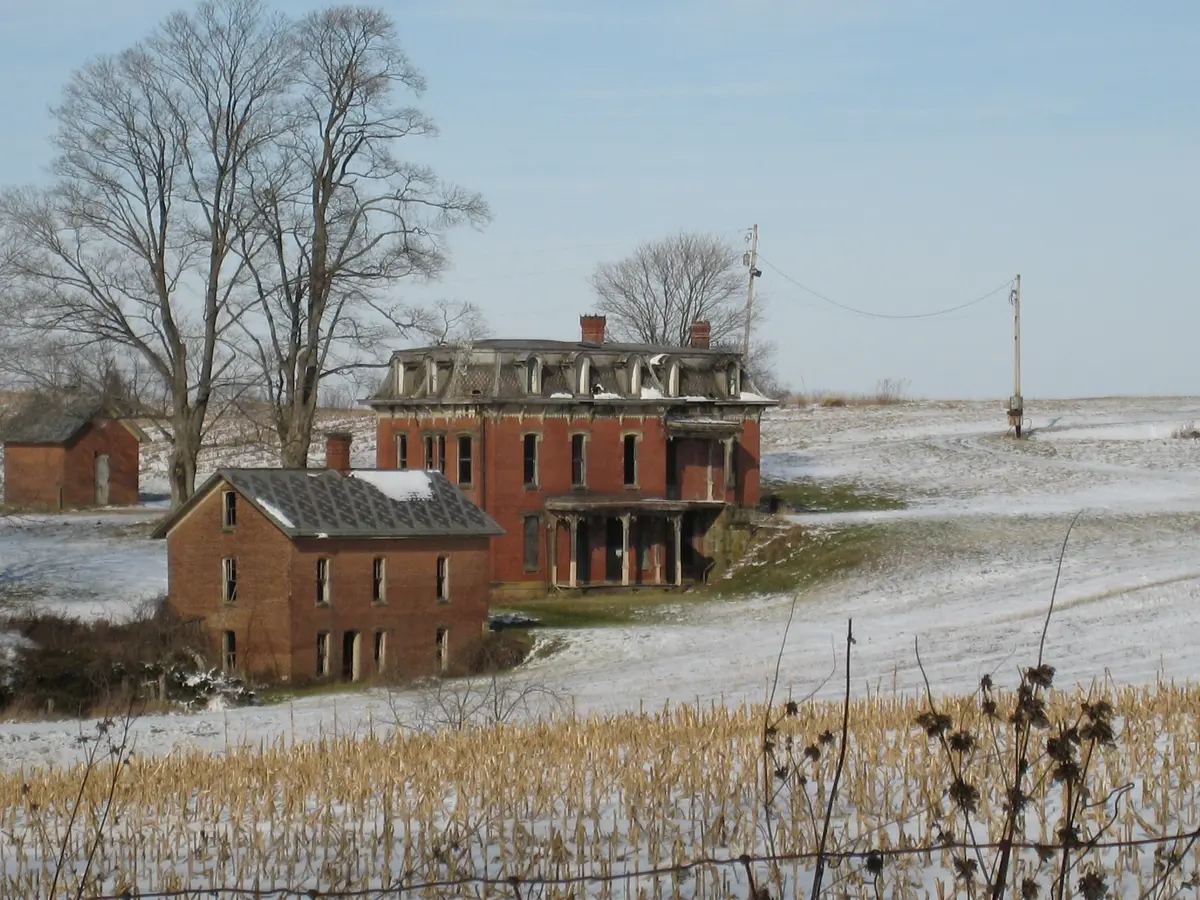
Mudhouse Mansion stood on Mud House Road in Pleasant Township, east of Lancaster, Ohio, until it was demolished on 21 September 2015.
Where is Mudhouse Mansion?
- Location
- Ohio, United States
- Type
- House / mansion
- Coordinates
- 39.755, -82.506
- Last updated
LOCATION
Why is Mudhouse Mansion said to be haunted?
It was a three-storey brick house with a mansard roof, built on the Rugh family farm after 1875 - the house engraved in the 1875 county atlas is the plain Federal farmhouse it replaced. What made it Ohio's most photographed haunted house was not a crime but an absence: the owners after 1890 mostly did not live in it, and it stood empty at the end of a long private drive for the better part of a century. The oldest datable version of the legend, archived in August 2002, tells of a government official who kept enslaved people locked in an outbuilding after the Civil War until one of them tunnelled out and killed the family; other strands make it the home of the original Bloody Mary. No court record, no inquest and no enslaved person has ever been traced to the property, and Ohio had barred slavery since 1802. The owner refused every offer to turn it into an attraction, and her son called it "just a farmhouse" as the excavators went in.
What is the history of Mudhouse Mansion?
The farm came first, and the farm is the part that is documented.
Christian Rugh (1803-1873) married Eleanor Spohn in June 1835 and put together a holding in section 23 of Pleasant Township, east of Lancaster, in Fairfield County, Ohio. The names usually attached to the purchase - Abraham Kagy and Henry Byler, in 1839 or 1852 - travel from retelling to retelling rather than from any deed that has been published. The genealogist who went through the census returns, wills and township maps in 2016 for the blog Rambling Genealogy found that Kagy, Rugh's brother-in-law, had already moved to Seneca County before 1830, and that the two men named Henry Byler had died or left the township by the 1840s and 1850s. What is firm is the 1860 census: 288 acres, valued at $11,520. By Rugh's death in 1873 the tract was 270 acres, thirteen having gone to a neighbour named John Martz. The same 270 acres are still one parcel today.
One of Rugh's sons, Thomas B. Rugh, had died in Kentucky in 1862 serving in the Union army. Christian's will left the Pleasant Township farm to his eldest son, William Henry Rugh, and the Berne Township land to the youngest, Benjamin Franklin.
Here is the detail that quietly undoes the usual dating. The house engraved in the 1875 Atlas of Fairfield County, Ohio - the plate the Lancaster Eagle-Gazette cited in 2015 to say the mansion "appeared in the 1875 Fairfield County atlas" - is not the mansion. It is a plain Federal-style farmhouse, drawn with the Rugh children and a dog beside it. The three-storey brick house with the mansard roof went up on the same ground after 1875, and later notices describe it as "newly improved" and a "modern pressed brick house". The smaller brick building that stands to the left of the mansion in almost every photograph of the site is very probably that older farmhouse, remodelled. (The atlas plate also explains the name "William Pugh" that the newspaper read off it in 2015: the Pleasant Township owner in those years was William Henry Rugh.)
And then, remarkably, almost nobody lived in it. Maria Sites Rugh, William Henry's wife, died in 1890 - she is the only person the documentary record places as dying in the house - and he left for Madison Township, in Pickaway County. The farm was advertised for sale in 1917, nearly went to Lewis E. Ruff of the Fairfield Oil & Gas Company, and was bought in 1919 by Henry Hartman (1855-1930). Hartman did not move in: every enumeration of him gives his Pitcher Street address in Lancaster. On his death the property passed inside the family to his daughter Lulu Victoria Hartman Mast (1888-1952), and her descendants, the Masts, farm the land still.
So the building that became one of Ohio's most photographed haunted houses spent most of its existence not as a scene of anything, but as an expensive empty box at the end of a long private drive.
Timeline: the documented record of Mudhouse Mansion
- 1860 The federal census records Christian Rugh's farm in Pleasant Township at 288 acres, valued at $11,520. By his death in 1873 it is 270 acres, thirteen having passed to a neighbour, John Martz.
- 1862 Thomas B. Rugh, Christian's second son, dies in Kentucky serving in the Union army - a detail that sits awkwardly against the legend that the family kept slaves after the war.
- 1875 The Atlas of Fairfield County, Ohio engraves the Pleasant Township farm. The house on the plate is a plain Federal-style farmhouse, not the Second Empire mansion: the mansion is built on the same ground afterwards.
- 1890 Maria Sites Rugh dies - the only person the documentary record places as dying in the house. Her widower, William Henry Rugh, leaves for Pickaway County and the mansion begins the long emptiness that defines it.
- 1919 After being advertised for sale in 1917, the farm is bought by Henry Hartman (1855-1930). He never moves in: every census entry gives his Pitcher Street address in Lancaster. In 1930 the property passes to his daughter Lulu Hartman Mast.
- 9 August 2002 Earliest archived capture of Andy Henderson's Forgotten Ohio page, the oldest datable version of the legends: the government official keeping slaves in an outbuilding, a later family massacred, and the house as the home of the original Bloody Mary. No albinism, no unwashable blood.
- 17 July 2003 A fire damages the ground floor. The Lancaster Eagle-Gazette police beat reports it two days later as a fire in an abandoned house in the 4500 block of Mudhouse Road, with no mention of ghosts.
- 24 July 2008 Scary For Kids publishes the elaborated narrative that most retellings now follow: the tunnelling slave, a family of five hanged in white nightgowns in 1892, and the figure at the upstairs window that had been hanging there for ten days.
- 21 September 2015 The house is demolished by Kull Excavating in about two hours. David Mast, son of the owner Jeane Mast, calls it "just a farmhouse" and says he never understood where the ghost stories came from. A crew member poses in the windows in a white sheet.
- 27 February 2016 A genealogical reconstruction from censuses, wills and township maps is published on Rambling Genealogy. It finds no crime, no court record and no enslaved people on the property, and calls the ghost stories "a hoax perpetuated by troublemakers".
Is there a rational explanation for Mudhouse Mansion?
Start with what the legend actually says, because it matters who is in it.
In every source of record the people locked up at Mudhouse are enslaved Black adults, not children. The oldest version that can be dated - Andy Henderson's Forgotten Ohio page, whose earliest archived capture is 9 August 2002 - tells of "a government official who lived there after the Civil War and still kept slaves (in the North, too), locking them in one of the outbuildings at night", until one of them dug his way out and killed the whole family. The same story, with the same outbuilding, is on Ohio Trespassers and Grave Addiction, and Scary For Kids expanded it into a full narrative on 24 July 2008, adding a family of five found hanging in white nightgowns in 1892 and a woman at an upstairs window who had not been standing there for ten days but hanging. A third strand makes the house the childhood home of Bloody Mary; children in Lancaster called it Mary's House.
Nothing in that corpus involves albinism, and nothing involves blood that cannot be washed off a wall. Searched for the string albin- across roughly 110 KB of the six pages that carry the legend - Forgotten Ohio in 2002 and 2013, Scary For Kids 2008, Grave Addiction 2013, Ohio Trespassers 2010 and Roadside America - the count is zero, against 2 to 17 hits for slave in the same sweep of the same files on the same day.
The slavery story is impossible on its own terms, and locals have said so for years. Ohio's 1802 constitution barred slavery, and the tale is set after a Civil War that ended it everywhere. The genealogical reconstruction published on Rambling Genealogy goes further: the Rughs came from a Mennonite background, a Rugh son died in Union uniform in 1862, and there is no crime, no inquest and no court record attached to the property at all. Its author's conclusion, published on 27 February 2016, is blunt: the house looked sad and creepy because it was neglected, and the ghost stories are "a hoax perpetuated by troublemakers" that persuaded people it was acceptable to trespass.
There is also no commercial incentive here, which is unusual. Nobody ever sold a ticket to Mudhouse Mansion. The owner, Jeane Mast, refused a company that wanted to turn it into a Halloween attraction, refused people who asked politely to photograph it, sat outside in a lawn chair to wait for trespassers, and pressed charges; a neighbour, Cindy Herd, told the Eagle-Gazette she had been reporting trespassers to the sheriff for twenty-three years. Her son David Mast, watching the demolition in 2015, called the place "just a farmhouse" and said he had never understood where the ghost stories came from. One of the demolition crew put on a white sheet and posed in the windows as the excavator moved in.
What is left, then, is the most ordinary explanation of all, and the documents support it: a large, isolated, architecturally odd brick house that stood empty for most of a century at the end of a private drive, visible from the road and reachable by nobody. An empty house of that kind attracts a story the way a wall attracts graffiti - and this one attracted two fires as well, one inside the mansion on 17 July 2003, reported without a word of ghostlore in the Eagle-Gazette police beat two days later.
One claim now circulating online should be set aside: that a concealed board bearing a builder's name and the date 6 December 1887 turned up during the demolition. It appears in an AI-generated encyclopaedia entry and I have not found it in the newspaper coverage of the demolition, in the genealogical reconstruction or anywhere with a source attached. Until someone produces the board or a photograph of it, it is not evidence of anything.
Can you visit Mudhouse Mansion?
There is nothing to visit. Mudhouse Mansion was pulled down on Monday 21 September 2015 by Kull Excavating, in about two hours, with the owner's son David Mast watching and a small crowd of neighbours on the road. One wall was already buckling before the machines arrived. The seven-bedroom house had no plumbing, some rooms had electricity, and the floors were spongy with rot; a contractor on site estimated three million dollars to bring it up to code as a bed and breakfast. Salvaged fittings were advertised for sale afterwards by Davis Services.
The 270 acres on Mud House Road, in Pleasant Township, remain private working farmland belonging to the Mast family. "We'll clean it up and start and plant corn," David Mast said on the day. There is no legal access of any kind, there never was, and this is the rare case where the warning is not decorative: trespassers at this address were prosecuted for decades, and Forgotten Ohio published emails from people sentenced to two days in jail and two years' probation for walking round the house with a camera. Please do not drive out to look for it.
A note on how current this is. As of August 2026 I could not confirm the parcel's present condition from the county's own records: the Fairfield County auditor's real-estate search sits behind an automated-access challenge, and the address fairfieldcountyauditor.com is not the county at all but a parked domain offered for sale. The description above therefore rests on the newspaper coverage of the demolition and its 2024 anniversary piece, both from the Lancaster Eagle-Gazette.
What can be seen is photographic. The Wayback Machine holds Forgotten Ohio's pages from 2002 onwards, including interior photographs, and Wikimedia Commons has the exterior view used on this page. Lancaster, the county seat, lies about six kilometres to the west and has a large stock of nineteenth-century architecture that is genuinely open to visitors.
Sources consulted
- Spencer Remoquillo, «Mudhouse Mansion demolished» — Lancaster Eagle-Gazette, 2015 newspaper archive
- Kristie, «Mudhouse Mansion (genealogical reconstruction of the Rugh, Hartman and Mast ownership from censuses, wills and township maps)» — Rambling Genealogy, 2016 archive
- Andy Henderson, «Mudhouse Mansion (earliest archived capture, 9 August 2002)» — Forgotten Ohio, 2002 web
- Lancaster Eagle-Gazette, «Police Beat: fire at an abandoned house in the 4500 block of Mudhouse Road (19 July 2003), reproduced in full on Forgotten Ohio» — Lancaster Eagle-Gazette, 2003 newspaper archive
- Scary For Kids, «Mudhouse Mansion (urban legend, published 24 July 2008)» — scaryforkids.com, 2008 web
- Jeff Barron, «The infamous Mudhouse Mansion met its demise nine years ago this month» — Lancaster Eagle-Gazette, 2024 newspaper archive
- Chris Riley, «Reflections on the Demolition of "Mudhouse Mansion"» — Historic Architecture of Ohio, 2015 web
- Loren Coleman, Andy Henderson and James A. Willis, «Weird Ohio: Your Travel Guide to Ohio's Local Legends and Best Kept Secrets (Sterling; its co-author Andy Henderson describes a two-page spread on Mudhouse Mansion)» — Sterling Publishing, 2005 book
- Ohio History Connection, «Ohio Memory digital collections (Ohio History Connection): search for "Mudhouse" returns 12 items, none of them the Fairfield County house; controls the same day, "Lancaster" 44,518 and "Zane's Trace" 71» — Ohio Memory, 2026 archive
Reviewed by V. Serrano on 2026-08-18 · How we verify our content
💬 Field testimonies (0)
No testimonies yet. Add the first.
Add your testimony
🔒 Log in to add a testimony