👻 HAUNTED PLACE · EXP. Nº9477
ACTIVE
New London Ledge Light
New London Ledge Light is a location reputed to be haunted in Connecticut, US. Its reputation comes from reported apparitions, unexplained phenomena and eyewitness accounts gathered over time.
Where is New London Ledge Light?
- Location
- Connecticut, US
- Type
- Lighthouse
- Coordinates
- 41.306, -72.077
- Testimonies
- 0
- Last updated
LOCATION
Why is New London Ledge Light said to be haunted?
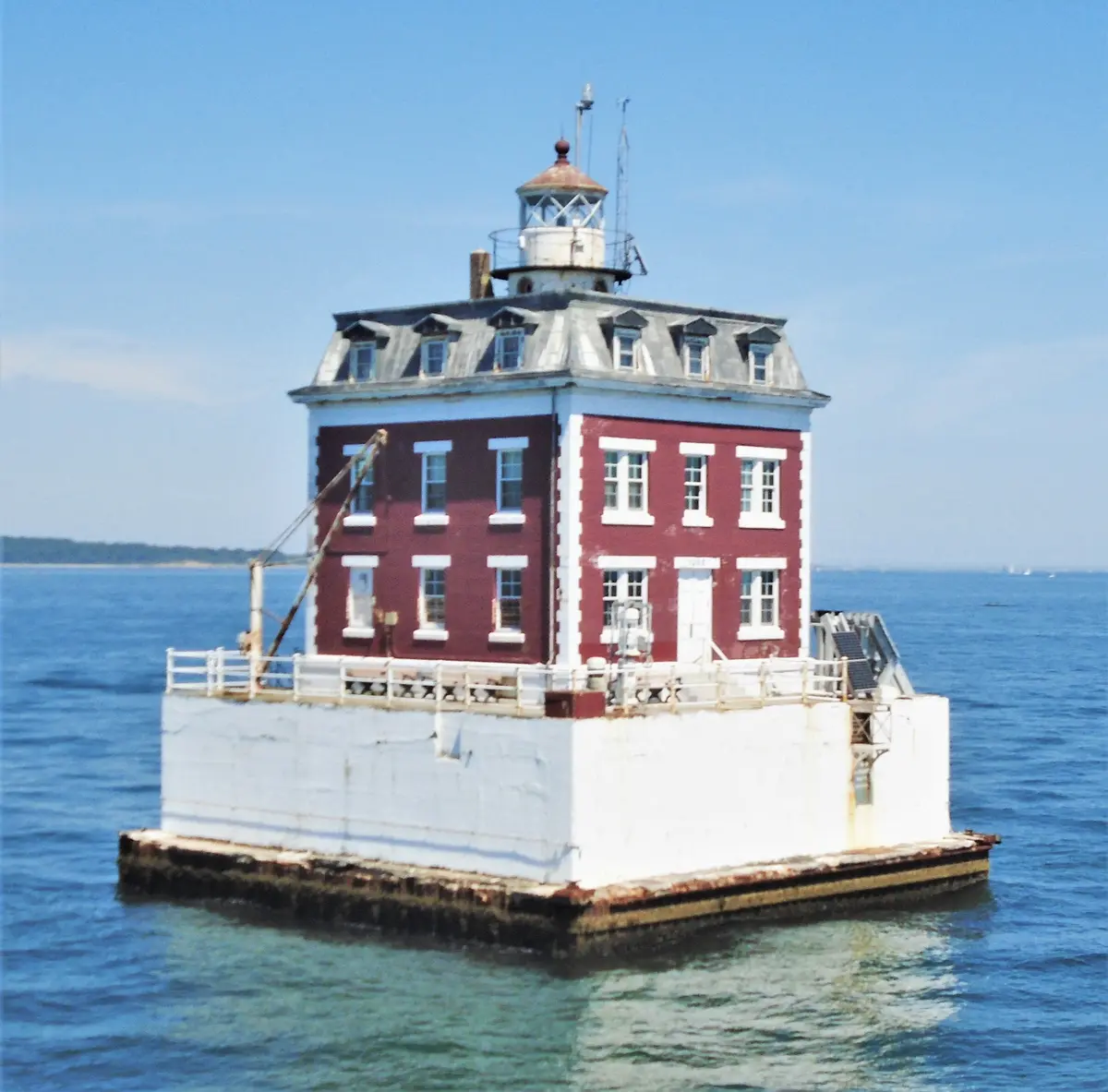
New London Ledge Light is a three-storey brick house with a mansard roof standing on a concrete pier in the middle of the entrance to New London Harbor, Connecticut. It was placed in operation on 10 November 1909, after the Lighthouse Board had asked Congress for it eleven times, and it cost $93,968.96. Its fame rests on a ghost called Ernie, said to be a keeper of the 1920s or 1930s who jumped from the roof when his wife left him for the captain of the Block Island ferry. No keeper of that name appears in either of the two independently compiled lists of the station's personnel between 1909 and 1987, and the oldest dated version of the story, given by two psychics in 1981, has neither a wife nor a ferry. The lighthouse's own owner, the New London Maritime Society, writes that the noises the Coast Guard crews reported were a practical joke. The building is real, documented down to the price of its concrete, and open to visitors in summer.
What is the history of New London Ledge Light?
The ledge was marked as a danger long before anything was built on it. Connecticut ceded the rocks and ledges off New London Harbor to the federal government in 1790, and in 1794 Congress provided for a buoy on Southwest Ledge, paid for out of import duties and tonnage fees. In 1853 Henry Hobart, Superintendent of Lights at New London, canvassed local captains and reported that the opinion was universal: a light instead of a buoy on Black Ledge "would be a great additional protection to vessels navigating Long Island and Fisher's Island sounds". Hobart sent the Lighthouse Board a signed petition and two letters that October, and nothing happened for nearly six decades.
The Board asked Congress for the money in 1890. "The necessity for establishing a light and an efficient steam fog signal in such a position as to enable vessels to enter and leave the harbor of New London, Conn., has become evident, and especially so for the aid of those approaching from seaward," it wrote, adding that the existing harbour light stood "so far inside the obstructions as to be partially ineffective". The Board repeated the request eleven times before Congress acted, on 28 April 1904, with $60,000 "for establishing a light and fog-signal at or near Black Ledge"; the Board then shifted the site a quarter of a mile west to Southwest Ledge, which left the ship channel clear, and the extra $55,000 that the better site cost did not arrive until 4 March 1909. An act of 4 March 1907 had meanwhile allowed a contract to be signed against a ceiling of $115,000.
Bids were opened on 4 June 1908 and the work went to the T.A. Scott Company of New London for $73,000. Scott's yard on the Groton bank of the Thames built a timber crib of southern yellow pine held together with nine tons of iron and steel; four tugboats towed it out to the ledge on 18 August 1908, a journey of eight hours, and it was sunk in twenty-eight feet of water and filled with concrete, gravel and riprap. The Lighthouse Bureau described the result in 1912: "The top of the crib extends 3 feet above mean low water and is capped inside the upper timbers with a layer of concrete 3 feet thick. This layer supports a concrete pier 50 feet square to a height of 18 feet above low water." The brick dwelling on top of that pier, about thirty-two feet square, was sublet to the New London firm of Hamilton R. Douglas, builders of Groton Town Hall, and the finished station cost $93,968.96.
It was placed in operation on 10 November 1909. The fourth-order lens, made in Paris by Henry-Lepaute and turned by a clockwork train that had to be wound every four hours, threw a 22,000-candlepower signature of three white flashes followed by one red flash every thirty seconds; a first-class six-inch air siren sounded a three-second blast every twenty seconds in thick weather, and in 1911 it took over the fog-signal duty from New London Harbor Light. The official name had been changed from Southwest Ledge to New London Ledge just before the opening, to keep it apart from the Southwest Ledge light off New Haven, "but the lighthouse was still often referred to as Southwest Ledge".
Even the style is disputed by the two bodies that document it. The 1985 National Register form, written by the historian Dorothy B. Templeton, calls the building a rare twentieth-century revival lighthouse that "reflects the Influence of the early Colonial Revival" in its red brick and white trim, prominent quoins and pedimented dormers. The Maritime Society's own library exhibit describes the same walls as "simplified French Second Empire style" and files under "rumored" the story that wealthy residents of the Pequot Colony neighbourhood wanted something picturesque to look at from their lawns.
Wilford B. Petty took charge in 1909 and George E. Hansen followed him in 1910, staying until at least 1917. Howard B. Beebe was principal keeper when the hurricane of 21 September 1938 struck, inside with a second assistant and a tinsmith while his family was ashore. "It washed out everything," Beebe said, and he told the Providence Journal: "About 3:15, the engines conked out, but the light was going. We moved to the lantern. It was a three-story building. Waves were coming through the second floor. I've seen waves before, in the Bay of Fundy, but I never saw them like that. There was 11 tons of coal in the cellar, and it boiled it all out." The outer timber crib was taken off that same year and a new boarding ledge built in its place.
The Lighthouse Service was folded into the Coast Guard in 1939. William Ivan Clark, moved here from Little Dumpling Light in New York on account of his health, was the last civilian keeper, from 1954 to 1959. Coast Guard crews held the station after him: Ed Jonin, aboard from 1974 to 1976, remembered "fog for weeks at a time, with those damn foghorns blowing every few seconds, trying to sleep with them on", and Petty Officer 1st Class Timothy Grant told the New York Times in 1984 that "after a week ashore, I can't wait to get back here."
The Fresnel lens came out in 1984 and a smaller automated rotating light replaced it. On 1 May 1987 Bill Grace lowered the flag and the last crew left, closing the last manned lighthouse on Long Island Sound. "I'm glad to get the hell off here," Grace said. "I'm glad it will free me up, but I think they should keep it manned." The building was leased to the New London Ledge Lighthouse Foundation in 1988 and listed on the National Register on 29 May 1990, reference 89001471, under the thematic nomination "Operating Lighthouses in Connecticut". A Coast Guard plan to bolt a solar array onto the station produced the Historic American Engineering Record survey HAER No. CT-172, written by Virginia H. Adams and Matthew A. Kierstead precisely because the array "will impact the historic and engineering integrity of this property"; the panels went up in 1998 and stand on the right-hand corner of the pier in photographs taken since. The Foundation cleaned and repainted the lighthouse inside and out in 2011 and put an interpretive centre in it. On 1 May 2013 the General Services Administration declared the station surplus and "being made available at no cost to eligible entities", and the New London Maritime Society took ownership in 2015.
Timeline: the documented record of New London Ledge Light
- 1890 The Lighthouse Board asks Congress for a light and fog signal at the harbour entrance, arguing that the existing New London Harbor Light stands "so far inside the obstructions as to be partially ineffective". The request is repeated eleven times before it is funded.
- 28 April 1904 Congress appropriates $60,000 "for establishing a light and fog-signal at or near Black Ledge". The Board then moves the site a quarter of a mile west to Southwest Ledge, which needs a further $55,000 and delays the work five more years.
- 18 August 1908 Four tugboats tow the timber crib built at the T.A. Scott yard in Groton out to Southwest Ledge, an eight-hour journey, and it is sunk in twenty-eight feet of water and filled with concrete, gravel and riprap.
- 10 November 1909 The station is placed in operation with a fourth-order Henry-Lepaute lens showing three white flashes followed by one red flash every thirty seconds. The total cost of the lighthouse is $93,968.96.
- 21 September 1938 Principal keeper Howard B. Beebe rides out the hurricane inside the lighthouse with a second assistant and a tinsmith. "About 3:15, the engines conked out, but the light was going," he told the Providence Journal. The outer timber crib is removed the same year.
- 2 October 1981 John Garosshen, a contractor fitting metal safety railing, falls about twenty-five feet from the lighthouse into the water and is pulled out alive by coastguardsmen Richard J. Mumenthaler and Vernon L. Smith. It is the same year in which two psychics from Chester are said to have named the ghost Ernie.
- 1984 The fourth-order Fresnel lens is dismantled and taken out of the lantern room, replaced by a smaller automated rotating light. The lens goes ashore to the Custom House Maritime Museum in New London.
- 1 May 1987 Bill Grace lowers the flag and the last Coast Guard crew leaves, closing the last manned lighthouse on Long Island Sound. The final log entry reads "Rock of slow torture. Ernie's domain. Hell on earth".
- 29 May 1990 New London Ledge Lighthouse is listed on the National Register of Historic Places, reference 89001471, under the multiple property nomination "Operating Lighthouses in Connecticut".
- 31 August 2005 Ghost Hunters broadcasts "The Ledge Lighthouse". The team traces the lights on its footage to one of its own cameras and the face in a window to one of its own investigators, and reports "more lore than fact at work in the lighthouse".
- 2015 The New London Maritime Society takes ownership of the lighthouse under the National Historic Lighthouse Preservation Act of 2000, two years after the General Services Administration declared it surplus to the Coast Guard.
Is there a rational explanation for New London Ledge Light?
The legend has a fixed shape: a keeper of the 1920s or 1930s learned that his wife had run off with the captain of the Block Island ferry and threw himself from the roof; his name is sometimes given as John Randolf or Randolph. Jeremy D'Entremont, who has compiled the station's records for years, puts it plainly: "If there's any truth behind the legend, it's elusive."
The rolls are the first place to look, and two lists compiled independently — D'Entremont's and the one on Lighthousefriends — cover the head keepers and their assistants along with the Coast Guard crews from 1909 to 1987. Neither list carries a Randolph; what they do carry, in exactly the decade the story wants, are two men called Ernest: Ernest F. Witty, second assistant from 1931 to 1934, and Ernest Metiver, second assistant from 1934 to 1937. Both left the station alive as far as the lists record, and D'Entremont warns that his own is "a work in progress" and open to correction, so this is a gap in the story rather than a refutation of it.
The oldest dated version of the tale does not match the popular one either. Lighthousefriends places the naming of the ghost in 1981, with two psychics from Chester, Roger and Nancy Pile, who identified Ernie as an "earthbound" spirit; in their account he cut his own throat with a fishing knife after a bitter quarrel with his girlfriend, and "the Piles say they forgot to ask when" the death happened. There is no wife and no ferry captain in that telling. One fall from the building is on record for that same year: on 2 October 1981 John Garosshen, a contractor fitting metal safety railing, slipped and dropped about twenty-five feet into the water, and coastguardsmen Richard J. Mumenthaler and Vernon L. Smith pulled him out alive. A separate investigation by the New England Ghost Project proposed that Ernie was a member of a construction crew who fell from the roof and died, which is the same accident with the ending changed.
The owner of the lighthouse is its bluntest sceptic. After listing the knockings at night, the doors opening and closing, the television switching itself on and off and the sheets pulled off the beds, the New London Maritime Society's own page ends the paragraph: "Of course, Coasties are famous for playing practical jokes...and that's what this was!"
Ghost Hunters filmed here for the episode "The Ledge Lighthouse", broadcast on 31 August 2005, guided by Jerry Olson, vice-president of the Ledge Lighthouse Foundation, who showed the team the water tanks, then the room the Japanese crew had used, then the spot where Ernie is said to have jumped. In the analysis the lights on the recording turned out to come from one of the team's own cameras and the face in a window turned out to be their own investigator Andy. Jason Hawes and Grant Wilson reported "a few unexplained phenomena, such as cold spots, but not enough for TAPS to say there's paranormal activity", and Hawes concluded there was "more lore than fact at work in the lighthouse".
The earliest document in which the name appears at the station, and which can be read rather than reported at second hand, is the log entry made on the last night of manned operation in 1987: "Rock of slow torture. Ernie's domain. Hell on earth -- may New London Ledge's light shine on forever because I'm through. I will watch it from afar while drinking a brew." It is a complaint about eighteen-month tours on a rock, written by a man leaving for good, and it names Ernie as a fixture the crew already lived with.
Can you visit New London Ledge Light?
The lighthouse stands offshore, on the east side of the main channel at the entrance to New London Harbor and, in the words of the 1985 National Register form, "1/4 mile West of Black Ledge". There is no way to reach it on foot.
The interior does open: the New London Maritime Society runs a boat trip billed as "Explore Ledge Light - Boat Trip & Tour inside the lighthouse", advertised for 20 June to 19 September 2026 in afternoon sailings, and the Society describes the point of it as a chance to "climb up to the lantern room in the middle of New London Harbor". The 2026 listing moves the departure: "This year we're leasing the water taxi, so trips will leave from beside the City Pier in downtown New London -- right behind the train station", at 1 Waterfront Park. The trip lasts "90-minutes long: 15 minutes out, one hour on the light, and 15 minutes back", is timed to high tide and is weather-dependent, and the booking page states flatly that "there are no toilets on the boat or at the lighthouse". Landing is a physical business: passengers "balance on the edge of a boat and climb directly up a ladder to reach the platform", in "deck shoes or sneakers", with sandals and flip flops ruled out. A Veolia and New London Water Authority grant funds fourteen $5 seats per trip for residents of New London or Groton who bring proof of address; the standard fare is not printed on the listing.
On 7 September 2026 the Society's front page reads "Tickets to Ledge Lighthouse have been temporarily suspended", and in July 2025 the Society described its volunteers as preparing "the first public Ledge Light tours in two years", so the season has been interrupted twice in three years.
The original fourth-order Henry-Lepaute lens and the station's fog horn are ashore at the Custom House Maritime Museum, 150 Bank Street, New London, Connecticut 06320, telephone 860-447-2501, open "Thursday through Sunday 1 to 5 PM" and from 10 AM on Saturdays. Admission is $10, $6 for youth to age 16 and $25 for a family, and holders of a SNAP Electronic Benefits Transfer card enter free with up to three companions, with no limit on repeat visits.
From land D'Entremont's guide reports that the lighthouse is visible "fairly distantly from the shore of New London, especially in the Pequot Avenue area", and that the Fishers Island and Block Island ferries out of New London give a good view. The Coast Guard still owns and maintains the lamp and the lantern. The two federal files on the building are free downloads: the National Register nomination under reference 89001471 and the nine data pages of HAER No. CT-172 at the Library of Congress.
Sources consulted
- Dorothy B. Templeton, John Milner Associates, Inc., «National Register of Historic Places Inventory-Nomination Form: New London Ledge Lighthouse (reference 89001471), with 1989 amendment and supplementary listing record» — U.S. National Park Service / Connecticut Historical Commission, 1985 report
- Virginia H. Adams and Matthew A. Kierstead, The Public Archaeology Laboratory, Inc., «New London Ledge Lighthouse, HAER No. CT-172: Photographs, Written Historical and Descriptive Data» — Historic American Engineering Record, Library of Congress, 1997 report
- Kraig Anderson, «New London Ledge Lighthouse, Connecticut» — Lighthousefriends.com, 2026 web
- Jeremy D'Entremont, «New London Ledge Light history» — New England Lighthouses: A Virtual Guide, 2026 web
- New London Maritime Society, «New London Ledge Light: history, ownership and tours» — nlmaritimesociety.org, 2026 web
- New London Maritime Society, «Explore Ledge Light - Boat Trip & Tour inside the lighthouse (2026 season listing)» — Humanitix, 2026 web
- Syfy, «Episode Recap: The Ledge Lighthouse (Ghost Hunters, season 2, episode 6)» — Ghost Hunters Blog, Syfy, 2005 web
- Frank L. McGuire Maritime Library, New London Maritime Society, «New London Ledge Light: The House in the Harbor» — Keeper of the Lights (online exhibit), 2026 web
Reviewed by V. Serrano on 2026-09-07 · How we verify our content
💬 Field testimonies (0)
No testimonies yet. Add the first.
Add your testimony
🔒 Log in to add a testimony