👻 HAUNTED PLACE · EXP. Nº9477
ACTIVE
Northam Bridge
The road bridge over the River Itchen linking Northam and Bitterne Manor, in Southampton, carries a layered ghost tradition.
Where is Northam Bridge?
- Location
- Southampton, Hampshire, England, United Kingdom
- Type
- Road / bridge
- Coordinates
- 50.915, -1.386
- Last updated
LOCATION
Why is Northam Bridge said to be haunted?
The best-known story is a local variant of the "vanishing hitchhiker": a soaked young girl gets into a car, gives an address, and disappears from the vehicle before arrival. Older reports describe a phantom Roman legion marching — visible only from the knee down — along the vanished line of the Roman road through Clausentum, which lay well below today's dual carriageway. Southampton folklorists have listed the bridge among the city's recurring haunted sites for decades, though no written source pins a sighting to a specific date. Enigma Atlas treats it as an active urban legend rather than a documented one-off haunting.
What is the history of Northam Bridge?
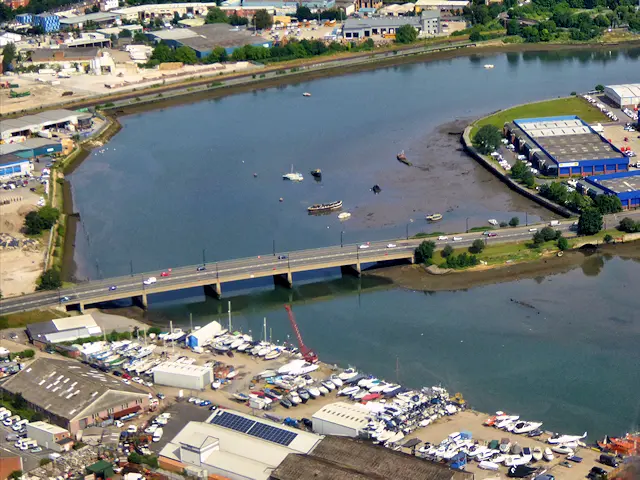
Northam Bridge is a road bridge across the River Itchen in Southampton, England, linking the suburbs of Northam and Bitterne Manor. The current concrete bridge, opened in 1954, is the first major prestressed concrete road bridge built in the United Kingdom. However, three bridges have stood at this location since the late 18th century.
The idea of Northam Bridge was conceived by David Lance, who acquired land in Bitterne and built Chessel House there in 1796. Realising that access to his land was poor, he encouraged the building of a bridge linking Bitterne Manor to Northam, together with roads from the bridge to Botley and a further bridge over the River Hamble in Bursledon. The Northam Bridge Company was formed in 1796, funded mainly by Portsmouth businessmen. An Act of Parliament, the Northam Bridge and Approaches Act 1796 (36 Geo. 3, c. 94), was passed quickly to authorize the project.
The first Northam Bridge was of wooden construction, opened in 1799. It became a toll bridge, with the toll payable at the toll house on the left side of the approach. Until 1929, when ownership transferred from the private sector to the Southampton Corporation under the Southampton Corporation Act 1928, the bridge operated as a toll road. The wooden bridge was replaced in 1889 by an iron bridge at a cost of £9,000. This iron structure served for 65 years before being replaced by the current prestressed concrete bridge in 1954, which cost £600,000 (including compulsory purchase of land and 610m of embankment construction).
The third and current bridge was constructed by Rendel Palmer & Tritton, the same firm that built Waterloo Bridge in London nine years earlier. It carries the A3024 road as a dual carriageway with two lanes on each carriageway. At mid-span the bridge is 13.5 metres wide and 4.7 metres above mean high water springs. At 148 metres long with supporting piers up to 32 metres apart, it remains one of the most important river crossings in Southampton. In January 2015 the bridge was partially closed for waterproofing work costing £1.2 million as part of the government's £317 million "pinch-point programme," with about 35,000 vehicles using the bridge daily.
Timeline: the documented record of Northam Bridge
- 1796 Northam Bridge and Approaches Act 1796 passed by Parliament, authorizing the Northam Bridge Company to build a bridge across the River Itchen. David Lance and Portsmouth businessmen form the company.
- 1889 Original wooden bridge replaced by iron bridge at cost of £9,000. The new iron structure serves for 65 years until 1954 replacement.
- 1954 Current prestressed concrete bridge opens, designed by Rendel Palmer & Tritton. First major prestressed concrete road bridge in the UK. Cost £600,000 including land purchase and embankment.
Is there a rational explanation for Northam Bridge?
The primary skepticism surrounding Northam Bridge concerns the vanishing hitchhiker legend. While numerous motorists have reported seeing a soaking-wet young girl near the bridge, particularly in the early morning hours, no contemporary photographic or documentary evidence from before the 20th century has been verified. The first written account appears in Penny Legg's 2011 book "Haunted Southampton," which collects local folklore rather than presenting verified paranormal evidence. Critics suggest the story follows the classic vanishing hitchhiker pattern common to many British bridges, where a pedestrian is picked up by police or motorists and disappears before reaching the destination, only for inquiries at the given address to reveal the person has been deceased for some time.
Skeptics also note that the bridge's heavy traffic—approximately 35,000 vehicles daily—makes anecdotal reports difficult to verify. The 2015 waterproofing closure, which caused delays of up to an hour for motorists, generated numerous contemporary complaints and social media posts, but no paranormal reports. Additionally, the replacement of three bridges over 200 years means any haunting entity would have to be exceptionally long-lived or attached to the specific site rather than the structure itself. While the legend persists in local storytelling circles, the historical record documents the bridge's construction, ownership transfer, and repair works extensively, with no mention of supernatural phenomena in civil engineering reports, municipal records, or newspaper accounts from any era.
Can you visit Northam Bridge?
Northam Bridge is open to traffic 24 hours a day, 365 days a year, as it forms part of the A3024 dual carriageway into Southampton. There is no toll since the bridge was taken over by Southampton Corporation in 1929. Pedestrians may cross the bridge on footpaths on either side, though caution is advised due to the high speed of traffic and the absence of dedicated pedestrian crossings at bridge level. The bridge is accessible from both the Northam side (via College Street) and the Bitterne Manor side (via Cobden Avenue).
For those interested in the bridge's history and legends, information panels are located at each end detailing the three successive bridges. The legend of the vanishing hitchhiker girl is a popular local tale, though as with all purportedly haunted locations, experiences are subjective. The Ship Inn, dating back to the 1830s and located to the right of the bridge approach, offers refreshments and has its own historic character; it is reportedly one of the oldest pubs in Southampton and features in local ghost walks. Public transportation routes 1, 2, and 7 cross the bridge frequently. There is no admission fee to cross Northam Bridge or visit the Ship Inn. Parking is available on nearby streets, though spaces are limited during peak commute hours. The bridge is fully wheelchair accessible via the pedestrian walkways, though the steep camber of the road surface may require assistance for some users.
Sources consulted
- Penny Legg, «Haunted Southampton» — The History Press, 2011 book
- H.C. Adams et al., «Discussion: New Northam Bridge, Southampton» — Proceedings of the Institution of Civil Engineers, 1955 academic
- BBC News, «Southampton travel delays as Northam Bridge repairs begin» — BBC News, 2015 web
- John Holt and Anne Cole, «A bend in the River: A History of the Itchen Bridge Area» — Bitterne Local History Society, 1992 book
- Southampton City Council, «Northam Bridge Approach» — PortCities Southampton, 1910 archive
Reviewed by V. Serrano on 2026-08-26 · How we verify our content
💬 Field testimonies (0)
No testimonies yet. Add the first.
Add your testimony
🔒 Log in to add a testimony