👻 HAUNTED PLACE · EXP. Nº9477
ACTIVE
Ramsey Cemetery
Ramsey Cemetery is a working township burial ground in Douglas Township, Effingham County, Illinois, six miles north of Effingham.
Where is Ramsey Cemetery?
- Location
- Illinois, United States
- Type
- Cemetery
- Coordinates
- 39.205, -88.574
- Last updated
LOCATION
Why is Ramsey Cemetery said to be haunted?
Alexander Ramsey was the first marked burial here in 1851; three more Ramseys followed within three years and a family plot became the neighbourhood's cemetery. Below the hill, at the head of a creek, shallow sandstone shelters that everyone calls the caves are covered with carved names and declarations of love. Since 2002 the place has also carried a werewolf and a red-eyed man in a black cloak, and both can be traced to a single thirty-word entry submitted anonymously to the Shadowlands Haunted Places Index: absent from the archived page in December 2001, present by August 2002. Everything printed since descends from it, gaining an adjective at each retelling. The folklorist Michael Kleen, who took four and a half years just to find the shelters, reported no sign of a werewolf; the caretaker of fifteen years told the Effingham Daily News in 2008 that he had never seen a ghost. The story can be followed back to its first traceable sentence.
What is the history of Ramsey Cemetery?
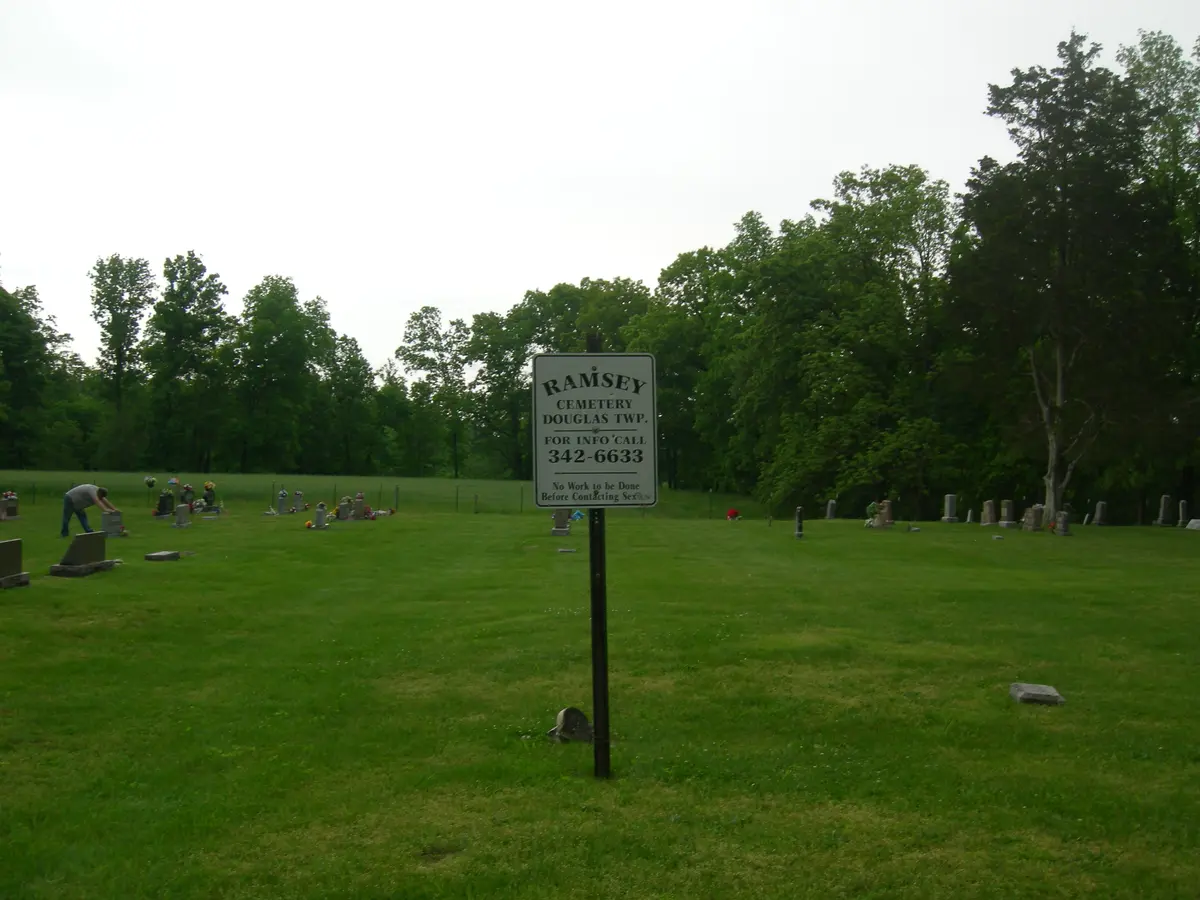
Ramsey Cemetery sits on a wooded crest in Douglas Township, Effingham County, Illinois, at the end of 1230th Street, some six miles north of the town of Effingham and about four miles from Shumway. The sign at the gate is not atmospheric. It reads RAMSEY CEMETERY, DOUGLAS TWP., FOR INFO CALL 342-6633, and underneath, in smaller letters, "No Work to be Done Before Contacting Sexton." This is a working township burial ground with a sexton and a telephone number, and it has been one for a hundred and seventy-five years.
It began as a family plot. Alexander Ramsey was the first marked burial, in 1851; three more Ramseys followed within three years, and what had started as a private project became the community cemetery for the neighbourhood. That account comes from John Russell's county history "Effingham County, Illinois — Past and Present", quoted in the Effingham Daily News in 2008. Every published version calls Alexander "29-year-old". The dates transcribed on his Find a Grave memorial — 22 March 1822 to 10 January 1851 — make him 28, ten weeks short of his birthday. The stone cannot settle it: photographed in 2017 and again in May 2023, it is a modest limestone tablet so deeply colonised by lichen that only the first line, ALEXANDER RAMSEY, can still be made out. The document that founded the cemetery has been eaten by the weather.
The Ghost Research Society's file on the site, citing the same county history, adds that the ground belonged to the Hooten family and that the cemetery was probably formalised around 1863, during the Civil War; Corporal Henry A. Hooten of Company K, 89th Illinois Infantry, lies here. Why it is called Ramsey rather than Hooten is not recorded. I have not been able to read Russell's book myself, and both of these details reach me at one remove.
A small mourning chapel stood on the grounds from the 1920s, built so that families would not have to stand in the rain. It is gone, and the accounts of how it went do not agree: Chad Lewis and Terry Fisk say it was torn down in the 1960s because of vandalism, the Ghost Research Society says it was already derelict by the late 1950s and was demolished at some point in the 1980s. Nobody produces a document.
Below the hill, off the road and out of sight of the graves, is the feature that made the place locally famous long before any ghost did. A creek no stronger than a bathtub tap falls over a ledge at the head of a small valley and has, over a very long time, eaten a wide gap in the sandstone. The shallow grottos inside it are what everyone calls "the caves." Generations of local residents have carved their names and their declarations of love into the rock. Michael Kleen, who first came looking in October 2003, searched for them repeatedly and concluded there were no caves at all; he did not find them until April 2008, four and a half years later. The only signage he found was a couple of rusted boards reading "no dumping."
Timeline: the documented record of Ramsey Cemetery
- 10 January 1851 Alexander Ramsey is buried on the hill in what becomes the first marked grave. Published accounts call him 29; the dates transcribed on his memorial make him 28.
- c. 1863 The family plot on Hooten land is probably formalised as a community cemetery during the Civil War, according to the Ghost Research Society's reading of John Russell's county history.
- 1938 The 1938 film Algiers introduces many Americans to the word Casbah. Two members of the Effingham County Genealogical and Historical Society later point to it as the likeliest origin of the cemetery's nickname.
- 1960s A young man is said to have shot himself inside the cemetery's mourning chapel, which had stood since the 1920s. Lewis and Fisk, who published the story in 2007, state they could find no evidence for it.
- 12 December 2001 The archived Illinois page of the Shadowlands Haunted Places Index contains no Effingham entry: zero occurrences, against 58 for the control word "cemetery" on the same page.
- 8 August 2002 The entry is there, under the heading "Effingham - Kazbar": thirty anonymous words about haunted caves, a werewolf and a man in a black cloak with red eyes. This is the oldest datable printed mention of the legend.
- October 2003 Michael Kleen finds the cemetery after asking at petrol stations and phoning the local monument company, because the existing accounts had it under the wrong name. He looks for the caves and concludes there are none.
- 31 October 2008 The Effingham Daily News reports on the site. Caretaker Paul Schmidt, fifteen years in the job, says he has never seen a ghost there; two investigators who worked it in 2004 say they never got anything either.
- February 2009 Kleen devotes issue 26 of his newsletter Legends and Lore of Illinois to Ramsey. He names the 2002 Shadowlands entry as the source, calls his own backwoodsman theory "highly speculative", and admits he can no longer find any trace of the warlock story.
- 13 November 2018 Kleen reposts the piece on his website without the page citation, without the word "mislabeled" and without the sentence admitting the theory was speculative. This is the version most sites now copy.
- 17 June 2023 A Wikipedia editor removes the article's entire "Legends and ghostlore" section in two consecutive edits, with the summary "trimmed unsourced". The historical sections stay.
Is there a rational explanation for Ramsey Cemetery?
This story has a datable first sentence, and it is thirty words long.
The Shadowlands Haunted Places Index was an unmoderated, user-submitted list of American haunted sites. Its Illinois page is preserved in the Internet Archive. In the snapshot of 12 December 2001 there is no Effingham entry at all — the word appears zero times, against 58 occurrences of "cemetery" on the same page, so the search works. In the snapshot of 8 August 2002 the entry is there, filed under a nickname: "Effingham - Kazbar - Old cemetery that has haunted caves. A werewolf and a man in a black cloak with red eyes is said to be seen there. Many weird things have happened here." Some time between February and October 2003 the heading was quietly changed from "Kazbar" to "Ramsey Cemetery", with the text untouched. Everything printed about this place since descends from those thirty anonymous words, and each retelling has added something.
The drift can be measured. The 2002 original says "black cloak" and "red eyes". The listing quoted by the Effingham Daily News in October 2008 says "red glowing eyes". Michael Kleen's 2009 write-up says "glowing red eyes" — and, transcribing the original, turns "cloak" into "coat". By 2020 the Ghost Research Society is describing "the black hooded figure with the red eyes". Nobody reported anything new in those eighteen years; adjectives simply accumulated.
The same thing happened to the hedges, and to their author. Kleen's February 2009 newsletter says the Shadowlands "mislabeled" the place, gives the page number for the Lewis and Fisk quotation, and ends his backwoodsman theory with the sentence "But that, like most of the explanations for these tales, is highly speculative." When he reposted the piece on 13 November 2018, "mislabeled" had become "labeled", the page number was gone, and the sentence about speculation was gone with it.
The warlock deserves its own paragraph, because it is the clearest case of all. Its only source in the world is Kleen's 2009 log, and this is what he actually wrote: "I seem to recall the story of a warlock associated with Ramsey Cemetery... but I've been unable to find any mention of the 'warlock's grave' since my initial discovery. The warlock had been hung, I remember reading, from an old oak tree outside of the cemetery... This story was quite possibly created and lost years ago somewhere in the rumor mills of the Internet." The oak is real — a big graffitied tree stands just outside the gate — but the hanging is a folklorist's admittedly unrecoverable memory of something he read online, flagged as such by the folklorist himself.
And everyone who has actually gone looking has come back with nothing. Kleen, who had taken four and a half years to find the shelters, noted that he "certainly didn't see any evidence of a werewolf." Paul Schmidt, the caretaker, told the Effingham Daily News in 2008 after fifteen years in the job that he had never seen a ghost there. Two local investigators who worked the site several times in 2004 with cameras and night-vision video said: "we've never got anything ourselves." Lewis and Fisk could not substantiate the chapel suicide. On 17 June 2023 a Wikipedia editor deleted the article's whole ghostlore section in two edits, with the summary "trimmed unsourced".
There is no commercial motive to fall back on here. Nobody sells a ticket to Ramsey Cemetery; there is no tour, no gift shop, no Halloween event, only a sexton's phone number on a board. What kept the story alive was not a till but an index: a free directory that granted the place an entry, after which everyone downstream cited the entry. What is genuinely there at night is more banal and more damaging — parties, carved rock, graffiti on the gate tree, and, according to the sexton, occult-looking symbols, objects hung in the branches and once a possum nailed to a trunk. One of the site's own witnesses, posting in 2018 about a cloaked figure walking towards him, offered the alternative himself: "I don't know if it was paranormal or just a groundskeeper."
Can you visit Ramsey Cemetery?
Ramsey Cemetery is still used for burials. Find a Grave's index for the cemetery, consulted on 23 September 2026, holds 172 memorials, and the most recent death recorded in it is from January 2026. The first marked grave is that of Alexander Ramsey, who died in 1851 at the age of 29.
The cemetery is at the end of 1230th Street in Douglas Township, Effingham County, which is the address in the Ghost Research Society's site file; BillionGraves files it as County Road 1230 E, Effingham, IL 62401. Coordinates 39.20504, -88.57422 are the point on Matt Hucke's Graveyards of Illinois (39.205041, -88.574219) and lie within a few metres of those on Wikipedia (39°12′18″N 88°34′27″W). They place it about 9.8 km (6.1 miles) north-north-west of central Effingham, in line with the "about six miles north of Effingham" given by the Effingham Daily News in 2008. The paper described the approach as a narrow, winding road under large trees and the cemetery as isolated and surrounded by forest; its caretaker of fifteen years, Paul Schmidt, said there was "a nice parking place out there" and that there used to be "parties galore here on the weekend". In Michael Kleen's account of 2009 the graves stand on the crest of the hill, inside a barbed-wire fence on bleached wooden posts. The Ghost Research Society's file, written after a visit on 29 August 2020, gives 217-342-6633 as the site's telephone and reports that the sexton had found a crucified possum pinned to a tree and "strange occult-like symbols and unusual offerings" hanging from the trees nearby.
The rock shelters are outside the cemetery. Kleen's guide of 2009 places them "off of the road at the head of a small creek that forms a tiny waterfall", deep in a wide inlet in the forest, with "a couple of rusted signs" reading "no dumping" as the only markers. In 2008 a local investigator told the Effingham Daily News that the supposed caves were on private property, which was why she had never been able to check them. Generations of local people have carved their names into the sandstone walls of the shelters, Kleen wrote, and those carvings are the damage the site carries.
Sources consulted
- Angie Faller, «Rumors linger about Ramsey Cemetery hauntings» — Effingham Daily News, 2008 newspaper archive
- Michael Kleen, «A Quick and Dirty Guide to Ramsey Cemetery / Adventurer's log (Legends and Lore of Illinois, vol. 3 no. 2, issue 26)» — Black Oak Media, 2009 report
- Anonymous contributor, «Shadowlands Haunted Places Index, Illinois page (snapshots of 12 December 2001 and 8 August 2002)» — theshadowlands.net, via the Internet Archive, 2002 archive
- Michael Kleen, «Ramsey Cemetery's Harrowing Casbah» — michaelkleen.com, 2018 web
- Dale Kaczmarek and others, «Ramsey Casbar Cemetery Investigation (site file and investigation of 29 August 2020)» — Ghost Research Society, 2020 report
- Find a Grave contributors, «Ramsey Cemetery (memorial index) and memorial 70655515, Alexander Ramsey» — Find a Grave, 2026 web
- Wikipedia contributors, «Ramsey Cemetery: revision history and revisions 1160625648 and 1160625745» — English Wikipedia, 2023 web
- Nick Wagers, «Ramsey Cemetery, located in Effingham County, Illinois (photograph, 2 June 2008, CC BY-SA 2.0)» — Wikimedia Commons, 2008 web
Reviewed by V. Serrano on 2026-08-21 · How we verify our content
💬 Field testimonies (0)
No testimonies yet. Add the first.
Add your testimony
🔒 Log in to add a testimony