👻 HAUNTED PLACE · EXP. Nº9477
ACTIVE
Riddle House
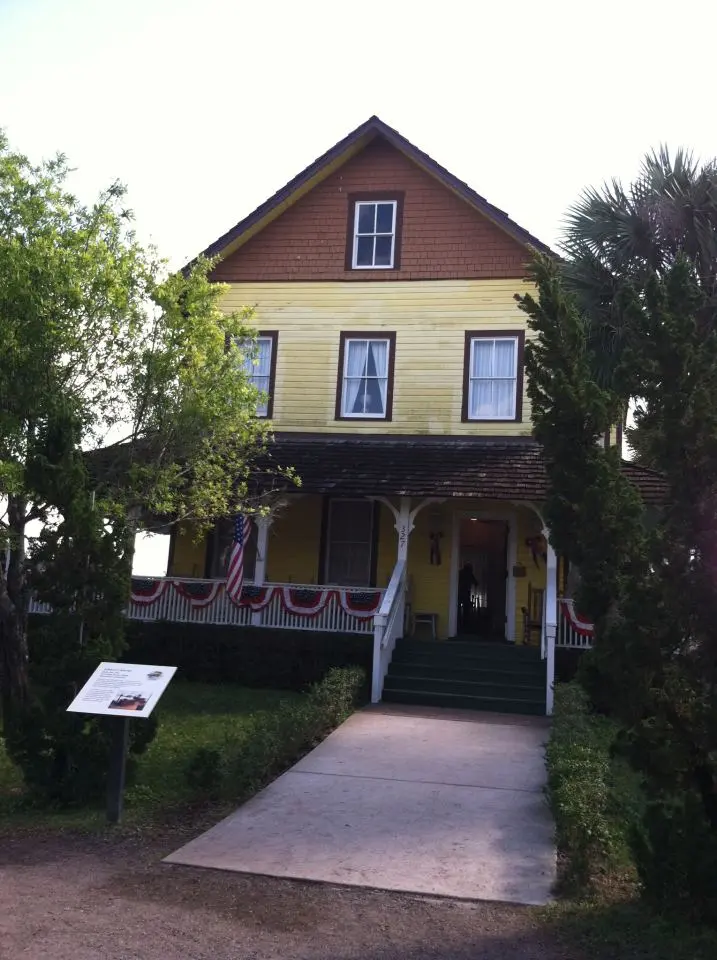
The Riddle House was never meant to be a home. Carpenters from Henry Flagler's hotel sites built it in West Palm Beach on 1 July 1905 out of leftover lumber, painted it Flagler's canary yellow and called it the Gate Keeper's Cottage: the caretaker lived there, parlour funerals were held there, and the cemetery across Dixie Highway was run from there.
Where is Riddle House?
- Location
- Florida, United States
- Type
- House / mansion
- Coordinates
- 26.684, -80.188
- Last updated
LOCATION
Why is Riddle House said to be haunted?
It took its name from Karl Riddle, the city's first city manager and superintendent of public works, who moved in in 1920. In August 1995, to save it from a college expansion, volunteers stripped its porches and chimneys, cut the roof and attic in two, and trucked the house fifteen kilometres west in five or six pieces to Yesteryear Village, on the South Florida Fairgrounds, where it stands today. Its ghost is easier to date than the death it describes. The press covering the 1995 move mentions none; a 2003 local-history column mentions none; the earliest printed account we could fix is from 2005, and it describes an unnamed former boarder hanged in the attic — with no year, no duel and no "Buck".
What is the history of Riddle House?
The Riddle House did not begin as anybody's home. It began as a piece of cemetery infrastructure.
Carpenters working on Henry Flagler's hotels started it on 1 July 1905 with lumber left over from those sites, and painted it in the canary yellow Flagler used on his own buildings — which is why the neighbourhood called it "the painted lady". It stood at 327 Acacia Road in downtown West Palm Beach, directly across Dixie Highway from the burial ground it served, and its official name was the Gate Keeper's Cottage: a house where the caretaker lived, where parlour funerals were held, and from which the cemetery was run.
There is a small disagreement in the record about which cemetery. When the Sun-Sentinel covered the building's removal in July 1995, Cary Lockman, then historic coordinator for the South Florida Fair, described it as the gatekeeper's house of the old Lakeview Cemetery — the city's first, later obliterated by the construction of the Norton Gallery. Every later account, including the 2005 encyclopedia entry that fixes the address, names Woodlawn Cemetery. The geography favours Woodlawn: it is the burial ground that sits across Dixie Highway from Acacia Road, roughly two hundred metres from the door. Lakeview lies a block further east.
The name it carries belongs to Karl Leon Riddle, who moved in in 1920. Riddle was West Palm Beach's first city manager and its first superintendent of public works, and — according to the 1995 Sun-Sentinel report — later chief engineer to the architect Addison Mizner. He was a working engineer, not a character in a ghost story: in 1928, laying road near Pahokee on the east shore of Lake Okeechobee, he pulled a small human effigy carved in cypress out of the muck. It is one of very few wooden figures recovered in south Florida, and after Riddle died in 1985 his family gave it to the Historical Society of Palm Beach County, which displays it as "the Riddle effigy".
The house outlived its purpose slowly. By the late 1970s and 1980s it belonged to Palm Beach Atlantic College and served as a women's dormitory. Then the campus needed the land. Rather than demolish it, the college donated the building to Yesteryear Village, the living-history park on the South Florida Fairgrounds, and the dismantling was coordinated by John Riddle — Karl's nephew and chairman of the village committee of the fair's board.
What happened next matters for everything written about the house since. Volunteers stripped the wraparound porches and the brick chimneys, the roof and attic were cut away as one unit and split in two, the first and second floors were divided into sections, and on 12 and 13 August 1995 the Riddle House travelled some fifteen kilometres west in five or six pieces. It was reassembled on a new foundation at the east end of the village, next to the relocated Red Level Baptist Church, where it stands today.
Timeline: the documented record of Riddle House
- 1 July 1905 Carpenters from Henry Flagler's hotel sites begin the house with leftover lumber at 327 Acacia Road, painting it Flagler's canary yellow. Its official name is the Gate Keeper's Cottage: caretaker's residence, parlour funeral room and office of the cemetery across Dixie Highway.
- 1920 Karl Leon Riddle, West Palm Beach's first city manager and first superintendent of public works, makes the cottage his home. The house has carried his name ever since.
- 1928 Working as an engineer on road construction near Pahokee, Riddle recovers a small human effigy carved in cypress from the peat. After his death in 1985 his family donates it to the Historical Society of Palm Beach County, which exhibits it as the Riddle effigy.
- 1979-1980 Vivian Campbell lives in the house as a Palm Beach Atlantic College student. In the memoir she publishes in 2012 she recalls the attic kept permanently locked by the college and the campus story that a local handyman, reportedly named Joseph, had hanged himself up there.
- 24 July 1995 The Sun-Sentinel reports the imminent move. Cary Lockman, the fair's historic coordinator, explains the plan; Palm Beach Atlantic's marketing director says the growing campus needs the land; John Riddle, Karl's nephew, coordinates the dismantling. The article mentions no ghost.
- 12-13 August 1995 The house travels to Yesteryear Village in five or six pieces: porches and brick chimneys removed, roof and attic cut away as one unit and split in two, the two floors sectioned. It is rebuilt on a new foundation beside the relocated Red Level Baptist Church.
- 5 February 2003 Eliot Kleinberg devotes a Palm Beach Post local-history column to the rescued buildings of Yesteryear Village. He describes the Riddle House down to its ten-foot ceilings and walk-in closets, and mentions no haunting.
- 2005 The earliest printed haunting account we have been able to date: the entry in Jeff Belanger's Encyclopedia of Haunted Places attributes a figure in a black frock coat to an unnamed former boarder who hanged himself in the attic, and quotes restoration carpenter Steve Carr, who says he will never enter the house again. No date for the death, no duel and no name.
- 7 November 2008 The Travel Channel broadcasts the Riddle House episode of Ghost Adventures, the fourth of the first season. According to the compilations that recycle it, a medium told the crew that the spirit in the house was called Joseph. The suicide has a name from here on.
- From 2011 Mass-market haunted-America compilations introduce a second character: Buck, a former cemetery worker killed during an argument with a townsperson, distinct from the man in the attic. The two figures are separate in every printed source; only later retellings merge them.
Is there a rational explanation for Riddle House?
The useful question here is not whether a man died in the attic. It is when anybody started saying so — and that can be dated, step by step, in print.
July 1995, the Sun-Sentinel devotes a full article to the building on the eve of its move, quotes the fair's historic coordinator at length, and mentions no ghost of any kind. February 2003, Eliot Kleinberg — the Palm Beach Post's local-history columnist — profiles the rescued houses of Yesteryear Village, describes the Riddle House room by room down to its ten-foot ceilings and walk-in closets, and again mentions no ghost.
2005 is the first printed haunting account we have been able to fix. The entry in Jeff Belanger's Encyclopedia of Haunted Places opens: "Something or someone in the Riddle House, a historic Victorian painted lady built in 1905, doesn't like men." It attributes a figure in a black frock coat to "a former boarder who hung himself in the single-room attic of the three-story house", and its one named witness is a restoration carpenter, Steve Carr, interviewed by telephone: "I'll never go into the Riddle House again," he said, describing an iron pot lid that he says lifted off its base and struck him while he was working in a first-floor room. Note what is absent in 2005: no year for the death, no duel, no disgrace, no employee of Karl Riddle — and no "Buck".
That name arrives later. The suicide acquires the name Joseph around the Ghost Adventures episode filmed at the house and broadcast on 7 November 2008, in which, as the mass-market compilations that recycle it report, a medium warned the crew that "the spirit of Joseph is an evil entity". Buck — described as a former cemetery worker killed during an argument with a townsperson — turns up in those same compilations from 2011 onwards, as a second and separate figure. Our own previous text fused the two, made Buck the man in the attic, gave him a duel and made him Riddle's assistant. None of those three details appears in any source read for this file.
The control is worth stating, because a nil result proves nothing on its own. Searching the full text of both editions of the Encyclopedia of Haunted Places with a phrase unique to the Riddle House entry returns the book for "attic", "Flagler", "Yesteryear" and "Joseph"; the same search for "Buck" and "gravedigger" returns nothing at all. The word is not in the book.
There is also a physical objection that applies before any of the above. This house was taken apart. Porches off, chimneys off, roof and attic cut in two, floors sectioned, trucked fifteen kilometres and rebuilt on a new foundation. Whatever visitors report today, they report it about a reassembled building on a fairground, not about the cottage that stood opposite the cemetery.
Finally, the claim has an owner. Yesteryear Village's own page describes the Riddle House as "one of the most haunted houses in the world". That is the site advertising itself, and it should be read as advertising.
Can you visit Riddle House?
The Riddle House no longer stands on its original site in downtown West Palm Beach. The Sun-Sentinel of 24 July 1995 reported that it was being taken apart for a move on 12 and 13 August to make way for the expansion of Palm Beach Atlantic College, and since then it has stood in Yesteryear Village, the living-history park of the South Florida Fairgrounds, at 9067 Southern Boulevard, West Palm Beach, FL 33411 (telephone +1 561 793-0333). The fair's page on the park describes it as nine acres of original and replicated buildings and names the Riddle House "one of the most haunted houses in the world"; Eliot Kleinberg's Palm Beach Post column of February 2003 gave the village six acres.
In 2003 Kleinberg tied the costumed re-enactors to fair time and to holiday weekends. The timetable on the fair's "Plan Your Visit" page, read on 24 September 2026, runs through the year on a weekly pattern: Tuesdays and Wednesdays for booked groups only, from 10:00 to 13:00; Thursdays and Fridays open to the public and to groups, from 10:00 to 16:00; Saturdays and Sundays reserved for private events. The page asks visitors to arrive at least two hours before closing to see the whole village.
General admission to the living-history park is $10 for adults and $7 for seniors over 60 and for children aged 6 to 11; children of 5 and under go free, and cash and major credit cards are accepted. Guided explorations for groups of ten or more cost $5 per student, with one free chaperone for every ten students and $10 for each additional chaperone.
The same page lists two stretches of 2026 in which the village operates only for ticketed special events and general admission is suspended, from 9 October to 6 November and from 24 November to 9 December. Its remaining holiday closures for the year fall on 11 and 26 November and on 24 and 25 December.
The page's directions run along Southern Boulevard to Sansbury's Way, west of the Florida Turnpike, then right into Gate 3 and on past the iThink Financial Amphitheatre to the Archway Gate; during concerts and special events at the amphitheatre, traffic may be sent through Gate 12 instead. Pets are not permitted on the fairgrounds; the only animals admitted are service and assistance dogs.
Sources consulted
- Fred Lowery, «Historic Riddle House Moving to Fairgrounds» — Sun-Sentinel, 1995 newspaper archive
- Eliot Kleinberg, «Village a Haven for Historic Homes» — The Palm Beach Post (Historic Palm Beach), 2003 newspaper archive
- Jeff Belanger (ed.), «Riddle House, in Encyclopedia of Haunted Places: Ghostly Locales from Around the World, pp. 82-83» — New Page Books, 2005 book
- Historical Society of Palm Beach County, «The Riddle Effigy» — Palm Beach County History Online, 2009 report
- Vivian Campbell, «Final Exams at the Riddle House, in Stalked by Spirits: True Tales of a Ghost Magnet» — Llewellyn Publications, 2012 book
- Travel Channel, «Riddle House (W. Palm Beach, FL), Ghost Adventures, season 1, episode 4» — Travel Channel, 2008 web
- Publications International, «Riddles of the Riddle House, in Haunted America (Armchair Reader)» — Publications International, 2011 book
- Janet DeVries, «The Riddle Brothers and the Riddle House, in Legendary Locals of West Palm Beach» — Arcadia Publishing, 2015 book
- South Florida Fair & Palm Beach County Expositions, «Yesteryear Village — Plan Your Visit (hours, admission, closures and directions, consulted 13 August 2026)» — southfloridafair.com, 2026 web
- South Florida Fair & Palm Beach County Expositions, «Yesteryear Village — About ("one of the most haunted houses in the world, The Riddle House", consulted 13 August 2026)» — southfloridafair.com, 2026 web
Reviewed by V. Serrano on 2026-08-13 · How we verify our content
💬 Field testimonies (0)
No testimonies yet. Add the first.
Add your testimony
🔒 Log in to add a testimony