👻 HAUNTED PLACE · EXP. Nº9478
ACTIVE
Shepherdstown, West Virginia
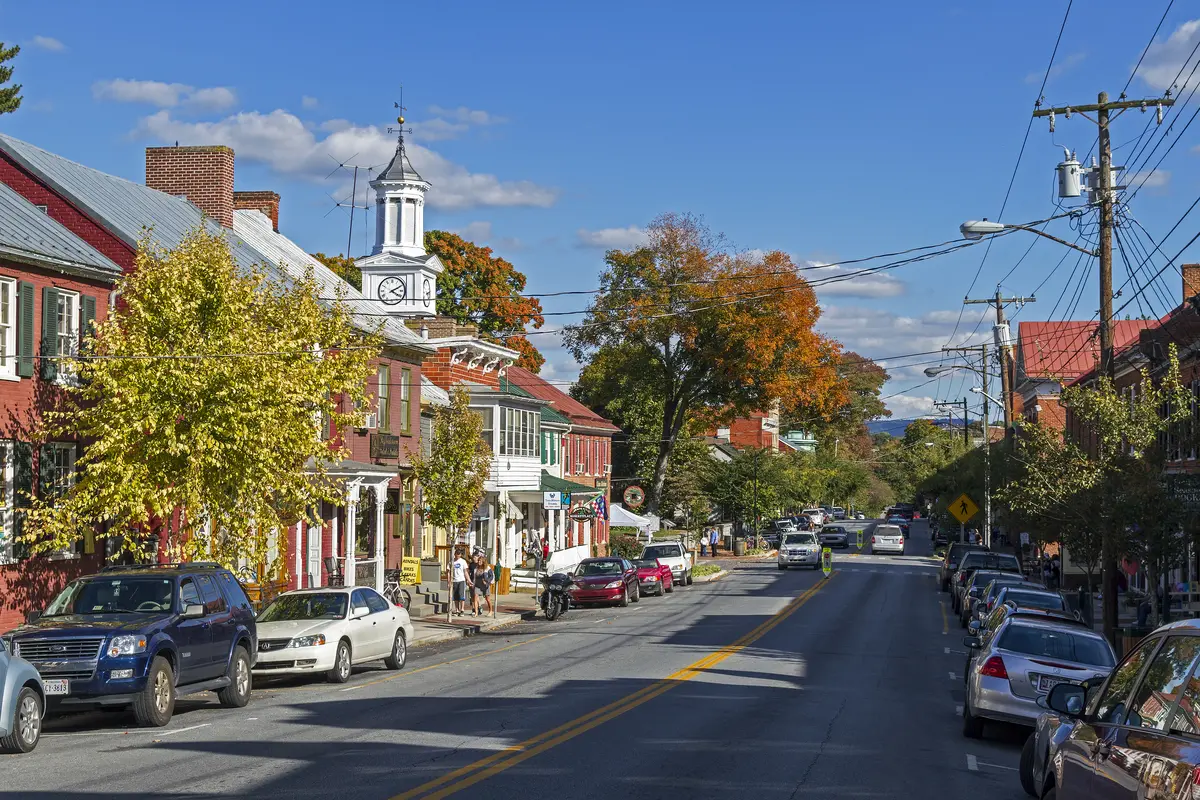
Shepherdstown sits on the Virginia bank of the Potomac in the Eastern Panhandle of West Virginia, and its own museum advertises itself as "the most haunted building in the most haunted town in America".
Where is Shepherdstown, West Virginia?
- Location
- West Virginia, United States
- Type
- Village / settlement
- Coordinates
- 39.432, -77.805
- Last updated
LOCATION
Why is Shepherdstown, West Virginia said to be haunted?
That reputation is recent and traceable. The Historic Shepherdstown Commission, which runs the museum inside the Entler Hotel on German Street, names its ghosts openly: a lady in white, an "amorous Frenchman", Civil War soldiers, and an "unlucky duelist" said to be a young lawyer carried in dying from a pistol duel in 1809. Destination America built a fifteen-episode series, Ghosts of Shepherdstown, on the same material in 2016, and the museum published its own ghost article the day after the premiere.
The documented history is older and stranger than the ghosts. The founding act of 1762 established the place as Mecklenburg and sits one chapter behind the act founding Romney, which is why the title of oldest town in West Virginia has never been settled. James Rumsey ran a steamboat up the Potomac here on 3 December 1787. And in September 1862, after Antietam, a resident wrote that "the whole town was a hospital".
What is the history of Shepherdstown, West Virginia?
Shepherdstown begins with a land grant and a surveyor's line, not with a ghost.
In 1734 the Colony of Virginia granted Thomas Shepherd 222 acres on the south side of the Potomac, along the Falling Spring Branch now called Town Run. From that tract he laid off some fifty acres into lots and streets and sold them. When the purchasers petitioned the General Assembly to make the arrangement official, the resulting statute — Chapter XXII of the November 1762 session, printed in Hening's Statutes at Large — recites that "Thomas Shepherd, of the county of Frederick, hath laid off about fifty acres of his land on Potowmack river" and establishes it as a town "to be called by the name of Mecklenburg".
That is the founding document, and it is also the reason Shepherdstown's proudest claim has never been settled. The act immediately before it, Chapter XXI of the same session, establishes the town of Romney in Hampshire County. Both bills were approved on the same day, 23 December 1762, by the same governor and burgesses. Romney's is the earlier chapter by one number. Two towns in what is now West Virginia were therefore born in the same afternoon, and both have claimed seniority ever since; the honest formulation is that they share it.
The name Mecklenburg lasted until 1798, when the corporate limits were enlarged and the town became Shepherd's Town; after the Civil War the name contracted to Shepherdstown.
The town's single greatest moment came on 3 December 1787, when James Rumsey ran a steam-powered boat up the Potomac at the north end of Princess Street before a crowd gathered on the banks and bluffs. Rumsey had shown a working model to George Washington at Bath in 1784, and Washington's written certificate of commendation had helped him to a Virginia patent and to investors. Rumsey died in London in 1792 with the argument over priority unresolved. His town did not forget: a committee formed in 1906, the West Virginia legislature appropriated the money over several years, the Forbes Granite Company of Chambersburg began work in 1914, and the Rumsey Monument was completed in 1915.
The building at the centre of the ghost stories grew by accretion on Lot No. 33, which Thomas Shepherd conveyed to Henry Cookus in 1764. In 1786 Christian Cookus sold the western part to Philip Adam Entler and raised the two-storey brick building that today houses the museum; Daniel Bedinger bought the rest and added a three-storey block in 1790. In 1809 James Brown leased the property and the Globe Tavern began taking overnight guests. By 1823 Daniel Entler was proprietor of the whole complex — twenty-four rooms, nineteen fireplaces, three cellars and three kitchens.
Then came September 1862. After Antietam, Shepherdstown was buried in wounded men. Mary Bedinger Mitchell, who lived through it and wrote the account down for Battles and Leaders of the Civil War in 1887, remembered six churches full, the Odd Fellows' and Freemasons' halls full, the town council room, the school-houses, the empty stone warehouses in the ravine, and finally the unfinished Town Hall roofed over with boards and straw. "The whole town was a hospital," she wrote; "there was scarcely a building that could not with truth seek protection under that plea." The Entler was one of them, and served as a Union billet for much of the rest of the war.
The hotel never recovered. It closed for good in 1917, was bought by Shepherd College in 1921, and spent half a century as a men's dormitory named Rumsey Hall, then as wartime quarters for Navy and Air Force cadets, then as faculty flats, then as a warehouse. In 1972 the college proposed demolition; townspeople organised, gathered signatures, and got the building onto the National Register of Historic Places in 1973. Governor Rockefeller signed it over to the town for one dollar in March 1978, the Historic Shepherdstown Commission took charge that June, and the museum opened in 1983.
Timeline: the documented record of Shepherdstown, West Virginia
- 1734 The Colony of Virginia grants Thomas Shepherd 222 acres on the south bank of the Potomac along the Falling Spring Branch. He lays roughly fifty of them out into lots and streets and begins selling.
- 23 December 1762 The Virginia General Assembly passes, in the same November session, Chapter XXI establishing Romney and Chapter XXII establishing Mecklenburg — the future Shepherdstown. Both were approved the same day, which is why the title of oldest town in West Virginia has never been settled.
- 1786 Christian Cookus sells the western part of Lot No. 33 to Philip Adam Entler and erects the two-storey brick building that today houses the Historic Shepherdstown Museum. Daniel Bedinger buys the rest and adds a three-storey block in 1790.
- 3 December 1787 James Rumsey runs a steam-powered boat up the Potomac at the north end of Princess Street before a crowd on the banks and bluffs, three years after showing a working model to George Washington at Bath.
- 1809 James Brown leases the property and the Globe Tavern begins offering overnight accommodation in what is now the museum building — the first record of a hotel on the site, and the year to which the museum's duel story is attached.
- September 1862 After Antietam the town is swamped with wounded. Resident Mary Bedinger Mitchell later wrote that six churches, the Odd Fellows' and Freemasons' halls, the council room, the schools and the empty warehouses were all filled: "The whole town was a hospital."
- 1915 The Rumsey Monument is completed, nine years after a local committee formed in 1906 and one year after the Forbes Granite Company of Chambersburg began work with money appropriated by the West Virginia legislature.
- 1921 Shepherd College buys the closed hotel and turns it into a men's dormitory, renamed Rumsey Hall in 1929. It houses students, wartime Navy and Air Force cadets, then faculty flats, and by 1968 is a storage warehouse.
- 1973 After the college proposes demolition in 1972 and townspeople gather signatures against it, the Entler Hotel is listed on the National Register of Historic Places. The town buys it for one dollar in 1978 and the museum opens in 1983.
- 12 June 2016 Destination America premieres Ghosts of Shepherdstown with Nick Groff, Elizabeth Saint and Bill Hartley. The synopsis calls the town "long considered the most haunted town in America"; the first episode is titled "Welcome to America's Most Haunted Town".
- 13 June 2016 The day after the premiere, the Historic Shepherdstown Commission publishes "Our Own Ghost of Shepherdstown", opening with a reference to the series and attributing night-time noises, moans and footsteps in the Entler to a duellist it names Peyton Bull Smith.
- October 2022–2025 The museum's BooFest ghost tours run each October with an unchanging list of ghosts — a lady in white, an "amorous Frenchman", Civil War soldiers and "the unlucky duelist" — and around two dozen spirits "that visitors have claimed to have seen, sensed and even felt". Evening investigations cost fifteen dollars.
Is there a rational explanation for Shepherdstown, West Virginia?
The unusual thing about Shepherdstown is that the case for scepticism can be built almost entirely out of the documents published by the people who sell the ghost tour.
The Historic Shepherdstown Commission is a serious preservation charity, incorporated in 1961, and its historical output is scrupulous: a chronology of the Entler Hotel researched by James C. Price in 1995 and Don C. Wood in 1997, a building history by Mary Corcoran Lehman, a restoration essay by Michael Langmyer, a brief history of the town. Not one of them mentions a ghost. The paranormal material lives in a separate part of the same website, in October announcements.
And that material does not agree with itself. The museum page calls the resident ghost "William Payton Smith" and dates his duel to "the summer of 1809". A 2016 article on the same site calls him "Peyton Bull Smith", opens with the line "It all started back in 1808", and then dates the duel to "daybreak on Tuesday, November 3, 1809" — a date that fell on a Friday. The article concedes the rest: "Later historians wrote that he died in Room One, the location of which is unclear." A story whose protagonist has two names, whose date has three versions and whose room nobody can find is a story that has been retold more often than it has been checked.
The chronology of the reputation is equally traceable. Destination America premiered Ghosts of Shepherdstown on 12 June 2016; its own synopsis describes a town "long considered the most haunted town in America", while the first episode is titled "Welcome to America's Most Haunted Town" — the claim and its evidence are the same sentence. The Commission published its ghost article the following day, 13 June 2016, and opened it by referring viewers to the series. In July 2024 the museum's own tour was advertised as led by a participant from that programme. The loop is closed.
The evening events invite visitors to bring digital recorders "to capture EVPs (spirit voices)" and EMF meters "which may help locate the spirits". Neither instrument has any validated ability to detect the dead: one records audio artefacts that listeners resolve into words, the other reads electromagnetic fields, of which a much-altered brick complex with a century of retrofitted wiring has plenty. The Entler is three separate buildings of 1786 and 1790 joined together, converted into a dormitory and converted back; timber floors of that age and that history move audibly with temperature and footfall.
Finally, two claims Enigma Atlas previously published do not survive contact with any source. No document consulted describes a nineteenth-century guest who checked in and was never seen leaving; the actual story is the reverse, a man carried in already dying. And nothing at all — not the Commission's ghost pages, which name their spirits one by one, not the Rumsey monument, museum or replica boat — mentions a "Rumsey ghost light" over the Potomac. That appears to be an invention laid over a real and well-documented event, and it has been removed.
Can you visit Shepherdstown, West Virginia?
The Historic Shepherdstown Museum occupies the Entler Hotel at 129 East German Street, on the corner of German and Princess Streets, Shepherdstown, West Virginia 25443, and its telephone is 304-876-0910. The museum's page, read on 24 September 2026, gives 2026 opening hours of 11:00 to 17:00 on Saturday and 13:00 to 16:00 on Sunday from April to October, and during the two weeks of Christmas in Shepherdstown. Admission is a suggested donation of five dollars per person, with members, children, students and military admitted free. A special tour can sometimes be arranged when a volunteer docent is available, by telephoning on a Tuesday, Wednesday or Friday, and the archives open on those days from 10:00 to 17:00 by appointment only.
The James Rumsey Boathouse Museum stands behind the museum at the same corner. According to the Rumseian Society, it was built to house the Rumseian Experiment, the replica steamboat made in 1987 which steamed for the last time in 2007, and it holds a mural by Larry Drechsler of the Shepherdstown bank of the Potomac on 3 December 1787. The Rumsey Monument, completed in 1915 by the Forbes Granite Company of Chambersburg, stands in a park reached by Mill Street.
The ghost events belong to late October and to the town's BooFest. For 2025 the Historic Shepherdstown Commission announced free daytime tours of the museum on 25 and 26 October, every half hour from 13:00 to 15:30, and evening paranormal investigations on 24 and 25 October led by local investigators, at $15 per person, with preregistration required and places limited.
Shepherdstown had 1,531 residents at the 2020 census. German Street is lined with working shops and private houses, while Destination America's 2016 series presented the whole town as "the most haunted town in America". Antietam National Battlefield lies across the Potomac at Sharpsburg, Maryland, about 7 km (4 miles) north-east of the town in a straight line. Boteler's Ford, where the fighting of September 1862 took place, is on the river downstream of the town.
Sources consulted
- William Waller Hening (ed.), «The Statutes at Large, Volume VII — Chap. XXI (Romney) and Chap. XXII (An Act for establishing the town of Mecklenburg, in the county of Frederick), November 1762 session» — Richmond: Franklin Press, 1820 archive
- Mary Bedinger Mitchell, «A Woman's Recollections of Antietam» — Battles and Leaders of the Civil War, vol. II, pp. 686-695, The Century Co., New York, 1887 book
- Mary Corcoran Lehman; chronology researched by James C. Price (1995) and Don C. Wood (1997); restoration by Michael Langmyer, «Entler Hotel: history, chronology and restoration» — Historic Shepherdstown Commission, 1997 report
- Historic Shepherdstown Commission, «Our Own Ghost of Shepherdstown» — historicshepherdstown.com, 2016 web
- Historic Shepherdstown Commission, «A Brief History of Shepherdstown» — historicshepherdstown.com, 2015 web
- Historic Shepherdstown Commission, «Historic Shepherdstown Museum: rooms, resident ghost, hours and admission» — historicshepherdstown.com, 2026 web
- Historic Shepherdstown Commission, «The Rumsey Monument» — historicshepherdstown.com, 2015 web
- Jill Craig / Historic Shepherdstown Commission, «Shepherdstown's BooFest and the Historic Shepherdstown Museum Ghost Tours (2022, 2023, 2024 and 2025 announcements)» — historicshepherdstown.com, 2025 web
- Destination America, «Ghosts of Shepherdstown - About the Show (archived 5 January 2019)» — Discovery Communications, via the Internet Archive, 2016 archive
- Wikipedia contributors, «Shepherdstown, West Virginia» — Wikipedia, 2026 web
Reviewed by V. Serrano on 2026-08-11 · How we verify our content
💬 Field testimonies (0)
No testimonies yet. Add the first.
Add your testimony
🔒 Log in to add a testimony