👻 HAUNTED PLACE · EXP. Nº1190
ACTIVE
Sorrel–Weed House
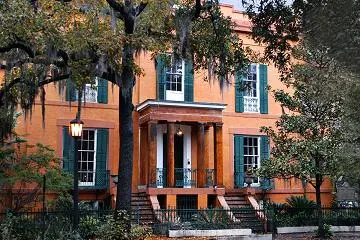
The Sorrel-Weed House stands on the north-west corner of Madison Square in Savannah, completed in 1840 to a design by Charles B. Cluskey for Francis Sorrel, a shipping merchant born in Saint-Domingue who owned between three and eleven enslaved people at a time.
Where is Sorrel–Weed House?
- Location
- Savannah, Georgia, United States
- Type
- House / mansion
- Coordinates
- 32.074, -81.094
- Last updated
LOCATION
Why is Sorrel–Weed House said to be haunted?
Since 2005 it has been run as a commercial tour house, and the ghost story it sells is the part the documents do not carry. Matilda Sorrel did die in a fall, on 27 March 1860, but the only contemporary account places her at the townhouse next door, which the family had moved into after selling this house in 1859, and the city's press printed nothing beyond a funeral invitation. No record of the tour's Molly has been found in the family papers; the one Molly documented in Sorrel's name is a woman of twenty-eight shipped from Savannah to New York in 1857. And the carriage house where the tour stages her death does not appear on maps before 1888. When the house's own staff had the basement dug in 2017, the archaeologists found a rubbish pit, not a grave.
What is the history of Sorrel–Weed House?
Francis Sorrel bought lots 6 and 7 on Savannah's newly laid out Madison Square in April 1837, the year the square itself was created, and by 1839 a Greek Revival house was going up on lot 6, at the corner of Harris and Bull. The design was by the architect Charles B. Cluskey, who also drew the old Governor's Mansion at Milledgeville. The marker that the Georgia Historical Commission put up outside in 1954 dates the completion to 1840 and reads the villa-like stucco and the deep verandas as an echo of the owner's Caribbean background.
Sorrel was born on 4 May 1793 in the French colony of Saint-Domingue, son of a colonial officer who owned a sugar plantation called Miragoâne. In 1798, when he was five and his father was away, he was nearly killed; the family's own account credits one of his nurses with hiding him and getting him to Port-au-Prince. His father left the island in 1803 and never came back for him. Francis was a clerk in a Port-au-Prince counting house by 1811, was transferred to a Baltimore branch in 1812, and by 1818 had declared his intention to settle in Georgia. In Savannah he became a cotton factor and shipping merchant, trading from 1838 as Francis & Co. in partnership with John C. Ferrill.
That fortune rested on slavery, and the archive is specific about it. Kelly Westfield's 2017 study of the property, working from Savannah's tax digests, found that Sorrel owned as few as three and as many as eleven enslaved people in a given year, averaging about six across the eighteen years in which he appears. The federal coastwise manifests name the people he moved by sea: Nancy, Judy, Diana, Lidia, Mary, Tom and Molly. Nancy, listed as forty years old, sailed from Savannah to New York aboard the Statira on 3 July 1826, and is probably the woman Sorrel called "old Mammy" in a letter of 1860 and "Old Nanny" in his will, still drawing small payments from his estate in 1875 "for her support at sundry times". In October 1827 he sold a girl named Minda to R. W. Stiles for 300 dollars. Between 1843 and 1848 he also appears in Savannah's Registers of Free Persons of Color as guardian to four young women — Leah Stevens, Betsey Stephens, Leah Williams and Elizabeth Williams — registered as washerwomen, nurses and, in sixteen-year-old Elizabeth's case, a house servant.
Sorrel's first wife, Lucinda Moxley, died of yellow fever in November 1827; two years later he married her sister, Matilda Aminta Douglass Moxley. Eleven children came of the two marriages and three died before adulthood. One son, Gilbert Moxley Sorrel (1838-1901), served on James Longstreet's staff, was made brigadier general at twenty-six and published Recollections of a Confederate Staff Officer in 1905. In 1859 the Sorrels sold the Madison Square house to the merchant Henry D. Weed and moved into the three-storey townhouse they had built next door on lot 7. It was there, not here, that Matilda died on 27 March 1860. Francis died of a stroke in 1870, and the house stayed in the Weed family until 1914.
Its museum life began in January 1940, when the Society for the Preservation of Savannah Landmarks — later the Historic Savannah Foundation — opened it for its first exhibit, a loan show of eighteenth- and nineteenth-century furniture and fine arts. A. J. Cohen Sr. bought the house in 1941; the Cohens lived in it for more than fifty years and built a brick addition round it for Lady Jane, an upscale women's clothing shop that closed in 1991. Stephen Bader bought the house in 1996 and took the addition off. The opening shot of Forrest Gump, released in 1994, with the feather drifting over the rooftops of Madison Square, was filmed from this roof. In 2007 the Vernacular Architecture Forum met in Savannah and Willie Graham, curator of architecture at Colonial Williamsburg, measured the house and wrote it up, confirming that the Victorian stair pulled out in 1999 had been a late nineteenth-century Weed addition. The house reopened to visitors in 2005 and has been a commercial tour venue ever since.
Timeline: the documented record of Sorrel–Weed House
- 4 May 1793 Francis Sorrel is born at Miragoâne, in the French colony of Saint-Domingue. In 1798, with his father away, one of his nurses is credited by the family with saving his life and getting him to Port-au-Prince; his father leaves the island in 1803 and never returns for him.
- 3 July 1826 The earliest coastwise manifest naming Francis Sorrel: a forty-year-old woman called Nancy sails from Savannah to New York aboard the Statira. Westfield identifies her as probably the "old Mammy" of Sorrel's 1860 letter and the "Old Nanny" of his will, still receiving payments from his estate in 1875.
- April 1837 Sorrel buys lots 6 and 7 on the newly created Madison Square. Building starts on lot 6 no later than 1839 to a design by Charles B. Cluskey; the 1954 state marker dates completion to 1840.
- 1857 A federal coastwise slave manifest records a twenty-eight-year-old woman named Molly, owned by Francis Sorrel and described as "black", shipped from Savannah to New York aboard the Augusta. There is no record of her returning. She is the only Molly documented in Sorrel's name, and she is neither sixteen nor in Savannah in 1860.
- 1859 The Sorrels sell the house to the merchant Henry D. Weed and move into the three-storey townhouse they have built next door on lot 7. The house remains in the Weed family until 1914.
- 27 March 1860 Matilda Sorrel dies. Charles C. Jones Jr. writes to his mother the same day that she "sprang from the second- or third- story window of her residence on Harris Street, next door to the house which was the family mansion for so many years". The Laurel Grove interment register gives concussion as the cause.
- 28 March 1860 The Savannah Daily Morning News prints the only item the city's press devoted to her death: a funeral invitation, on page 2, asking the friends of Mr Francis Sorrel to attend "this afternoon at half past three o'clock, from the residence, Madison Square". It gives no cause of death.
- 1888 First cartographic evidence of detached buildings at the back of the lot. The carriage house does not appear on the maps considered reliable for 1853 or 1871, which is why Westfield concludes that enslaved people living in it in 1860 is an impossibility.
- January 1940 The Society for the Preservation of Savannah Landmarks, later the Historic Savannah Foundation, opens the house to the public for its first exhibit, a loan show of eighteenth- and nineteenth-century furniture and fine arts.
- 1954 The Georgia Historical Commission erects its marker outside the house. Its text mentions an enslaved person once, as "a faithful slave" who saved the owner as a child in Saint-Domingue, and says nothing about ghosts.
- 22 October 2003 The earliest archived capture of the house's own website sells architecture, Cluskey, Moxley Sorrel and the 1779 siege. The words ghost and haunted do not appear in it, and neither Molly nor Matilda is named.
- 31 October 2005 TAPS films the house for the Sci Fi Channel's Ghost Hunters Halloween special. By the site capture of 3 April 2006 the owner's whole homepage is built on it, quoting Jason Hawes and Grant Wilson naming this "the most haunted house in the history of the TAPS ghost investigations".
- 30 March and 30 May 2006 The English Wikipedia article is created by an account named Cincinnatus7 — the handle of the contact e-mail address the house published for its owner that year — and the photograph used on this page is uploaded to Wikipedia by the same account two months later.
- February-March 2017 Armstrong State University students dig the depression in the carriage house basement at the request of the house's staff, who believed it held the remains of an enslaved person. They find a rubbish pit with a terminus post quem of 1880 and no human remains.
- 26 November 2020 Molly and Matilda enter the English Wikipedia article for the first time, fourteen years after it was created, in a sentence that calls the enslaved woman Sorrel's "mistress". On 14 May 2023 an anonymous editor adds "Ghost adventures should also investigate this place" to the architecture section, where it remains.
Is there a rational explanation for Sorrel–Weed House?
The tour narrative is easy to state: Francis Sorrel was involved with Molly, a sixteen-year-old enslaved woman; his wife Matilda found out and threw herself from an upper storey; Molly was found hanged in the carriage house a fortnight later and buried under its basement floor. Tiya Miles built the first chapter of Tales from the Haunted South (2015), "Molly and Matilda: Old Savannah Specters", around this house precisely because that story is sold to visitors. Her finding, which English Wikipedia repeats, is that no record in the Sorrel family papers mentions an enslaved woman named Molly.
Take the four load-bearing claims in turn.
Matilda Sorrel's death is real and it is dated, but it did not happen in this house. By March 1860 the Sorrels had sold the house to Henry D. Weed and were living in the townhouse they had built on the next lot. Charles C. Jones Jr., a friend who rented an office from Sorrel, wrote to his mother on the day she died — 27 March 1860 — in a letter printed in The Children of Pride (Yale University Press, 1972) and quoted here from Westfield's transcription, that Mrs Sorrel, "probably in a fit of lunacy, sprang from the second- or third- story window of her residence on Harris Street, next door to the house which was the family mansion for so many years, falling upon the pavement of the yard, and by the concussion terminating her life". His mother answered two days later that she had heard Mrs Sorrel "was subject to great mental depressions". The Laurel Grove interment register gives concussion as the cause. The city's press gave none: the only notice the Savannah Daily Morning News carried was a funeral invitation on 28 March 1860, asking the friends of Mr Francis Sorrel to attend "this afternoon at half past three o'clock, from the residence, Madison Square" — no cause, no suicide, nothing. Two months before she died Matilda was still an active board member of the city's Female Asylum.
Molly is thinner still. Westfield went to the federal slave manifests and found a Molly owned by Francis Sorrel: a woman of twenty-eight, described as "black", shipped from Savannah to New York aboard the Augusta in 1857, with no record of her return. That is a real person and it is worth saying so — but she is twenty-eight in 1857, not sixteen in 1860, and she had been sent north three years before the events the tour narrates. A second Molly in the manifests, aged twenty-two, belonged to Charles Green, the Sorrels' neighbour on Madison Square. Westfield's own verdict is that the manifest is "far from proving the tragic oral tradition". English Wikipedia also cites a 2025 study of urban slavery for a far stronger statement about how Molly died; that page has not been read here, and the statement is not repeated.
The carriage house is the clearest failure. Excavation of the depression in its basement floor, carried out in February and March 2017 by Armstrong State University students under Laura Seifert and reported by Westfield, found a long, narrow rubbish pit with a terminus post quem of 1880 — coal, slag, animal bone, corroded hardware, ceramics — and no human remains and nothing to read as an African-American subfloor pit. Worse for the story, the building itself does not appear on maps considered reliable for 1853 or 1871; detached buildings are on the back of the lot by 1888. Westfield's conclusion is blunt: the existence of the building cannot be verified before 1888, which makes enslaved people living in it in 1860 an impossibility.
Finally, the reputation. The house is routinely credited with a long local fame for being haunted, and that is the claim measurement kills. The earliest capture of the house's own website, 22 October 2003, sells architecture: Cluskey, Moxley Sorrel, the 1779 siege, the columns stripped of fifteen coats of paint. The words ghost and haunted do not appear in it once. In the captures of 2004 and 2005 they appear in the search-engine keywords and in lines listing ghost and haunted tours among the things the house sells, next to antiques, weddings and bed-and-breakfast packages; not one of them says that this house is haunted, and Molly and Matilda are named nowhere. Then TAPS filmed the house for the Sci Fi Channel's Ghost Hunters Halloween special of 31 October 2005, and by the capture of 3 April 2006 the whole site is built on it. The owner's homepage states that Jason Hawes and Grant Wilson named the house "the most haunted house in the history of the TAPS ghost investigations", and advertises the trolley tour that had begun calling on 1 March 2006. The fame is datable, it is recent, and the parties who sold it were the broadcaster and the owner.
The paper trail behind this page deserves the same scrutiny. The English Wikipedia article was created on 30 March 2006 by an account called Cincinnatus7, and cincinnatus7 was the handle of the contact e-mail address the house published for its owner on its own website that year; the photograph on this page was uploaded to Wikipedia by the same account on 30 May 2006. Molly and Matilda were not in that article at all until 26 November 2020, and the enslaved woman was introduced there as Sorrel's "mistress". On 14 May 2023 an anonymous editor added the line "Ghost adventures should also investigate this place" to the middle of the architecture section, where it still sits. The 1954 state marker, for its part, mentions an enslaved person exactly once, and in the idiom of its decade: "a faithful slave" who saved the future owner of this house when he was a boy in Saint-Domingue. It says nothing about a haunting. Nor does the claim that the house was "the first" or "one of the first two" homes in Georgia named a State Landmark hold still: the house's own site said "the first... in 1953" in 2003 and says "the first" today, Wikipedia says one of the first two in 1954, and what is documented is that the Georgia Historical Commission erected its marker in 1954.
None of this makes the subject smaller, and the archaeologist who did the digging says so herself: whether or not this particular story happened, the sexual coercion of enslaved women by the men who owned them was ordinary in the antebellum South, and she points to the two thousand people recorded as mixed-race in Savannah in 1860 as one measure of it. What the record will not carry is the saleable version — a named girl of sixteen, a fortnight, a rope, a grave under a floor. The women it does carry are the ones no tour names: Nancy, Judy, Diana, Lidia, Mary and Molly on the coastwise manifests; Minda, sold in October 1827 for three hundred dollars; Leah and Betsey Stephens and Leah and Elizabeth Williams in the Register of Free Persons of Color; and the woman the family called Old Nanny, still drawing payments from Sorrel's estate fifteen years after his death.
Can you visit Sorrel–Weed House?
The Old Sorrel-Weed House Museum stands at 6 West Harris Street, Savannah, Georgia 31401, on Madison Square. Its booking pages send visitors through the side entrance on Bull Street to the courtyard, and ghost-tour and investigation groups check in at the carriage house 15 minutes before the start. The directions link on the museum's Linktree page resolves to its gift shop at 311 Bull Street, and the telephone number listed there is (912) 257-2223.
The museum's FareHarbor booking page had three tours on sale on 24 September 2026. The Historical and Architectural Tour cost 14 dollars plus tax for 45 minutes, open to all ages and to pets, and the page states that it "will not cover the deaths or dark history of the property". The Historical Ghost Tour cost 35 dollars plus tax for 75 minutes, from the age of 10. The After Hours Paranormal Investigation cost 80 dollars plus tax for two hours, from the age of 16, by reservation only and with a minimum of four participants; in 2024 the house's own website had listed it at 60 dollars for adults aged 18 and over, starting at 11.30 p.m. The same booking page says that the property has no restrooms and is not temperature-controlled, and that photographs are allowed.
The Georgia Historical Commission marker of 1954 stands outside the house, and the Georgia Historical Society places it "across from Madison Square at Bull and Macon Sts". Kelly Westfield's 2017 report on the excavation of the carriage-house basement can be downloaded from Georgia Southern University's Digital Commons.
The tours cover the mansion and the carriage house. Matilda Sorrel died in 1860 at the three-storey townhouse the family had built on the neighbouring lot 7.
Sources consulted
- Kelly Westfield, «Excavations in the Carriage House Basement of the Sorrel-Weed House» — Digging Savannah Reports 1, Armstrong State University (Georgia Southern Commons), 2017 report
- (unsigned), «Funeral Invitation [for Mrs Sorrel], page 2, column 2» — Savannah Daily Morning News, 1860 newspaper archive
- Tiya Miles, «Molly and Matilda: Old Savannah Specters, chapter 1 of Tales from the Haunted South: Dark Tourism and Memories of Slavery from the Civil War Era, pp. 21-47» — University of North Carolina Press, Chapel Hill, 2015 book
- Georgia Historical Commission (transcription by the Georgia Historical Society), «Old Sorrel-Weed House: text of the state historical marker erected in 1954» — Georgia Historical Marker Program, 1954 archive
- Sorrel-Weed House (Steven C. Bader), «The Sorrel Weed House in Historic Savannah: official website, capture of 22 October 2003» — Internet Archive Wayback Machine, 2003 archive
- Sorrel-Weed House, «Sorrel Weed House official website, capture of 3 April 2006 (Ghost Hunters Halloween special, TAPS, trolley tour from 1 March 2006)» — Internet Archive Wayback Machine, 2006 archive
- Sorrel-Weed House, «Paranormal Investigations and History Architecture Tours: tour descriptions and prices, captures of 2024» — Internet Archive Wayback Machine, 2024 archive
- English Wikipedia contributors, «Sorrel-Weed House: article and revision history (created 30 March 2006; Molly and Matilda added 26 November 2020)» — Wikipedia, 2026 archive
- Old Sorrel-Weed House Museum, «Old Sorrel-Weed House Museum: official links, telephone, directions and booking page» — linktr.ee/sorrelweed, 2026 web
Reviewed by V. Serrano on 2026-08-21 · How we verify our content
💬 Field testimonies (0)
No testimonies yet. Add the first.
Add your testimony
🔒 Log in to add a testimony