👻 HAUNTED PLACE · EXP. Nº9478
ACTIVE
Sumpter Valley Gold Dredge
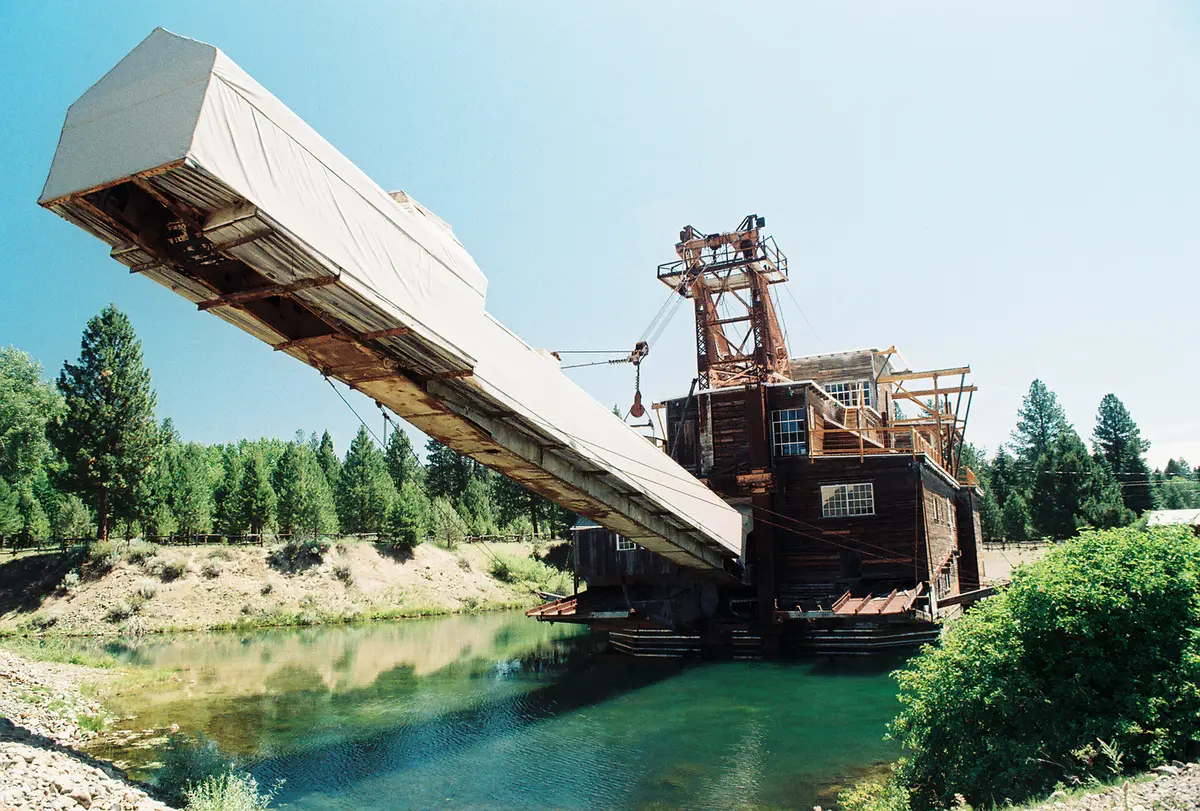
Oregon's last surviving gold dredge is not a mine. It is a boat: a 52-by-120-foot hull, engineered by a shipbuilder in 1935 and launched from the bank, that dug its own pond and floated forward through the Sumpter Valley until August 1954, taking $4.5 million in gold and leaving 1,600 acres under tailings.
Where is Sumpter Valley Gold Dredge?
- Location
- Oregon, United States
- Type
- Ship
- Coordinates
- 44.743, -118.204
- Last updated
LOCATION
Why is Sumpter Valley Gold Dredge said to be haunted?
Its ghost is called Joe Bush, and the crew invented him. Wes Dickison, who worked the dredge in the late 1940s, told the Baker City Herald in 2007 that it began as a joke he blamed on a workmate, George Hansen. The park itself says it has no record of any Joe Bush working or dying there: only two men died across all three Sumpter Valley dredges, and neither was called Joe. The one real death — oiler Christopher Rowe, pulled into the winch gears of Dredge No. 1 in 1918 — happened on a machine that no longer exists, though some of its gear was rebuilt into this one. The dredge later gave Patrick Carman his novel Skeleton Creek and Syfy an episode of Ghost Mine.
What is the history of Sumpter Valley Gold Dredge?
Gold turned up in the Blue Mountains and the Sumpter Valley in 1862, in the same rush that filled eastern Oregon and western Idaho with placer miners. Sumpter, Bourne and Granite drew a triangle of activity on the upper Powder River, but the town's real boom came later: a big lode struck near Bourne in 1896, and the arrival of the Sumpter Valley narrow-gauge railway from Baker, turned a placer camp into a hard-rock town. By local accounts Sumpter covered 400 acres in 1901 with improvements valued at $500,000. A fire in 1917 took most of that back; about 175 people live there today.
By then the easy gold was gone, and what was left was flour-fine and buried in the old riverbed. The answer was the dredge: a hull that digs its own pond and floats forward in it. Three were built in the valley, in 1912, 1915 and 1935. The first worked from 1913 to 1924 and the second from 1915 to 1923; both were stopped and taken apart by their owners in the mid-1920s. There was never a moment when three dredges worked this valley at once, and the machine visitors see today did not start digging until eleven years after the first one stopped.
The survivor is the third, and it is not a mine. It is a boat. The Sumpter Valley Dredging Company, based in Portland and largely financed by a family whose shipbuilding firm had prospered during the First World War, had it engineered by W. H. Cullers of that same yard; Cullers went on to run the company until his death in 1944. Following shipyard practice, the hull was built on the bank and launched, instead of being assembled in a pit that was flooded afterwards. It measures 52 by 120 feet. A bucket line of 72 buckets, nine cubic feet apiece, driven by a 250-horsepower electric motor, cut 20 to 25 buckets a minute and bit 13 to 16 feet down to bedrock; two ten-inch pumps and a six-inch pump moved 8,000 gallons a minute; the waste went out over a 96-foot stacker on a 36-inch belt. Some of the machinery was salvaged from the worn-out No. 1 dredge — a detail that matters later.
The timing helped. The dredge went to work under Franklin Roosevelt's gold policy, with the metal revalued to about $34 to $35 an ounce. Three men ran the digging on each shift and as many as twenty more worked as labourers, machinists, surveyors and clerks, most of them from the town itself. It ran day and night, 363 days a year, with the Fourth of July and Christmas off. In 1938 it was reported to have washed ten acres of river bottom in a single month.
Work stopped during the Second World War, and the idle years were spent on repairs and improvements. The dredge was sold to the Baker Dredging Company in 1948 and to the Powder River Dredging Company in 1950. Rising costs and pressure from local citizens shut it down for good in August 1954, more than $100,000 in debt. Of the roughly $10 million the three dredges took out of some 2,500 acres, $4.5 million came from this one. What they left is the landscape you drive through: in 2004 a park ranger put the damage at 1,600 acres buried under ten-foot piles of tailings, which have since filled with water and become some 300 ponds and a wetland that holds beaver, mink, muskrat, waterfowl and deer.
The dredge then sat where it had stopped for four decades. When Oregon nominated it to the National Register in 1971, park historian Elisabeth Walton described it as deteriorated by years of extreme winters and noted that its private owner, Ken Alexander of Sumpter, was refurbishing it to open as a mining museum. That took another generation: the Oregon Parks and Recreation Department bought the dredge, the tailings and the surrounding ground from the Trust for Public Land and private owners in 1992-1993, opened it to visitors in 1994 and began restoration the following year.
Its modern fame is literary before it is televisual. Patrick Carman told the Baker City Herald in February 2009 that a family holiday proposed by his mother-in-law took him to Sumpter, that he spent most of three days aboard the dredge — "I was completely captivated by that thing" — and that a ghost story grew out of the visit. Skeleton Creek, published by Scholastic on 10 February 2009, alternates a written journal with video the reader unlocks online; Carman spent his advance on the filming, and the crew shot aboard the dredge from dusk to dawn. The ghost in the book is called Old Joe Bush. Four years later Syfy's Ghost Mine — a series built around the Crescent Mine at Sumpter, not around the dredge — sent its investigators aboard in the third episode of its first season, "Vengeful Spirit", broadcast on 30 January 2013, and reported recording an apparition they took for a miner named Joe. The dredge is a visited location in that programme, not its subject.
Timeline: the documented record of Sumpter Valley Gold Dredge
- 1862 The first gold finds in the Powder River district come during the rush that draws prospectors into eastern Oregon and western Idaho. Sumpter, Bourne and Granite form a triangle of placer activity on the upper river.
- 1896 A big lode is struck near Bourne and the Sumpter Valley narrow-gauge railway reaches town from Baker, opening a hard-rock era. Sumpter booms between 1899 and 1903; by local accounts it covers 400 acres in 1901 with improvements worth $500,000.
- 1913-1924 The valley's first gold dredge works the riverbed. A second, built in 1915, runs until 1923. Both are stopped and dismantled by their owners in the mid-1920s.
- 1918 Christopher Robin Rowe, an oiler on Dredge No. 1, is greasing the gears of the bucket-line winches when they turn and pull him in. According to the park, it is the only work-related death across all three Sumpter Valley dredges, and no ghost stories were ever attached to that first dredge.
- 1935 The Sumpter Valley Dredging Company launches Dredge No. 3, engineered by shipbuilder W. H. Cullers and built on the bank like a boat. It reuses machinery from the worn-out No. 1 dredge; the park dates the transfer of the gear system that killed Rowe to 1934.
- 1942 George “Buck” Mosley, a crewman on the third dredge, goes to lunch feeling unwell, falls asleep and does not wake up. It is the second and last death recorded across the three dredges, and it was not an accident.
- Early 1940s to 1945 According to the park, the Joe Bush tales start in the early 1940s, before the dredge shuts down for the Second World War, and persist from 1945, when it reopens. Ranger Miranda Krane names George Hansen as the man blamed for starting them, and the Dickison brothers and Hank Potts among those who added their own versions.
- 1948 and 1950 The dredge is sold to the Baker Dredging Company and, two years later, becomes the property of the Powder River Dredging Company.
- August 1954 Rising costs and pressure from local citizens stop the machine for good, more than $100,000 in debt. It had produced $4.5 million of the roughly $10 million taken from some 2,500 acres by all three dredges.
- 26 October 1971 The dredge is listed on the National Register of Historic Places. In the nomination, park historian Elisabeth Walton records it as deteriorated by extreme winters and notes that its private owner, Ken Alexander of Sumpter, is refurbishing it to open as a mining museum.
- 1992-1995 The Oregon Parks and Recreation Department buys the dredge, the tailings and the surrounding ground from the Trust for Public Land and private owners in 1992-1993, opens the dredge to the public in 1994 and begins restoration in 1995.
- 28 February 2004 The earliest printed account of the phenomena that this entry has been able to read and date. Richard Cockle of The Oregonian, on the AP wire, reports that free tours begin each May and that “tour groups are always on the lookout for 'Joe Bush'”, attributing the wet bare footprints, the flickering lights and the doors to ranger Karen Spencer. It is a description of the tour, not a witness statement.
- 31 October 2007 Lisa Britton interviews two surviving crewmen for the Baker City Herald. Wes Dickison, 77, four years on the dredge in the late 1940s: “It all started as a joke, and I'd blame George Hansen.” Norm Hansen, 85, George's younger brother: “He was the ghost on the dredge. There were no lights, nothing. They just sat in the dark and waited for Joe Bush to come by.” Dickison also says of the dredge: “We all say it was haunted.”
- 10 February 2009 Scholastic publishes Patrick Carman's Skeleton Creek, whose ghost is called Old Joe Bush. Carman tells the Baker City Herald that a family holiday took him to Sumpter, that he spent most of three days aboard the dredge and that the crew filmed there from dusk to dawn: “We were up all night. There were a lot of bats in there.”
- 30 January 2013 Syfy broadcasts “Vengeful Spirit”, the third episode of the first season of Ghost Mine. The series is built around the Crescent Mine at Sumpter, not around the dredge, but the investigators go aboard and report recording an apparition they take for a miner named Joe.
- 8 February 2013 Nine days after the broadcast, park ranger Miranda Krane publishes the park's own account: two deaths across three dredges, neither man named Joe, “we have no records of a Joe Bush having worked or died on the dredge or even in the area”, and a mundane explanation for the noises — wind through cracks, old wood and metal, and moving shadows.
- 1 August 2019 Richard Hanners sums up the state of the legend in the Blue Mountain Eagle: “The name Joe Bush does not appear in company records, but in 1918 an oiler named Chris Rowe was crushed in the gearbox of Sumpter No. 1, and the story goes that his spirit may have ended up inside the third dredge — along with equipment from the earlier dredges.”
Is there a rational explanation for Sumpter Valley Gold Dredge?
The best sceptic available on this site is the site itself.
In February 2013 the park's own ranger, Miranda Krane, published what the Oregon Parks and Recreation Department actually knows about Joe Bush, and it is very little: "we have no records of a Joe Bush having worked or died on the dredge or even in the area". Krane counted two deaths across the working lives of all three Sumpter Valley dredges, and only one of them was an accident. In 1918, aboard Dredge No. 1, an oiler named Christopher Robin Rowe was greasing the gears of the bucket-line winches when the gears turned and pulled him in. In 1942, aboard this dredge, George "Buck" Mosley went to lunch feeling unwell, fell asleep and did not wake up. Neither man was called Joe.
That 1918 death is the only real hook the story has, and every source that uses it marks it as a guess. Krane noted that no ghost stories attach to the first dredge at all, but that the gear system that killed Rowe was transferred into the third dredge in 1934. Reporting for the Blue Mountain Eagle in 2019, Richard Hanners kept it firmly in the conditional: "the story goes that his spirit may have ended up inside the third dredge — along with equipment from the earlier dredges". No source consulted here claims that anyone ever called Rowe by the name Joe Bush.
Where Joe Bush did come from, according to the men who were there, is the night shift. Wes Dickison — 77 when Lisa Britton interviewed him for the Baker City Herald on Halloween 2007, and a dredge hand for four years in the late 1940s — remembered what happened when the power failed: the head oiler and the winch man lowered the gangplank and went for the dredgemaster, and the most junior man stayed aboard in the dark. "It all started as a joke, and I'd blame George Hansen," Dickison told Britton. George's younger brother, Norm Hansen, then 85 and himself a dredge worker for about five months, was quoted in the same article: "He was the ghost on the dredge. There were no lights, nothing. They just sat in the dark and waited for Joe Bush to come by."
It is worth reading Dickison to the end, because the version of this entry we published did not. He did not renounce the ghost. Of the dredge he said "We all say it was haunted", and of the night shift, "You wondered when water starting running for no reason. It was a spooky place in the middle of the night." Krane complicates the confession further. George Hansen may get the blame for starting the tales, but she names the Dickison brothers and a worker called Hank Potts among those who added their own versions, and she offers the plainest available explanation of the footsteps on the upper deck: it "also might be Hank sneaking off to hide behind that corner you're about to walk around". Her structural explanation is just as ordinary — cracks and chinks for the wind to blow through, creaks and moans from old wood and metal, and light and shadow that shift whenever a loose board or a cloth cover does.
That leaves the question of when the modern catalogue of phenomena — wet bare footprints, flickering lights, doors that open and close by themselves — first reached print. The earliest version I have been able to read and date is not a witness statement. It is a description of the tour. On 28 February 2004, Richard Cockle of The Oregonian, on the Associated Press wire, wrote that free tours of the dredge begin each May and that "tour groups are always on the lookout for 'Joe Bush'", attributing the footprints, the lights and the doors to ranger Karen Spencer. English Wikipedia traces the same list to an earlier magazine piece (D. Schoeningh, "Dredging up the Past", Oregon Trail, November 1999), which I was unable to obtain and therefore do not cite as read. Either way, the list arrives in public as visitor-centre patter roughly half a century after the crew invented the joke, not as a file of reported incidents — which is why this entry does not say that visitors "report" any of it.
One control on that negative, because a search that finds nothing proves nothing on its own. In the Internet Archive's full-text book index, the phrase "ghost of Joe Bush" returns zero hits; "Old Joe Bush" returns 29; and the controls "Sumpter Valley dredge" and "Sumpter, Oregon" return 92 and 201 respectively, so the index is working. The only titles among those 29 that place Joe Bush on this dredge are Patrick Carman's novels, from 2009 onwards. The older hits belong to unrelated subjects — a Noël Coward revue collection, a cowboy memoir, a book about World Series heroes and a United States Geological Survey paper.
Can you visit Sumpter Valley Gold Dredge?
The dredge sits in the Sumpter Valley Dredge State Heritage Area, run by the Oregon Parks and Recreation Department, at 441 South Mill Street in Sumpter, Baker County, Oregon, some 48 km (30 miles) west of Baker City by State Route 7 and State Route 410. The park brochure, item 63400-8101 of November 2018, prints the postcode as 97887; the postcode of the town of Sumpter is 97877. The hull entered the National Register of Historic Places on 26 October 1971 under reference number 71000676, and the heritage area is public land.
The department's park page says visitors are welcome aboard the dredge from May to October, with ranger-led tours at weekends only. It gives 541-894-2486 for the park and 800-551-6949 for the state parks line, with Oregon Relay on 711 for hearing-impaired callers. The Friends of the Sumpter Valley Dredge advertise the grounds open daily from 07:00 to 19:00 between 1 May and 31 October, the dredge doors from 08:00 to 17:00, and the interpretive centre from 10:00 to 16:00 Monday to Thursday and from 09:00 to 17:00 Friday to Sunday.
Two alerts were live on the park page when it was read on 10 September 2026, both dated 27 August 2026. The Dredge Loop Trail is closed "for the public's safety while fire crews extract water", and the visitor centre is temporarily closed. Fire restrictions dated 18 June 2026 allow propane barbecues in designated areas for cooking, and nothing else that carries an open flame. The page advertises no night programme and no ghost tour; what has been filmed on the dredge after dark was television production.
The dredge is a ninety-year-old industrial vessel of wood and steel, with stairs, narrow walkways and exposed machinery, and the department publishes no accessibility statement for the decks themselves. The Friends of the Sumpter Valley Dredge keep news at historicsumpter.com.
Sources consulted
- Elisabeth Walton, «Sumpter Valley Gold Dredge — National Register of Historic Places Inventory / Nomination Form (ref. 71000676)» — Oregon State Highway Division / National Park Service, 1971 archive
- Lisa Britton, «The Legend of Joe Bush» — Baker City Herald, 2007 newspaper archive
- Lisa Britton, «Sumpter's Spooky Old Dredge Inspires Author's Ghostly Tale» — Baker City Herald, 2009 newspaper archive
- Richard Cockle, «The woods of Oregon's Sumpter Valley yield another mining relic» — The Oregonian / Associated Press, in The Montana Standard, 2004 newspaper archive
- Miranda Krane, Park Ranger, «We Ain't Scared of No…GHOSTS!» — The Sumpter Valley Dredge (Oregon State Parks staff blog), 2013 web
- Oregon Parks and Recreation Department, «Sumpter Valley Dredge State Heritage Area — park brochure and trail map (63400-8101)» — Oregon Parks and Recreation Department, 2018 report
- Oregon Parks and Recreation Department, «Sumpter Valley Dredge State Heritage Area — official park page» — stateparks.oregon.gov, 2026 web
- Richard Hanners, «JOURNEY: Sumpter Valley Dredge a monument to area mining» — Blue Mountain Eagle, 2019 newspaper archive
- TVmaze, «Ghost Mine, season 1 episode 3: “Vengeful Spirit” — episode record and original air date» — TVmaze, 2013 web
- Patrick Carman, «Skeleton Creek» — Scholastic, 2009 book
Reviewed by V. Serrano on 2026-08-14 · How we verify our content
💬 Field testimonies (0)
No testimonies yet. Add the first.
Add your testimony
🔒 Log in to add a testimony