👻 HAUNTED PLACE · EXP. Nº9477
ACTIVE
The House of Blue Lights
Nothing is left of the House of Blue Lights. The white-tiled farmhouse that Skiles Edward Test bought off Fall Creek Road in 1913 was razed, with every outbuilding on the estate, by the Indianapolis Board of Parks and Recreation in 1978; the wooded acres around it are now Skiles Test Nature Park, free and open to walkers.
Where is The House of Blue Lights?
- Location
- Indiana, United States
- Type
- Park
- Coordinates
- 39.869, -86.05
- Last updated
LOCATION
Why is The House of Blue Lights said to be haunted?
What survives is the story. Test, heir to the Diamond Chain fortune, holder of parking-garage patents and keeper of a private pet cemetery, strung blue lights through his trees and hung blue bug lamps around a solar-heated pool, and Indianapolis decided he must be hiding something. In the version collected in Marion County from February 1959 onwards, a dead wife lay under glass in the living room, lit blue. It was never true: Test married three times and all three women outlived him. He also had a living daughter, Louellen, whose family runs the memorial site devoted to him today. The Indiana State University Folklore Archives hold 129 collected variants of this legend, and not one of them mentions a daughter.
What is the history of The House of Blue Lights?
Skiles Edward Test was born in Indianapolis on 19 October 1889, the eldest child of Charles Edward Test and Mary Elizabeth Skiles. His father had made a fortune running the Indianapolis Chain Works — later the Diamond Chain Company — and in 1900 co-founded the National Motor Vehicle Company alongside Arthur C. Newby, one of the men who would go on to build the Indianapolis Motor Speedway. Skiles finished Manual Training High School in three and a half years, graduating in 1908. Two years later Charles Test died of Bright's disease in a Wisconsin sanatorium, and at twenty the eldest son found himself heading the family.
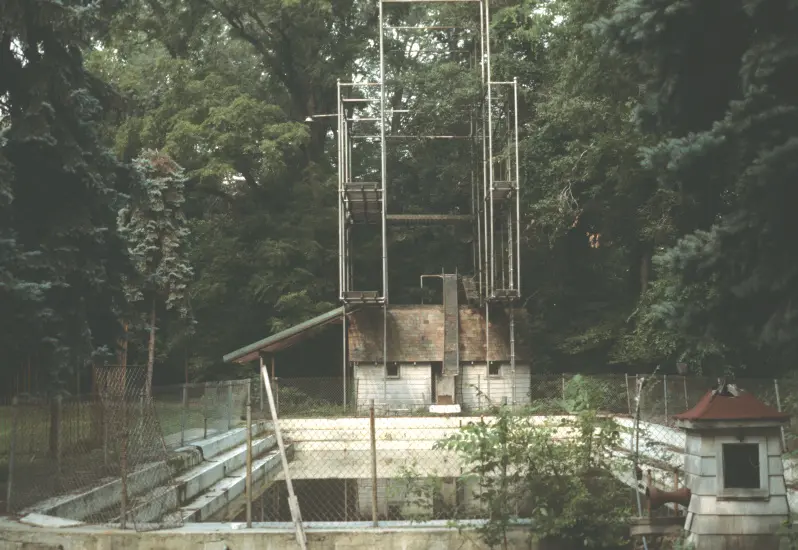
In 1913 he married Josephine Benges, and the couple moved out to a small farmhouse on a large, heavily wooded tract off Fall Creek Road, north-east of the city. What Test did with that ground over the next fifty years is the part of the story that got lost. He was a compulsive builder and a real inventor, holding patents in multi-storey garage design; the Test Building his family raised on Monument Circle in 1925 housed what is usually called the city's first parking garage, and for twenty years its six parking storeys held roughly two-thirds of all the parking available downtown. Out at the farm he laid a miniature railway powered by National engines, and when he fell out with Indianapolis Power & Light he simply built his own generating plant. He sided the farmhouse in white opaque tile, added glass-brick wings and glazed the interior. He put in a forty-by-eighty-foot solar-heated swimming pool with a three-storey diving complex and a motorised surfboard, and a three-storey bathhouse with a basement, a sun deck and a lift. He kept separate parks for his dogs and for his cats.
The animals are what people remember. Garry Ledbetter, who worked on the farm in Test's last years and later wrote about it, recalls between five and seven Saint Bernards and somewhere between 150 and 200 cats — most of them strays that turned up and were allowed to stay, fed on boiled fish, cottage cheese and chicken, housed in individually heated cat houses. When they died Test buried them on the hillside in small caskets, under handmade headstones and brass nameplates, in a private pet cemetery.
He married three times. The standard accounts, which rest on K. J. Miclot's 1975 booklet and on contemporary Indianapolis Times reporting, name the three women: Josephine Benges, married in 1913 and divorced in 1933; Elsa Pantzer Haerle, married in 1936; and Ellen Louise Saxon, whom he met around 1938 or 1939 and with whom he had a daughter, Louellen. Every one of the three outlived him. So did Louellen — the memorial website devoted to her father is run today by the Louellen Test Hesse family.
Test died on 19 March 1964, aged 74, and was buried in the family lot at Crown Hill Cemetery. The estate auction held that May drew a crowd estimated at fifty thousand, most of whom, by every account, had come to look at the property rather than to bid on anything in it.
Timeline: the documented record of The House of Blue Lights
- 19 October 1889 Skiles Edward Test is born in Indianapolis, eldest child of Charles Edward Test of the Diamond Chain Company. He inherits the family's position at twenty, when his father dies in 1910.
- 1913 Test marries Josephine Benges and the couple move to a farmhouse on a heavily wooded tract off Fall Creek Road. Over the following decades he adds white tile siding, glass-brick wings, a solar-heated pool, a three-storey bathhouse, a miniature railway and his own power plant.
- February 1959 The earliest datable version of the legend on record is collected in Marion County by Richard T. Woodbury: a glass dome lit by blue lights, containing the body of the householder's wife. Test is alive and 69, and all three of his wives are living.
- 1962 Susan L. Buckingham collects a variant from Patsy McCombs Roy: a man lived with his wife until she died young, and people who went to look at the house saw him talking to her body in a glass coffin ringed with blue lights.
- 19 March 1964 Test dies aged 74 and is buried at Crown Hill Cemetery. The estate auction held that May draws a crowd estimated at 50,000, most of them there to see the property. In the same year Frank Haas collects a variant from Dave Straber in which the wife was killed by a robber.
- 6 June 1967 Bill Smock collects a version from Bill Cullen in Greene County, near Bloomfield, in which a widower keeps his wife's coffin surrounded by green lights. The story has left both Indianapolis and the colour blue behind.
- Fall–Winter 1968 Magnus Einarsson-Mullarky publishes the first scholarly treatment, "The House of Blue Lights", in the opening issue of Indiana Folklore, the journal of the Hoosier Folklore Society edited by Linda Dégh. The launch of the journal coincides with the peak of student collecting: 85 of the 129 archived variants are dated 1967–1971.
- 1969 Linda Dégh returns to the case with "The House of Blue Lights Revisited" in Indiana Folklore II:2, pages 11 to 28. She reprints the study in 1980 in Indiana Folklore: A Reader, under the section heading "Horror Stories".
- 1978 The Board of Parks and Recreation razes the house and every outbuilding, despite public protest and interest from the Historic Landmarks Foundation of Indiana. The same foundation photographs the house, water tower, bathhouse and pool that year; the images survive in a university library. The 86 wooded acres become Skiles Test Nature Park.
- 1994 Vickie J. West writes the entry on the legend for the Encyclopedia of Indianapolis (Indiana University Press), revised online in March 2021. It is the reference source that states plainly that the recluse of the story never existed as described and that the lights were a personal taste.
- 1998 Susan Neville publishes the short-story collection In the House of Blue Lights with the University of Notre Dame Press, taking its title from the legend and carrying it into literary fiction.
- 29 October 2008 Samantha Dixon collects the legend from Marilene Dixon. The version recorded already includes its own refutation: that Test had three wives and that all of them outlived him. The correction has become part of the tradition.
- 29 October 2013 Ryan Hamlett publishes a long account in Historic Indianapolis built on interviews with Garry Ledbetter, who had worked on the farm in the 1960s. It documents what the legend cost Test: fences, fires, lawsuits, stress ulcers, and years of leaving his own house at night to sleep elsewhere.
- 2022 Friends of Skiles Test Nature Park, first formed in 2006, is reorganised by neighbours concerned at the park's decline. Across 2024 and 2025 the group removes twelve sections of sewer pipe, six concrete platforms and nearly a thousand feet of old farm fencing — the last physical traces of the estate.
Is there a rational explanation for The House of Blue Lights?
The legend cannot be true, and what refutes it is a date rather than an argument. The earliest variant anyone has managed to file was collected in Marion County in February 1959 by Richard T. Woodbury, and it already has its finished shape: a glass dome with blue lights playing over it and, inside, the body of the householder's wife. In February 1959 Skiles Test was sixty-nine years old and alive, and so were all three of the women he had married. There was no dead wife. There was nothing under the glass.
The blue light has a flat explanation, given in the same terms by the Encyclopedia of Indianapolis and by Ryan Hamlett's 2013 account for Historic Indianapolis. Blue was Test's favourite colour. He strung blue Christmas lights through the trees around the house and left them up; he ringed the swimming pool with blue floodlights; and he hung blue bug-zapping lamps around the water to keep the insects off it. A large fenced compound glowing blue among the trees at night, glimpsed from a road, needs no ghost in it.
The coffin is the more interesting half, because there really were coffins. Vickie J. West's encyclopedia entry notes that Test fed the rumours himself by burying his cats in carpeted caskets under brass nameplates. Anyone who got over the fence and came upon a hillside of small caskets and headstones had something to work with.
Two further things suggest a legend behaving like a legend rather than a report of anything. First, it travels. In June 1967 Bill Smock collected a version from Bill Cullen in Greene County, near Bloomfield, in which a widower keeps his wife's coffin surrounded by green lights: the same story in a different county, in a different colour, with Test gone from it altogether. Second, the correction has itself become part of the tradition. When Samantha Dixon collected the legend from Marilene Dixon on 29 October 2008, the text she wrote down already contained the debunking — that Test had had three wives and that all three outlived him.
One caution about the archive, because it is easy to misread. The Indiana State University Folklore Archives holds 129 records of this legend, and 85 of them are dated between 1967 and 1971. That cluster records when students were being sent out with notebooks — Indiana Folklore, the journal of the Hoosier Folklore Society, began publishing in 1968 — and is not a measurement of when the story was most told. The archive is reliable evidence of what people said and when it was written down. It is weak evidence of how many people were saying it.
Can you visit The House of Blue Lights?
The House of Blue Lights no longer exists. The Encyclopedia of Indianapolis, in Vickie J. West's entry of 1994 as revised in March 2021, records that the Test estate bequeathed the house and 86 heavily wooded acres (about 35 hectares) to the Department of Parks and Recreation, and that the Board of Parks and Recreation razed the house and all outbuildings in 1978 "despite widespread public protest and interest in the structure by the Historic Landmarks Foundation of Indiana". Ryan Hamlett, writing for Historic Indianapolis in October 2013, puts the final clearance in the mid-1970s instead. A photograph of the house and its water tower dated 1978, credited to Indiana Landmarks and held by IU Indianapolis University Library, is on Wikimedia Commons under a CC BY 4.0 licence.
The ground is now Skiles Test Nature Park, which the Friends of Skiles Test Nature Park describe as a natural resource area in the Indy Parks system, managed by Indy Parks and Recreation together with the Indianapolis Office of Land Stewardship. Indy Parks gives the address as 6828 Fall Creek Road, Indianapolis, Indiana 46220, and the telephone as 317-327-7180; its page, consulted on 24 September 2026, lists the hours as "Dawn to Dusk" and the entrance fee as "None". The Friends place the parking lot at 6800 Fall Creek Road and call it "free but limited", with two ADA-accessible spaces. Street parking is not permitted at either entrance, and walkers and cyclists can also come in from 65th Street. The paved Skiles Test Trail runs 0.8 miles (1.3 km) north from the parking lot to 65th Street and climbs 76 feet (23 m) in its first 0.2 miles (320 m); six numbered natural-surface trails branch off it. Indy Parks estimates about 45 minutes for a walk to the far end of the park and back with a loop or two. Across Fall Creek Road the park is a trailhead for the Fall Creek Greenway, which the Friends give as a 13.2-mile (21.2 km) paved trail from Indiana Avenue to the edge of Fort Harrison State Park.
In 2013 Hamlett found what survived of the estate: rusting fences running through the woods and old ceramic drains, and near the concrete slab at the top of the hill "random, hidden and ankle-breaking holes in the ground". The Friends, first formed in 2006 and revived by neighbours in 2022, list among their work since then the removal in 2024-2025 of twelve sections of sewer pipe and six concrete platforms, as well as nearly 1,000 feet (about 300 m) of old farm fencing. Their list also records an interpretive sign on the park's history, installed in 2024, and a unified system of nearly five miles (8 km) of foot trails completed in 2025. The group adds that an official trail map was still pending when the federal government cut funding for the AmeriCorps team that had collected the data.
The encyclopedia locates the house on Fall Creek Road and records that the site was developed as Skiles Test Nature Park; Hamlett's article marks the approximate position of the house on a satellite view of the park.
Sources consulted
- Vickie J. West, «House Of Blue Lights» — Encyclopedia of Indianapolis (Indiana University Press), revised online March 2021, 1994 web
- Indiana State University Folklore Archives, «House of blue lights — 129 collected variants, 1959–2010 (Indiana Folklore Collection)» — Special Collections, Cunningham Memorial Library, Terre Haute, Indiana, 2011 archive
- Magnus Einarsson-Mullarky, «The House of Blue Lights» — Indiana Folklore, journal of the Hoosier Folklore Society, vol. I, no. 1, 1968 academic
- Linda Dégh, «The House of Blue Lights Revisited» — Indiana Folklore, vol. II, no. 2, pp. 11–28, 1969 academic
- Linda Dégh (ed.), «Indiana Folklore: A Reader (contains "The House of Blue Lights in Indianapolis")» — Indiana University Press, Bloomington, 1980 book
- Ryan Hamlett, «The House of Blue Lights» — Historic Indianapolis, 29 October 2013, 2013 web
- Garry Ledbetter, «Garry's Story — recollections of a farm worker on the Test estate» — houseofbluelights.com, site run by the Louellen Test Hesse family, 2014 web
- Historic Landmarks Foundation of Indiana (Indiana Landmarks), «Photographs of the Skiles Test estate — house, water tower, bathhouse and swimming pool, 1978» — IU Indianapolis University Library, via Indiana Memory and the Digital Public Library of America; CC BY 4.0, 1978 archive
- Indy Parks and Recreation, «Skiles Test Nature Park — address, hours, trails and contact» — City of Indianapolis, 2026 web
- Friends of Skiles Test Nature Park, «About — Friends of Skiles Test Nature Park» — friendsofstnp.org, 2025 web
- Susan Neville, «In the House of Blue Lights» — University of Notre Dame Press (Richard Sullivan Prize in Short Fiction), 1998 book
- Friends of Skiles Test Nature Park, «Visit — parking lot at 6800 Fall Creek Road, the Skiles Test Trail (0.8 miles, paved) and six natural-surface trails, Fall Creek Greenway trailhead, park rules» — friendsofstnp.org, 2025 web
Reviewed by V. Serrano on 2026-08-14 · How we verify our content
💬 Field testimonies (0)
No testimonies yet. Add the first.
Add your testimony
🔒 Log in to add a testimony