👻 HAUNTED PLACE · EXP. Nº9475
ACTIVE
Tinker Swiss Cottage
Robert Hall Tinker did not arrive in Rockford rich. He arrived in 1856 as a clerk for the Manny Reaper Company, which was run by Mary Dorr Manny, the widow who had taken over her late husband's factory.
Where is Tinker Swiss Cottage?
- Location
- Illinois, United States
- Type
- House / mansion
- Coordinates
- 42.265, -89.102
- Last updated
LOCATION
Why is Tinker Swiss Cottage said to be haunted?
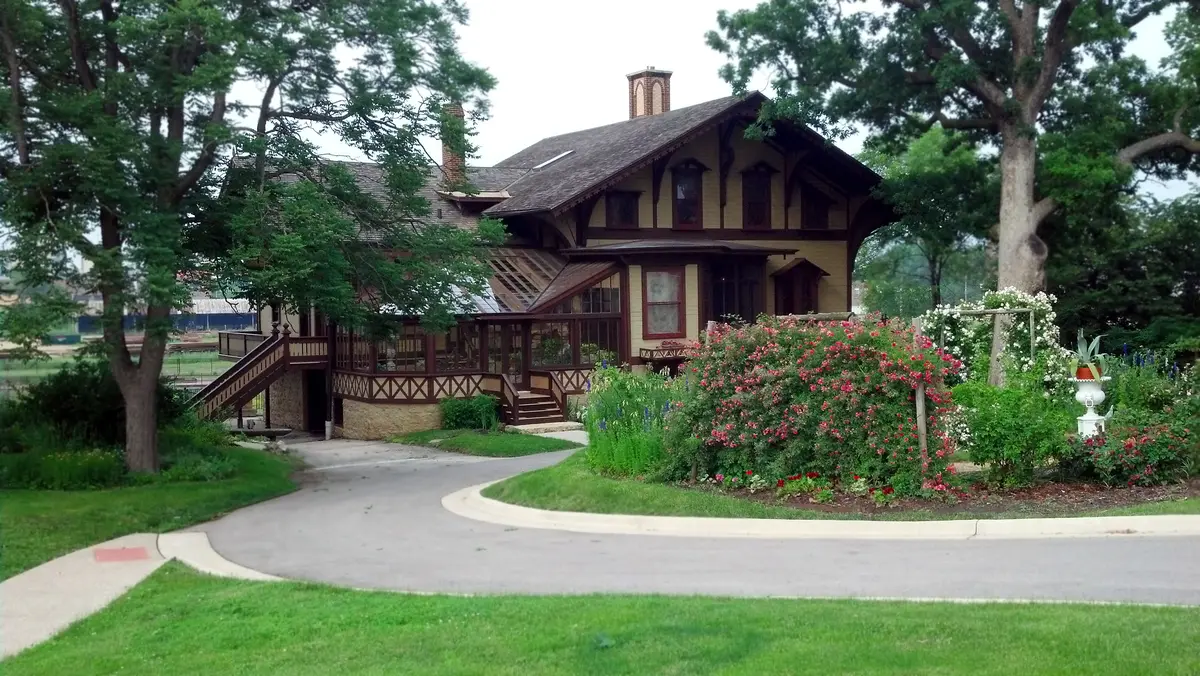
Tinker toured Europe for nine months in 1862, fell for the Swiss chalets he saw there, and between 1865 and 1870 built himself a twenty-seven-room timber cottage on a limestone bluff above Kent Creek. In 1870 he married his employer. She died in 1901; he died in the house on his eighty-eighth birthday in 1924; and it was his second wife, Mary's niece Jessie Dorr Hurd, whose 1938 trust handed the cottage and everything in it to the Rockford Park District. It opened as a museum in 1943, still full of the family's furniture, clothes and diaries. The ghost stories are much younger than the house. The oldest firm dates for them are from October 2012: the Internet Archive's first capture of the museum's page of paid paranormal tours, on the 14th, and Syfy's broadcast on the 24th of a Ghost Hunters episode with a segment filmed at the cottage, roughly seventy years after the last Tinker moved out.
What is the history of Tinker Swiss Cottage?
The story usually told about Tinker Swiss Cottage begins with a rich industrialist. The documented one begins with a bookkeeper who married his boss.
Robert Hall Tinker was born in Honolulu on 31 December 1836, the son of the Reverend Reuben Tinker and Mary Throop Wood Tinker, American missionaries in what were then called the Sandwich Islands. The family returned to the mainland and settled in Westfield, New York. In 1856, at the invitation of William Knowlton, Tinker travelled west to Rockford, Illinois — he recorded his arrival as 12 August 1856 — to take a clerk's job at the Manny Reaper Company. He worked his way up to bookkeeper and then to managing the factory floor.
The company he worked for was not run by a man. John H. Manny, the reaper manufacturer whose machine had made Rockford briefly famous as the "Reaper City", had been sued for patent infringement in 1855 by his far larger rival Cyrus McCormick. Manny's defence team included Edwin M. Stanton and a lawyer from Springfield named Abraham Lincoln. Manny won — and died of tuberculosis two weeks after the verdict. A change in Illinois law allowed his widow, Mary Dorr Manny, to take control of the Manny Reaper Works and draw a salary from it from 1857. She ran a national manufacturing concern at a time when almost no woman did. Robert Hall Tinker was her employee.
In 1862 Tinker spent nine months travelling in Europe and came home fixed on the timber chalets he had seen in Switzerland. In 1865 he began building on a limestone bluff above Kent Creek, next to Mrs Manny's estate; the house was finished by 1870. It is a two-storey, twenty-seven-room timber cottage with high angled ceilings, rooms with rounded corners and a walnut spiral staircase. He laid out twenty-seven acres of paths, vines and flowerbeds around it, added a three-storey Swiss-style barn for cows, chickens and horses, and threw a suspension footbridge across Kent Creek to link his cottage with Mary's limestone mansion on the far bank. The museum quotes him on his intention: "I only wanted to built a home that would give Rockford a name."
Robert and Mary married on 24 April 1870 at her residence. He was thirty-four; she was forty-one. Tinker served a single one-year term as mayor of Rockford in 1875, during which he reworked the city's water system, and he was a founding member of the Rockford Park District. The couple had no children, but the house filled with Mary's relatives: her father Josephus Dorr came to stay upstairs and died there, and her nieces Marcia and Jessie Dorr lodged with them while attending Rockford Seminary. Marcia died in the house too.
On Saturday 3 March 1900 Tinker, then sixty-three, fell under a freight car at a rail crossing and had his left foot crushed; it was amputated above the ankle. He lived more than two decades afterwards using prosthetics. Mary died in the house on 4 September 1901, aged seventy-two, after thirty-one years of marriage. Her funeral was one of several held in the cottage parlour, and Robert designed her monument in Greenwood Cemetery the following year. Her death was reported as far away as Honolulu, where the front page of The Hawaiian Star of 27 September 1901 carried the headline "Death of Mrs. Tinker".
On 14 March 1904 Tinker married Mary's niece Jessie Dorr Hurd (1859–1942) in a private ceremony in the cottage. It is generally described as a marriage of convenience — an unmarried man and an unmarried woman could not respectably share a house. In 1908 Jessie adopted a ten-week-old boy from the Baby Fold orphanage in Normal, Illinois; they named him Theodore. Robert was seventy-one. He died in the cottage on 31 December 1924 — his eighty-eighth birthday.
What happened next turns on Jessie. She inherited the house and negotiated a partnership with the Rockford Park District that let her stay on in it. In 1938 she finalised the trust that left the cottage and its grounds to the Park District and its contents to three trustees. She died on 30 March 1942, after seventy-two years of continuous Tinker occupancy, and the house opened as a museum in 1943 with the family's own furniture, clothing, artwork and diaries still in it. Without Jessie Dorr Hurd Tinker there is no museum. The building was listed on the National Register of Historic Places on 27 December 1972 (reference 72000468) under the architecture and landscape-architecture criteria, with 1870 recorded as its significant year and the architect given as unknown. A pre-Columbian conical mound on the grounds has been archaeologically dated to between 1000 and 1300 CE.
Timeline: the documented record of Tinker Swiss Cottage
- 1855 Cyrus McCormick sues John H. Manny of Rockford for reaper patent infringement. Manny's defence includes Edwin M. Stanton and Abraham Lincoln; Manny wins and dies of tuberculosis two weeks after the verdict.
- 12 August 1856 Robert Hall Tinker, aged 19 and raised in Honolulu by missionary parents, arrives in Rockford to clerk for the Manny Reaper Company, then run by John Manny's widow Mary Dorr Manny.
- 1862 Tinker spends nine months travelling in Europe and returns fixed on the Swiss chalets he has seen — the origin of the cottage's design.
- 1865–1870 Tinker builds his twenty-seven-room Swiss-style cottage on the limestone bluff over Kent Creek, with twenty-seven acres of gardens, a three-storey barn and a suspension footbridge to Mary Manny's mansion.
- 24 April 1870 Robert Hall Tinker, 34, marries his employer Mary Dorr Manny, 41, at her residence. The wealth in the marriage is hers.
- 1875 Tinker serves a single one-year term as mayor of Rockford, reworking the city's water system. He is also a founding member of the Rockford Park District.
- 3 March 1900 Tinker, 63, falls under a freight car at a rail crossing and his left foot is crushed and then amputated above the ankle. The museum records that he lived more than two decades afterwards using prosthetics.
- 4 September 1901 Mary Dorr Manny Tinker dies in the cottage aged 72, after 31 years of marriage, twenty-three years before her husband. Her funeral is held in the parlour.
- 27 September 1901 The front page of The Hawaiian Star in Honolulu carries the headline "Death of Mrs. Tinker".
- 14 March 1904 Tinker, 68, marries Mary's niece Jessie Dorr Hurd, 45, in a private ceremony in the cottage. It is consistently described as a marriage of convenience.
- 1908 Jessie adopts a ten-week-old boy from the Baby Fold orphanage in Normal, Illinois. They name him Theodore. Robert Tinker is 71.
- 31 December 1924 Robert Hall Tinker dies in the cottage on his eighty-eighth birthday.
- 1938 Jessie Dorr Hurd Tinker finalises the trust leaving the cottage and grounds to the Rockford Park District and the contents to three trustees. This bequest, not Robert's, is what created the museum.
- 30 March 1942 Jessie dies, ending seventy-two years of Tinker occupancy. The Rockford Park District takes the property and opens it as a museum in 1943, with the family's furniture, clothing and diaries still in place.
- 27 December 1972 The cottage is listed on the National Register of Historic Places (reference 72000468) for architecture and landscape architecture, with 1870 as the significant year and the architect recorded as unknown. The nomination file has not been digitised by the National Park Service.
- 1988 Laura Bergheim's national guide to offbeat attractions, Weird, Wonderful America, lists Tinker Swiss Cottage among Illinois' curiosities as a Victorian house museum — with no ghost attached.
- 2004 Kathi Kresol, a librarian with the Rockford Public Library, founds Haunted Rockford, the bus-tour and events operation that will bring paying groups into the cottage.
- 14 October 2012 Earliest archived capture of the museum's "Paranormal Tours" page: Friday-night tours at $15 for members and $20 for others, inviting visitors to "listen to audio clips found in the Tinker Cottage". This is the oldest firm date for the haunting as a ticketed product.
- 24 October 2012 Syfy broadcasts "Fear Factory" (Ghost Hunters, season 8, episode 20), including a segment filmed at Tinker Swiss Cottage. Two further shows follow: Expedition Entity (season 2, episode 6) and Jack Osbourne's Night of Terror (season 1, episode 2).
- 2017 Kathi Kresol publishes "The Tinker Family Ghosts" in Haunted Rockford, Illinois, the fullest first-person account of the reports. She names her witnesses — former executive director Steve Litteral and psychic Sara Bowker — and notes that "there were no murders or suicides that took place here".
Is there a rational explanation for Tinker Swiss Cottage?
The stories about the cottage's ghosts have named tellers, and each can be set against the family's record.
The best-documented teller is Kathi Kresol, a Rockford Public Library librarian who founded Haunted Rockford in 2004 and published "The Tinker Family Ghosts" in her book Haunted Rockford, Illinois (2017). She writes in the first person and names her witnesses: Steve Litteral, the museum's former executive director, and the psychic Sara Bowker. Among the things guests have reported on her tours she lists that they "heard children playing, been touched, noticed whistling and humming". In August 2020 the museum's executive director, Samantha Hochman, told WGN-TV: "Occasionally we will hear them whispering… or humming." Haunted Rooms America, which sells overnight hunts in the building, adds cigar smoke, "consistent with Robert's habit documented in his personal diaries", and EVP recordings of "a woman humming". All of these are personal experiences on ghost tours and events that are sold, and Kresol's own chronology drifts, giving Robert Tinker's death as 1926 rather than 1924.
Where the operator's account touches the family record, it slips. Haunted Rooms America says the Tinker family were the only occupants of the house "for seventy-five years"; the 2018 account in the Digital Research Library of Illinois History Journal runs from the wedding of 24 April 1870 to Jessie's death in 1942, seventy-two. It places Mary's ghost in the second-floor bedroom "where she died from tuberculosis in 1901". Kresol and that account give tuberculosis as the cause of death of John Manny, Mary's first husband, in 1856; for Mary, Kresol says only that in 1901 she "became ill and passed away in the house", and the Journal gives the date, 4 September 1901, and her age, seventy-two, with no cause.
The dating is the strongest argument. The Tinkers lived in the house from 1870 to 1942; it has been a museum since 1943. Laura Bergheim's Weird, Wonderful America (1988), a national guide devoted precisely to offbeat attractions, lists Tinker Swiss Cottage among Illinois' curiosities as a Victorian house museum, with no ghost attached. The Internet Archive's first capture of the museum's "Paranormal Tours" page is from 14 October 2012; it advertised Friday-night tours at $15 for members and $20 for others and invited visitors to "listen to audio clips found in the Tinker Cottage". Ten days later, on 24 October 2012, Syfy's Ghost Hunters broadcast a Tinker Cottage segment in "Fear Factory" (season 8, episode 20). The reputation and the ticketed event arrive together, roughly seventy years after the last Tinker left the building.
The commerce is published on the museum's own pages. In October 2026 it charges $10 for adult general admission, $20 for members and $25 for others on a paranormal tour, and $40 or $50 for a paranormal investigation; Haunted Rooms America runs separate overnight hunts in the building at $129 a head. The museum's rules for these events are written from inside the premise: visitors are told that "the Tinker family is a very kind group of spirits, and speaking rudely to them will not be tolerated".
Finally, the phenomena themselves match the building. This is a timber house of twenty-seven rooms with a walnut spiral staircase, high angled ceilings and a hundred and fifty years of settling, standing on a limestone bluff over a creek and beside a rail corridor. Footsteps, whistling, temperature changes and voices carrying between floors are what such a building does. Kresol makes the point that undercuts the usual formula without meaning to: "There were no murders or suicides that took place here." Her explanation for the activity is a family "who loved their home and who still continue to occupy it", a premise no observation can refute and an excellent one to sell tickets on.
Can you visit Tinker Swiss Cottage?
Tinker Swiss Cottage Museum & Gardens is at 411 Kent Street, Rockford, Illinois 61102, telephone (815) 964-2424, on the limestone bluff over Kent Creek where Robert Tinker began building in 1865. The details below were read on the museum's own visit and paranormal pages on 24 September 2026; that day the visit page carried notices for 20 September and for October, so it had been updated for the autumn.
Entry is by guided tour only, which the museum puts down to the way the family's collection is displayed. General-admission tours start Tuesday to Sunday at 1:00 pm and 3:00 pm and last roughly sixty to ninety minutes, entirely on foot; the museum is closed on Mondays. From January to March every tour needs a reservation made at least twenty-four hours ahead. From April to December a reservation is required only for groups of eight or more or for special accommodations, and groups are asked to allow at least two weeks. The published closure list runs from New Year's Day to New Year's Eve and takes in the Memorial Day and Labor Day weekends as well as Thanksgiving and the day after it. The page also warns that winter weather can close the house without notice. Its notices of 24 September announced no public tours on 4 October or on 9 and 10 October, and a holiday closure from 22 December to 4 January.
General admission is $10 for adults and $9 for seniors aged 65 and over; children aged 6 to 17 pay $5. Children of 5 and under go free, as do museum members. Illinois residents enter free on scheduled Donation Days with proof of residency, with places limited to fifteen per tour; reserved school and group tours do not qualify. The 2026 calendar on the same page lists every Tuesday in September among those days. The museum belongs to the Time Travelers reciprocal membership network. It also takes part in Blue Star Museums, which admits active-duty military personnel and their immediate families free from Memorial Day to Labor Day.
The museum itself states that accessibility is limited: there are no ramps into the cottage and no elevators inside it. The Barn, where every tour begins, is wheelchair accessible and has a standard wheelchair available free of charge. Wheelchair and stroller users can be dropped off at the Barn, where there is free accessible parking nearby. Accommodations for hearing or vision impairments and other disabilities have to be requested at least forty-eight hours in advance. The house rules prohibit flash photography as well as food and drink. Visitors may not handle the artefacts or sit on the furniture; strollers are not allowed inside the buildings, and animals are admitted only if they are service animals. According to the same page all the buildings are climate controlled.
The paranormal programme is ticketed separately. In 2026 the museum charges members $20 for a paranormal tour and $40 for a paranormal investigation; non-members pay $25 and $50. It asks that children attending be at least twelve years old. A tour runs from 7:00 to 8:00 pm as a talk by a guest speaker and continues with a walk through the cottage until 10:00 pm. An investigation opens with a half-hour introduction at 7:00 pm and goes on in the cottage until 10:00 pm with breaks. No physical tickets are issued: buyers are put on a reservation list and check in at the Barn, and tickets are non-refundable. The event rules ban spirit boards and Ouija boards on site as well as provocative language. They also warn that attendees may be recorded by the investigating groups and that any evidence captured may be shown at later events. The dates listed on 24 September include the Illinois Paranormal Conference on 10 October 2026. Two of the listed investigations, on 26 September and 21 November, are run with Haunted Rooms America, a commercial operator whose own page prices its Tinker Swiss Cottage hunt at $129 per person for a session from 6:00 pm to midnight. That operator admits people aged 18 or over; those aged 16 or 17 need a responsible adult.
The museum's history page describes a pre-Columbian conical mound on the grounds, archaeologically dated to between 1000 and 1300 CE. It also describes the three-storey Swiss-style barn that Tinker added to the property. The cottage and its grounds sit on the bluff, and the site changes level throughout.
Sources consulted
- The Hawaiian Star, «Death of Mrs. Tinker (front page)» — The Hawaiian Star (Honolulu), 27 September 1901, p. 1, 1901 newspaper archive
- Tinker Swiss Cottage Museum & Gardens, «History of Tinker Swiss Cottage» — tinkercottage.com, 2026 web
- Kathi Kresol, «The Tinker Family Ghosts (originally published in Haunted Rockford, Illinois, 2017)» — Haunted Rockford, 2017 web
- Tinker Swiss Cottage Museum & Gardens, «Paranormal Tours (archived capture of 14 October 2012)» — Internet Archive Wayback Machine, 2012 archive
- Laura Bergheim, «Weird, Wonderful America: The Nation's Most Offbeat and Off-the-Beaten-Path Tourist Attractions» — Collier Books, New York, 1988 book
- National Park Service, «Tinker Swiss Cottage, National Register of Historic Places, reference 72000468» — NPGallery / National Register Information System, 1972 report
- Tinker Swiss Cottage Museum & Gardens, «Paranormal events, tours and investigations» — tinkercottage.com, 2026 web
- Tinker Swiss Cottage Museum & Gardens, «Visiting the Tinker Swiss Cottage Museum: hours, admission and accessibility» — tinkercottage.com, 2026 web
- Lynne Conner, for Chronicle Media, «Where history, folklore and mystery converge in Haunted Rockford» — Chronicle Illinois, 18 October 2019, 2019 newspaper archive
- Digital Research Library of Illinois History Journal, «The History of the Tinker Family and the Tinker Swiss Cottage Museum and Gardens in Rockford, Illinois» — drloihjournal.blogspot.com, 2018 web
- Tinker Swiss Cottage Museum & Gardens, «Disability Pride Month – A Historical Perspective» — A Truly Victorian Experience (museum blog), 23 July 2025, 2025 web
- Haunted Rooms America, «Tinker Swiss Cottage Ghost Hunt, Rockford, Illinois — Haunted Rooms America's overnight event: $129 per person, 6:00 pm to midnight CT, 18 and over or 16-17 with a responsible adult» — hauntedrooms.com, commercial ghost-hunt operator (consulted 24 September 2026), 2026 web
- Elliot Grandia, «Get a glimpse of Victorian era life at Rockford's Tinker Swiss Cottage — executive director Samantha Hochman: "Occasionally we will hear them whispering… or humming"» — WGN-TV, 2020 web
Reviewed by V. Serrano on 2026-08-14 · How we verify our content
💬 Field testimonies (0)
No testimonies yet. Add the first.
Add your testimony
🔒 Log in to add a testimony