👻 HAUNTED PLACE · EXP. Nº9478
ACTIVE
Union Hotel (Flemington, New Jersey)
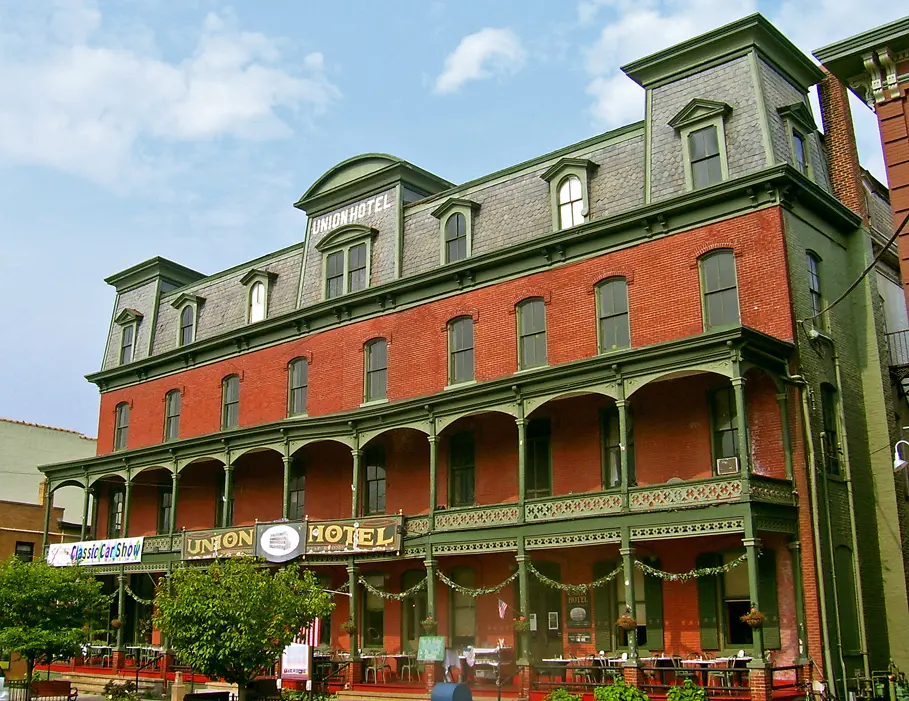
The Union Hotel faces the Flemington courthouse where, between 2 January and 13 February 1935, Bruno Richard Hauptmann was tried for the murder of the Lindbergh baby, and it is the building where, according to Ludovic Kennedy, the jury and the visiting press were lodged.
Where is Union Hotel (Flemington, New Jersey)?
- Location
- New Jersey, United States
- Type
- Hotel / inn
- Coordinates
- 40.511, -74.859
- Last updated
LOCATION
Why is Union Hotel (Flemington, New Jersey) said to be haunted?
That is its claim on the world. Almost everything else usually said about it is wrong. Neal Hart did not build it in 1814: he took over an existing Main Street tavern in 1808 and bought the lot in 1810, and there had been a tavern on that corner since the 1770s. Nor is the building an old core behind a Victorian face — the Hunterdon Republican watched the old hotel torn down in October 1877, and the present Second Empire block was built new, in two halves, in 1877 and 1878. The ghosts arrived far later and from a single article, in which a former manager, a bouncer and two waiting staff, none of them named, describe footsteps, a child and a lullaby on floors sealed since the 1950s. After eighteen years empty and a bitter fight over its demolition, the hotel reopened in July 2026.
What is the history of Union Hotel (Flemington, New Jersey)?
The Union Hotel's official origin story — that Neal Hart built it in 1814 — is a line from the hotel's own marketing, and the deeds contradict it. The ground is lot 10 of the 1767 division of the David Eveland tract, whose map James P. Snell reprinted in his 1881 county history. Jacob Mattison bought that lot in 1764 and his son Joseph took a tavern licence in 1777, so drink was being sold on the corner a generation before Hart appears.
Hart's first Flemington licence, in 1808, was for the house "lately occupied by Isaac Servis", and he paid $18 for it — the going rate for a Main Street tavern. He did not own the place. The owner was John James of Nottingham, an absentee who had to hire a resident keeper, because New Jersey law required a tavernkeeper to live in his own tavern. James sold the lot to Hart on 2 April 1810 for $2,350. Where Hart came from, nobody has established: a former Hunterdon county archivist, Phyllis D'Autrechy, told the genealogist Marfy Goodspeed that he "seems to come out of nowhere". What is documented is that his house became the town's meeting room — when Flemington organised its Fourth of July for 1824 the citizens gathered "at the house of Neal Hart, innkeeper" (Trenton Federalist, 28 June 1824). Hart died away from home, at Stroudsburg, Pennsylvania, on Monday 4 September 1837, aged 59, and the Hunterdon Gazette gave him an unusually long obituary two days later.
The name arrived under his son. Mahlon C. Hart's licence application of 1834 still called the house "the Flemington Inn"; the 1835 one called it "The Flemington Union House". In the 1830s "Union" was not a neutral word, and something odd happened: nineteen leading townsmen had signed Hart's 1834 petition, and in 1835 only one of them signed. No letter survives to explain it. The compound "Union Hotel" first reached print in the Hunterdon Gazette of 7 March 1838, in an advertisement by an attorney who could be found "at the Union Hotel, opposite the Court House".
The building in the photographs is not Hart's, and it is not an old core behind a new face. George F. Crater bought the hotel in 1857 and doubled its size (Hunterdon Gazette, 27 June 1860), then sold it on 1 December 1875 to the brothers Lambert and William Humphrey for $26,000. On 4 October 1877 the Hunterdon Republican reported that "Samuel Humphrey has vacated the old Union Hotel and it is now being torn down and removed", the salvaged material bought by Runkle Rea for a house on Court Street. What went up in its place was entirely new, and it was built in halves: the southern five bays in 1877, the northern four in 1878, for $13,200, by the contractors Titus and Conrad to plans by the architects C. Graham & Son — figures published by the Flemington architect Chris Pickell for the Friends of Historic Flemington. Second Empire, slate mansard roof, gas lighting throughout, pressed-tin ceilings, encaustic tile floors and about two dozen guest rooms. The joint between the two halves can still be read in the brick and in the window count, five bays to the south against four to the north; the 1980 National Register inventory counted the nine bays of the front porch without noticing they were built two years apart.
Then came the trial. Charles A. Lindbergh Jr., twenty months old, was taken from his parents' house in East Amwell Township, Hunterdon County, on 1 March 1932. Because the crime was Hunterdon's, the trial was Hunterdon's too: on 2 January 1935 the county's Oyer and Terminer opened proceedings against Bruno Richard Hauptmann in the courthouse directly across Main Street. New Jersey's attorney-general, David T. Wilentz, prosecuted in person alongside the county prosecutor Anthony M. Hauck Jr. On 13 February 1935 the jury convicted Hauptmann of murder in the first degree "without recommendation of life imprisonment" — the wording that carried the electric chair. Egbert Rosecrans and Frederick A. Pope argued the appeal on 20 June 1935; the Court of Errors and Appeals affirmed on 9 October (State v. Hauptmann, 115 N.J.L. 412). Hauptmann was electrocuted at Trenton State Prison on 3 April 1936, still denying the crime, and historians have argued about the safety of the conviction ever since — Ludovic Kennedy's 1985 book is subtitled "the framing of Richard Hauptmann", while other researchers hold the verdict sound.
The Union Hotel is where the trial slept. Kennedy, describing the town he found decades later, called it "the Union Hotel where jury and visiting journalists had stayed"; the hotel's own website later claimed to have been the "communications center" of the case for forty-six days. After that came the long decline: overnight guests stopped in the 1950s, the second and third floors were closed off, and the ground floor traded as the Union Hotel Restaurant until 2008.
Timeline: the documented record of Union Hotel (Flemington, New Jersey)
- 1764 Jacob Mattison buys lot 10 of the Eveland tract, the ground the hotel still occupies; his son Joseph takes out a tavern licence for it in 1777, more than thirty years before Neal Hart appears.
- 1808 Neal Hart pays $18 for a licence to keep the Flemington tavern "lately occupied by Isaac Servis". He is the tenant keeper, not the builder and not yet the owner.
- 2 April 1810 John James of Nottingham conveys the tavern lot to Hart for $2,350. The deed describes "all that certain messuage, tenement, tavern house and lot" — an existing building, four years before the date the hotel would later advertise.
- 4 May 1835 Mahlon C. Hart's licence petition renames the house "The Flemington Union House". Nineteen townsmen had signed the year before; this time only one of them does.
- 4 September 1837 Neal Hart dies at Stroudsburg, Pennsylvania, aged 59, on his way home from business. The Hunterdon Gazette of 6 September credits him with "many of our most valuable improvements".
- 7 March 1838 The words "Union Hotel" appear in print for the first time, in a Hunterdon Gazette advertisement placed by the attorney C. Elmendorf, whose office is "at the Union Hotel, opposite the Court House".
- 4 October 1877 The Hunterdon Republican reports that the old Union Hotel "is now being torn down and removed", its timber sold to Runkle Rea for a house on Court Street. The present building is therefore new work, not a refaced core.
- 1877–1878 The Second Empire hotel goes up in two phases — five bays south in 1877, four bays north in 1878 — for $13,200, built by Titus and Conrad to plans by C. Graham & Son, with two dozen rooms, gas lighting and pressed-tin ceilings. Lambert Humphrey takes over the management in April 1878.
- 1 March 1932 Charles A. Lindbergh Jr., twenty months old, is taken from his parents' house in East Amwell Township. Because the crime falls in Hunterdon County, the case will be tried in Flemington.
- 2 January 1935 The Hunterdon Oyer and Terminer opens the trial of Bruno Richard Hauptmann across the street. The jury and the visiting press are lodged in the Union Hotel — the detail Ludovic Kennedy records when he describes the town.
- 13 February 1935 The jury convicts Hauptmann of murder in the first degree without recommendation of life imprisonment. The appeal is argued on 20 June and dismissed on 9 October 1935; Hauptmann is electrocuted on 3 April 1936, still denying the crime.
- 17 September 1980 The Flemington Historic District is listed on the National Register (reference 80002493). The nomination describes the hotel bay by bay and dates it 1875 and 1876 in different paragraphs — both wrong — and never mentions the Lindbergh trial or any ghost.
- 2008 The Union Hotel Restaurant closes its doors. The second and third floors had already been shut since the late 1950s, when the hotel stopped taking overnight guests.
- 12 May 2017 After a 2016 redevelopment scheme that would have demolished the hotel, the borough announces a deal with the redeveloper Jack Cust to preserve the building. The facade and the neighbouring Deats Building are kept; the interior is not.
- 16 July 2026 The restored building is due to start taking guests again as The Union Hotel Flemington, a Tribute Portfolio Hotel, with 100 rooms, the Jersey Prime Steakhouse and JP's Bar — the first paying guests since the 1950s.
Is there a rational explanation for Union Hotel (Flemington, New Jersey)?
Every ghost story attached to this building comes from a single published source: a Weird NJ article, updated 12 May 2017, based on a tour of the sealed upper floors. Read it closely and the attribution thins out fast. A former manager who "asked to remain anonymous" reports a bouncer — unnamed — who saw a pair of children's patent-leather shoes climbing the main stairway, and a waitress — unnamed — who dropped a cash drawer and never came back after hearing someone humming a lullaby. The manager herself describes a pressure on her chest at three in the morning. Another former employee relays a waiter's sighting of a girl of eight or ten in a fancy dress in the closed dining room. The one person named in the piece, Joe LoPiccolo, is not a witness to any of that: he was an investor showing the writers around, and what he describes is a heavy door slamming in a derelict building. No named employee, no dated incident, no published investigation.
The strongest test is what the business itself said. The Union Hotel Restaurant's own history page, archived in February 2005 while the place was trading, sells the stagecoach stop, the Victorian roofline and the Lindbergh trial at length — and does not mention a ghost. A restaurant with a haunted upstairs and an incentive to say so said nothing. The 1980 National Register nomination, which describes the building bay by bay, says nothing either. The haunted reputation only becomes an asset once the building becomes a redevelopment story: today the developer's own newsroom runs an item headlined "Historic Building Restoration: Haunted Hotel to Courthouse Square" and invites readers to walk through the "spooky interior" on video.
The physical setting explains a great deal. From the late 1950s until the 2020s, two full floors sat empty, unheated and largely without electricity directly above a working bar — decades of settling timber, uneven pressure, draughts through a shut-up mansard and staff alone in the building after midnight. Weird NJ's own writers had the back door slam on them while they stood there talking about it.
There is also a mismatch nobody points out. The hotel is famous for a case involving a boy of twenty months who was never inside it, yet its ghosts are a girl of eight or ten, a lullaby and children's shoes. The cast does not match the story that makes the building famous, which is what one would expect if the tales grew from an atmospheric derelict rather than from 1935.
Two specific claims should be retired. The first is that Neal Hart built the hotel in 1814. That sentence traces to the restaurant's own website ("a site that has provided respite for weary travelers since 1814. The first hotel was built in that year by Neal Hart"), from where it passed to Wikipedia and to the guidebooks; the licence records and deeds put Hart in an existing tavern in 1808 and make him the owner in 1810, on a lot that had held a tavern since the 1770s. The second is H. L. Mencken's supposed verdict on the case. The line is quoted in two incompatible forms — "the biggest story since the Resurrection" and "the greatest story since the Resurrection" — each returning dozens of books in the Internet Archive's full-text index, attached variously to the kidnapping, to the trial and, in one book, to the wedding of Wallis Simpson, and sometimes to an unnamed "journalist" rather than to Mencken. We could not fix it to a dated piece of Mencken's writing in a named paper, so it does not appear on this page. Even the local record is careless: the Weird NJ article dates the trial to 1934. It was 1935.
Can you visit Union Hotel (Flemington, New Jersey)?
The Union Hotel faces the former Hunterdon County Courthouse at the corner of Main and Court in Flemington, New Jersey. The reopened hotel gives its address as 74 Main Street, Flemington, New Jersey 08822, with a reservations line on 1-844-631-0595; the 1980 National Register inventory records the building as 70–74 Main Street. It is a contributing property in the Flemington Historic District, listed on the National Register on 17 September 1980 under reference 80002493.
The historic district is a free walk in its own right: the courthouse; the Alexander Wurts law office; Fleming Castle; the County Hall of Records, all within a few hundred metres.
For most of the last two decades there was nothing here to visit. The restaurant closed in 2008 and the building stood empty and scaffolded through a contested redevelopment: three successive designated redevelopers, whose files the borough still publishes online; a 2016 scheme that would have demolished the hotel outright; a reversal announced on 12 May 2017 that saved it. The interior did not survive it. The developer's own wording is "preserving its historic facade while transforming the interior into modern, creative spaces", and what stands behind that facade is the 1877–78 shell.
The building is open again, and New Jersey 101.5 reported on 11 June 2026 that the restored hotel would take guests from 16 July 2026 as The Union Hotel Flemington, a Tribute Portfolio Hotel in the Marriott system, with 100 rooms. Marriott's dining page for the hotel was live on 22 September 2026 with service hours on it: Jersey Prime Steakhouse on the ground floor, "Mon-Thu,Sun 6:30 AM-10:30 AM, 4:00 PM-9:00 PM" and "Fri-Sat 6:30 AM-10:30 AM, 4:00 PM-10:00 PM"; JP's Lounge on the second floor, "Tue-Thu 5:00 PM-11:00 PM" and later at weekends, dark on Mondays. Any description of the place as closed and derelict is out of date. Older guidebooks and ghost-hunting sites still carry one.
There is no ghost tour and there never has been. The upper floors were sealed from the late 1950s and were never open to the public, and the only people who described them in print did so on a private visit. The Union Hotel in Lambertville, a short drive south-west, has carried the same name since the 1820s.
Courthouse Square around it adds 206 rental apartments at 23 Bloomfield Avenue, The Residences at Courthouse Square, in a five-storey block finished in 2026, with about 22,000 square feet of retail. The block is a building site turning into a downtown.
Sources consulted
- Marfy Goodspeed, «Union Hotel, part 1» — Goodspeed Histories (Hunterdon County History and Genealogy), 2021 archive
- Marfy Goodspeed, «Union Hotel, part 2» — Goodspeed Histories (Hunterdon County History and Genealogy), 2021 archive
- Marfy Goodspeed, «Union Hotel, part 3» — Goodspeed Histories (Hunterdon County History and Genealogy), 2021 archive
- Roz Li, «National Register of Historic Places Inventory–Nomination Form: Flemington Historic District (ref. 80002493)» — United States National Park Service, 1980 report
- James P. Snell, «History of Hunterdon and Somerset Counties, New Jersey» — Everts & Peck, Philadelphia, 1881 book
- New Jersey Court of Errors and Appeals, «State v. Hauptmann, 115 N.J.L. 412; 180 A. 809» — New Jersey Law Reports, 1935 archive
- Ludovic Kennedy, «The Airman and the Carpenter: The Lindbergh Kidnapping and the Framing of Richard Hauptmann» — Viking (consulted through the Internet Archive full-text index), 1985 book
- Union Hotel Restaurant, «The Union Hotel Restaurant — History (official site, archived 7 February 2005)» — unionhotelrestaurant.com via the Internet Archive, 2005 archive
- Mark and Mark, «Ghosts of the Union Hotel, Flemington» — Weird NJ, 2017 newspaper archive
- Erin Vogt, «NJ's century-old Union Hotel in Flemington gets a stunning makeover» — New Jersey 101.5, 2026 newspaper archive
- Flemington Center Urban Renewal LLC (Cust Investments), «Union Hotel / Proposed Plans (official project site)» — Courthouse Square Flemington, 2026 web
- Borough of Flemington, «Union Hotel — redevelopment document archive (three successive redeveloper phases)» — historicflemington.com, 2026 web
Reviewed by V. Serrano on 2026-08-11 · How we verify our content
💬 Field testimonies (0)
No testimonies yet. Add the first.
Add your testimony
🔒 Log in to add a testimony