👻 HAUNTED PLACE · EXP. Nº9478
ACTIVE
Wolf Creek Inn State Heritage Site
Oregon's state parks tell visitors that Jack London finished The Valley of the Moon at this 1883 roadside hotel.
Where is Wolf Creek Inn State Heritage Site?
- Location
- Oregon, United States
- Type
- Hotel / inn
- Coordinates
- 42.695, -123.396
- Last updated
LOCATION
Why is Wolf Creek Inn State Heritage Site said to be haunted?
The state's own heritage file says otherwise. The 1972 National Register nomination lists that story among the "romantic tradition and misinformation" attached to the building, alongside a president's visit that was never substantiated. London did come through Wolf Creek, in August 1911, on the four-horse driving trip his wife Charmian documented town by town; the stories he wrote that summer are named in her book, and The Valley of the Moon is not one of them. The Clark Gable honeymoon fails on dates. The ghosts appear in Weird Oregon (2010) and in the inn's own paranormal tours, reported in 2019, while neither the state's page for the site nor the operator's website mentions them. What is left is better than the legend — a hotel built by a Pennsylvania storekeeper on a road the railroad was already killing, a 1920s landlord who invented its history with the help of a reporter, and a building the state bought for $50,000 in 1975 to stop it falling down.
What is the history of Wolf Creek Inn State Heritage Site?
The hotel at Wolf Creek is younger than its own legend, and the paperwork proving it was filed by the state that owns it.
Henry Smith (c. 1820-1892) reached Oregon in September 1853 with his wife Phoebe and took a donation land claim on Cow Creek. Widowed in 1856, he sold up in 1859 and moved to the placer diggings on upper Coyote Creek. In 1863 he and his partner Francis Gabbert bought a house and store that had stood beside Wolf Creek and the Territorial Road since about 1854; in 1870-1871 Smith built a larger log hotel a mile downstream, the second Six Bit House, and the settlement of Wolf Creek gathered around it. He homesteaded his forty acres in 1872, married the widow Elizabeth Williams in 1878, served as a Josephine County commissioner from 1878 to 1880, and by his death owned 1,880 acres.
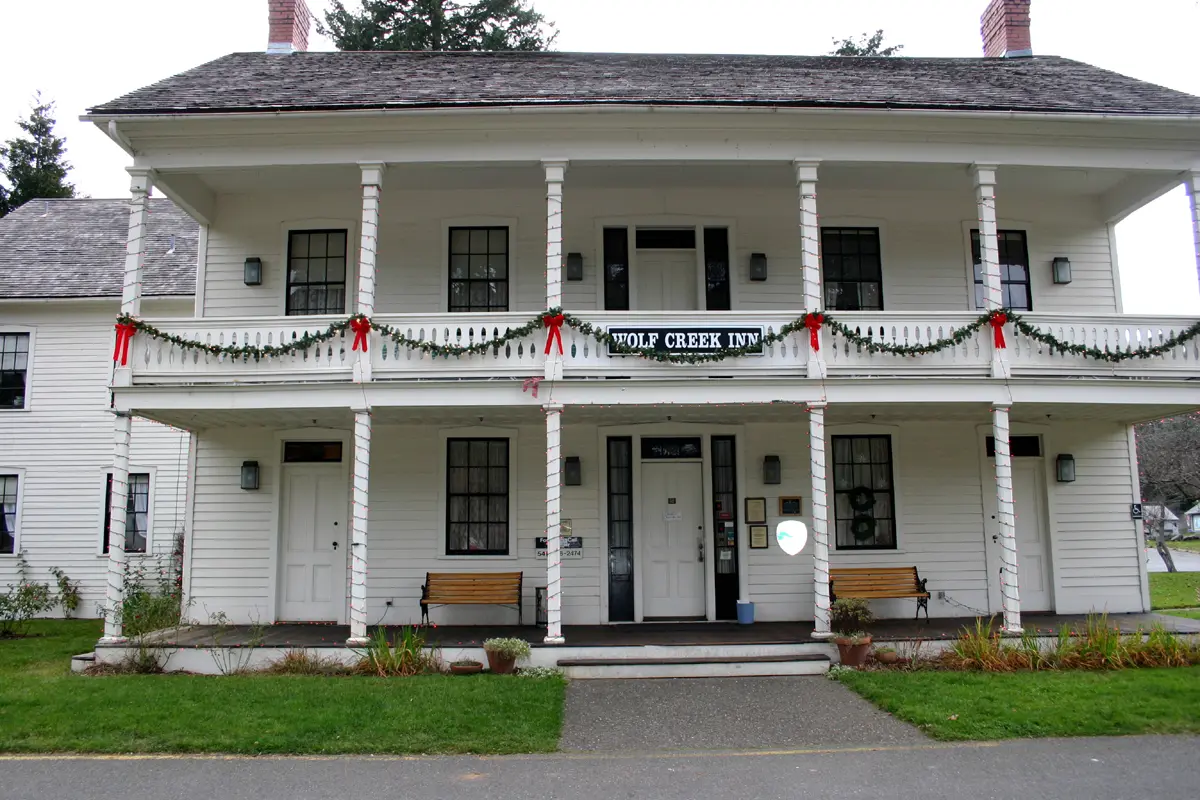
The building that survives is his second venture, begun in 1883: two storeys and an attic, hand-hewn timber and sawn lumber in balloon frame, a main block of 20 by 43 feet with an eight-foot double veranda across the front and a 25 by 40-foot ell behind. County assessment records show improvements of $3,000 and $2,000 in the tax years 1882-83 and 1883-84. The sawyer Lewis Vaughn recalled that the kitchen-and-dining ell went up first, and work seems to have continued in stages: a signature inscription found on a painted plank wall in the ladies' parlour chamber during restoration is dated 21 July 1888.
It was never a contract stage station. The revised National Register nomination is explicit: the spacing of the existing way stations made it redundant, and "the records indicate no regularly scheduled overnight stops". Passengers boarded and got off at Wolf Creek, and the stages ran in when high water closed the roads, but the scheduled stops belonged to Twogood and Harkness at Grave Creek, five miles south. By 1887 the last link of the Oregon and California Railroad was closed through the Siskiyous and the through-stage era ended altogether. The hotel's real heyday as a stage stop began later, in 1905, when the Greenback Mining Company leased it and ran its own coaches up to the mines on Coyote Creek.
The names on the deed then change fast. In 1894 the Smith heirs sold to Robert A. Booth and James T. Tuffs, and it is from that moment — when the place left the family — that it began to be called Wolf Creek Tavern rather than hotel. In 1908 the Reverend W. G. Smith, an ordained minister and no relation to the founder, bought it, platted the townsite, planted the valley with apple orchards, restored the name Wolf Creek Hotel and required his managers to keep it dry. Alice Rogers took the deed in 1909 and held it about twelve years; in 1913 she installed a generating plant that lit the hotel and the village.
In 1922 John Lathrop Dougall assumed the purchase contract, and the tavern became a motor-age business. He married a local woman, Hazel "Dinkey" Blynn, started the roast chicken dinners the place was known for, raised painted arches and a picket fence around a crescent driveway to pull cars off the new Pacific Highway, incorporated the Wolf Creek Tavern Company to finance the eight-room south guest wing built in 1925, and added bathrooms, electric refrigeration and steam heat. In the 1920s he had the telegraph brought into the building by enlisting as a weather observer; in 1933 he installed the first telephone within 23 miles, to reach the State Police at Roseburg and Medford. Dougall sold in 1935 and the family left Wolf Creek in 1939.
Then the road moved. The Highway 99 realignment of 1943-1944 cut through the centre of the village; Interstate 5 by-passed it on a grade a quarter of a mile east in the late 1950s, and motorists could no longer see the building. By the early 1970s it stood empty and open to vandals, most of its interior door hardware gone. In 1973 a communal group led by Arthur L. Finn Jr., Robert Wycoff and David Maranov took a purchase option and began repairs with its own labour; in 1975 they yielded it, and the building and its three acres were sold to the Oregon Department of Transportation for $50,000, nearly half of it met by a National Park Service matching grant. The keys passed to the state on 5 June 1975. Restoration under the consulting historical architect Philip H. Dole ran from 1976 to 1979.
Wolf Creek Tavern had been listed in the National Register of Historic Places on 22 September 1972, reference number 72001081, and recorded by the Historic American Buildings Survey as ORE-17 back in 1934. It is not, and has never been, a National Historic Landmark: on the 1998 revised registration form prepared by Elisabeth Walton Potter for the Oregon Parks and Recreation Department, that box is left unticked.
Timeline: the documented record of Wolf Creek Inn State Heritage Site
- 1883 Henry Smith begins the two-storey hotel that still stands, a mile downstream from his earlier log inn. County assessment records log improvements of $3,000 and $2,000 in the 1882-83 and 1883-84 tax years. The building was believed for a century to date from 1857; the date was corrected on the strength of those records and the research of the local historian Larry L. McLane.
- 1887 The last link of the Oregon and California Railroad closes through the Siskiyou Mountains and through-stage travel ends. The tavern had never been a contract stage station: the revised nomination states that the records indicate no regularly scheduled overnight stops there. Its heyday as a stage stop came later, from 1905, under lease to the Greenback Mining Company.
- August 1911 Jack and Charmian London pass through Wolf Creek on the four-horse driving trip of June to September 1911; her itinerary lists the town between Canyonville and Grants Pass. On Wednesday 16 August the Medford Mail Tribune runs London on its front page, back from Crater Lake the previous afternoon, saying he will write no article about it because he is already working a description into a short story.
- April–December 1913 The Valley of the Moon is serialised in Cosmopolitan and published as a book by Macmillan in October 1913. Charmian London records that the 1911 trip supplied only the wagon-travel episode of the novel, and that in New York in January 1912 her husband did almost none of the writing on it. The story he did write that summer, The End of the Story, had appeared in Woman's World in November 1911.
- 1922–1935 John Lathrop Dougall runs the tavern for the motor age: painted arches on a crescent driveway off the new Pacific Highway, the eight-room south wing built in 1925, the telegraph brought in via a weather-observer post, and in 1933 the first telephone within 23 miles. He also produced, with a local reporter, the invented background that gave the building its false 1857 date.
- 1934 The building is recorded by the Historic American Buildings Survey as ORE-17, among 47 mostly Classical Revival buildings documented in Oregon that year, and is later published as an illustration of the frontier Classical Revival in Talbot Hamlin's Greek Revival Architecture in America (1944).
- 29 March 1939 Clark Gable marries Carole Lombard at Kingman, Arizona, and a cable from Hollywood announces that they will be back there the next day because his work prevents an extended honeymoon; the claim that they honeymooned at Wolf Creek in 1940 postdates the wedding by a year. The Dougalls, whose innkeeping Gable is said to have known, had sold in 1935 and left Wolf Creek in 1939.
- 1943–1944 The new alignment of Highway 99 cuts through the centre of the village, moving the store and post office. The revised National Register form ends the historic period of significance at 1943 because it was then that the property's functional continuity was first interrupted by closure — the state's own answer to the phrase continuously operated.
- 5 June 1975 After standing empty and vandalised in the early 1970s and a spell under a communal group's purchase option, the building and its three acres are sold to the Oregon Department of Transportation for $50,000, nearly half met by a National Park Service matching grant, and the keys pass to the state. It had been listed in the National Register on 22 September 1972 under reference 72001081. Restoration ran 1976-1979.
- 2010 Weird Oregon, by Al Eufrasio and Jefferson Davis, carries the chapter The Wolf Creek Inn Still Howls on pages 214-215 — a printed treatment of the inn's ghost lore. It reports accounts from guests and staff and a night in the Clark Gable suite by two investigators named only as Cougar and Fox. Local press followed on 30 October 2020, with the Mail Tribune video Spooky Seasons: Wolf Creek Inn of Ghosts.
- October 2014 – April 2018 The inn closes for a fire suppression system and stays shut. In June 2015 Oregon Parks and Recreation announces it will remain closed for the year after the concessionaire Quist Hospitality withdraws; the sprinkler and climate work passes $700,000 and approaches a million dollars. In March 2017 the agency says it will reopen to overnight guests on 1 May, run by parks staff and volunteers with the restaurant closed, after failing to find a concessionaire; full dining and lodging return only on 1 April 2018, under a contract awarded to The Public, LLC.
Is there a rational explanation for Wolf Creek Inn State Heritage Site?
Almost everything famous about this building has a paper trail, and the paper trail usually says something slightly different.
Start with Jack London. He was here: Charmian London's day-by-day account of the four-horse driving trip that ran from early June to early September 1911 lists the route town by town, and between Canyonville and Grants Pass it reads simply "Wolf Creek". What he wrote there is another matter. Charmian names the work of that summer — several David Grief episodes, "The Prodigal Father", "By the Turtles of Tasman", "The End of the Story" and "The Mexican" — and adds that the trip fed only "the wagon-travel episode in 'The Valley of the Moon'". The novel itself came later: in New York in January 1912 he did "almost none" of the writing on it, it was serialised in Cosmopolitan from April to December 1913, and Macmillan issued the book in October 1913. Meanwhile "The End of the Story" appeared in Woman's World in November 1911, weeks after the wagon reached home. And on Wednesday 16 August 1911 the Medford Mail Tribune put London on its front page, back from Crater Lake the previous afternoon, saying he would not write an article about the lake because he was "already working a description of it into a short story". The novel reached print two years after that interview.
Oregon State Parks nonetheless tells visitors that "it is here that Jack London completed his novel Valley Of The Moon". The state's own heritage file disagrees with the state's own tourism page. The 1972 National Register nomination warns that "owing to the loss of authentic records of the day-to-day operation of the Tavern, a certain amount of romantic tradition and misinformation has been attached to the building over the years", and then lists, in one breath, the false attribution of the building to Ben Holladay, the unsubstantiated visit of President Rutherford B. Hayes's entourage in 1880, General Grant, and "California author Jack London, who is said to have completed the final chapters of Valley of the Moon during his stay". London's novel closes that list.
There is even a named culprit for the habit. The 1998 revised nomination records that the building's long-believed 1857 date was "a journalistic invention of the 1920s": John Dougall, the owner-manager, "with the cooperation of a local reporter, he created an imaginative background for the inn which was widely promoted and thereby introduced the readily-accepted myth of an 1857 date of origin". This is a house with a documented history of inventing its own history.
Clark Gable fails on dates. A Hollywood cable dated 29 March 1939, printed by the Evening Post of Wellington two days later, announced that he and Carole Lombard had been married at Kingman, Arizona, and were returning to Hollywood the next day because his work prevented an extended honeymoon. A honeymoon at Wolf Creek in 1940 would fall a year after that wedding. What Oregon State Parks actually says is milder: Gable "was a good friend of the innkeeper in the 1930s and stopped by several times while fishing the Rogue River", and Carole Lombard and Orson Welles signed the guest register. For most of that decade the innkeeper was John Dougall, who sold in 1935.
The two websites that speak for the building today do not mention ghosts. Measured on 10 October 2026, the Oregon State Parks page for the site contains no occurrence of ghost, haunted, spirit, paranormal or apparition, while the same page names London twice, Gable twice and Smith four times; on the operator's site, wolfcreekinn.com, the only two occurrences of "ghost" belong to "ghost town", for the old mining settlement of Golden three miles away. The inn has sold the haunting at other times. In October 2019 Oregon Wine Press reported that the hotel "offers paranormal tours", "something the Inn often puts on", and quoted Andrew Shroyer, who had come to the inn in January 2018: "We've had plenty of action around here." In October 2024 the Daily Tidings described the inn as the site of an episode of Ghost Adventures and recorded its yearly Halloween conversion into "Creepsville" under the managers Nancy Davis and Jeremy Schainen.
In print, the ghost lore appears in the chapter "The Wolf Creek Inn Still Howls" of Weird Oregon (Al Eufrasio and Jefferson Davis, 2010), pages 214-215, which reports accounts from guests and staff plus a night spent in the Clark Gable suite by two investigators identified only by the nicknames Cougar and Fox. In October 2013 Portland Monthly put the inn on a list of Oregon's five most haunted destinations, on the strength of "occasional visitors and paranormal investigators" who "have claimed to witness spirits and other eerie activity".
Finally the superlative. "The oldest continuously operated hotel in the Pacific Northwest" is a phrase from the Oregon State Parks page, and the National Register paperwork tells a longer story. The 1972 nomination called the building unique among surviving examples in having "remained in continuous use for essentially its original purpose"; the 1998 revision ends the historic period of significance at 1943, "that brief period when the property's functional continuity was first interrupted by closure". The building also stood unoccupied in the early 1970s, and it was shut from October 2014, with a reopening for overnight guests announced for 1 May 2017 and full dining and lodging returning only on 1 April 2018. The hotel is old, and its operation has had at least three breaks.
Can you visit Wolf Creek Inn State Heritage Site?
On 23 September 2026 the inn was taking overnight guests and serving meals, according to the operator's site and the Oregon Parks and Recreation Department page for the heritage site. It has been shut before: the building stood empty in the early 1970s, and the latest closure ran from October 2014 until lodging and dining returned on 1 April 2018 (refs. 3-5).
The address is 100 Front Street, Wolf Creek, Oregon 97497, beside Interstate 5. In a straight line the site lies about 29 km (18 miles) north of central Grants Pass and 5 km (3 miles) south-south-east of Glendale. The building and its three acres belong to the state and are managed by Oregon State Parks; the day-to-day business is run by a concessionaire that takes bookings through wolfcreekinn.com, [email protected] and (541) 866-2474. The general Oregon State Parks information line is 800-551-6949.
The park page describes "nine beautifully appointed rooms", each with a private bathroom, and "a common restroom with a toilet and sink, downstairs in the guest wing". The operator advertises air-conditioned rooms with Wi-Fi, and electric car charging. Its pet policy allows pets inside the building only in guest rooms 1 to 4, reached by the guest entrance, for a $30 fee, and says dogs "must not be left unattended".
On the same date the operator's site gave the restaurant hours as Thursday and Sunday 8:30 a.m. to 6:30 p.m. and Friday and Saturday 8:30 a.m. to 7 p.m. Self-guided tours of the building run Thursday to Sunday from 8:30 a.m. to 6 p.m., with guided tours at 8:30 a.m. and 6 p.m. on those days. The park page says the grounds are "open to the public dawn to dusk, seven days a week, free of charge", with interpretive panels on the Applegate Trail in front of the tavern.
An Open Flame Ban has been in effect at the site since 17 July 2026 and was still posted on 23 September: campfires, wood, charcoal, candles and tiki torches are banned, while propane stoves and other cooking devices with a shutoff valve are allowed.
Neither the operator's site nor the park page listed a ghost tour on 23 September 2026. A "Paranormal Investigation at the Wolf Creek Inn", sold on Tripadvisor by Pioneer Saloon – Star Journey with the front lobby as its meeting point, was marked that day as unavailable to book.
Golden State Heritage Site, the old mining settlement of Golden, lies about 5.5 km (3.4 miles) east of the inn in a straight line; its surviving buildings, the rebuilt church and the general store among them, are in the National Register as the Golden Historic District (reference 02000825, listed on 25 July 2002). London Peak, above the village, is named after Jack London. The Klamath-Siskiyou Wildlands Center describes two ways up: a lower trail of about 2 miles from Josephine County's Wolf Creek Park, with over 1,400 feet of climb, and a half-mile barrier-free trail from an upper trailhead on Bureau of Land Management land.
The tavern's National Register file, reference 72001081, holds the 1972 nomination and the 1998 revision by Elisabeth Walton Potter, which corrects the construction date; both are published by the National Park Service (ref. 0).
Sources consulted
- Elisabeth Walton Potter, «Wolf Creek Tavern — National Register of Historic Places registration form (1972 nomination and 1998 revision), reference number 72001081» — Oregon Parks and Recreation Department / National Park Service, 1998 report
- Charmian London, «The Book of Jack London, volume II (chapter XXXIV, Four-Horse Driving-Trip; New York City, 1911, pages 212-215, and the appendix of first publications)» — The Century Co., New York, 1921 book
- Medford Mail Tribune, «Crater Lake is Oregon's greatest asset; incomparable in beauty, says Jack London» — Medford Mail Tribune, Medford, Oregon, 16 August 1911, page 1, 1911 newspaper archive
- Shaun Hall, «Wolf Creek Inn closed for the year» — Grants Pass Daily Courier / Mail Tribune, 8 June 2015 (archived capture; mailtribune.com no longer resolves), 2015 newspaper archive
- Mail Tribune, «Wolf Creek Inn to reopen April 1» — Mail Tribune, Medford, Oregon, 30 January 2018 (archived capture), 2018 newspaper archive
- Shaun Hall, «Wolf Creek Inn set to reopen» — Grants Pass Daily Courier / Mail Tribune, 23 March 2017 (archived capture), 2017 newspaper archive
- Oregon Parks and Recreation Department, «Wolf Creek Inn State Heritage Site — park page (history, hours, notices; consulted 14 August 2026)» — stateparks.oregon.gov, 2026 web
- Al Eufrasio and Jefferson Davis, «Weird Oregon: Your Travel Guide to Oregon's Local Legends and Best Kept Secrets (chapter The Wolf Creek Inn Still Howls, pages 214-215)» — Weird US series, 2010 book
- Wolf Creek Inn concessionaire, «The Historic Wolf Creek Inn — operator's site (restaurant and tour hours, rooms, booking; consulted 14 August 2026)» — wolfcreekinn.com, 2026 web
- Evening Post, «Film stars marry — Hollywood cable of 29 March 1939: Clark Gable and Carole Lombard married at Kingman, Arizona, returning to Hollywood the next day, his work preventing an extended honeymoon» — Evening Post, Wellington, 31 March 1939 (Papers Past), 1939 newspaper archive
- Mark Stock, «Paranormal Guests: haunted historic hotels nourish spirit of Halloween — the Wolf Creek Inn 'offers paranormal tours', 'something the Inn often puts on'; Andrew Shroyer, at the inn since January 2018» — Oregon Wine Press, 1 October 2019, 2019 newspaper archive
- Daily Tidings, «Get 'Creeped Out' this Halloween at the Wolf Creek Inn near Medford — Halloween 'Creepsville', site of a Ghost Adventures episode, managers Nancy Davis and Jeremy Schainen since 2021» — Ashland Daily Tidings, 7 October 2024, 2024 newspaper archive
- Portland Monthly, «5 most haunted destinations in Oregon — Wolf Creek Inn, where 'occasional visitors and paranormal investigators have claimed to witness spirits'» — Portland Monthly (pdxmonthly.com), 22 October 2013, 2013 web
Reviewed by V. Serrano on 2026-08-14 · How we verify our content
💬 Field testimonies (0)
No testimonies yet. Add the first.
Add your testimony
🔒 Log in to add a testimony