📜 LEGEND · EXP. Nº0270
ACTIVE
The Curse of the Hope Diamond
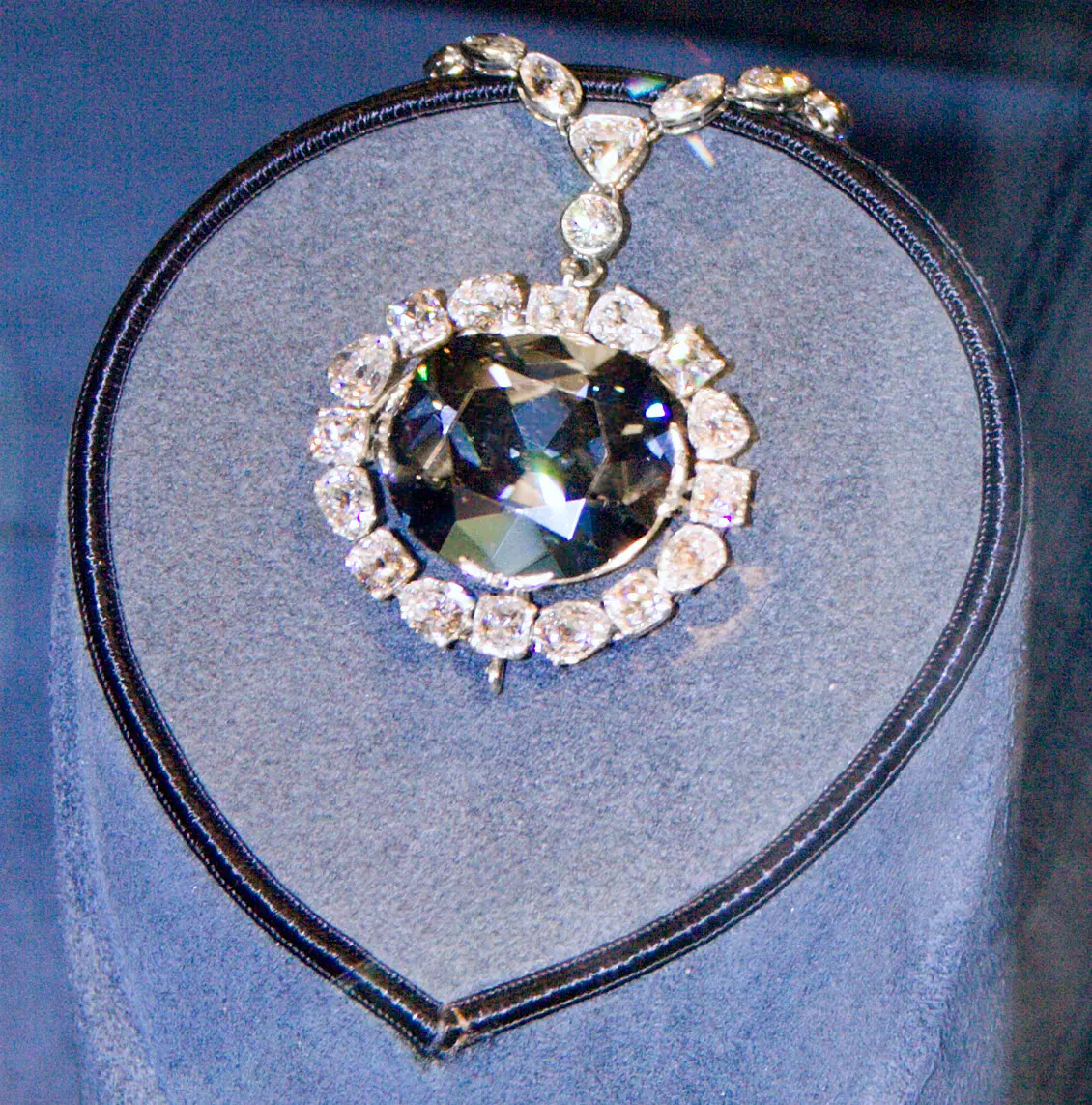
The Hope Diamond is a 45.5-carat blue diamond in a case on the second floor of the Smithsonian's National Museum of Natural History, and the most famous cursed object in the world.
Where does the legend of The Curse of the Hope Diamond come from?
- Location
- National Museum of Natural History, Washington, D.C., United States
- Kind of legend
- Cursed object
- Coordinates
- 38.891, -77.026
- Last updated
LOCATION
What is the legend of The Curse of the Hope Diamond?
Its curse can be dated. The oldest attribution of misfortune to the stone found in the digitised American press is 7 January 1908, when the New York diamond brokers Joseph Frankel's Sons went into the hands of trustees and their own lawyer told reporters the unsellable Hope was 'in part responsible'. A newspaper headline turned that into 'Diamond a Hoodoo'. Eighteen months later the list of victims appeared whole in a Paris dispatch: Marie Antoinette, Louis XVI, a prince, an actress, a broker who went mad. In 1910 the jeweller Pierre Cartier added the detail everyone repeats — that Tavernier, who brought the stone from India, was torn apart by wild dogs — while trying to sell it to an American heiress. She wrote it down, noted that he did not vouch for it, and quoted him calling such superstitions baseless. Tavernier died in Moscow at about eighty-four; his grave was found in 1876.
What is the history of The Curse of the Hope Diamond?
The blue diamond that sits in a case on the second floor of the Smithsonian's National Museum of Natural History has a documented history and a manufactured one, and the two can be told apart to within a few weeks.
The documented one begins with Jean-Baptiste Tavernier, a Parisian gem merchant who made six journeys to Persia and India between 1631 and 1668. He reached Paris on 6 December 1668, aged sixty-three, sold Louis XIV a large parcel of diamonds and coloured stones, and in February 1669 was granted letters of nobility for it; in April 1670 he bought the barony of Aubonne near Geneva. His own book, published in 1676, shows the stones as a plate of engraved figures headed "Figures of twenty Diamonds which the Author sold to the King on his return from his last Voyage to India". The first of them, a violet-blue stone, is the ancestor of the Hope. That is the whole of what Tavernier says about it: a number, an outline and a weight. He gives it no origin, no temple and no owner.
The stone stayed in the French crown collection, was recut, and vanished in the looting of the Garde-Meuble in September 1792. When it surfaces again it is smaller and it is in London. The first published description of it under the name it now carries is an entry in a private catalogue: Bram Hertz, cataloguing the gem collection of the banker Henry Philip Hope in 1839, listed it as number 1* of the polished diamonds, "A most magnificent and rare brilliant, of a deep sapphire blue, of the greatest purity, and most beautifully cut", weighing 177 grains and mounted as a medallion inside a border of small rose diamonds ringed by twenty brilliants. Hertz searched for a pedigree and reported that he could not find one: "in vain do we search for any record of a gem which can, in point of curiosity, beauty, and perfection, be compared with this blue brilliant."
The manufactured history begins on 6 January 1908, in New York, and it begins as an excuse. Four Fifth Avenue diamond houses, among them Joseph Frankel's Sons, who had brought the Hope to America in November 1901, put their affairs into the hands of trustees after the financial panic. Their counsel, Moses Stroock of Stroock & Stroock, told reporters that the Hope diamond was "in part responsible" for his clients' condition: "The Frankels imported the diamond which had such an eventful history several years ago at a cost of about $250,000, and they have never been able to dispose of it. There have been many possible customers, but so soon as negotiations were begun something always happened to the intending purchaser, and the great gem remains in their vaults today." The Evening Star and Newark Advertiser ran it under the headline "Diamond a Hoodoo". The New York Sun covered the same receivership at greater length on its front page that morning, with the same figures and the same Tavernier provenance, and printed no curse of any kind. Twelve days later the Washington Times reported flatly that the owners "are convinced the diamond is a hoodoo".
The list of victims arrives eighteen months later. On 11 July 1909, after the stone had been auctioned in Paris, the Washington Herald printed "Hope Diamond Has a Tragic History", a Paris dispatch that names, in one column, Tavernier, Madame de Montespan, Nicolas Fouquet, Marie Antoinette, the Princesse de Lamballe, Louis XVI, an Amsterdam cutter's suicidal son, a "Francis Beaulieu" who starved, a Prince Kanitovski who shot an actress from a box, a broker who went mad and a Greek jeweller who jumped off a cliff. It calls them "the authenticated tragedies". In that version Tavernier, ruined at eighty-one, "set out again for the East to recoup his fortune and died of fever on the journey."
The dogs come last, and we know who added them. Pierre Cartier bought the stone and spent the autumn of 1910 selling it to Evalyn Walsh McLean, a Colorado mining heiress. She wrote down the pitch in her 1936 memoir: Cartier traced the jewel's history, "or what he freely acknowledged were his beliefs concerning that history", and "said he understood that Tavernier had stolen the gem from a Hindu, perhaps a Hindu god. My recollection is that he said Tavernier afterward was torn and eaten by wild dogs." She adds that "M. Cartier told me things he did not vouch for", and quotes his own view of them: "I think, myself, that superstitions of the kind we speak about are baseless. Yet, one must admit, they are amusing." She refused the stone in Paris because she did not like the setting. Cartier reset it as the diamond pendant on a chain that the museum still displays, sent it to Washington, and she bought it on 28 January 1911.
Timeline: the documented record of The Curse of the Hope Diamond
- 6 December 1668 Jean-Baptiste Tavernier reaches Paris from his sixth and last voyage and sells Louis XIV a parcel of diamonds and coloured stones; among the twenty diamonds engraved in his 1676 book is the violet-blue stone from which the Hope was later cut. He gives it no origin story at all.
- 1676 Tavernier publishes his Six Voyages. In the chapter on the great pagodas he reports that a jeweller who let himself be shut in the temple at Jagannath prised a diamond from the idol's eye and died at the door next morning. The thief is anonymous and it is not his own story; three centuries later the legend gives him the part.
- 1689 Tavernier dies at Moscow at about eighty-four, having entered Russia that February with a Swedish passport. In 1876 T. Tokmakof identifies his grave in an old Protestant cemetery outside the city; Charles Joret publishes the documents in 1886 and V. Ball summarises them in English in 1889.
- September 1792 The recut French crown stone disappears in the looting of the Garde-Meuble during the Revolution. The blue brilliant that resurfaces in London is a fragment of it.
- 1839 Bram Hertz catalogues Henry Philip Hope's gem collection and describes the stone as number 1* of the polished diamonds, 177 grains, set in a medallion ringed by twenty brilliants. He notes that he can find no historical record of it, and neither a curse nor Tavernier's name appears anywhere in the catalogue's 52,538 words.
- 29 June 1902 The Savannah Morning News reprints a New York Journal report on efforts to sell the Hope to an American buyer. It recounts the whole provenance — Tavernier, the crown jewels, the theft, Lord Francis Hope, May Yohe — and never suggests that the stone harmed anyone.
- 7 January 1908 The Frankel diamond houses go into the hands of trustees after the financial panic. Their counsel Moses Stroock tells reporters the Hope is 'in part responsible', because 'so soon as negotiations were begun something always happened to the intending purchaser'. The Evening Star and Newark Advertiser heads it 'Diamond a Hoodoo'. This is the oldest dated attribution of misfortune to the stone found in this search. The New York Sun reports the same collapse on its front page the same morning without a word of a curse.
- 11 July 1909 Days after the stone is auctioned in Paris, the Washington Herald prints the full list of victims for the first time, calling them 'authenticated tragedies'. In this version Tavernier is ruined at eighty-one and dies of fever on the road; there are no dogs yet.
- Autumn 1910 At the Hotel Bristol in Paris, Pierre Cartier shows the diamond to Evalyn Walsh McLean and tells her Tavernier stole it from a Hindu idol and was afterwards torn and eaten by wild dogs. She records that he 'freely acknowledged' these were his beliefs, not facts, and quotes him saying such superstitions are 'baseless' but 'amusing'. She turns the stone down.
- 28 January 1911 McLean takes delivery of the diamond in Washington, reset by Cartier as a pendant on a diamond chain. Her mother-in-law's reaction, as she reports it: 'It is a cursed stone and you must send it back.'
- 8 March 1911 Louis and Pierre Cartier sue the McLeans in the District Supreme Court for the $180,000 price. The Washington Times runs it on page one as the curse at work — 'true to its international reputation as a hoodoo' — and upgrades Marie Antoinette from someone who wore it to someone whose crown it graced. The suit was settled on 2 February 1912.
- 10 November 1958 Postman James Todd, 34, of Seat Pleasant, delivers the diamond by registered mail to the Natural History Building at 10.30 a.m., with a police lieutenant on the roof. Curator George Switzer opens the package with a penknife; Harry Winston's gift enters the Hall of Gems and Minerals the same day.
- August 1959 After a string of accidents and the death of his wife, Todd is asked about the curse by a wire reporter. 'I don't believe any of that stuff,' he answers. 'If the hex is supposed to affect the owners, then the public should be having the bad luck.'
- 2026 The diamond remains on permanent display in the Janet Annenberg Hooker Hall of Geology, Gems, and Minerals on the museum's second floor, described by the Smithsonian as a 45.5-carat blue diamond donated by Harry Winston in 1958. Admission is free.
Is there a rational explanation for The Curse of the Hope Diamond?
Almost every element of the curse can be dated, and several can be refuted with a subtraction.
Tavernier was not torn apart by dogs, and he did not die on the road of fever either. Valentine Ball, translating him in 1889, set out what the biographer Charles Joret had established three years earlier: Tavernier obtained a passport in July 1687, was in Copenhagen in 1688, entered Russia in February 1689 carrying a Swedish passport, and died at Moscow. In 1876 T. Tokmakof found his tomb in an old Protestant cemetery outside the city, the name still legible and part of the date, "16—". He was about eighty-four. All of this was in print, in English, twenty years before any newspaper said he had been eaten.
The idol's eye is not an invention either, but it is not his. Tavernier himself tells the story, in his chapter on the great pagodas of India, about a different man: the great idol at Jagannath "has two diamonds for his eyes", and jewellers are no longer allowed inside "since one of them, who allowed himself to be shut up during the night, extracted a diamond from one of the eyes of the idol, intending to steal it. As he was about to leave in the morning, when the pagoda was opened, this thief, they say, died at the door, and the idol performed this miracle as a punishment for sacrilege." The legend later cast Tavernier in the role of the anonymous thief he had reported on.
Nicolas Fouquet fails on arithmetic. The 1909 list has him borrowing the stone from Louis XIV and falling into disgrace shortly afterwards. Fouquet was arrested in 1661, was in the fortress of Pignerol from the beginning of 1665 and died there on 23 March 1680. Tavernier did not reach Paris with the diamond until 6 December 1668, by which time Fouquet had been in prison for seven years.
The silence before 1908 is measurable. Searching the Library of Congress's Chronicling America for 1902 to 1907 returns 105 newspaper pages that mention the Hope diamond and none that call it unlucky; the six candidate pages thrown up by the words "curse" and "unlucky" all turned out, on reading the scanned text, to be about something else. One of them, the Savannah Morning News of 29 June 1902, reprints a New York Journal piece that runs through the whole provenance — Tavernier, the French crown, the theft, Lord Francis Hope, May Yohe, the Brunswick blue — and never suggests that anyone came to harm. Bram Hertz's catalogue of 1839 is the same result at greater depth: in 52,538 words describing the collection that contained the stone, the word "curse" does not appear once and neither does the name Tavernier.
The lawsuit is the mechanism caught in the act. On 8 March 1911 the Cartier brothers sued the McLeans in the District Supreme Court for the $180,000 purchase price. The Washington Times put it on the front page and opened: "True to its international reputation as a 'hoodoo,' bringing misfortune and trouble to its owners, the famous 'Hope' diamond is today giving its first grief to its present possessors." An unpaid instalment had become an omen. The same story upgraded the Marie Antoinette claim, which Cartier had offered McLean as "so we understand" and the 1909 dispatch had placed at a Tuileries ball, into a diamond that "once graced the crown of Marie Antoinette".
And the postman answered for himself. James G. Todd, who had carried the parcel into the museum in November 1958 and was 35 by the following summer, had his leg crushed by a truck, lost his wife to a heart attack while he was recovering, was thrown from his car in a later accident and watched fire sweep four rooms of his house. A wire reporter asked him about the curse in August 1959. "I don't believe any of that stuff," Todd said. "Perhaps I'm actually having good luck — thank God all four children were outside instead of in those rooms. If the hex is supposed to affect the owners, then the public should be having the bad luck."
Evalyn Walsh McLean, who had more reason than anyone to believe it, wrote the flattest line of all in the foreword to her memoir in January 1936: "I had it blessed myself and I am sitting back on the side lines letting the curse and the blessing fight it out together." Elsewhere in the same book: "What tragedies have befallen me might have occurred had I never seen or touched the diamond."
Can you visit The Curse of the Hope Diamond?
The Hope Diamond is a permanent exhibit in the Janet Annenberg Hooker Hall of Geology, Gems, and Minerals, on the second floor of the Smithsonian's National Museum of Natural History in Washington, D.C. The museum's page for the hall, in the Internet Archive capture of 28 August 2025, describes a 20,000-square-foot exhibition and points to "The Hope Diamond—a world-famous, 45.5-carat blue diamond donated to the Smithsonian by Harry Winston in 1958 and seen by more than 100 million people since then". Around it the same hall holds the 168-carat Mackay emerald and diamond necklace, the Carmen Lúcia ruby, the Whitney Flame Topaz, plus a Mine Gallery built from reproductions of four American mines.
Hours and admission come from the museum's visit page as archived on 1 August 2026: "Open seven days a week. 10:00 a.m - 5:30 p.m., including holidays with the exception of December 25th when we are closed to the public", and "Admission is free. Tickets are not required"; at 5:30 p.m. the doors close and the building is cleared. The address is 10th Street and Constitution Avenue NW, Washington, DC 20560, with entry from the National Mall on Madison Drive or from Constitution Avenue; the nearest Metro station is Federal Triangle on the Blue, Orange and Silver lines. Everyone entering walks through a metal detector, and the museum offers no storage for coats or bags. The same capture carries a notice for that summer: "pedestrian and vehicle access along and across the National Mall may be limited", with the Constitution Ave. entrance recommended. Both sets of figures come from dated captures because the si.edu domain served a bot-verification page instead of the article on 9 September 2026.
Two things about the object in the case are older than the case. The stone is smaller than the one Tavernier sold Louis XIV, having been recut after the theft of 1792, and the weights recorded for it move: Bram Hertz catalogued 177 grains in 1839, 44¼ carats by his own conversion; the press of November 1958 reported 44½; the museum now gives 45.5. The pendant it hangs in dates from 1910, the mounting Pierre Cartier made while trying to close a sale that was going badly.
Sources consulted
- Jean-Baptiste Tavernier; V. Ball (trans.), «Travels in India, vol. II (translated from the original French edition of 1676)» — Macmillan and Co., London, 1889 book
- V. Ball (after Charles Joret, 1886), «Travels in India, vol. I: biographical introduction» — Macmillan and Co., London, 1889 book
- Bram Hertz, «A Catalogue of the Collection of Pearls and Precious Stones formed by Henry Philip Hope, Esq.» — London, 1839 book
- Unsigned, «The Hope Diamond: Senator Clark Said to Have His Eye on the Gem (from the New York Journal)» — The Savannah Morning News, p. 8, 1902 newspaper archive
- Unsigned, «Diamond a Hoodoo: Historic Gem Embarrasses New York Dealers» — The Evening Star and Newark Advertiser, p. 10, 1908 newspaper archive
- Unsigned, «Report on the Frankel receivership and the Hope diamond» — The Washington Times, p. 19, 1908 newspaper archive
- Unsigned Paris dispatch, 10 July 1909, «Hope Diamond Has a Tragic History» — The Washington Herald, p. 9, 1909 newspaper archive
- Unsigned, «Mr. and Mrs. Edward B. McLean, Latest Owners, Sued by Jewelers» — The Washington Times, p. 1, 1911 newspaper archive
- Evalyn Walsh McLean, with Boyden Sparkes, «Father Struck It Rich» — Little, Brown and Company, Boston, 1936 book
- Unsigned, «Hope Diamond Arrives In the Smithsonian» — Evening Star (Washington, D.C.), p. 21, 1958 newspaper archive
- Wire dispatch from Washington, «Hope Diamond Jinx Dogs Mailman Who Delivered It» — The Nome Nugget (Nome, Alaska), p. 1, 1959 newspaper archive
- Smithsonian National Museum of Natural History, «Janet Annenberg Hooker Hall of Geology, Gems, and Minerals» — naturalhistory.si.edu (consulted 16 August 2026), 2026 web
- Smithsonian National Museum of Natural History, «Visit: hours, admission and location» — naturalhistory.si.edu (consulted 16 August 2026), 2026 web
- Unsigned, «Fouquet, Nicolas (Encyclopædia Britannica, 11th edition)» — Cambridge University Press / Wikisource, 1911 book
- Unsigned, «4 Diamond Houses Trusteed: One Holds Famous Unsalable Hope Diamond» — The Sun (New York), p. 1, 1908 newspaper archive
Reviewed by V. Serrano on 2026-08-16 · How we verify our content
📎 Source: Enigma Atlas
💬 Field testimonies (0)
No testimonies yet. Add the first.
Add your testimony
🔒 Log in to add a testimony