🛸 UFO CASE · EXP. Nº5663
ACTIVE
The Betty and Barney Hill abduction claim
Around midnight on 19–20 September 1961, Betty and Barney Hill, a Portsmouth couple driving home from Montreal on US Route 3 through the White Mountains of New Hampshire, watched a light that seemed to follow their car.
The Betty and Barney Hill abduction claim: where and when did it happen?
- Location
- New Hampshire, United States
- Date of the event
- What was reported
- Abduction account
- What the evidence says
- Probable explanation According to: Correspondence between Benjamin Simon, Philip J. Klass, Betty Hill and Robert Sheaffer, 1975-1976
- Coordinates
- 44.086, -71.684
- Last updated
LOCATION
What is known about the Betty and Barney Hill abduction claim?
Near Indian Head, Barney stopped, looked through binoculars and later said he had seen figures at the windows of a craft. They reached home at dawn and the next day phoned Pease Air Force Base; Project Blue Book filed the sighting as “insufficient data”, with a note that the light had “all characteristics of an advertising search light”. Betty then had nightmares of being taken aboard, and in 1964 the Boston psychiatrist Benjamin Simon treated both under hypnosis, which produced the story of an abduction and a medical examination. A Boston newspaper leaked it in 1965 and John G. Fuller's book The Interrupted Journey made it famous in 1966. Simon wrote in 1975 that the abduction “did not take place but was a reproduction of Betty's dream”; the star map Betty drew was later matched first to Pegasus and then to Zeta Reticuli.
What is the history of the Betty and Barney Hill abduction claim?
Barney Hill, a 39-year-old post office clerk, and Betty Hill, a 41-year-old child welfare worker, as the investigator Walter Webb described them a month later, lived in Portsmouth, New Hampshire. Simon, who treated them from December 1963, noted that when Barney introduced his wife, “who is white”, he wondered whether their interracial marriage had a part in Barney's troubles. According to Fuller's book, they left a restaurant in Colebrook at 10:05 on the night of 19 September 1961 on the way home from a short trip to Niagara Falls and Montreal, expecting to be home “by 2:30 in the morning—or 3:00 at the latest”. South of Lancaster, Betty noticed below the Moon, which Fuller calls “almost full” and which Sheaffer later placed two days past first quarter, one star and then a second, bigger one that seemed to grow.
The light stayed in view through Franconia Notch, and not far south of Indian Head, Barney stopped in the middle of the road, got out with the binoculars and saw what he described as a large glowing pancake with a row of windows. He ran back to the car shouting that they were going to be captured. As they drove off they heard a series of beeps on the back of the car; the next thing they clearly remembered was a second set of beeps near Ashland, 35 miles further south, and a road sign for Concord. They got home at dawn.
Later that day, at the urging of Betty's sister, they phoned Pease Air Force Base. In Fuller's account Barney “sheepishly avoided mentioning the figures he had clearly observed on the craft”. The report filed by Major Paul W. Henderson of the 100th Bomb Wing, Information Report No. 100-1-61, which Fuller reproduces, describes a “Continuous band of lights—cigar shaped at all times, despite changes in direction”, with wings that seemed to come out of the body, and says of Barney that “he just cannot believe that such a thing could or did happen”. It adds: “The reliability of the observer cannot be judged”. Project Blue Book's record card dates the sighting 20 September 1961, between 00:01 and 01:00 local time, near Lincoln, and also ticks “Air-Intercept Radar”: the same file deals with a radar contact at Pease that night.
On 26 September Betty wrote to Donald Keyhoe, the retired Marine major who ran the National Investigations Committee on Aerial Phenomena (NICAP). Her letter already says that Barney “did see several figures scurrying about” who seemed “dressed in some type of shiny black uniform”. About ten days after the sighting Betty began five nights of vivid dreams of a roadblock, of being taken aboard and examined, and of a leader who showed her a map; on a friend's advice she typed them up. Webb, a lecturer at the Hayden Planetarium in Boston, interviewed the couple on 21 October and wrote to NICAP on 26 October that “they were telling the truth, and the incident occurred exactly as reported except for some minor uncertainties and technicalities”, adding that “Mr. Hill believes he saw something he doesn't want to remember.” On 25 November two engineers, Robert Hohman and C. D. Jackson, questioned them for most of a day and pointed out that the drive had taken far longer than it should have: this is where the “missing time” comes from.
Simon, a Boston psychiatrist, first saw the Hills on 14 December 1963 and began hypnosis on 4 January 1964. In his introduction to Fuller's book he says the couple came with “crippling anxiety, manifested by him in fairly open fashion and by Mrs. Hill more in the form of repetitive nightmarish dreams”. Under hypnosis both described being stopped by a group of men, taken aboard and examined; Betty described the map again, and in one session Simon told her that if she remembered it afterwards she could try to draw it: “Don't do it if you feel concern or anxious about it.” Treatment ended on 27 June 1964.
In the week of 25 October 1965 a series of articles in a Boston newspaper, written by a reporter Simon had refused to see, made the story public; Betty later wrote to Philip Klass that John Luttrell had “published our experience in the Boston newspaper, for five days in 1965”. The Hills then cooperated with Fuller, whose book appeared from the Dial Press in 1966 with the transcripts, Simon's introduction and, as an appendix, Betty's written dreams. Barney died in 1969. Betty, who died in 2004 at 85, left her papers to the University of New Hampshire, which received them in 2006.
Timeline: the documented record of the Betty and Barney Hill abduction claim
- 19 September 1961, 22:05 The Hills leave a restaurant in Colebrook, New Hampshire, heading south on US 3 for Portsmouth.
- 20 September 1961, 00:01–01:00 The time Project Blue Book gives for the sighting near Lincoln: a cigar-shaped band of light with wings and red lights, watched for about 30 minutes.
- 20 September 1961 Home at dawn, the Hills phone Pease Air Force Base. Major Paul W. Henderson writes Information Report No. 100-1-61; Barney leaves out the figures he says he saw.
- 26 September 1961 Betty writes to Donald Keyhoe of NICAP, describing figures in “shiny black uniform” seen through the craft's windows.
- 21 and 26 October 1961 Walter Webb of the Hayden Planetarium interviews the Hills for six hours and reports to NICAP that they were telling the truth.
- 25 November 1961 Robert Hohman and C. D. Jackson question the Hills and raise the question of the hours missing from the drive.
- 4 January – 27 June 1964 Benjamin Simon treats the Hills with hypnosis in Boston; both describe being taken aboard and examined.
- 10 and 22 February 1964 “The Bellero Shield” is first broadcast; twelve days later, by Kottmeyer's count, Barney first describes and draws the beings' wraparound eyes under hypnosis.
- Week of 25 October 1965 A series of articles in a Boston newspaper makes the abduction story public without the Hills' consent.
- 1966 The Dial Press publishes John G. Fuller's The Interrupted Journey, with Simon's introduction and Betty's star-map sketch beside a map of Pegasus.
- December 1974 Astronomy magazine leads with “The Zeta Reticuli Incident”, Marjorie Fish's reading of the star map.
- 28 October 1975 Simon writes to Philip Klass that the abduction “did not take place but was a reproduction of Betty's dream”.
- August 1976 Robert Sheaffer argues in Official UFO that the light the Hills first followed was Jupiter.
- 2006 Two years after Betty's death, the University of New Hampshire receives the Hills' papers.
- November 2008 Brett Holman finds that, with Hipparcos distances, six of Fish's fifteen stars no longer fit her own criteria.
- 2011 New Hampshire puts up historical marker 224 on US 3 in Lincoln.
- December 2015 Sheaffer releases 48 pages of correspondence between Simon, Klass, Betty Hill and himself.
- April – 2 November 2026 The Portsmouth Historical Society shows “Betty & Barney”, on the Hills' civil rights work as well as the abduction story.
Is there a rational explanation for the Betty and Barney Hill abduction claim?
The Air Force's own verdict on the light was cautious. The Blue Book record card files the case under “Insufficient Data for Evaluation”: the box “Other” is ticked, its typed entry struck through and “INSUFF DATA” written beside it. The analysis sheet behind it says that both the radar and the visual sighting “are probably due to conditions resulting from the strong inversion which prevailed in the Lincoln N.H. area on the morning of the sighting”, and that the light the Hills saw “is not known but it has all of the characteristics of an advertising search light.” The radar contact, which Robert Sheaffer later found quoted in the Air Force report as an unidentified target on the precision approach radar at Pease at 06:14 GMT (02:14 local), was put down to the same inversion.
Sheaffer, writing in Official UFO in August 1976, proposed a simpler source for the light. Betty described a star below the Moon and a second, brighter one above it. Sheaffer worked out that around midnight Saturn lay just below the Moon and Jupiter appeared as “a much brighter star a few degrees above Saturn”. He asked Betty to sketch the configuration, and in her drawing “the object she labelled as the craft was in the precise position of Jupiter”. His conclusion: “the supposed craft was in reality the planet Jupiter.” He also pointed out that the times given for the encounter do not agree: between midnight and 1 a.m. in the report to the Air Force, “not long after 11 p.m.” in Fuller's book, and “right around 3 a.m.” in a later quotation from Betty. Sheaffer's reading explains the first part of the night, not what Barney said he saw through the binoculars at Indian Head.
For the abduction itself, the most important voice is that of the psychiatrist who recovered it. Fuller's book already said that Simon's “best alternative lay in the dream hypothesis”, and quoted him: anything beyond that “would seem to stretch the limits of credulity too far. But I'm not absolutely convinced.” Betty's typed dreams, printed as an appendix, already contain the roadblock, the examination and the leader who pulls down a map from the wall, more than two years before the hypnosis. Barney admitted under hypnosis that Betty had told him many details of her dreams. On 28 October 1975, after the NBC film The UFO Incident, Simon wrote to Philip Klass: “I have never deviated from my conviction that the ‘sighting’ took place. What was sighted, I don't know, nor do the Hills know. I am also sure that the ‘abduction and examination’ did not take place except as Betty's dreams”. The same letter ends: “The abduction did not take place but was a reproduction of Betty's dream which occurred right after the sighting.” In March 1976 he told Klass that his interest had been “almost entirely” in “Barney Hill's developing racial paranoia”. Sheaffer released these letters in December 2015; Jason Colavito reports that Betty's niece, the ufologist Kathleen Marden, says Betty considered them a hoax.
Barney's description of the beings has its own problem. In Magonia in January 1990 Martin Kottmeyer noted that wraparound eyes were almost unknown in science fiction except for the alien in “The Bellero Shield”, an episode of The Outer Limits first broadcast on 10 February 1964, and that “Barney first described and drew the wraparound eyes during the hypnosis session dated 22 February 1964. … Only twelve days separate the two instances.” Colavito argued in 2012 that another episode of the same weeks, “The Children of Spider County”, fits even better.
Fuller's book prints Betty's sketch next to a New York Times map of Pegasus of 13 April 1965 showing the radio source CTA-102, and notes that she, “struck by the similarity”, added the star names. From the late 1960s the teacher Marjorie Fish built bead-and-thread models from the 1969 Gliese catalogue and found a match centred on Zeta Reticuli, which Astronomy magazine made its lead article in December 1974. Carl Sagan and Steven Soter replied in the same magazine in July 1975 that the resemblance depends on the lines drawn between the dots. In 2008 Brett Holman rechecked Fish's choice against the Hipparcos satellite's distances: “six of the fifteen stars chosen by Fish must be excluded, which is no match at all.” An obituary quoted by the Armagh Planetarium says Fish herself later concluded “that the correlation was unlikely.”
The verdict here is therefore a probable explanation and not a closed one: the treating psychiatrist put in writing that the abduction was Betty's dream, but nobody can now establish what light the Hills followed down Route 3.
Can you visit the Betty and Barney Hill abduction claim?
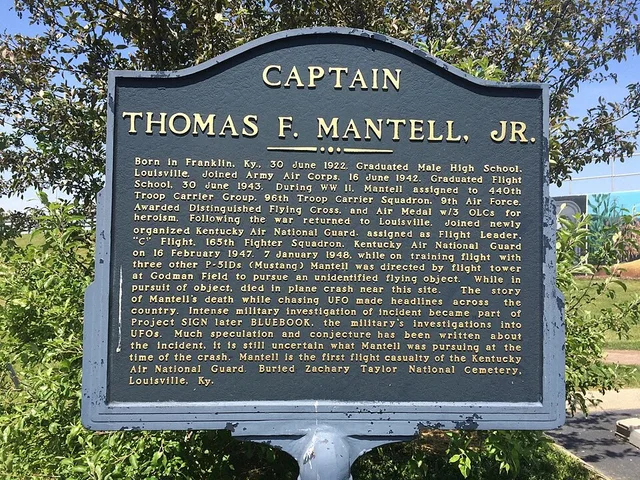
New Hampshire historical marker 224, put up by the state Division of Historical Resources in 2011, stands on the Daniel Webster Highway (US 3) in Lincoln, on the right when travelling north, near the Indian Head Resort; the Historical Marker Database gives its position as 44° 5.128′ N, 71° 41.048′ W. It is a roadside sign with nothing else on site. Its text says the Hills “experienced a close encounter with an unidentified flying object and two hours of ‘lost’ time” and ends: “This was the first widely-reported UFO abduction report in the United States.” Colavito objected in 2011 that the wording leaves out that the abduction was not claimed until long after the report to the Air Force.
The Betty and Barney Hill Papers are in the Milne Special Collections at the University of New Hampshire in Durham, and the library says the collection “is open to the public for viewing by appointment”, booked through [email protected]. It lists among the highlights “the dress Betty wore during the abduction, correspondence about the star maps, and ‘Junior,’ a bust of the aliens commissioned by Betty.”
In Portsmouth, the Portsmouth Historical Society, 10 Middle Street, ran the exhibition “Betty & Barney” from April 2026; its press release gave the run as “until Nov. 2” and the building's hours as “daily from 10am-5pm, from April through December”. As of 20 November 2026 the exhibition has closed. Its exhibitions manager, Meredith Affleck, told New Hampshire Public Radio: “we are very specifically in this exhibition, not choosing a side as to whether or not it happened”.
The documents can be read for free online: the Blue Book record card and analysis sheet, and the Simon–Klass letters released by Sheaffer, are linked in the references.
Sources consulted
- US Air Force, Project Blue Book, «Project 10073 Record Card and UFO Analysis Sheet — Lincoln, New Hampshire, 20 Sep 61: “Insufficient data”, with the inversion and advertising-searchlight comments (scan of the Blue Book microfilm)» — Project Blue Book files (NARA T1206), scan hosted by ufoscans.com, 1961 archive
- John G. Fuller, «The Interrupted Journey: Two Lost Hours “Aboard a Flying Saucer” — with Simon's introduction, Pease Information Report No. 100-1-61, Webb's NICAP report, the hypnosis transcripts and Betty Hill's written dreams» — The Dial Press, New York, 1966 book
- Benjamin Simon; Philip J. Klass; Betty Hill, «Correspondence between Benjamin Simon, Philip J. Klass, Betty Hill and Robert Sheaffer, 1975-1976 — including Simon's letter to Klass of 28 October 1975 (48 pages, scanned and released by Sheaffer)» — debunker.com (Robert Sheaffer), historical UFO documents, 1975 archive
- Robert Sheaffer, «The New Hampshire Abduction Explained — Jupiter and Saturn below the Moon, the Pease radar entry, Simon on the Today show (reprinted in the same scan as ref. 2)» — Official UFO (Countrywide Publications), August 1976, 1976 newspaper archive
- Martin Kottmeyer, «Entirely Unpredisposed: The Cultural Background of UFO Abduction Reports — the “Bellero Shield” episode and Barney Hill's session of 22 February 1964» — Magonia (January 1990), reprinted on debunker.com, 1990 newspaper archive
- Jason Colavito, «New Documents Offer Insight into Barney Hill's “Racial Paranoia” and His Alleged Alien Abduction — on the Sheaffer release and Simon's letter of 1 March 1976» — jasoncolavito.com (blog), 2015 web
- Brett Holman, «Goodbye, Zeta Reticuli — summary of his Fortean Times article (November 2008) testing the Fish map against Hipparcos data» — Airminded, 2008 web
- Colin Johnston, «The Truth about Betty Hill's UFO Star Map — Fish's method, the Hipparcos objections and the 2013 obituary note on Fish's change of mind» — Armagh Observatory and Planetarium (Astronotes), 2011 web
- Jeffrey L. Kretsch, «The Zeta Reticuli Incident: The Age of Nearby Stars — Astronomy's follow-up to its December 1974 lead article (reproduced by NICAP)» — Astronomy, reproduced on nicap.org newspaper archive
- The Historical Marker Database, «Betty and Barney Hill Incident — inscription of New Hampshire historical marker 224 (2011) and its location on US 3 in Lincoln» — hmdb.org, 2026 web
- University of New Hampshire Library, «Using the Betty & Barney Hill Collection — what the papers hold and how to see them» — library.unh.edu, 2026 web
- Kristin Waterfield Duisberg, «An extraterrestrial special collection — how the Hill papers reached UNH in 2006» — UNH Magazine, Spring/Summer 2021, 2021 web
- Michelle Liu and Julia Barnett, «‘Come for the aliens, stay for the history’: Portsmouth's new Betty and Barney exhibition» — New Hampshire Public Radio, 2026 newspaper archive
- Portsmouth Historical Society, «Alien abduction and local history collide in ‘Betty & Barney’ Exhibition — press release with the run (to 2 November 2026), address and opening hours» — Greater Portsmouth Chamber of Commerce (news), 2026 web
- Jason Colavito, «NH's UFO Abduction Plaque and the Assault on Truth — quotes and criticises the text of marker 224» — jasoncolavito.com (blog), 2011 web
Reviewed by V. Serrano on 2026-11-20 · How we verify our content
💬 Field testimonies (0)
No testimonies yet. Add the first.
Add your testimony
🔒 Log in to add a testimony