🛸 UFO CASE · EXP. Nº5667
ACTIVE
The Mantell incident (Godman Field, 1948)
On the afternoon of 7 January 1948 the control tower at Godman Field, beside Fort Knox in Kentucky, watched a white object hang in the sky south of the base for more than an hour.
The Mantell incident (Godman Field, 1948): where and when did it happen?
- Location
- Kentucky, United States
- Date of the event
- What was reported
- Sighting
- What the evidence says
- Probable explanation According to: The Report on Unidentified Flying Objects
- Coordinates
- 37.907, -85.972
- Last updated
LOCATION
What is known about the Mantell incident (Godman Field, 1948)?
Four Kentucky Air National Guard P-51 Mustangs were passing on their way home to Louisville, and the tower asked the flight leader, Captain Thomas F. Mantell Jr., to take a look, and he climbed after it. The tower chief wrote two days later that Mantell had called it “metallic object of tremendous size”, and the last words logged from him came at about 15:15. His fighter came down on a farm south-west of Franklin, near the Tennessee line, when he was 25. The Air Force first blamed Venus. In November 1948 its own analysts wrote that the object “was not the planet Venus” and filed the case as unexplained. In 1952 Edward Ruppelt of Project Blue Book concluded that it “could have been a balloon”, one of the large Skyhook research balloons that were secret at the time, though he never found a record of the launch.
What is the history of the Mantell incident (Godman Field, 1948)?
Godman Field was the airfield of Fort Knox, south-west of Louisville. On 7 January 1948 the man on duty as chief operator in its control tower was Technical Sergeant Quinton A. Blackwell, and the clearest account of the afternoon is the statement he signed two days later, now in the Project Blue Book case file for Incident 33.
“Up until 1315 or 1320 matters were routine,” it begins. Then Sergeant Cook, from the office of the base commander, Colonel Guy F. Hix, telephoned to say that, according to the Fort Knox military police and the state police, there was “a large curcular object from 250 to 300 ft in diameter” over “Mansville, Ky.” (Ruppelt's later account says Maysville, a town about 80 miles east of Louisville). Army Flight Service knew of no unusual aircraft, but soon passed on positions for an object of the same size and description over Irvington and then Owensboro, west of the base. A second document in the file, the Report of Unusual Incident, gives the police description as “circular in appearance approximately 250 - 300 feet in diameter, moving westward at "a pretty good clip."”
“About 1345 or 1350 I sighted an object in the sky to the South of Godman Field,” Blackwell wrote. He called his detachment commander, First Lieutenant Paul I. Orner, who called the operations officer, Captain Carter, who called Colonel Hix, who reached the tower at about 14:20. Their statements do not describe the same thing. Carter's says it “appeared round and white (whiter than the clouds that passed in front of it)”. Private First Class Stanley Oliver's check-list records that it looked like an “ice-cream cone topped with red”. Captain James F. Duesler, who came up with Lieutenant Colonel E. Garrison Wood, gave “Silver - bright” and a shape “like tear drop - round; later, object seemed fluid”.
Between 14:30 and 14:40, in Blackwell's words, “a flight of four P-51's approached Godman Field from the South, enroute from Marietta, Ga. to Standiford Field, Ky.” He asked the flight leader, call sign NG 869, whether he had the fuel to try to identify the object. The leader was Captain Thomas F. Mantell Jr., born in Franklin, Kentucky, on 30 June 1922, a transport pilot during the war who had joined the newly formed Kentucky Air National Guard as leader of C Flight of the 165th Fighter Squadron on 16 February 1947. One aircraft, flown by a pilot the Report of Unusual Incident names as Hendrichs, went on to Louisville; Mantell turned south with the other two, flown by Hammond and Clements, on a heading of 210°.
About 14:45 Mantell reported the object “ahead and above, I'm still climbing”, and a wingman retorted, “What the Hell are we looking for?” At 15,000 feet he said that “The object is directly ahead of and above me now, moving about half my speed”, and, asked for a description, “It appears metallic object of tremendous size”. His last message in Blackwell's record came at about 15:15: “I'm still climbing, the object is above and ahead of me moving at about my speed or faster. I'M trying to close in for a better look.” Carter, who wrote that it was impossible to tell which plane was talking, heard a different ending: that the pilot was going to 20,000 feet and, “if no closer was going to abandon the chase”.
None of the three aircraft carried enough oxygen. The Report of Unusual Incident says that at 22,000 feet Hammond told Clements “that he had no oxygen equipment” and both turned back. As they passed Godman, Clements, NG 800, reported, again in Blackwell's statement, “It appears like the reflection of sunlight on an airplane canopy.” He refuelled, took on oxygen and flew south a second time, to 33,000 feet and about a hundred miles, without seeing anything.
Mantell's Mustang came down, in the words of a 1964 Air Force letter in the same file, “into the yard of Mrs Carrie Phillips, Route 3, Lake Spring Road, 5 miles Southwest of Franklin, Kentucky (W J Phillips farm)”. The state police officer who took charge, Joe Walker, told the Maxwell Flight Service Center that witnesses said the aircraft “had exploded in the air before it hit the ground”, and that the wreckage was scattered over about a mile. The accident report, which Ruppelt obtained in 1952, found that the aircraft had lost a wing through excessive speed in a dive after Mantell had “blacked out” from lack of oxygen.
The sky over Godman was not empty after the crash: at about 17:35 Orner, back in the tower, saw a bright light at 240° azimuth and 8° of elevation, tracked it with the weather station's theodolite and watched it sink below the horizon “in a manner similar to the sun or moon setting”. Towers at Lockbourne and Clinton County, in Ohio, reported a great ball of light moving south-west. And between 16:30 and 16:45, the flight service log records, “a Dr. Seyfert, Astronomer at Vanderbilt Univ.” had spotted an object south-south-east of Nashville, Tennessee, which the Report of Unusual Incident describes as “a pear shaped balloon with cables and a basket attached”.
Timeline: the documented record of the Mantell incident (Godman Field, 1948)
- 6 January 1948, 08:00 CST According to the StratoCat database, General Mills launches a balloon for the Office of Naval Research from Camp Ripley, Minnesota, carrying a cosmic-ray camera; its cut-down device fails.
- 7 January 1948, about 13:15-13:20 CST Colonel Hix's office telephones Godman tower: the military and state police report a circular object 250 to 300 feet across. Flight Service later reports it over Irvington and Owensboro.
- 7 January 1948, 13:45-13:50 CST T/Sgt Quinton A. Blackwell sights an object south of Godman Field; Orner, Carter and, at about 14:20, Colonel Hix come to the tower to watch it.
- 7 January 1948, 14:30-15:15 CST Captain Thomas F. Mantell Jr. turns his P-51 flight south to identify the object and climbs; his last logged transmission is at about 15:15. His two wingmen turn back without oxygen.
- 7 January 1948 Mantell's Mustang crashes into the yard of the W. J. Phillips farm, Lake Spring Road, five miles south-west of Franklin, Kentucky; he is killed.
- 7 January 1948, 16:30-16:45 CST Dr Carl Seyfert of Vanderbilt University reports an object south-south-east of Nashville that the flight service log describes as a pear-shaped balloon with cables and a basket.
- 9 January 1948 Blackwell, Carter, Duesler and others sign their statements, which Captain Duesler certifies for the case file.
- 10 November 1948 A. B. Deyarmond of the Technical Intelligence Division concludes that the object “was not the planet Venus” and that the sighting “must be considered as unexplained”.
- August 1949 The Project Grudge report includes Hynek's analysis: the evening lights were Venus; the afternoon object may have been Venus, but a Navy cosmic-ray balloon, if established, is “to be preferred”.
- 1952 Edward Ruppelt reopens the case for Project Blue Book, rejects Venus after talking to Hynek and concludes that the object “could have been a balloon”; the record card is marked BALLOON.
- July 1964 The Federal Aviation Agency asks for the Mantell file to compare it with a P-51 crash in Oregon in which the pilot became hypoxic above 20,000 feet.
- 29 September 2001 The Simpson County Historical Society unveils a marker to Mantell at the Franklin exit of Interstate 65.
- 16 October 2025 WNKY reports that Simpson County Tourism has opened a new office at 105 West Cedar Street, in downtown Franklin.
Is there a rational explanation for the Mantell incident (Godman Field, 1948)?
The Air Force's first answer was Venus, and the case file shows how it fell apart inside the Air Force before it fell apart in public. In October 1948 the Technical Intelligence Division asked for the position of the planet between 13:30 and 15:15 that day. The reply, dated 8 November, said that “It is doubtful that Venus could be observed by the unaided eye from the ground or 15,000 feet as it would probably be hidden by the high degree of sky brightness due to its proximity to the Sun.” Two days later A. B. Deyarmond, assistant deputy for technical analysis, closed the question: “It is apparent, from the data given above, that the object sighted at Godman Air Force Base on 7 January 1948 was not the planet Venus. Therefore, this sighting must be considered as unexplained.”
The astronomer J. Allen Hynek, who analysed the case for the Project Grudge report of August 1949, split the day in two. The evening lights seen from Godman, Lockbourne and Clinton County after 17:30 he called “undoubtedly of the planet Venus”: they set where and when Venus set. For the afternoon object the sums were less kind, and he worked out that Venus was then only “6 times brighter than an equivalent area of sky”, possible to see but hard to find, and wrote: “It has been unofficially reported that the object was a Navy cosmic ray balloon. If this can be established, it is to be preferred as an explanation.” He ended by proposing several objects, balloons for the reports across the state and perhaps Venus for the fatal chase. His index nonetheless filed Incident 33 under astronomical, high probability, and his text calls the pilot “Lieutenant Mantell”, a rank he did not hold.
Edward J. Ruppelt took the case up again in early 1952. In his book he says that Hynek apologised for the “weasel-worded” 1949 report and told him he did not think the object was Venus. Ruppelt then went through the descriptions the tower had given, “a parachute,” “an ice cream cone tipped with red,” “round and white”, and concluded that they fit one of the large Skyhook balloons, a project that in 1948 was “highly classified”; Mantell, he wrote, “had never heard of a huge, 100-foot-diameter skyhook balloon, let alone seen one”. He found two telescope sightings of a balloon in the file, from Madisonville, Kentucky, and from north of Nashville, and had the winds of 7 January reconstructed for a balloon launched from Clinton County Air Force Base in Ohio. He did not find a launch: “It could have been a balloon. This is the answer I phoned back to the Pentagon.” The Blue Book record card, a Temporary ATIC Form 329 dated January 1952, carries the remark “Famous "Mantell case"” and the word BALLOON written across it by hand.
The launch Ruppelt looked for in Ohio may have been in Minnesota. The StratoCat database of balloon flights, compiled by Luis E. Pacheco, lists a General Mills balloon for the Office of Naval Research launched from Camp Ripley, Minnesota, at 08:00 CST on 6 January 1948, the day before, carrying a cosmic-ray camera, whose automatic cut-down device failed. StratoCat cites two articles in the bulletin Just Cause (1994) for the link to Mantell; I have not been able to read them, and the connection rests on them.
Two pieces of the popular version do not survive the file. The words “metallic object of tremendous size” are not a later invention: Blackwell wrote them down on 9 January 1948. But Ruppelt says that nobody in the tower could later agree on that part of the transmission, and the fuller line that circulates, “I've sighted the thing. It looks metallic and it's tremendous in size... Now it's starting to climb”, is what Ruppelt calls the version “saucer historians have credited him with”; it is not in any statement in the file. A third wording appears in a 2023 Army news article, “It appears to be a metallic object or possible reflections of sun from a metallic object, and it is of tremendous size”, and the same article says that some accounts have him reporting “people sitting inside the flying object”; none of the four tower statements I read in the file contains anything of the kind. As for what wrecked the aircraft, Ruppelt, summarising the accident report, writes that Mantell's body “had not burned”, and in 1964 the Federal Aviation Agency asked for the file to compare it with a P-51 crash in Oregon in which the pilot “apparently became hypoxic at an altitude of over 20,000 feet and dove into the ground”.
Some details still do not fit. Duesler's sheet gives the object's speed as 360 mph “according to statement of Mantell”, and nobody has matched a slow balloon to the height and pace Mantell reported. The marker in Franklin settles nothing either: “it is still uncertain what Mantell was pursuing at the time of the crash”.
Can you visit the Mantell incident (Godman Field, 1948)?
There is nothing to see at Godman itself for the ordinary visitor. Godman Army Airfield is still the airfield of Fort Knox, an active Army post, and the FAA record, as published by AirNav in November 2026, lists it as “Private use. Permission required prior to landing”. The farm where the Mustang came down, on Lake Spring Road south-west of Franklin, is private land, and no source I have found marks the exact spot.
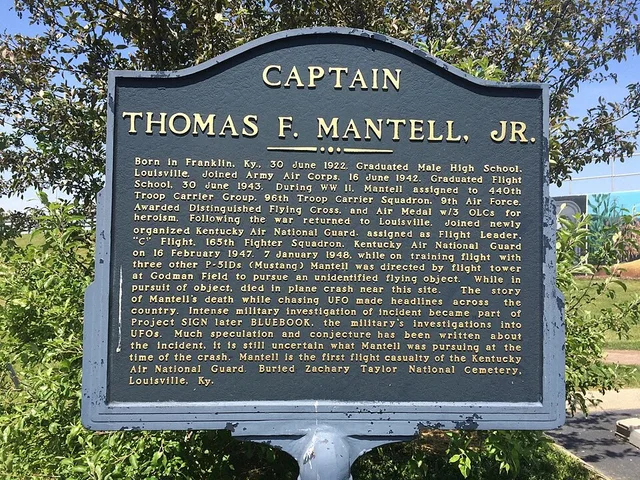
What can be visited is the marker in Franklin, Mantell's home town. The Historical Marker Database, whose page was last revised in January 2024 with photographs taken in May 2015, places it on Steele Road, 0.1 miles south of South Main Street (US 31W), at or near 81 Steele Road, beside what was then the Simpson County Tourism office, and gives the coordinates 36° 40.063′ N, 86° 33.461′ W. The text reads, in part: “7 January 1948, while on training flight with three other P-51Ds (Mustang) Mantell was directed by flight tower at Godman Field to pursue an unidentified flying object. While in pursuit of object, died in plane crash near this site.” The Kentucky National Guard's online museum says the Simpson County Historical Society unveiled it on Saturday 29 September 2001 “at the Franklin, Kentucky exit off Interstate 65, next to the office building of Simpson County Tourism”. Two cautions apply to it. An Army news article of January 2023 says the plaque was “Placed at the site of Mantell’s crash”; the 1964 letter in the Blue Book file puts the crash five miles south-west of Franklin, while the marker stands east of the town centre, and its own wording is “near this site”. And the tourism office has moved: WNKY reported on 16 October 2025 that it now occupies 105 West Cedar Street, downtown. I have not been able to confirm whether the marker stayed on Steele Road after the move.
Mantell is buried in Zachary Taylor National Cemetery, 4701 Brownsboro Road, Louisville. The Department of Veterans Affairs gives his grave as section F, site 66, and the cemetery's visiting hours as “Open daily from sunrise to sunset”; the office opens Monday to Friday from 8.00 to 16.30.
The case file can be read at home. The scans of Blue Book Incident 33, 75 pages including Blackwell's statement, the Venus correspondence of 1948 and the 1964 letters, are free on the Internet Archive, and Hynek's analysis is on pages 73 to 79 of the scan of the Project Grudge report held on Wikimedia Commons.
Sources consulted
- United States Air Force (Project Sign / Project Blue Book), «Incident 33, Godman AFB, Kentucky, 7 January 1948 — Project Blue Book case file: record card marked BALLOON, statements of Blackwell, Carter, Duesler, Orner and Oliver, Report of Unusual Incident, Venus correspondence of October-November 1948 and FAA letters of 1964 (scan)» — National Archives microfilm T1206, via Internet Archive (Project Blue Book - 1940s Case Files), 1948 archive
- Air Materiel Command, Technical Intelligence Division; J. Allen Hynek, «Unidentified Flying Objects: Project "Grudge" — includes J. Allen Hynek's analysis of Incident 33 (Godman Field, 7 January 1948), scan pp. 73-79, and his incident index» — United States Air Force (scan on Wikimedia Commons), 1949 report
- Edward J. Ruppelt, «The Report on Unidentified Flying Objects — chapter 3, "The Classics": the Mantell incident, Hynek's apology, the accident report and the Skyhook hypothesis (Project Gutenberg text of the expanded edition)» — Doubleday, 1956 book
- Luis E. Pacheco, «Cosmic ray study — balloon launched on 6/1/1948 from Camp Ripley, Little Falls, Minnesota, by General Mills for the Office of Naval Research; cut-down failure; link to the Mantell case citing Just Cause (1994)» — StratoCat, 2023 web
- Mark Hilton (submitter), «Captain Thomas F. Mantell, Jr. — marker inscription, location on Steele Road, Franklin, and photographs of May 2015 (archived copy of 17 November 2026)» — The Historical Marker Database (HMdb.org), 2024 web
- Kentucky National Guard, «Captain Thomas Francis Mantell Jr. — biography and the unveiling of the Franklin marker on 29 September 2001 (archived copy)» — Kentucky National Guard History eMuseum (Commonwealth of Kentucky), 2008 web
- Eric Pilgrim, «Questions remain 75 years after mysterious Fort Knox UFO incident, downed pilot — on the 2001 plaque in Franklin and later versions of Mantell's transmissions» — U.S. Army, Fort Knox (DVIDS / army.mil), 2023 newspaper archive
- WNKY, «Simpson County Tourism Commission opens new office in downtown Franklin — 105 West Cedar St.» — WNKY News 40 (Bowling Green), 2025 newspaper archive
- U.S. Department of Veterans Affairs, National Cemetery Administration, «Thomas F Mantell — Veterans Legacy Memorial: Zachary Taylor National Cemetery, section F, site 66» — Veterans Legacy Memorial, 2026 web
- U.S. Department of Veterans Affairs, National Cemetery Administration, «Zachary Taylor National Cemetery — address and visiting hours» — cem.va.gov, 2026 web
- AirNav, publishing FAA data, «KFTK — Godman Army Airfield, Fort Knox: FAA airport reference point 37-54-25.4350N 085-58-19.3300W and "Private use" status (FAA data effective 29 October 2026)» — airnav.com, 2026 web
Reviewed by V. Serrano on 2026-11-20 · How we verify our content




💬 Field testimonies (0)
No testimonies yet. Add the first.
Add your testimony
🔒 Log in to add a testimony