🛸 UFO CASE · EXP. Nº5666
ACTIVE
Kenneth Arnold sighting (Mount Rainier, 1947)
On the afternoon of Tuesday 24 June 1947 Kenneth Arnold, a businessman from Boise, Idaho, was flying his own small plane near Mount Rainier, Washington, when he saw nine bright objects cross in front of him between Rainier and Mount Adams.
Kenneth Arnold sighting (Mount Rainier, 1947): where and when did it happen?
- Location
- Washington, United States
- Date of the event
- What was reported
- Sighting
- What the evidence says
- Not yet assessed
- Coordinates
- 46.719, -122.186
- Last updated
LOCATION
What is known about Kenneth Arnold sighting (Mount Rainier, 1947)?
He timed them with the clock on his instrument panel at one minute and forty-two seconds, which works out at well over a thousand miles an hour. The next day the East Oregonian, in Pendleton, printed the first account on its front page, and by 26 June a Chicago headline was calling them flying saucers. Arnold later said the press had misquoted him: he had described how the objects moved rather than their shape. His own written report to the Army Air Forces, however, already calls them saucer-like. The Air Force's own analysts did not agree on an answer. J. Allen Hynek judged in 1949 that the objects must have been much closer and slower than Arnold thought, and Project Blue Book eventually filed the sighting as a mirage. This file sets out what Arnold wrote, what the newspapers printed and what each explanation rests on.
What is the history of Kenneth Arnold sighting (Mount Rainier, 1947)?
Kenneth Arnold was 32, married with two children, and sold fire-control equipment across the Northwest from his own aeroplane, a three-seat CallAir that he described as "made for mountain work". On 24 June 1947 he finished a job for Central Air Service at Chehalis, Washington, and took off at about two in the afternoon for Yakima. He delayed the trip for an hour to look for a Marine Corps transport lost near Mount Rainier; in the book he wrote with Ray Palmer in 1952 he adds that finding it "meant a $5,000 reward".
The fullest account from 1947 is the report Arnold typed for the Army Air Forces and signed with his Boise address, which a Counter Intelligence Corps agent attached as "Exhibit A" to a memorandum of 16 July 1947. A copy survives in the Project Blue Book file on microfilm at the National Archives. In it Arnold says he made a 360-degree turn over the town of Mineral, climbed to about 9,200 feet and was flying east when "a bright flash reflected on my airplane". Looking for the source, he saw to the north of Rainier "a chain of nine peculiar looking aircraft flying from north to south at approximately 9,500 foot elevation". He assumed they were jets and was bothered that "I couldn't find their tails". The sweep hand of his panel clock "read one minute to 3 P.M." as the first one passed the southern edge of Rainier, and he wrote that "They flew like many times I have observed geese to fly in a rather diagonal chain-like line as if they were linked together."
He put their distance at "between twenty to twenty-five miles" and judged their size against a DC-4 airliner some fifteen miles away by holding up a "zeus fastener or cowling tool". When the last one passed the southern crest of Mount Adams the clock showed "one minute and forty-two seconds". Arnold also wrote that newsmen had suggested "reflections or even a mirage" and answered: "This I know to be absolutely false", because he had opened his side window to watch them "(Without sun glasses)". His conclusion in the same report was cautious: "I am convinced in my own mind that they were some type of airplane." The last page carries a hand drawing of a rounded outline marked "Top" and a flat side view, with the notes "Mirror Bright" and "their thickness was about 1/20th of their width".
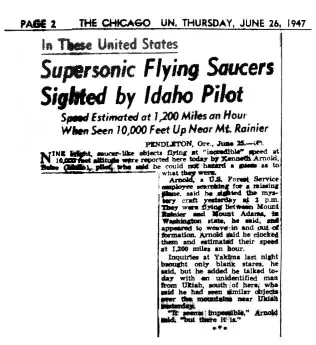
He landed at Yakima, told the story to Al Baxter of Central Aircraft and flew on to Pendleton, Oregon. The first printed account appeared on the front page of Pendleton's East Oregonian on 25 June under the headline "Impossible! Maybe, But Seein' Is Believin', Says Flier". It said he had seen "nine saucer-like aircraft flying in formation", "extremely bright -- as if they were nickel plated", at "about 1200 miles an hour", and quoted him: "It seemed impossible, but there it is -- I must believe my eyes." In 1988 the paper's reporter Bill Bequette told the French sociologist Pierre Lagrange, as quoted by the ufologist Bruce Maccabee, that his colleague Nolan Skiff wrote that first short story and that Bequette put a version on the Associated Press wire. On 26 June the Chicago Sun ran a wire report datelined Pendleton under "Supersonic Flying Saucers Sighted by Idaho Pilot".
The CIC agent who interviewed Arnold on 12 July, Frank M. Brown, wrote that if Arnold could invent such a report "he should be writing Buck Rogers fiction", and recorded Arnold's vow that "If I saw a ten story building flying through the air I would never say a word about it".
Timeline: the documented record of Kenneth Arnold sighting (Mount Rainier, 1947)
- 24 June 1947, about 3 p.m. Flying from Chehalis to Yakima, Kenneth Arnold sees nine bright objects pass between Mount Rainier and Mount Adams and times them at one minute and forty-two seconds on his panel clock.
- 25 June 1947 The East Oregonian of Pendleton prints the first account at the foot of its front page, describing "nine saucer-like aircraft" at about 1,200 miles an hour; the story goes out on the Associated Press wire.
- 26 June 1947 The Chicago Sun runs the wire report on page 2 under the headline "Supersonic Flying Saucers Sighted by Idaho Pilot".
- 12–16 July 1947 Frank M. Brown of the Counter Intelligence Corps interviews Arnold in Boise; his memorandum of 16 July attaches Arnold's written report, which calls the objects "saucer like".
- 1949 J. Allen Hynek's evaluation for Project Grudge finds Arnold's figures "mutually contradictory" and concludes the objects were probably much closer and subsonic.
- 7 April 1950 On CBS, Arnold tells Edward R. Murrow that newspapers misquoted him: he had said the objects flew "in a saucer-like fashion".
- 1952 Arnold and Ray Palmer publish The Coming of the Saucers, privately printed, with the line that the objects "flew like a saucer would if you skipped it across the water".
- 1953 The Harvard astronomer Donald Menzel suggests in Flying Saucers that Arnold saw sunlit blasts of snow blown off the mountain ridges.
- 1963 Menzel and Lyle Boyd judge the objects "probably a mirage" of mountain peaks; the Project Blue Book record card, on a form dated September 1963, gives the conclusion as "Other (MIRAGE)".
- 1988 Bill Bequette tells the sociologist Pierre Lagrange that Nolan Skiff wrote the first East Oregonian story and that he himself is "sure I didn't coin 'Flying Saucers.'"
Is there a rational explanation for Kenneth Arnold sighting (Mount Rainier, 1947)?
The case has two separate questions: what Arnold said about the shape, and what he saw.
On the first, Arnold's later version is well known. On 7 April 1950 he told Edward R. Murrow on CBS, in a transcript published by the CUFOS Associate Newsletter in 1984: "They said that I said that they were saucer-like; I said that they flew in a saucer-like fashion." Murrow called it "an historic misquote". In the 1952 book Arnold wrote that he had told newsmen in Pendleton that "they flew like a saucer would if you skipped it across the water". The documents of 1947 complicate this. The East Oregonian printed "saucer-like aircraft" as its own paraphrase, outside quotation marks, and Bequette told Lagrange in 1988: "I don't remember whether or not Arnold used the words 'saucer-shaped craft.'" But Arnold's own report to the Army Air Forces, in his own words and filed by mid-July 1947, calls them "the chain of these saucer like objects" and "these saucer-like disks", and its drawing is a rounded outline. Donald Menzel and Lyle Boyd pointed out in 1963 that in Arnold's article for the first issue of Fate magazine "He no longer described them as saucerlike", and that a drawing based on his revised account showed "an object like the crescent moon". The skipping-saucer phrase is real, but it does not show that the shape came only from the press.
On the second question, the official explanations contradict one another. J. Allen Hynek's evaluation, extracted from the Project Grudge report of 1949, takes Arnold's distance, size and timing and calls them "mutually contradictory": if the distance was right, the objects "must have been of the order of 100 X 2000 feet in size" for any detail to show, and "In all probability, therefore, objects were much closer than thought, and moving at definitely 'sub-sonic' speeds." Menzel's book of 1953 proposed "billowing blasts of snow, ballooning up from the tops of the ridges". In 1963 Menzel and Boyd wrote that "No absolutely certain answer is possible after so long a time" and that "The disks were probably a mirage" of mountain peaks; they also reported the meteorologist R. J. Reed's suggestion of fast-moving wave clouds, which they rejected because Arnold described smooth air. The Project Blue Book record card, on a form dated September 1963, gives the conclusion as "Other (MIRAGE)", and the case summary states that "It is the Air Force conclusion that the objects of this sighting were due to a mirage", reasoning that the clear, smooth air indicated an inversion.
The Blue Book file has its own problems. The record card summarises the sighting as "a large circular objects heading west" and gives the course as "West", while Arnold's report says north to south. The summary computes 47 miles in one minute and forty-two seconds as "1656.71 miles per hour"; the division gives about 1,659. The summits of Rainier and Adams are some 46.7 miles apart, so the 47 miles is sound. Arnold himself was inconsistent: the report has a 360-degree turn over Mineral and a clock reading "one minute to 3 P.M.", while the 1952 book has a 180-degree turn and says he could not remember whether the clock was on Pacific or Mountain time. In 1950 he told Murrow the objects came in "at about 107 degrees"; in 1947 he wrote 170.
Later proposals include a meteor fireball, put forward in June 1997 by the San Francisco Examiner writer Keay Davidson after a conversation with Philip Klass, as described by Maccabee, who rejects it because Arnold timed the objects for over a minute and a half. None of the proposed explanations has been tested against an independent observation of that afternoon, and no photograph exists.
Sources consulted
- Kenneth Arnold (copy from National Archives microfilm T1206, roll 1, in the Richard F. Haines papers, American Heritage Center, University of Wyoming), «Kenneth Arnold's written report to the Army Air Forces, filed as Exhibit A to a CIC memorandum of 16 July 1947 — Project Blue Book case file, Mt. Rainier, Washington, 24 June 1947» — Project Blue Book records, National Archives (NARA T1206), 1947 archive
- U.S. Air Force, Project Blue Book (copy in the Richard F. Haines papers, American Heritage Center, University of Wyoming), «Project 10073 record card and case summary «UFO Sighting, Mt Ranier, Washington, 24 June 1947» — conclusion «Other (MIRAGE)»; card on a form dated September 1963» — Project Blue Book records, National Archives (NARA T1206, roll 1), 1963 report
- J. Allen Hynek (copy in the Richard F. Haines papers, American Heritage Center, University of Wyoming), «Dr Hynek's evaluations extracted from Project Grudge report — Arnold case: «These statements are mutually contradictory»» — Project Blue Book records, National Archives (NARA T1206, roll 1), 1949 report
- East Oregonian (unsigned; written by Nolan Skiff according to Bill Bequette), transcribed by Project 1947, ««Impossible! Maybe, But Seein' Is Believin', Says Flier», East Oregonian (Pendleton, Oregon), 25 June 1947, p. 1 — transcription» — NICAP / Project 1947, «UFO Reports – 1947», 1947 newspaper archive
- The Chicago Sun (microfilm at Chicago Public Library), ««Supersonic Flying Saucers Sighted by Idaho Pilot», The Chicago Sun, 26 June 1947, p. 2 — scan of the wire report datelined Pendleton, 25 June» — Wikimedia Commons, 1947 newspaper archive
- Kenneth Arnold and Ray Palmer, «The Coming of the Saucers: A Documentary Report on Sky Objects That Have Mystified the World» — Privately published by the authors, Boise, Idaho and Amherst, Wisconsin, 1952 book
- Edward R. Murrow and Kenneth Arnold; transcription published by the Center for UFO Studies, reproduced by Project 1947, «Transcript of Ed Murrow–Kenneth Arnold telephone conversation, broadcast 7 April 1950 (CUFOS Associate Newsletter, February–March 1984, p. 3)» — Project 1947 (Wayback Machine capture), 1984 interview
- Frank M. Brown, Special Agent, CIC, 4th Air Force; transcribed by Project 1947, «Memorandum for the Officer in Charge, Incident 4AF 1208 I, 16 July 1947 — interview with Kenneth Arnold on 12 July 1947 (transcription)» — Project 1947 (Wayback Machine capture), 1947 archive
- Donald H. Menzel, «Flying Saucers» — Harvard University Press, 1953 book
- Donald H. Menzel and Lyle G. Boyd, «The World of Flying Saucers: A Scientific Examination of a Major Myth of the Space Age — chapter II, «Arnold's Nine Disks» and «Mirage or Wave Clouds?»» — Doubleday (Project Gutenberg eBook 66639), 1963 book
- Bruce Maccabee, «June 24, 1947: How It All Began — The Story of the Arnold Sighting (quotes Pierre Lagrange's 1988 interview with Bill Bequette and the July 1997 meteor proposal)» — brumac.8k.com (Wayback Machine capture, 16 March 2016), 2002 web
Reviewed by V. Serrano on 2026-11-20 · How we verify our content


💬 Field testimonies (0)
No testimonies yet. Add the first.
Add your testimony
🔒 Log in to add a testimony