🦶 CRYPTID SIGHTING · EXP. Nº0555
ACTIVE
Bear Lake Monster
The Bear Lake Monster has a birthday, an author and a newspaper.
Where and when was Bear Lake Monster sighted?
- Location
- Bear Lake, Utah-Idaho border, United States
- Date sighted
- Unknown
- Coordinates
- 42.0, -111.3
- Last updated
LOCATION
What is Bear Lake Monster?
In the summer of 1868 Joseph Colton Rich — son of the apostle who colonised the valley, surveyor, telegrapher and correspondent of the Deseret Evening News — published an account of settlers who had seen serpent-like creatures in the turquoise lake on the Utah-Idaho line. Within two months his own paper was reporting that the Bear Lake settlers believed it entirely, while admitting the accounts were "fishy, decidedly so". By May 1870 the News had a fuller sighting off Swan Creek: twenty feet of body, fur like an otter's, flippers like oar blades. Eight days later a Washington paper had made it sixty feet and filed it under summer attractions; by 1880 the Salt Lake Herald put the reported lengths at fifty to five hundred feet. The clause that lends the story its age — that the Indians would not camp by the lake — appears only in the settler press, and the published ethnography of the Shoshone describes Bear Lake as a gathering place instead. When Rich died in 1908, the Deseret Evening News said so on page one: he had originated the Bear Lake Monster.
What is the history of Bear Lake Monster?
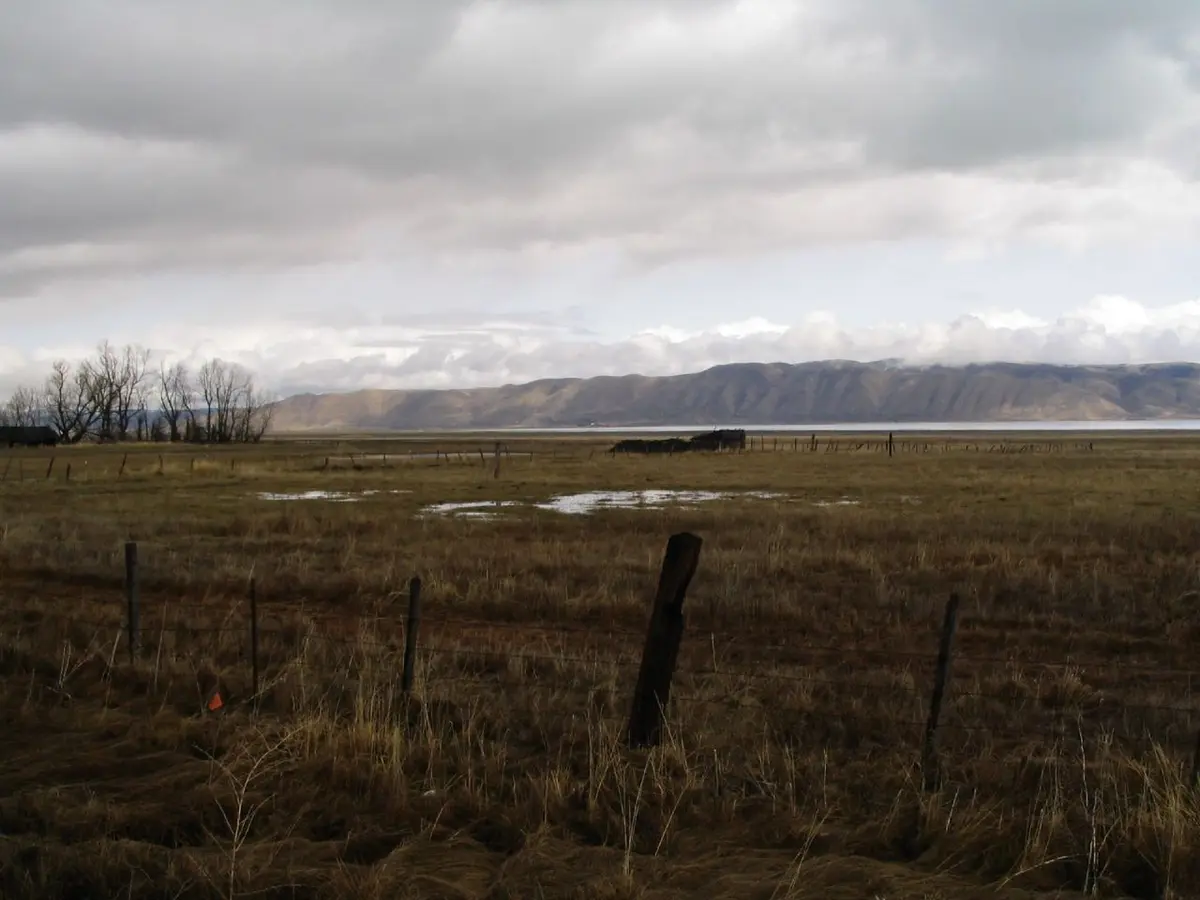
Bear Lake is a genuinely strange body of water, and none of what makes it strange is a monster. It sits at 5,924 feet on the Utah-Idaho line, more than twenty miles long and about eight wide, 109 square miles of surface when full, 94 feet deep on average and 208 feet at its deepest point, off South Eden on the Utah side. Core samples put it at more than 250,000 years old. The turquoise colour that photographs so well is calcium carbonate held in suspension in exceptionally clear water. Isolation for that long produced four fish that exist nowhere else on earth: the Bonneville cisco, the Bonneville whitefish, the Bear Lake whitefish and the Bear Lake sculpin.
Latter-day Saint settlers reached the valley in the 1860s under the apostle Charles C. Rich, who gave his name to Rich County, Utah, and whose family founded Paris, Idaho, at the north end of the lake. His eldest son, Joseph Colton Rich, surveyed and laid out much of the valley, worked as a telegrapher and a newspaper correspondent, and later became a district judge in Idaho. In the summer of 1868 he sent the Deseret Evening News in Salt Lake City an account of settlers who had seen serpent-like creatures in the lake. That article is the origin of everything that followed, and it is not a folk tradition: it is a piece of newspaper copy with a byline.
The Deseret News did not treat it as a joke. In a correspondent's letter datelined Salt Lake City, 26 August 1868 — reprinted in the church's Liverpool weekly, the Latter-Day Saints' Millennial Star, on 10 October 1868 under the heading "The Monsters of Bear Lake" — the paper reported conversations with Charles C. Rich and other Bear Lake settlers "respecting the monsters which have been seen in the Lake, an account of which, from the pen of brother Joseph C. Rich, was published in the Evening News a short time ago." The settlers, it said, "all firmly believe the account as published." The same paragraph contains the sentence that has propped the legend up ever since: "The Indians' traditions corroborate all that has been said of these creatures. It is well known that the Indians will not camp near the Lake, and they have never been known to bathe in its waters." The editorial ends in a shrug that is worth remembering: "The accounts are fishy, decidedly so, but we cannot dispute the persons who make them... We must believe they saw something remarkable, whether monsters or no we hope time will soon decide."
The fullest early text that survives in a searchable archive is not the 1868 piece but its sequel, printed by the Deseret News on 24 May 1870 and reprinted verbatim in Philadelphia by the Evening Telegraph on 8 June under the headline "Utah's Utopian Monster". Charles C. Rich, Jr., of Paris, called at the paper's office to report that a young man named Marion Thomas and three sons of Phineas H. Cook had seen the creature from a fishing boat opposite Swan Creek. Thomas, the article insists, "was one of the strongest unbelievers in its existence, and it was this skepticism which had impelled him to row" towards what he took for a duck. He described a serpent-shaped head and "about twenty feet of its body, which was covered with hair or fur, something like an otter, and light brown", with "two flippers, extending from the upper part of the body, which he compared to the blades of his oars". The paper's verdict: "We think that this ought to squelch all doubts that may have existed heretofore in the minds of any of our people." In the same column it concedes that "owing to slight real or seeming incongruities in their descriptions, the Bear Lake monster has been regarded by many more as a myth than in any other light."
Eight days after that Utah article, the Washington Evening Star ran a paragraph on 1 June 1870 that shows exactly what the story had become on the eastern seaboard: "The Mormons are getting ready for a brisk summer season, and have trotted out their sea-serpent story for Bear Lake, Utah, considerably in advance of the annual arrival of that monster of Nahant." The Star made the animal "about 60 feet in length" — three times the length the Deseret News had printed the week before — kept the otter fur and the oar-like flippers, and added that it was "described, (and authenticated,) by several Mormon Elders". The Alexandria Gazette reprinted the same paragraph on 3 June under the heading "Summer 'Attractions'". Editors on the other side of the continent had already filed Bear Lake next to the Nahant sea serpent as a seasonal item.
From there the monster becomes a fixture of the regional press rather than of the lake. On 23 September 1880 the Salt Lake Herald, reporting a six-foot "sea serpent" landed off British Columbia, noted drily that "the sea serpents that have been seen but not captured, including the famous Bear Lake monster of recent date, have ranged in length from fifty to 500 feet". In 1889 the Herald ran a full-page comic travel piece signed "Jake Miles" and datelined from the future. In September 1907 the Logan Republican printed a letter from two men who said the thing had eaten their horse, then printed a burlesque confirmation from a local politician. Joseph C. Rich died on 18 October 1908; the Deseret Evening News obituary next day, repeated word for word in his own county paper four days later, settled the authorship without ceremony.
Timeline: the documented record of Bear Lake Monster
- Summer 1868 Joseph Colton Rich, son of the apostle Charles C. Rich and correspondent of the Deseret Evening News, publishes an account of settlers who claim to have seen serpent-like creatures in Bear Lake. It is the first appearance of the story in print and the source of everything that follows.
- 26 August 1868 A Deseret News correspondent's letter, later reprinted in the Millennial Star, reports that Charles C. Rich and the Bear Lake settlers "all firmly believe the account as published", asserts that "the Indians will not camp near the Lake", and concedes: "The accounts are fishy, decidedly so, but we cannot dispute the persons who make them."
- 23 April 1869 The Montana Post in Virginia City notes that "the Utah papers have, during the last year, largely discussed the existence of huge amphibious monsters in Bear lake, Utah, but we are not aware that any definite conclusion has yet been reached" — evidence that the story ran in the Utah press through 1868 and 1869.
- 24 May 1870 The Deseret News prints the fullest early sighting: Marion Thomas and three sons of Phineas H. Cook, fishing off Swan Creek, see "about twenty feet" of a body "covered with hair or fur, something like an otter", with flippers like oar blades. The paper says this "ought to squelch all doubts", while admitting the monster "has been regarded by many more as a myth than in any other light".
- 1 June 1870 Eight days later the Washington Evening Star turns the twenty feet into sixty and files the story as a seasonal item: "The Mormons are getting ready for a brisk summer season, and have trotted out their sea-serpent story for Bear Lake, Utah." The Alexandria Gazette reprints it on 3 June under the heading "Summer 'Attractions'".
- 23 September 1880 The Salt Lake Herald, reporting a six-foot sea serpent landed off British Columbia, jokes that "the sea serpents that have been seen but not captured, including the famous Bear Lake monster of recent date, have ranged in length from fifty to 500 feet".
- 25 August 1889 A Salt Lake Herald travel feature signed "Jake Miles", openly written as a tall tale, records a Garden City shop clerk's explanation — "the only one I ever saw was a string of ducks or some boys or girls in bathing" — before its author claims to have watched a 300-foot creature eat the shoreline birches.
- 25 June 1900 The Deseret Evening News prints its St. Charles, Idaho, correspondent — writing from the lakeshore — calling the monster "a superstitious delusion... which has become extinct", and directing anyone who wants a description to "Judge Joe Rich who has made the monster famous both in song and story".
- 18 September 1907 The Logan Republican prints a letter from T. R. Mooney and Fred Horne, dated Bear Lake, Idaho, 12 September, describing a twenty-foot beast with a bear's tracks and kangaroo hind legs that killed and carried off their horse. The paper ends the column with one line of its own: "The Republican would like to know who these men are and the brand they use."
- 21 September 1907 The same paper publishes a "confirmation" from Aquilla "Quil" Nebeker of Laketown that is transparent burlesque: it misnames the first witnesses "Messrs. Looney and Corn", compares the creature's eyes to Logan automobile headlights, calls it a "mastodonaflshicus" and has it eat eight of his pigs and a haystack.
- 19 October 1908 Joseph C. Rich dies on 18 October. The Deseret Evening News obituary, page one: "He was gifted and known as a natural wit, having originated the 'Bear Lake Monster' and other stories." The Montpelier Examiner, in his own county, repeats the sentence word for word on 23 October.
- 1909 Solomon F. Kimball's memoir Thrilling Experiences, in a chapter headed "Bear Lake Yarns", recalls being introduced at a Paris, Idaho, dance to "the great humorist and author of the 'Bear Lake Monster' yarn, Joseph Colton Rich".
- 1938 Julian H. Steward's Basin-Plateau Aboriginal Sociopolitical Groups describes Bear Lake as "a common meeting place for Shoshoni from various regions", a destination for roots, berries and mountain sheep, and cites Powell and Ingalls (1874) counting seventeen people living at the lake under a headman named Tay-i-wun-shear — the opposite of the shunned lake claimed in 1868.
- May-July 2004 Brian Hirschi, who rents watercraft on the lake and operates a pontoon boat built to look like a green serpent, places an account of a June 2002 sighting in the Salt Lake press over Memorial Day weekend, the start of the season, and begins running monster cruises. Folklorist Steve Siporin of Utah State University: "The way I interpret it, it's got more to do with tourism than belief."
- 25 April 2025 A "Legends & Lore" roadside marker for the Bear Lake Monster is dedicated at 1499 South Bear Lake Boulevard, Garden City, Utah, funded by the William G. Pomeroy Foundation and researched by the Folklore Program of Utah State University.
Is there a rational explanation for Bear Lake Monster?
Every popular retelling ends the same way: Joseph C. Rich confessed. The confession is usually dated twenty-six years later, to 1894, and quoted as a "wonderful first-class lie". We could not anchor that quotation to a document. The Bear Lake Valley visitor bureau dates the admission twenty-six years after 1868; the Deseret News, reporting on the legend on 12 July 2004, dates it to 1888 instead. Two incompatible years and no page reference between them, so the quotation does not appear in this article. Something better does.
Rich died on 18 October 1908, and the paper that had published him printed this the following day, on page one: "He was gifted and known as a natural wit, having originated the 'Bear Lake Monster' and other stories." The Montpelier Examiner, published in Bear Lake County among the people who had lived through it, ran the same sentence on 23 October. The year after, Solomon F. Kimball's memoir Thrilling Experiences, in a chapter running under the head "Bear Lake Yarns", introduced him to a party of visiting missionaries as "the great humorist and author of the 'Bear Lake Monster' yarn, Joseph Colton Rich". His neighbours did not need a confession; they knew who wrote it.
They also stopped believing it early. On 25 June 1900 the Deseret Evening News printed a letter from its correspondent in St. Charles, Idaho, a village on the lake itself: "There is no fear now of the famous Bear Lake monster... which was a superstitious delusion existing mainly in the minds of some of our southern neighbors and the Indians, which has become extinct. Students of natural history who would know more of him... may for an accurate description of him apply to Judge Joe Rich who has made the monster famous both in song and story." Eleven years earlier, a Salt Lake Herald writer touring the valley had asked a shop clerk at Cook Brothers' store in Garden City about the creature and printed her answer: "Oh no, I haven't seen the monster for some time — the only one I ever saw was a string of ducks or some boys or girls in bathing."
The clause that keeps the legend respectable is the one about Indigenous tradition, and it should be treated as the claim it is. It appears in the settler press, unsourced, in the same paragraphs that were promoting the monster. The published ethnography does not support it. Robert H. Lowie's monograph The Northern Shoshone (1909) runs to some 420,000 characters of Shoshone and Bannock belief and narrative, with 459 occurrences of "Coyote" and 48 of "snake" — and not one occurrence of "Bear Lake". Julian H. Steward's Basin-Plateau Aboriginal Sociopolitical Groups (Bureau of American Ethnology Bulletin 120, 1938) does mention Bear Lake eleven times, every one of them geographical or economic, and contains the word "monster" zero times. Both searches were repeated to guard against an intermittent zero. Lowie did record Northern Shoshone water beings — Pa-n-dzo'avits the water giant, Pa'gutc the water buffalo, Pa'ona the water baby that is heard crying and never seen — so the absence is not for want of looking. None of them is a serpent in Bear Lake.
Worse for the 1868 clause, Steward's evidence points the other way. Bear Lake, he writes, "was a common meeting place for Shoshoni from various regions, including Wyoming"; families from Fort Hall went "to the region of Bear Lake for roots, berries, mountain sheep, and other game"; and Powell and Ingalls, surveying in 1874, counted a group of seventeen people living at Bear Lake under a headman named Tay-i-wun-shear. The people who supposedly would not camp by the lake had a camp there. We cannot prove that no Shoshone or Bannock water story was ever attached to Bear Lake; we can say that the only witnesses to it are the settlers who were selling the monster, and that the specialist literature describes the lake as a gathering place rather than a shunned one.
Then there is the arithmetic, which is the fastest way to see the animal being written rather than seen. On 24 May 1870 the Deseret News, printing its most detailed eyewitness, gave "about twenty feet" of body. On 1 June the Washington Evening Star made it sixty. By 23 September 1880 the Salt Lake Herald put the field at "fifty to 500 feet". In 1889 the Herald's own correspondent, in a piece he openly framed as a tall tale, watched a 300-foot creature with eyes a foot across tear birch trees out of the shore and swallow them. In September 1907 two men described a twenty-foot animal with a bear's tracks and a kangaroo's hind legs; three days later a second witness in the same newspaper made it "easily fifty feet long, fifteen feet high, and covered with scales like armor plate" with eyes that lit the whole valley. The size of the Bear Lake monster is a function of the writer, not of the lake.
The 1907 exchange also shows the newspaper doing the work in plain sight. The Logan Republican printed the Mooney-Horne letter on 18 September 1907 and closed the column with a single line of its own: "The Republican would like to know who these men are and the brand they use." Three days later it published the confirmation of Aquilla "Quil" Nebeker under a straight headline — and inside, misnamed the original witnesses "Messrs. Looney and Corn", corrected the creature's eyes from wagon wheels to something "mistaken for the headlights used on Logan automobiles", called it a "mastodonaflshicus", and had it eat eight of Nebeker's shoats and a small haystack. This was comic writing, published as news, in the paper of a university town.
Nothing in the lake will fill the role. Bear Lake is oligotrophic and cold, and its published species list runs to the four endemics plus cutthroat, lake trout, brown and rainbow trout, carp, perch, chub, sucker, dace, shiner, sunfish and bullhead. Sturgeon are sometimes offered as an explanation; as of August 2026 no sturgeon appears on any published species list for Bear Lake, and none is recorded in the Bonneville basin fish fauna catalogued by Steward in 1938 or by the lake's own conservation group today. What the lake does have is a long fetch, sudden wind, and water so clear that distance is hard to judge — which is roughly what the Cook Brothers clerk said in 1889, in fewer words.
Finally, the incentive. The monster is worth money and always has been. The last widely reported sighting was announced by Brian Hirschi, who owned a fleet of watercraft rentals on the lake and a large pontoon boat built to look like a green sea serpent; he placed his 2002 sighting in the press over Memorial Day weekend 2004, the start of the tourist season, and then ran forty-five-minute monster cruises. Steve Siporin, a folklorist at Utah State University, told reporters at the time: "The way I interpret it, it's got more to do with tourism than belief." Garden City now holds the Bear Lake Monster Winterfest every January, the county sells the creature on merchandise, and the Legends & Lore roadside marker dedicated on 25 April 2025 is itself the product of a university folklore programme. That is the honest shape of the thing: not a hidden animal, but the most successful piece of copy a Utah newspaper correspondent ever filed.
Can you visit Bear Lake Monster?
Getting there. Bear Lake straddles the 42nd parallel, which is the state line between Utah and Idaho. The Utah shore is in Rich County (Garden City, Laketown) and the Idaho shore in Bear Lake County (Fish Haven, St. Charles, Paris, Montpelier). The usual approach from the south is US-89 through Logan Canyon, designated the Logan Canyon Scenic Byway, which climbs from Logan and comes down to Garden City past overlooks above the lake.
Bear Lake State Park (Utah) has three separate areas. On 23 September 2026 the Utah State Parks page gave the Marina, on the west shore at Garden City, as open year-round with its gates open from 6:00 am to 11:00 pm. Rendezvous Beach, on the south shore near Laketown, was listed as open from 1 May to about 23 October, with gates open from 7:00 am to 10:00 pm. The Eastside area keeps its launch ramp open all year, with campsites from about 1 May to 31 October. Idaho runs its own Bear Lake State Park on its side of the lake.
The marker. The Bear Lake Monster marker of the William G. Pomeroy Foundation's "Legends & Lore" programme stands at 1499 South Bear Lake Boulevard, Garden City, Utah 84028, at the corner of Hodges Canyon Road; the foundation's record places it at 41.918583, -111.393222. Its inscription opens: "BEAR LAKE MONSTER / REGIONAL LEGEND OF BEAR LAKE VALLEY TELLS OF SIGHTINGS OF LARGE SERPENTINE MONSTER IN THIS LAKE." The grant went to Utah State University, where the master's student Melissa Anderson Asay of the Folklore Program drove the application under Professor Jeannie Thomas. USU dates the dedication to 25 April 2025, while the foundation's record gives the year as 2024. The marker stands in the open beside the road.
Winterfest. The Bear Lake Monster Winterfest is held in Garden City at the end of January; in 2026 it ran on 30 and 31 January. Its programme includes a cardboard boat regatta and a 5K, and the Monster Plunge takes jumpers into the lake at the marina. The festival's website gives the plunge fee as "$50 per jumper", which includes a hoodie and a towel, and limits online registration "to the first 300 people". In summer Garden City holds Raspberry Days, which celebrates the valley's raspberry harvest and in 2026 was held from 6 to 8 August at Heritage Park.
The lake. The Bear Lake Watch fact sheet describes it as "more than 20 miles long" (32 km) and "about eight miles wide" (13 km), 208 feet (63 m) deep at its deepest when full. Four fish live in it and nowhere else: the Bear Lake whitefish, the Bear Lake sculpin, the Bonneville whitefish and the Bonneville cisco. The marshes at the north end, on the Idaho side, are the Bear Lake National Wildlife Refuge.
Sources consulted
- Unsigned Deseret News correspondent, «The Monsters of Bear Lake (in "President Young's Trip North", correspondence datelined Salt Lake City, 26 August 1868)» — The Latter-Day Saints' Millennial Star, vol. 30 no. 41, 10 October 1868, pp. 642-643, 1868 newspaper archive
- Unsigned, «[Untitled paragraph on the Utah papers and the amphibious monsters of Bear Lake]» — The Montana Post (Virginia City, Montana Territory), 23 April 1869, p. 4, 1869 newspaper archive
- Unsigned, «Utah's Utopian Monster: The Sea Serpent in Bear Lake — A Monster with Fins like Oar-blades (from the Salt Lake Deseret News, 24 May 1870)» — The Evening Telegraph (Philadelphia), 8 June 1870, p. 6, 1870 newspaper archive
- Unsigned, «Summer "Attractions" [The Mormons... have trotted out their sea-serpent story for Bear Lake]» — Evening Star (Washington, D.C.), 1 June 1870, p. 2; reprinted in the Alexandria Gazette, 3 June 1870, p. 4, 1870 newspaper archive
- Unsigned, «[Editorial: At last they have captured a veritable sea serpent off the coast of British Columbia]» — The Salt Lake Daily Herald, 23 September 1880, p. 2, 1880 newspaper archive
- "Jake Miles", «Six Years Hence: Bear Lake Valley as It Will Be in 1895 — The True History of the Bear Lake Monster, Taken on the Spot» — The Salt Lake Herald, 25 August 1889, p. 14, 1889 newspaper archive
- Unsigned correspondent, «Neighbors: St. Charles, Idaho (special correspondence, 23 June 1900)» — Deseret Evening News, 25 June 1900, p. 7, 1900 newspaper archive
- T. R. Mooney and Fred Horne (letter, Bear Lake, Idaho, 12 September 1907), «Bear Lake Monster Appears: Leviathan Comes from Lake and Devours Horse While Men Shoot At It» — The Logan Republican, 18 September 1907, p. 1, 1907 newspaper archive
- Aquilla Nebeker (letter) and the editors, «Quil Nebeker Sees Monster: Verifies Mooney and Horne's Story of the Bear Lake Terrorizer and Gives Own Experience» — The Logan Republican, 21 September 1907, pp. 1-2, 1907 newspaper archive
- Unsigned, «[Obituary of Judge Joseph C. Rich]» — Deseret Evening News, 19 October 1908, p. 1, 1908 newspaper archive
- Unsigned, «[Obituary of Judge Joseph C. Rich]» — Montpelier Examiner (Montpelier, Idaho), 23 October 1908, p. 1, 1908 newspaper archive
- Solomon F. Kimball, «Thrilling Experiences (chapter "Bear Lake Yarns", p. 145)» — Salt Lake City, 1909 book
- Robert H. Lowie, «The Northern Shoshone» — Anthropological Papers of the American Museum of Natural History, vol. II, part II, 1909 academic
- Julian H. Steward, «Basin-Plateau Aboriginal Sociopolitical Groups (Bureau of American Ethnology, Bulletin 120)» — Smithsonian Institution / U.S. Government Printing Office, 1938 report
- Associated Press / Deseret News staff, «Bear Lake Monster resurfaces anew» — Deseret News, 12 July 2004, 2004 newspaper archive
- Utah State University, «From Myth to Marker: USU Folklore Program Brings Bear Lake Monster to Life» — USU Today, 2025 web
- Bear Lake Watch, «Bear Lake Fact Sheet and The Fish of Bear Lake» — Bear Lake Watch, 2026 web
- Utah Division of State Parks, «Bear Lake State Park: areas, seasons and hours» — Utah State Parks, 2026 web
- William G. Pomeroy Foundation, «Bear Lake Monster [historic marker record]» — Legends & Lore marker programme, 2025 web
Reviewed by V. Serrano on 2026-08-14 · How we verify our content
📎 Source: Enigma Atlas
💬 Field testimonies (0)
No testimonies yet. Add the first.
Add your testimony
🔒 Log in to add a testimony