🦶 CRYPTID SIGHTING · EXP. Nº6501
ACTIVE
Goatman
Goatman is the name shared by two unrelated American legends. In Prince George's County, Maryland, a goat-headed figure was blamed for the death of a dog called Ginger, found decapitated near Fletchertown Road in Bowie; the Prince George's County News ran the story on 10 November 1971 under the headline "Residents Fear Goatman Lives".
Where and when was Goatman sighted?
- Location
- Maryland/Texas, United States
- Date sighted
- Unknown
- Coordinates
- 38.943, -76.736
- Last updated
LOCATION
What is Goatman?
University of Maryland students were already collecting the tale for folklore papers, and in 1975 the reporter Ivan Goldman pointed to a passing train. In Denton, Texas, the name belongs to Old Alton Bridge, an iron truss built in 1884, and to a far graver story: a Black goat farmer, Oscar Washburn, said to have been lynched from it by the Klan in 1938. That lynching is not documented. The database of lynchings in Texas records six in Denton County, none in the 1930s and none at the bridge, and the story cannot be traced in print earlier than an unsourced Wikipedia edit made in March 2010. What is documented is the destruction of Denton's Black neighbourhood of Quakertown from 1921.
What is the history of Goatman?
Two different legends share the name Goatman, and they are not the same story. One belongs to Prince George's County, Maryland; the other to a single iron bridge in Denton County, Texas. They have separate origins, separate dates and separate evidence, and merging them has hidden something that deserves to be said plainly.
The Maryland Goatman is a suburban legend with an unusually well documented paper trail. It reached print in the autumn of 1971 in the Prince George's County News, the local paper for a county then filling up with new subdivisions and still ringed by woods. The article that fixed the creature in local memory ran on 10 November 1971 under the headline "Residents Fear Goatman Lives: Dog Found Decapitated in Old Bowie", a citation preserved in the bibliography of Deena West Budd's Weiser Field Guide to Cryptozoology. The dog was a young mongrel called Ginger, described by the reporter who covered the story as resembling a German shepherd; she was found decapitated cleanly at the neck, and her body was never recovered. Residents around Fletchertown Road blamed the Goatman.
The legend was already being collected by folklorists before it was news. Ed Okonowicz, writing in Monsters of Maryland, cites three undergraduate folklore papers held in Special Collections at the University of Maryland, written in the 1970s and 1980s by students George Lizama, Rose Ann Duley and Laura McKeller. Duley's is titled "Goatman: Who He Is, Where He Lives, and What He Does", and she opened it by calling the Goatman "only a tale of my high school" days. By 1975 the creature was national enough for Daniel Cohen to record in Monsters, Giants and Little Men from Mars that "Goatman was here" had become common graffiti in the county.
Two explanations for the creature circulate locally. In one, he is a hermit who lived in the woods and walked the back roads at night. In the other, he is a scientist whose experiment on goats went wrong, a version usually attached to the Beltsville Agricultural Research Center, the large United States Department of Agriculture research station that really does occupy a stretch of the same county. The scientist has acquired a name in recent web retellings; that name does not appear in the 1970s sources.
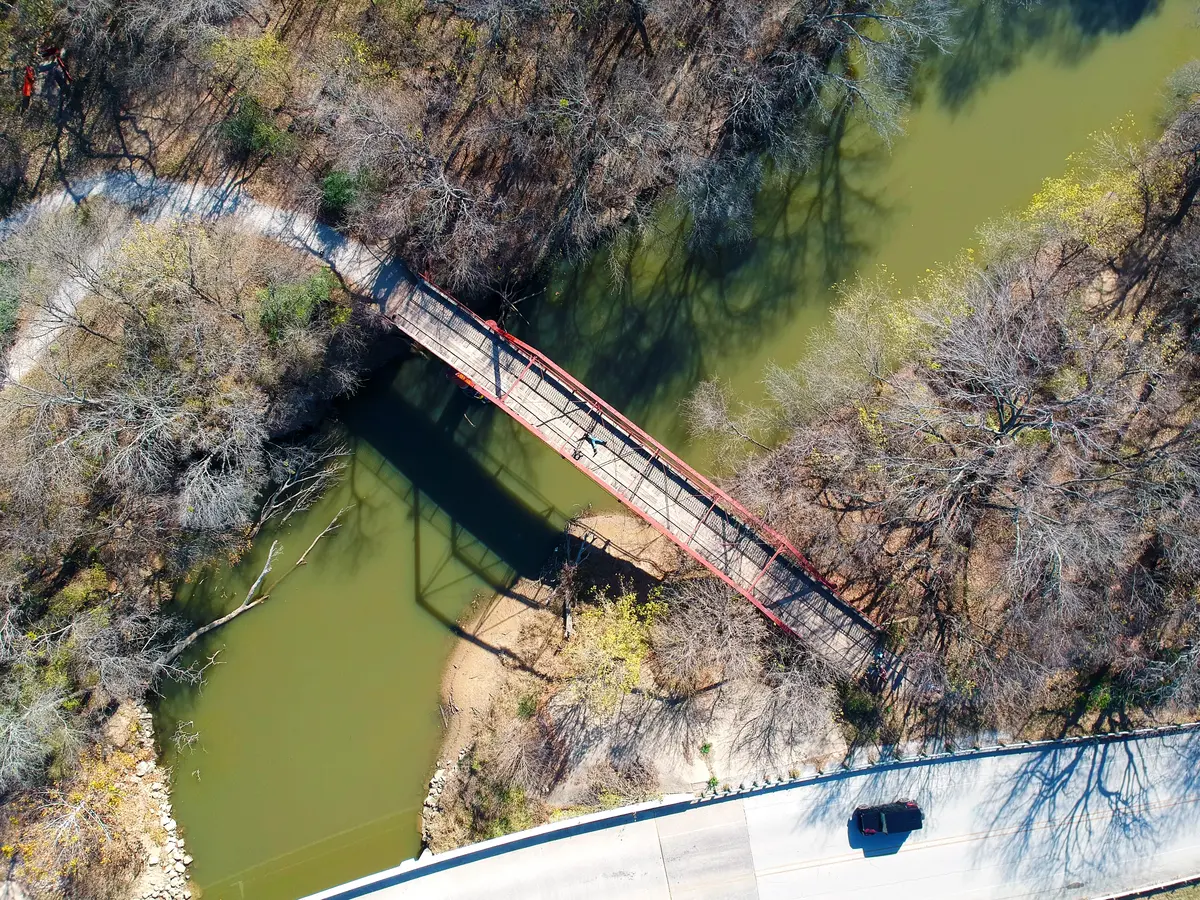
The Texas Goatman is a different creature attached to a real and datable object. Old Alton Bridge is a Pratt truss iron bridge built in 1884 by the King Iron Bridge Manufacturing Company, carrying what was then the main road from Denton to Dallas over Hickory Creek. It takes its name from Alton, the vanished settlement that served as county seat between 1848 and 1856 before Denton was founded. Denton County rerouted the road in 1997, and the bridge now carries only walkers and horses. It was listed on the National Register of Historic Places in 1988 and is a Recorded Texas Historic Landmark.
The story attached to that bridge is grave, and this entry previously reduced it to half a line about "a murdered farmer". In the telling that circulates today, a Black goat farmer named Oscar Washburn lived just north of the bridge, prospered, hung a sign reading "This way to the Goatman", and was lynched from the bridge by Klansmen in the local government in August 1938; when they found the noose empty they went back and killed his wife and children. Whether any of that happened is examined in the section below. What is documented is that Denton had a thriving Black neighbourhood, Quakertown, founded in the mid-1870s around a school that opened in 1878, and that the city commission resolved to turn it into a park: a petition was presented in March 1921 and the city began buying the properties in May 1922. The community disappeared, its residents selling up or hauling their houses across the railway tracks to Solomon Hill.
Timeline: the documented record of Goatman
- 1848-1856 Alton, the settlement that gives the bridge its name, serves as seat of Denton County before the county seat moves to the newly founded town of Denton; Alton disappears soon afterwards.
- 1884 The King Iron Bridge Manufacturing Company builds the Pratt truss bridge over Hickory Creek that carries the main road from Denton to Dallas. It is the oldest surviving iron bridge in the county.
- March 1921 - May 1922 A petition asks Denton's city commission to turn Quakertown, the town's Black neighbourhood, into a park; the city begins buying the properties in May 1922 and the community disappears, its residents moving their houses to Solomon Hill.
- 14 December 1922 Two Black men are taken from the jail at Pilot Point, in Denton County, accused of horse theft, and are never seen again. Their names were not recorded. These are the last lynchings documented in the county.
- 10 November 1971 The Prince George's County News reports the death of a dog under the headline "Residents Fear Goatman Lives: Dog Found Decapitated in Old Bowie". The dog, Ginger, was found decapitated near Fletchertown Road in Bowie and her body was never recovered.
- December 1975 The reporter Ivan Goldman publishes "Legend of Goatman Survives Despite Lack of Evidence", attributing the dog's injuries to a passing train. The same year Daniel Cohen records that "Goatman was here" has become common graffiti in the county.
- 1970s-1980s University of Maryland students George Lizama, Rose Ann Duley and Laura McKeller write undergraduate folklore papers collecting Goatman accounts. Duley's, "Goatman: Who He Is, Where He Lives, and What He Does", calls the creature "only a tale of my high school". The papers are held in Special Collections at College Park.
- 8 July 1988 Old Alton Bridge is listed on the National Register of Historic Places. Denton County reroutes the road away from it in 1997, leaving it to walkers and horses.
- 2 March 2010 An anonymous editor adds the story of Oscar Washburn to the English Wikipedia article on Old Alton Bridge, citing no source. In this first version the farmer arrives "at the turn of the century" and there is no year for the killing.
- 31 October and 22 November 2010 The murder of Washburn's wife and children is added to the same article on Halloween 2010; the date 1938 is added three weeks later. In July of that year Legends of America publishes its own version, which the Wikipedia paragraph now cites as its source.
- 16 September 2013 University of Maryland folklorist Barry Pearson explains the legend to Modern Farmer as a legend trip sustained by teenagers and car mobility, and traces its shape back to the Greco-Roman satyr.
- 31 October 2023 KERA reports on the racial roots of the Texas legend and states that there is little evidence that a Black farmer named Oscar Washburn existed in 1930s Denton. The historian Jeffrey L. Littlejohn explains that lynching records come overwhelmingly from the white community that carried them out.
Is there a rational explanation for Goatman?
The Maryland case has a named sceptic, and he was working while the story was still warm. In December 1975 the reporter Ivan Goldman published a piece headlined "Legend of Goatman Survives Despite Lack of Evidence", in which he described Ginger's death and proposed a mundane cause: a passing train. Prince George's County is crossed by heavily used rail lines, and a clean decapitation with the body carried off is what a train does to an animal on the track. The University of Maryland folklorist Barry Pearson has explained the legend's persistence without invoking any creature at all. Every such story, he told Modern Farmer in 2013, has "a keeper who passes the story on from one generation to the next", and its engine is adolescent: "Today they have the mobility of the automobile and rampant hormones, so they're always off to Lovers Lane." Folklorists call the practice a legend trip, and the Goatman is a textbook example, a guardian of the woods who punishes parked couples. Pearson also points at the oldest layer: "The satyr in Greco-Roman times was the kind of keeper of the woodlands, drunk all the time and known mainly for being lustful."
The Texas case needs a different kind of scepticism, because the question is not whether a monster exists but whether a man was murdered. The lynching of Oscar Washburn is not documented. Lynching in Texas, the database directed by the historian Jeffrey L. Littlejohn at Sam Houston State University, records six lynchings in Denton County: four at Elm Bottom on 22 June 1882, over alleged cattle theft, and two Black men taken from the jail at Pilot Point on 14 December 1922, over alleged horse theft. None is from the 1930s, none is at Old Alton Bridge, and none involves a goat farmer. That absence is not an artefact of a bad search: the same database returns 23 entries for 1922, 21 for 1882 and several for the early 1930s, so the decade and the county are both covered. A search of the full text of digitised books returns 28 occurrences of "Oscar Washburn", every one of them in New England genealogies and Massachusetts town histories except a single ghost-tourism guide that is retelling this legend. The Denton County government website, 1,210 pages including a section on the county's historic iron bridges, does not mention the Goatman, Oscar Washburn or any lynching. Reporting the story for KERA in 2023, Sean Saldana put it flatly: "There's little evidence to verify the existence of a Black farmer named Oscar Washburn in 1930s Denton."
The story itself can be dated, and it is recent. The earliest appearance anyone can point to is an edit made to the English Wikipedia article on Old Alton Bridge at 07:57 UTC on 2 March 2010, by an anonymous address, citing no source and filed under an edit summary that mentioned only the photo gallery. In that first version the killing has no year at all: the farmer arrives "at the turn of the century". The murder of the wife and children was added by another anonymous editor on 31 October 2010, Halloween. The date "1938" was added on 22 November 2010, more than eight months after the story first appeared. In July 2010 the popular history site Legends of America published its own version, and today the Wikipedia paragraph cites Legends of America as its source, closing a circle in which the article is footnoted to a page that came after it.
None of this makes Denton innocent. It makes the legend a poor substitute for what is on the record: the two men taken from the Pilot Point jail in December 1922, whose names nobody wrote down, and the destruction of Quakertown in the same period. The filmmaker Trey Murphy, who has made a horror film about the Goatman, says of Washburn simply that he is not a real person. Ollie Asser, who grew up in Denton and has run a Goatman page for a decade, defends telling the story anyway: "It brings up the conversation of the racial atrocities that happened back then. So to me and to a lot of people in the Denton area, it's very important to keep that story alive, whether true or not." It is worth noting who is missing from that conversation. The 2023 KERA report, the fullest account of the legend's racial roots, quotes a ghost tour guide, an enthusiast and two academic historians, one of them at a university in another state; it quotes no descendant of Quakertown and no member of Denton's historic Black community. This entry could not find such an account either.
Can you visit Goatman?
The Texas half of the legend has a site that stands open. Old Alton Bridge remains where it was built in 1884, over Hickory Creek at Copper Canyon Road between Denton and Copper Canyon: a 145-foot iron Pratt truss that Denton County calls the oldest such bridge left in the county. The roadway was rerouted in 1997; the deck now carries hikers and horses on the trail that links the Elm Fork and Pilot Knoll routes around Lake Lewisville. It entered the National Register of Historic Places on 8 July 1988 under reference 88000979, and the Texas Historical Commission awarded it a Recorded Texas Historic Landmark marker in 2010. Neither Denton County nor the trail network charges admission at the bridge. The story attached to the structure is the alleged lynching there in 1938 of Oscar Washburn, a Black goat farmer.
The Maryland half has no comparable place to go and see. Fletchertown Road and Lottsford Vista Road, near Bowie in Prince George's County, are public roads through woodland and private land; nothing is signposted and no monument or museum marks the legend. Glenn Dale Hospital, the tuberculosis sanatorium that opened in 1934 and closed in 1981 and turns up in some retellings, sits on about 206 acres bought by the Maryland-National Capital Park and Planning Commission in 1995. Its buildings are shut, a 2018 feasibility study put asbestos abatement at between $2.3 million and $4 million, and the commission's park police patrol the grounds, where entering is trespass. The Beltsville Agricultural Research Center nearby is a working federal research station.
The paper trail sits in archives rather than in the woods. The undergraduate folklore collections on the Goatman are held in Special Collections at the University of Maryland, College Park. The county's Office of History and Culture, in Denton, runs the 1896 Courthouse-on-the-Square and the Denton County Historical Park, and it keeps an oral history collection.
Sources consulted
- Sean Saldana, «The Goatman of Old Alton Bridge: A tale rooted in Texas' historical racial tensions» — KERA News, 2023 newspaper archive
- Andy Wright, «Maryland's Goatman Is Half Man, Half Goat, and Out for Blood» — Modern Farmer, 2013 newspaper archive
- Ed Okonowicz, «Monsters of Maryland: Mysterious Creatures in the Old Line State» — Stackpole Books, 2012 book
- Deena West Budd, «The Weiser Field Guide to Cryptozoology» — Weiser Books, 2010 book
- Jeffrey L. Littlejohn, «Lynching in Texas: Denton County records (1882-1945)» — Sam Houston State University, 2023 archive
- Handbook of Texas, «Quakertown, TX» — Texas State Historical Association, 2021 academic
- Anonymous editor 76.164.116.166, «Old Alton Bridge, revision of 2 March 2010 (first appearance of the Oscar Washburn story)» — Wikipedia revision history, 2010 archive
- Office of History and Culture, «Historic Iron Bridges of Denton County» — Denton County, Texas, 2024 report
- Kathy Alexander, «Alton, Texas and Goatman's Bridge» — Legends of America, 2010 web
- Handbook of Texas, «Alton, TX (Denton County)» — Texas State Historical Association, 2020 academic
- Daniel Cohen, «Monsters, Giants and Little Men from Mars: An Unnatural History of the Americas» — Doubleday, 1975 book
Reviewed by V. Serrano on 2026-08-11 · How we verify our content
📎 Source: Enigma Atlas
💬 Field testimonies (0)
No testimonies yet. Add the first.
Add your testimony
🔒 Log in to add a testimony