🦶 CRYPTID SIGHTING · EXP. Nº6501
ACTIVE
Hodag
The Hodag is a squat, spiny beast from Wisconsin lumberjack folklore, described as having the head of a frog, the face of an elephant-like grin full of large teeth, thick horns, a row of sharp spikes down its back, and short stocky legs ending in claws.
Where and when was Hodag sighted?
- Location
- Rhinelander, Wisconsin, United States
- Date sighted
- Unknown
- Coordinates
- 45.64, -89.41
- Last updated
LOCATION
What is Hodag?
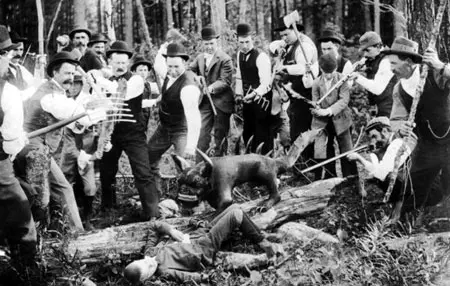
It is closely tied to the logging camps around Rhinelander in northern Wisconsin, where 19th-century timber workers passed around tall tales of a beast said to be born from the ashes of cremated oxen, cursed by their years of hard labor and abuse. The creature's fame exploded in 1893 when local prankster and lumberman Eugene Shepard claimed to have captured a live Hodag, staging a photograph of a horned, spiked wooden creation billed in newspapers as "the strangest animal ever captured alive" and displaying it to a credulous public before eventually admitting the whole affair was a hoax. Far from fading away, the confessed prank turned into a beloved civic mascot, and today the Hodag is embraced good-naturedly by Rhinelander as a piece of tongue-in-cheek regional heritage rather than a creature anyone seriously believes stalks the woods, making it one of the most openly acknowledged hoax-origin cryptids in American folklore.
What is the history of Hodag?
Very few cryptids have a named inventor, a documented method and a surviving confession. The Hodag has all three — and a town that decided to keep the monster anyway.
The inventor was Eugene Simeon Shepard (1854-1923), a land surveyor and timber cruiser who had settled in Rhinelander, in the pine country of northern Wisconsin, and who was known locally as a humorist and practical joker. His trade took him alone into logging country for weeks at a time; his hobby was persuading other people to believe things.
The Hodag first appeared in print in Rhinelander's own newspaper, The New North, on 28 October 1893, under the heading "Capture of a Hodag, By the Snake Editor". It is not a news report — it is a comic column, and it reads like one. "Since the Hodag was seen the other day there has been considerable many hunters out all aspiring to capture one", it begins. Men from the "poverty hill and log town districts" go into a tamarack swamp with rifles and a "large bore squirt loaded with poisonous water"; the enraged beast starts "slashing down the timber which was falling in every direction"; dynamite and fire finish the job, and the hunters then need nine hours "to put a quietus on the muscular action of their dangerous tails". This is logging-camp humour written for men who would recognise every joke in it.
Three years later Shepard produced the animal itself. In an account he signed from his Rhinelander home, "The Pines", under the title "Capture of the Black Hodag and His Mate", he calls the creature the Bovine Spirituallis, "identified by Prof. Jones of Philadelphia and classified as one of a prehistoric race of animals". He describes finding it near Rice Creek, photographing the old male while it foraged for water snakes and mud turtles, blocking the entrance to its den, working in a sponge saturated with chloroform, roping the unconscious beast and hauling it back to Rhinelander in a cage.
In 1896 the Oneida County Agricultural Society staged the county's first fair, and the Hodag was its main attraction — the first time, as the local historians put it, that a Hodag was something you could go and stand in front of. It was shown in a darkened enclosure. Visitors were admitted only briefly, ostensibly for their own safety. The thing growled, and it moved. Admission was ten cents. Kerry Bloedorn, who runs the Pioneer Park Historical Complex in Rhinelander, puts the takings at more than 500 dollars over the first weekend — several thousand dimes, in a lumber town of a few thousand people.
How exactly the exhibit ended is the part of the story everyone repeats and nobody documents; it is dealt with below. What is not in dispute is that Shepard eventually conceded the point. In the Rhinelander Chamber of Commerce's own summary, he "admitted that the Hodag was something of a hoax, and that the beast in the photograph was really just made of wood and ox hides".
The extraordinary part is what happened next: nothing was retracted, because nobody wanted it retracted. Shepard himself framed the whole business as advertising rather than fraud — thousands of people came to see the Hodag, he wrote, "and not one of them went away without having learned a little more about north Wisconsin". Rhinelander agreed. By the 1940s the county fair was widely known as the Hodag Fair. In 1978 the town launched the Hodag Country Festival, now one of the largest outdoor country music events in the United States. The high school teams are the Hodags; in 2022 they were voted the best high-school mascot in America. And in October 2019, when Algoma Township in Michigan announced a hodag festival of its own, Rhinelander's Common Council spent an evening debating whether the town could trademark a beast that had never existed. A confessed fraud had become municipal property.
Timeline: the documented record of Hodag
- 28 October 1893 The New North of Rhinelander publishes "Capture of a Hodag, By the Snake Editor", a comic column describing a hunting party that kills the beast in a tamarack swamp with rifles, a squirt gun loaded with poisoned water, dynamite and fire. It is the Hodag's first appearance in print.
- 1896 — the capture Eugene Shepard circulates a signed account, "Capture of the Black Hodag and His Mate", claiming to have found the animal near Rice Creek, photographed it, sealed its den and subdued it with a chloroform-soaked sponge before caging it and bringing it to Rhinelander.
- 1896 — the Oneida County Fair The Hodag is exhibited at the county's first fair in a darkened enclosure, moved by hidden wires and growling thanks to Shepard's sons. Admission is ten cents; Pioneer Park director Kerry Bloedorn puts the first weekend's takings above 500 dollars.
- 1910 William T. Cox, Minnesota's first state forester, includes the Hodag in Fearsome Creatures of the Lumberwoods — but describes a rhinoceros-sized, hairless porcupine-hunter with a spade-shaped nose, nothing like Shepard's spiked lizard. The name belonged to the logging camps before it belonged to Rhinelander.
- 1923 Eugene Simeon Shepard dies at 69. His biographer Kurt Kortenhof records his own verdict on the affair: thousands came to view the Hodag "and not one of them went away without having learned a little more about north Wisconsin".
- 1928 Luke Sylvester "Lake Shore" Kearney, a Rhinelander man, publishes The Hodag and Other Tales of the Logging Camps in Madison — the creature's transition from local prank to written folklore.
- 1940s-1950s The Oneida County Fair becomes widely known as the "Hodag Fair". Half a century after the confession, the hoax has become the county's own brand.
- 4-6 August 1978 The first Hodag Country Festival is held, headlined by Freddy Fender. The festival's own list of past line-ups numbers the edition of 9-12 July 2026 as the 48th.
- 1984 Wisconsin governor Tony Earl jokingly threatens to have the hodag declared an endangered species if Michigan keeps "trying to kidnap it" — the first public skirmish over ownership of a creature that does not exist.
- 29 October 2019 After Algoma Township, Michigan, announces its own hodag festival, Rhinelander's Common Council debates trademarking the beast. City attorney Steve Sorenson warns that prior users could keep using it and that national registration "is not cheap"; the council opts for cooperation instead of a legal fight. The Chamber of Commerce holds the mark on the current design, and a state registration sits with Downtown Rhinelander, Inc.
- November 2022 The Rhinelander Hodags are voted best high-school mascot in America in a national poll run by Scorebook Live, taking 183,455 of more than 291,000 votes. A confessed 19th-century fraud wins a 21st-century popularity contest.
Is there a rational explanation for Hodag?
There is nothing to explain away here: the Hodag of 1896 was a made object, and its maker said so.
The accounts agree on the construction. The body was carved wood — a shaped stump — covered with an ox hide. The horns along its back and the fangs in its mouth came from oxen and cattle. It did not walk; it was worked from outside with wires, which is why viewers were kept at a distance, in the dark, and only for a moment "for their own safety". The growling was supplied by Shepard's sons, hidden out of sight. Every element of the illusion depends on controlling how long and how well you are allowed to look — the oldest principle in sideshow work.
Shepard's own written account contains the tell. The animal is authenticated by "Prof. Jones of Philadelphia", an authority with the commonest surname in the English language, no institution and no first name. Invented experts are a standard device of nineteenth-century hoaxes, and Shepard, writing for a readership that enjoyed the game, did not work hard to hide it.
The famous ending deserves more caution than it usually gets. The story told everywhere — including by the Rhinelander Chamber of Commerce and by the University of Wisconsin's public-history project — is that scientists from the Smithsonian Institution announced they were coming to examine the specimen, and that Shepard confessed rather than face them. We could not verify it. There is no contemporary newspaper account, no Smithsonian record and no 1890s document naming the institution in any source we could reach; the versions in circulation either cite one another or rest on secondary works published a century after the fact. It may well be true. It should be read as tradition, not as documented history, and the date of Shepard's admission is likewise unfixed.
The wider point is that Shepard did not invent the Hodag from nothing. Fearsome critters — invented animals used to entertain the camp and to haze new hands — were a standing genre in the logging woods of the Great Lakes. The name was already loose in that tradition and did not belong to Shepard's model. In 1910 William T. Cox, Minnesota's first state forester, published Fearsome Creatures of the Lumberwoods and gave the Hodag an entry describing a completely different animal: rhinoceros-sized, hairless, mottled and striped, with a spade-shaped bony growth on its nose instead of a horn, slow and deliberate but intelligent, which hunts porcupines by uprooting the trees they sit in and which coats itself in pine pitch and dead leaves to overwinter. Luke Sylvester "Lake Shore" Kearney, another Rhinelander man, published a whole book of such logging-camp tales in 1928 with the Hodag at the front of it.
And the incentive is not hidden. Rhinelander in the 1890s was a lumber town on a resource that was visibly running out. The Hodag brought newspapers, visitors and, at ten cents a look, money. Shepard's defence was that the fraud was a form of advertising for northern Wisconsin — and on that specific charge, a hundred and thirty years of Hodag tourism suggest he was right.
Can you visit Hodag?
The Hodag belongs to Rhinelander in Oneida County. The pin on this file, 45.64 N, 89.41 W, is a rounded point inside the city: an OpenStreetMap reverse lookup made on 24 September 2026 returns North Pelham Street. The Rhinelander Area Chamber of Commerce keeps "a larger-than-life representation" of the creature outside its office at 450 West Kemp Street, according to the Chamber's page read on the same date, and the page credits Downtown Rhinelander Inc.'s Hodags on Parade initiative with the hand-painted Hodag statues placed at businesses and other locations around the town.
The Pioneer Park Historical Complex, owned and run by the City of Rhinelander and founded in 1932, stands on Martin Lynch Drive inside Pioneer Park beside the Pelican River; its entrance is at the corner of Oneida Avenue and Ocala Street. On 24 September 2026 its website listed "extensive Hodag displays" and said that the complex houses "the oldest logging museum of its kind in the nation". Admission is free and the complex depends on donations. The 2026 season ran from the Saturday of Memorial Day weekend to Sunday 30 August. The complex opened from 10am to 5pm Tuesday to Saturday and from noon to 4pm on Sunday, closed on Mondays, and kept the same weekend hours in September; the telephone number given is (715) 369-5004.
The Hodag Heritage Festival is held at Pioneer Park in May. WXPR reported that its second edition, in 2022, offered a pancake breakfast, a history bus tour and a re-enactment of Eugene Shepard's sideshow, and in May 2026 that the sixth was set for 16 May; the museum's page gives special opening hours for the festival on Saturday 22 May 2027. The Hodag Country Festival is held at 4270 River Road, Rhinelander. Its list of past line-ups dates the first festival to 4-6 August 1978, with Freddy Fender, and numbers the festival of 9-12 July 2026 as the 48th; the 49th is announced for 8-11 July 2027, with tickets on sale from 2 November 2026. WXPR's local history series noted in May 2026 that the Hodag waterski shows on Boom Lake, at Hodag Park, which were part of the Hodag Holidays of the 1970s, still draw crowds in the summer months.
Sources consulted
- The New North (unsigned column), «Capture of a Hodag, By the Snake Editor» — The New North, Rhinelander, Wisconsin, 28 October 1893, 1893 newspaper archive
- Rhinelander Historical Society, «Hodag Capture Stories (reproduces E. S. Shepard's signed account "Capture of the Black Hodag and His Mate")» — Rhinelander Historical Society archive, 2026 archive
- William T. Cox, «Fearsome Creatures of the Lumberwoods, With a Few Desert and Mountain Beasts» — Judd & Detweiler, Washington D.C., 1910 book
- Luke Sylvester "Lake Shore" Kearney, «The Hodag and Other Tales of the Logging Camps» — Democrat Printing Company, Madison, Wisconsin, 1928 book
- Kurt Daniel Kortenhof, «Long Live the Hodag! The Life and Legacy of Eugene Simeon Shepard, 1854-1923» — Hodag Press (revised edition; first published 1996), 2006 book
- Tea Krulos, «What Is the Hodag? Rhinelander, Wisconsin's Mystical Cryptid» — Milwaukee Magazine, 2024 newspaper archive
- WXPR (interview with Kerry Bloedorn, Pioneer Park Historical Complex), «Hodag Heritage Festival returns to celebrate Rhinelander's long history with the mythical creature» — WXPR Public Radio, 2022 interview
- Ken Krall, WXPR, «Trademarking Hodag Leaves Questions For Common Council» — WXPR Public Radio, 29 October 2019, 2019 newspaper archive
- Wisconsin Public Radio, «Rhinelander, Home Of The Hodag, Contests Michigan Town's Claim On Mythical Beast» — WPR, 2019 newspaper archive
- Sophie Mullen, «The Myth of the Hodag in Rhinelander» — Wisconsin 101, University of Wisconsin-Madison public history project, 2023 web
- Rhinelander Area Chamber of Commerce, «About the Hodag» — Official visitor information, 2026 web
- Pioneer Park Historical Complex, Rhinelander, «Pioneer Park Historical Complex — visitor information and Hodag displays» — Official museum site, 2026 web
- WXPR, «Hodag Events: Past and Present (A Northwoods Moment in History)» — WXPR Public Radio, 2026 newspaper archive
- Hodag Country Festival, «Hodag Country Festival — official site» — hodag.com, 2026 web
- Spectrum News 1 Wisconsin, «Rhinelander Hodags win 'Best High School Mascot in America'» — Spectrum News 1, 2022 newspaper archive
- Hodag Country Festival, «Hodag Country Festival — history: past performers by year, 1978-2026 (1st annual, 4-6 August 1978; 48th annual, 9-12 July 2026)» — hodag.com, 2026 web
Reviewed by V. Serrano on 2026-07-29 · How we verify our content
📎 Source: Enigma Atlas
💬 Field testimonies (0)
No testimonies yet. Add the first.
Add your testimony
🔒 Log in to add a testimony