🦶 CRYPTID SIGHTING · EXP. Nº6501
ACTIVE
Jackalope
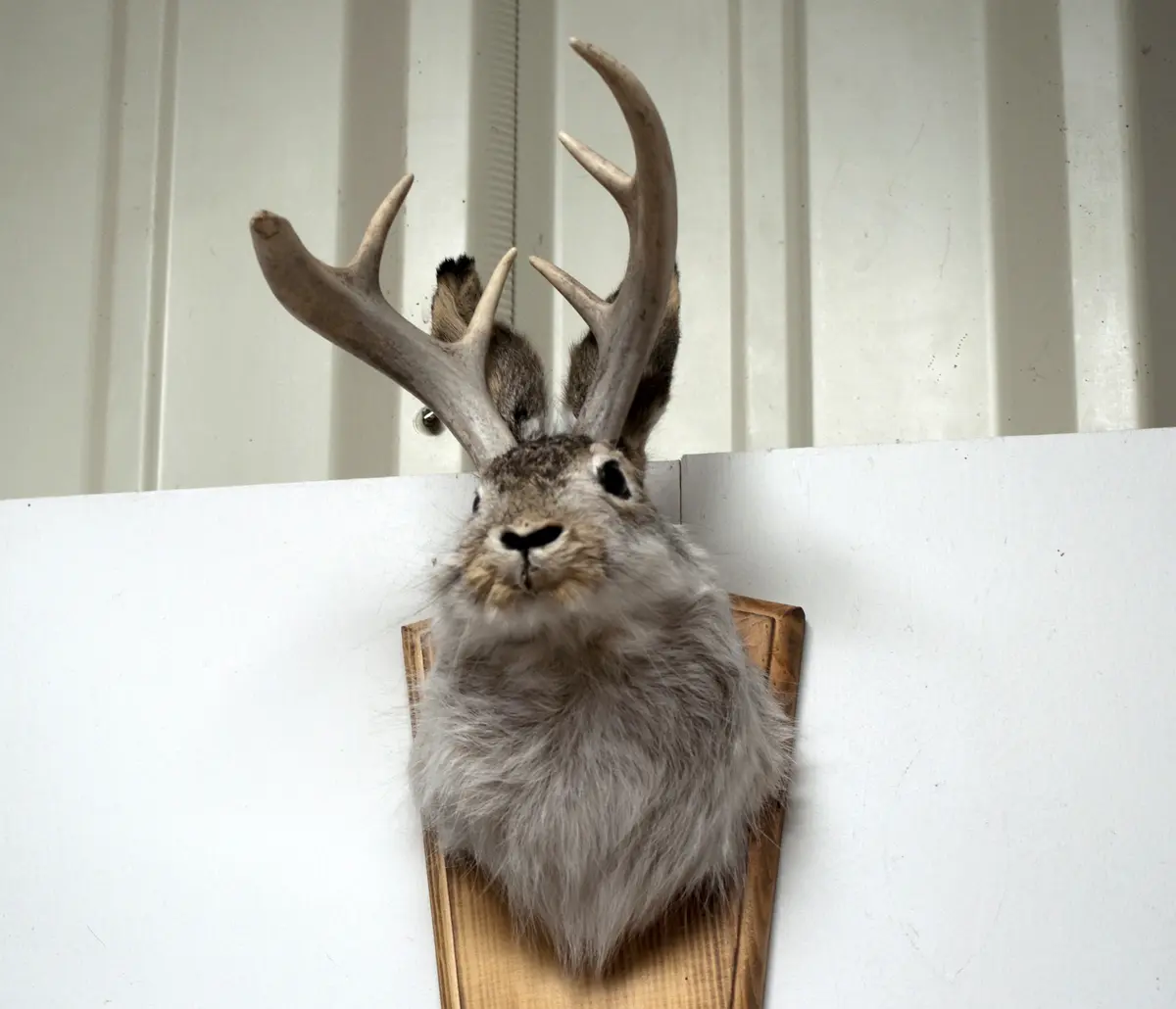
The jackalope is a jackrabbit wearing deer or antelope antlers: a taxidermy mount, and a joke that Douglas, Wyoming has sold to visitors for decades.
Where and when was Jackalope sighted?
- Location
- Douglas, Wyoming (American West), United States
- Date sighted
- Unknown
- Coordinates
- 42.753, -105.381
- Last updated
LOCATION
What is Jackalope?
The usual origin story credits two brothers from Douglas, Douglas and Ralph Herrick, who learned taxidermy by mail order and mounted a dead jackrabbit the way it had come to rest against a pair of deer antlers in their shop. The year is disputed: the New York Times gave 1934 in 1977, and so does the City of Douglas today; the Casper Star-Tribune repeatedly gave 1939; Ralph said 1932, but only after his brother's death in 2003. The word itself is found in print in 1950, in Douglas Chamber of Commerce publicity timed to President Truman's whistle-stop tour. Horned rabbits are much older than the Herricks: Renaissance naturalists catalogued the horned hare as Lepus cornutus, and American newspapers reported antlered jackrabbits from 1892 onwards. Some of those were real animals. In 1933 Richard Shope and E. Weston Hurst showed that a virus produces hard, horn-like growths on wild cottontails; it was the first papillomavirus described, and the rabbit model later supplied the first proof of concept for the HPV vaccines.
What is the history of Jackalope?
Almost every cryptid arrives without a birth certificate. The jackalope arrives with two brothers, a small taxidermy shop and a pair of deer antlers — and even so, nobody can agree on the year.
Douglas Herrick was born on 8 July 1920 in Douglas, Wyoming, a railway and ranching town on the North Platte. He and his younger brother Ralph learned taxidermy as teenagers from a mail-order course, the kind advertised in the back pages of hunting magazines during the Depression. The story they told for the rest of their lives is domestic and unglamorous. They came back from a jackrabbit hunt, threw the dead animal into the shop, and it slid across the floor until it came to rest against a pair of deer antlers lying there. Ralph's version, quoted in his brother's New York Times obituary: "We just throwed the dead jack rabbit in the shop when we come in and it slid on the floor right up against a pair of deer horns we had in there. It looked like that rabbit had horns on it." Douglas said: "Let's mount it the way it is."
They sold the result for ten dollars to Roy Ball, who hung it in the La Bonte Hotel in Douglas. It stayed there until September 1977, when somebody stole it; a New York Times report from later that year, which the City of Douglas reprints on its website, says the culprit "remains at large".
The year of that first mount is disputed in print. In 1977 the Wall Street Journal and the New York Times both reported the first jackalope as a 1934 creation. From 1992 onwards the Casper Star-Tribune, published fifty-five miles down the interstate, repeatedly gave 1939. Ralph Herrick insisted on 1932 — but only after Douglas died in 2003, with no one left to contradict him. The City of Douglas puts 1934 on its own website today. Michael P. Branch, who spent years chasing the animal for a book, lists 1934, 1936, 1938, 1939 and 1940 among the claims in circulation. If 1932 is right, the inventors were roughly twelve and ten years old.
The word itself is easier to date than the object. The researcher Peter Jensen Brown traced "jackalope" — a portmanteau of jackrabbit and antelope — to press releases issued by the Douglas Chamber of Commerce around March 1950, timed to President Harry Truman's whistle-stop tour through Wyoming that May. Brown also found the earlier joke names: in 1930 The Ironwood Times, in Michigan's Upper Peninsula, had written of a "boop-oop-o-doopdeer or whatizzit", and neither caught on. The mount may be from the thirties; the brand is from 1950, and it was deliberate.
The business outlived the joke. Douglas Herrick made perhaps a thousand mounts before leaving full-time taxidermy in 1954 to work as a welder and pipefitter at the Amoco refinery, retiring in 1980. Ralph and his son Jim kept producing them by the thousand, most of the output going to Wall Drug in South Dakota; the New York Times reported in 1977 that Ralph had sold more than 165 trophies at up to $35 each the year before. Douglas still calls itself the jackalope capital of the world, a title that the University of Wyoming's American Heritage Center traces to the brothers' work in the 1930s. Wyoming trademarked the name in 1965, and in 1985 Governor Ed Herschler issued a proclamation on the creature's official home.
The state legislature has been less obliging. A bill to make the jackalope Wyoming's official mythical creature was filed in 2001 by Representatives Gay and Edwards as House Bill 101, and died in committee on 1 March; it came back in 2005 from Representatives Edwards, Alden and Hageman with Senator Anderson, and in 2013 from a dozen sponsors led by Representative Dan Zwonitzer. The 2005 bill cleared the House 45 to 12 and was indefinitely postponed by the Senate on 2 March. The 2013 version passed the House 48 to 10 — after the Committee of the Whole amended "creature" to "critter" throughout — and then died in Senate committee. A fourth bill, House Bill 66 of 2015, was sponsored by Representatives Zwonitzer, Campbell and Cannady. Chapter 3 of Title 8 of the Wyoming Statutes, which lists the state's emblems from the flag to rodeo as the official sport, does not include the jackalope.
Douglas Herrick, a B-17 tail gunner in the Second World War, died of bone and lung cancer at a hospice in Casper in early January 2003, aged 82. Fittingly, the obituaries disagree: the Los Angeles Times obituary reprinted by The Seattle Times gave 3 January, the New York Times 6 January.
Timeline: the documented record of Jackalope
- c. 1575–1580 Joris Hoefnagel paints a horned hare in plate 47 of Animalia Quadrupedia et Reptilia (Terra), placing it between an ordinary rabbit and a hare copied from Dürer — evidence that European naturalists filed the animal, as Lepus cornutus, among the real ones.
- 1892 The Ness County News reports that a Kansas hunter named Bill Spencer has killed two horned jackrabbits — the earliest of several American press accounts of antlered rabbits located by researcher Peter Jensen Brown, forty years before the Herricks.
- 8 July 1920 Douglas Herrick is born in Douglas, Wyoming. He and his brother Ralph will learn taxidermy as teenagers from a mail-order course.
- 1932 (disputed) The date Ralph Herrick gave for the first jackalope — but only after his brother's death in 2003. If correct, the brothers were about twelve and ten. Rival claims put it in 1934, 1936, 1938, 1939 or 1940.
- 31 October 1933 Richard E. Shope and E. Weston Hurst publish "Infectious Papillomatosis of Rabbits" in the Journal of Experimental Medicine, showing that a filterable agent produces horn-like growths on wild cottontails. It is the first papillomavirus described and the first virus shown to cause cancer in a mammal.
- 1934 The date the City of Douglas gives officially today, and the one the Wall Street Journal and the New York Times both reported in 1977. From 1992 the Casper Star-Tribune would repeatedly use 1939 instead.
- March–May 1950 The word "jackalope" appears in print in press releases from the Douglas Chamber of Commerce, timed to President Truman's whistle-stop tour through Wyoming. The object may be from the thirties; the brand is a deliberate 1950 marketing operation.
- 1965 Wyoming trademarks the jackalope name. Twenty years later, in 1985, Governor Ed Herschler issues a proclamation on the creature's official home.
- 1977 The original mount — sold for $10 to Roy Ball and hung in the La Bonte Hotel in Douglas — is stolen.
- January 2003 Douglas Herrick dies of bone and lung cancer at a hospice in Casper, aged 82. The obituaries disagree even on the day: the Los Angeles Times obituary reprinted by The Seattle Times gives 3 January, the New York Times 6 January.
- 2 March 2005 House Bill 0004, to make the jackalope Wyoming's official mythical creature, passes the House 45–12 and is indefinitely postponed by the Senate. A 2013 attempt passes the House 48–10 — after "creature" is amended to "critter" — and dies in Senate committee.
- 2015 A survey of museum rabbit specimens by Escudero Duch and colleagues finds Shope's papillomavirus far outside its assumed Midwestern range — Nevada, New Mexico, Texas and Mexico — in about 1.8 % of the Sylvilagus rabbits examined.
- 2022 A review in Viruses describes the cottontail rabbit papillomavirus model as the gold standard that provided "the first proof-of-evidence for the current HPV vaccines" — the myth's biological cause turned into a vaccine.
Is there a rational explanation for Jackalope?
There is nothing to debunk here in the usual sense. A jackalope is a taxidermy mount, the people who make them have always said so, and the town that sells them is in on the joke. What deserves scepticism is something else: the claim that the Herrick brothers invented it. Three independent lines of evidence say they did not.
The first is European and four centuries older. Renaissance naturalists catalogued the horned hare as a real species under the Latin name Lepus cornutus, and it survived in natural histories into the eighteenth and nineteenth centuries. The Flemish illuminator Joris Hoefnagel painted one around 1575–1580 in plate 47 of his Animalia Quadrupedia et Reptilia (Terra), now in the National Gallery of Art in Washington: the horned rabbit sits between an ordinary rabbit and a hare copied from Dürer's Young Hare of 1502, presented as the equal of two real animals. The specimens behind those pages were, on later examination, exactly what the Herricks would make: stuffed hares with young deer antlers, or the trimmed horns of small antelopes, grafted onto their skulls. Bavaria kept the same craft alive as the Wolpertinger.
The second line is American and predates the brothers by decades. Peter Jensen Brown's newspaper research turned up the Ness County News reporting in 1892 that a Kansas hunter named Bill Spencer had killed two horned jackrabbits; the Minneapolis Star Tribune describing in 1900 a cottontail with deer-like antlers shot on the Sioux River; a similar account in the Arizona Republic in 1927; and an antlered jackrabbit trophy on display at a Northern Pacific Railroad ticket office in St Paul in April 1932. Some of those were trophies. Some were almost certainly the real thing.
The third line is the one that makes this file worth writing. On 31 October 1933 the Journal of Experimental Medicine published "Infectious Papillomatosis of Rabbits; with a Note on the Histopathology" by Richard E. Shope and E. Weston Hurst, volume 58, pages 607–624. Shope, working at the Rockefeller Institute, had taken the warty growths from wild cottontail rabbits, ground and filtered them, and reproduced the disease in healthy animals. The agent passed readily through a Berkefeld filter but not reliably through a Seitz, survived thirty minutes at 67 °C, and infected both wild and domestic rabbits. What it produced were keratinised growths on the face, head, neck and back that can reach several centimetres — hard, dark and, at a distance, indistinguishable from horns.
That paper described the first papillomavirus known to science, and the first virus shown to cause cancer in a mammal. The agent is now called Sylvilagus floridanus papillomavirus 1, and a 2015 survey of museum specimens by Escudero Duch and colleagues found it well outside Shope's assumed Midwestern range — Nevada, New Mexico, Texas and Mexico — with symptomatic animals in about 1.8 % of the Sylvilagus rabbits examined. The rabbit model went on to become, in the words of a 2022 review, the gold standard that supplied "the first proof-of-evidence for the current HPV vaccines".
So the chronology is the punchline. The scientific explanation for horned rabbits was published in 1933, within a year or two of a taxidermy mount whose date nobody can fix, and roughly four centuries after European naturalists had already given the animal a Latin binomial. Science did not trail behind this myth correcting it; science got there first, and then handed medicine a vaccine.
What remains is a very ordinary human story: a tidy origin anecdote, told decades after the fact by the surviving brother, competing against two newspaper dates, one municipal date and a shelf of earlier trophies. Douglas, Wyoming has never lied about the jackalope — it hands out hunting licences valid only on 31 June. But it did quietly claim an invention that was, at best, a reinvention.
Can you visit Jackalope?
Douglas is the seat of Converse County, Wyoming, about 77 km (48 miles) east of Casper in a straight line, and the town has built its civic identity around the jackalope. The City of Douglas dates the Herrick brothers' first mount to 1934 and says it hung in Roy Ball's La Bonte Hotel until it was stolen, adding that "the culprit remains at large"; the Associated Press obituary of Douglas Herrick puts the theft in 1977.
The town's statue began as an eight-foot figure on one of the Center Street islands. The Wyoming State Archives recorded in 2014 that it "met its demise when a four wheel drive pick up tried to run it over", and that the rebuilt jackalope went to Jackalope Square in the centre of Douglas. The county tourism office gives the square's address as 700 Center Street, and Wyoming's state tourism office dates its dedication to 1990, the year of the statehood centennial. The city's page on the animal, "Meet Jack", lists another statue at the Visitors Center and a thirteen-foot cutout on a hillside near the north entrance to the city from Interstate 25.
The Wyoming Pioneer Memorial Museum is at 400 West Center Street, on the Wyoming State Fairgrounds, and the city's facility page describes "two floors of historic memorabilia from early settlers and Plains Indians", with admission "free, donations welcome". Read on 24 September 2026, the same page gives seasonal hours of 08:00 to 16:00 from Tuesday to Saturday in April–May and September–October, 08:00 to 17:00 from Monday to Saturday between June and August, and 08:00 to 16:00 on Friday and Saturday from November to March, with the note that hours are subject to change. Wyoming's state tourism office says a jackalope is on display in the museum.
The hunting licence is issued by the Douglas Chamber of Commerce, and the city says it is handed out at the Douglas Visitors Center. Its wording has changed over the years: a permit quoted by the American Heritage Center of the University of Wyoming allowed "one one-tailed jackalope in the boundaries of Converse County, June 31, between the hours of midnight and 2 a.m. only", while the version the city offered for download on 24 September 2026 authorises the holder to take "one (1) pronghorn jackalope" in Converse County "on June 31st between sunrise and sunset only". High Country News named Wall Drug, in Wall, South Dakota, in 2003 as a major outlet for the mounts the Herrick family went on making; Wall lies about 290 km (180 miles) east-north-east of Douglas in a straight line.
Sources consulted
- Myrna Oliver (Los Angeles Times), «Douglas Herrick, 'jackalope' creator, dies at 82» — Los Angeles Times, reprinted in The Seattle Times, 26 January 2003, 2003 newspaper archive
- Douglas Martin, «Douglas Herrick, 82, Dies; Father of the Jackalope» — The New York Times, 2003 newspaper archive
- Richard E. Shope and E. Weston Hurst, «Infectious Papillomatosis of Rabbits; with a Note on the Histopathology» — The Journal of Experimental Medicine 58(5): 607–624, 1933 academic
- Wyoming State Legislature, «H.B. No. 0004 — Jackalope: official mythical creature. 2005 General Session Journal Digest» — Official legislative record, 2005 report
- Wyoming State Legislature, «HB0149 — State mythical creature (introduced bill and 2013 journal digest)» — Official legislative record, 2013 report
- Michael P. Branch, «The legend of the horned rabbit of the West» — High Country News, 2022 newspaper archive
- Peter Jensen Brown, «Civic Pride Through Taxidermy — a Many-Pronged History of Jackalopes» — Early Sports and Pop Culture History Blog, 2019 web
- City of Douglas, Wyoming, «The Legend of the Jackalope» — Official municipal website, 2026 web
- Wyoming State Archives, «Greetings From… Douglas!» — Wyoming Postscripts, 2014 archive
- Escudero Duch, C., Williams, R.A.J., Timm, R.M., Pérez-Tris, J. & Benítez, L., «A Century of Shope Papillomavirus in Museum Rabbit Specimens» — PLOS ONE 10(7): e0132172, 2015 academic
- Cladel, N.M., Xu, J., Peng, X., Jiang, P., Christensen, N.D., Zheng, Z.-M. & Hu, J., «Modeling HPV-Associated Disease and Cancer Using the Cottontail Rabbit Papillomavirus» — Viruses 14(9): 1964, 2022 academic
- American Heritage Center, University of Wyoming, «Tall Tales and Other Oddities — The Fabulous Jackalope of Wyoming» — Institutional archive blog, 2025 archive
- Steve Voynick, «Of Western myth and jackalopes» — High Country News, issue 246, 2003 newspaper archive
- City of Douglas, Wyoming, «Wyoming Pioneer Memorial Museum — visitor information» — Official municipal website, 2026 web
- Wyoming State Legislature, «H.B. No. 0101 — Jackalope-official mythical creature. 2001 General Session Journal Digest (sponsored by Representatives Gay and Edwards; died in committee 1 March 2001)» — Official legislative record, 2001 report
- Wyoming State Legislature, «HB0066 — State mythical creature, introduced bill (sponsored by Representatives Zwonitzer, Dn., Campbell and Cannady)» — Official legislative record, 2015 report
- Wyoming State Legislature, Legislative Service Office, «Wyoming Statutes, Title 8 (General provisions), chapter 3: state emblems, from the flag (8-3-102) to rodeo as the official state sport — no jackalope among them (compressed title read 8 October 2026)» — Wyoming Statutes, compressed Title 8, 2026 report
Reviewed by V. Serrano on 2026-07-29 · How we verify our content
📎 Source: Enigma Atlas
💬 Field testimonies (0)
No testimonies yet. Add the first.
Add your testimony
🔒 Log in to add a testimony