🦶 CRYPTID SIGHTING · EXP. Nº0555
ACTIVE
Piasa Bird
In 1673 Jacques Marquette and Louis Jolliet saw two monsters painted on a limestone bluff above the Mississippi near present-day Alton, Illinois: as large as a calf, horned like deer, red-eyed, bearded like a tiger, covered in scales, with a tail that wound around the body and ended in a fish's tail.
Where and when was Piasa Bird sighted?
- Location
- Illinois, United States
- Date sighted
- Unknown
- Coordinates
- 38.898, -90.199
- Last updated
LOCATION
What is Piasa Bird?
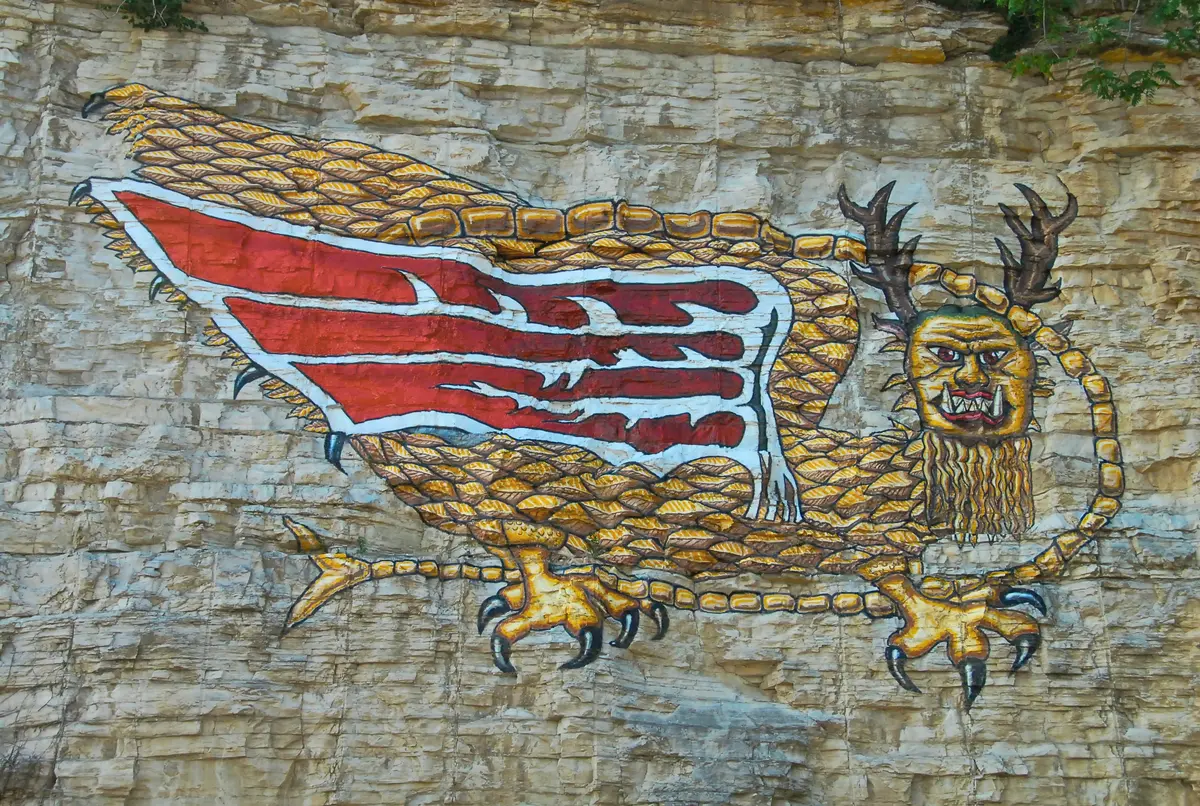
The journal gives them no name and no wings; both arrived later, and both can be dated. The word Piasa is in print as a place name on Hutchins's map of 1778 and as "Piesa" in Amos Stoddard's book of 1812. The legend of Chief Ouatogá, the twenty warriors and the poisoned arrows first appears in August 1836, on pages 101-102 of The Family Magazine, in an article signed "J. R." by John Russell of Bluffsdale, who himself wrote "of course I do not vouch for its truth", later told William McAdams that his story had been "somewhat illustrated", and in 1847 printed a wholly different legend with a different hero. The rock was quarried away for lime in the mid-nineteenth century; when Francis Parkman passed in 1867 it carried a huge advertisement for Plantation Bitters. What stands on the Great River Road today is a modern mural, the latest in a chain of repaintings begun in 1924.
What is the history of Piasa Bird?
The bluffs that run east from the mouth of the Illinois River to Alton are a wall of limestone capped with sandstone, and in the summer of 1673 something painted on one of them stopped a canoe.
The account is in the journal attributed to Jacques Marquette, printed by Reuben Gold Thwaites in volume 59 of The Jesuit Relations and Allied Documents. "While Skirting some rocks, which by Their height and Length inspired awe," it reads, "We saw upon one of them two painted monsters which at first made Us afraid, and upon Which the boldest savages dare not Long rest their eyes. They are as large As a calf; they have Horns on their heads Like those of deer, a horrible look, red eyes, a beard Like a tiger's, a face somewhat like a man's, a body Covered with scales, and so Long A tail that it winds all around the Body, passing above the head and going back between the legs, ending in a Fish's tail." Green, red and black were the three colours. The passage ends: "Here is approximately The shape of these monsters, As we have faithfully Copied It." The drawing was made and the drawing is lost.
The journal has two monsters, and it gives them no wings, no name and no legend. Sieur de La Salle wrote in 1680 that "the monster a sketch of which the Sieur Jolliet brought back is a grotesque figure painted by some Indian of the river": the sketch that survived the journey was credited to Louis Jolliet, Marquette's companion, who is usually the first name to fall out of the story. In September 1687 Father Anastasius Douay and Henri Joutel reached the same place and came away unimpressed. Joutel counted "two scurvy Figures drawn in red, on the flat Side of a Rock, about eight or ten Foot high", and Douay wrote flatly that he "touched them without difficulty". In December 1698 Buisson de Saint-Cosme passed and recorded that the figures "are now almost effaced". Charlevoix came down the river in 1721 and said nothing about them at all.
The name arrives separately from the picture. Thomas Hutchins's map of 1778 labels the ground where Alton now stands "Piasas". Major Amos Stoddard, writing in Sketches, Historical and Descriptive, of Louisiana (Philadelphia, 1812), reported that what Jolliet and Marquette "call Painted Monsters on the side of a high perpendicular rock, apparently inaccessible to man, between the Missouri and Illinois, and known to the moderns by the name of Piesa, still remain in a good degree of preservation" (p. 17). Whether anything was still visible is another matter: in 1824 Murray McConnel of Jacksonville examined the rock and later told John F. Snyder that he had seen nothing but "blotches of rusty-looking discoloration, such as stained the exposed faces of the cliffs generally".
The legend has a date, a page and an author. In August 1836 The Family Magazine; or, Monthly Abstract of General Knowledge (vol. IV, Boston edition) carried on pages 101–102 an article headed "The Piasâ: An Indian Tradition of Illinois", signed only "J. R.". The volume's own prefatory Advertisement names him: "The Piasa," it says, was "obligingly furnished by J. Russell, Esq., of Bluffsdale, Ill." John Russell, a professor at Alton Seminary, wrote that the stream below the bluff was called the Piasa, that the word meant in the language of the Illini "the bird that devours men", and that on the cliff was "cut the figure of an enormous bird, with its wings extended". Then came the tale: a man-eating bird, whole villages depopulated, a chief named Ouatogá who fasted a moon, dreamed, offered himself as bait, and twenty warriors with poisoned arrows. Russell closed the legend with a line that almost everyone who repeats him drops — "Of course I do not vouch for its truth" — and followed it with his own excursion to a cliff cave whose floor, he said, was "a mass of human bones".
The article travelled fast: reprinted in the Alton Telegraph on 28 September 1836, in the Sangamo Journal of Springfield on 15 October, carried by the Cincinnati edition of the magazine that same month, and reprinted again in the Evangelical Magazine and Gospel Advocate of Utica, New York, in July 1848 — which is why several nineteenth-century writers, and some modern ones, misdate Russell to 1848. What almost nobody noticed is that in between, on 28 October 1847, Russell published in the Springfield Illinois Journal a completely different legend: the creature is a giant condor, the hero is not Ouatogá but a lone Illini named Alpeora who kills it single-handed, and the figure on the rock is admitted to be "now obscured by time". Questioned by William McAdams, Russell allowed that his story had been "somewhat illustrated". His son Spencer G. Russell told John F. Snyder that his father had confessed the legend was the product of imagination coupled with Marquette's account.
The rock itself did not survive the century, and the sources do not agree on when it went. McAdams wrote in 1887 that "the whole face of the bluff was quarried away in 1846 and '47" (p. 9), yet a page earlier described a gradual quarrying for lime after 1844–45 with all traces gone about the time the Civil War began. Perry A. Armstrong, publishing the same year, said the rock was quarried by convicts of the Alton penitentiary "as late as about the year 1856". Francis Parkman settled at least the end of it: "In 1867, when I passed the place, a part of the rock had been quarried away, and, instead of Marquette's monsters, it bore a huge advertisement of 'Plantation Bitters'."
What has hung on the bluffs since is a chain of copies of copies. On 4 October 1924 Herbert Forcade, an eighteen-year-old Boy Scout, presented a Piasa he had painted on the cliff to the city of Alton, dedicated the next day. I. H. Mawdsley, a Shurtleff College student, repainted it in 1935 with money raised by John D. McAdams, and restored his own work in 1938 in red and green instead of the yellow that had dominated. Jack Buese and Eldon Grove began a thirty-by-eighteen-foot version on 12 September 1952, dedicated on 12 October. In 1984 the Alton-Godfrey Rotary Club, unable to raise the $50,000 an aluminium panel would have cost, had a steel Piasa of 9,000 pounds cut, painted by nine local artists over some 400–500 hours and craned onto the bluff at Norman's Landing; it was removed some years later, kept under the Clark Bridge, and bought by Southwestern High School, whose mascot is the Piasa, for one dollar. The painting on the rock today is later still.
Timeline: the documented record of Piasa Bird
- Summer 1673 Jacques Marquette and Louis Jolliet see two painted monsters on a bluff above the Mississippi. The journal describes horns, red eyes, a tiger's beard, a human-ish face, scales and a tail ending in a fish's tail — as large as a calf, in green, red and black. It names no creature and mentions no wings, and the copy they made of the figures is lost.
- 1680 La Salle writes that "the monster a sketch of which the Sieur Jolliet brought back is a grotesque figure painted by some Indian of the river" — the earliest attribution of the lost drawing, and to Jolliet rather than Marquette.
- September 1687 Henri Joutel and Father Anastasius Douay reach the same rock. Joutel counts "two scurvy Figures drawn in red… about eight or ten Foot high" and Douay says he touched them without difficulty, contradicting the tradition that the figures hung out of human reach.
- December 1698 Buisson de Saint-Cosme records that the painted figures "are now almost effaced". Temple treats this as the last reliable eyewitness report of the original.
- 1812 Amos Stoddard prints the name in a book: the Painted Monsters are "known to the moderns by the name of Piesa". It is 24 years before Russell, and it is why the claim that Russell coined the word is wrong.
- 1824 Murray McConnel of Jacksonville examines the bluff and later reports to John F. Snyder that he saw nothing but "blotches of rusty-looking discoloration" of the sort that stain the cliffs generally.
- 3 April 1825 Date inscribed on the pen-and-ink sheet headed "Flying Dragon" and "Made by Wm. Dennis", which William McAdams published in 1887 and which became the model for every later mural. McAdams claimed only that it purported to represent Marquette's painting; his daughter said in 1932 that her father drew it himself, from Marquette's description.
- August 1836 "The Piasâ: An Indian Tradition of Illinois" appears on pages 101–102 of The Family Magazine, vol. IV, signed "J. R."; the volume's own preface credits "J. Russell, Esq., of Bluffsdale, Ill." This is the first appearance of Chief Ouatogá, the twenty warriors, the poisoned arrows and the wings. Russell himself adds: "Of course I do not vouch for its truth."
- 28 September 1836 The Alton Telegraph reprints Russell's article; the Sangamo Journal of Springfield follows on 15 October and the Cincinnati edition of the magazine that same month. The legend is in local circulation within weeks of being written.
- 28 October 1847 Russell publishes an entirely different Piasa legend in the Springfield Illinois Journal: the creature is a condor, the hero is a lone Illini named Alpeora, and the figure on the rock is now "obscured by time". Two incompatible traditions from the same author in eleven years.
- 1846–1847 William McAdams dates the destruction: "The whole face of the bluff was quarried away in 1846 and '47." Armstrong, publishing the same year, blames convicts of the Alton penitentiary about 1856, and McAdams himself elsewhere describes a gradual quarrying finished around the start of the Civil War. The date is not settled.
- 1867 Francis Parkman passes the spot: "a part of the rock had been quarried away, and, instead of Marquette's monsters, it bore a huge advertisement of 'Plantation Bitters'." He also notes that a proposal to repaint the figures "after conceptions of their own" had been abandoned.
- 4 October 1924 Herbert Forcade, an eighteen-year-old Boy Scout, presents to the city of Alton the Piasa he has painted on the cliff; the formal dedication takes place the following day. It is the first of the modern murals.
- 12 October 1952 A thirty-by-eighteen-foot Piasa by Jack Buese and Eldon Grove is dedicated, begun on 12 September. It follows repaintings by I. H. Mawdsley in 1935 and 1938 — each one copied from the last, and none from the rock.
- 1984 The Alton-Godfrey Rotary Club, having raised $12,000 of the $50,000 an aluminium panel would have cost, has a 9,000-pound steel Piasa cut and painted by nine local artists and craned onto the bluff at Norman's Landing. It was removed some years later and bought by Southwestern High School for one dollar.
- 4 November 2024 The Great Rivers & Routes Tourism Bureau announces that the visitor centre planned for Piasa Park in 2023 is not feasible there — land ownership and tax liabilities — and that the Byway Discovery Center will be built west of Alton near Piasa Creek instead, aiming at spring 2026.
Is there a rational explanation for Piasa Bird?
Nothing here needs a paranormal explanation. Nobody claims to have met a living Piasa; what is in dispute is a text, and the text can be checked.
The provenance clause fails. The sentence that does the work in every popular retelling is some version of "an ancient Illini tradition recorded by Marquette in 1673". Thwaites's volume 59 prints Marquette's journal in French and in English on facing pages, and the Internet Archive's text of the volume runs to about 91,000 words. Searched on 8 October 2026, it returns 0 hits for Piasa, 0 for Ouatoga and 0 for ailes in the French. Wings appears twice, for swans moulting and for a calumet being made to "spread its wings". The control terms in the same file: monsters 11, monstres 7, Pekitanoui 9, calf 1, scales 1 — the exact vocabulary of the passage. The single occurrence of Piesa in the whole volume is in Thwaites's own 1900 footnote, quoting Stoddard's book of 1812. Marquette's text names nothing and describes no wings.
The wings can be dated. Wayne C. Temple put it in one sentence in 1956: "Not until John Russell published his tale of the Piasa Bird in 1836 was there any account of wings on the figure." Ives Goddard, of the Smithsonian, reached the same place from the other direction in 1985: the presence of wings in the nineteenth-century depictions and descriptions "probably merely reflects European conceptions of what dragons look like projected onto the unclear pictographs". The best-known image — the horned, bearded, winged dragon reproduced on every mural since — is a pen-and-ink sheet inscribed "Made by Wm. Dennis, April 3d, 1825" and headed Flying Dragon, which William McAdams owned and published in 1887 while saying only that it "purport[s] to represent the ancient painting described by Marquette". McAdams's own daughter, Georgia McAdams Clifford, wrote in 1932 that it was her father who had made the drawing, from Marquette's description. Spencer G. Russell later explained the missing wings by claiming the colours only came out in damp weather; Temple read that as "searching for an alibi".
And the name is older than the legend, which cuts the other way. Russell did not invent the word: "Piasas" is on Hutchins's map of 1778 and "Piesa" is in Stoddard in 1812. But Jacob P. Dunn, who worked on the Illinois language, stated in 1923 that there was no such word as Piasa in their vocabulary and that the legend did not fit Indian folklore, and Goddard concluded that the name "does not appear to be attested in Illinois, Miami, or other Algonquian languages" and that the proposed Indigenous etymologies require distortions severe enough to sink them. A related-sounding name does exist among neighbouring peoples — a Kaskaskia chief called Paessa killed fighting the Iroquois in the winter of 1680–81, and Black Hawk's father was called Pyesa — both of them the names of men.
The Indigenous account that Goddard matches to the painting is a Fox one. He identifies Marquette's creature with the manitou who overturns canoes in a Fox narrative written out in the Fox syllabary, probably in the summer of 1912, by Alfred Kiyana, and published by Truman Michelson in 1925 with a translation based closely on one written out by Horace Poweshiek. In Goddard's words the manitou "corresponds in all specified respects" to the figure on the cliff: it is of the Underwater Panther type, an enemy of the thunderers, and its tail is prominent in the story, as it is in Marquette's description. That is the tradition the picture belongs to, an underwater manitou set down by a Meskwaki author in 1912. The winged bird comes from Russell's magazine article of 1836.
Temple added a speculation of his own: he noted that a dragon-like figure called La Grande Goule was paraded at Poitiers, that a wooden model of it made in 1677 survives in the museum there, and that it has wings — his suggestion being that a French Jesuit's imagination may have supplied part of what he reported. Temple's blunter conclusion is the one that matters: "It is very doubtful that anyone actually saw the figures after 1698." Every drawing we have was made more than a century later.
Can you visit Piasa Bird?
The painting is on the bluff above Illinois Route 100, the Great River Road, at Piasa Park, about 1.5 km (1 mile) west-north-west of downtown Alton, Illinois, and about 30 km (19 miles) north of the Gateway Arch in St Louis in a straight line. The Great Rivers & Routes Tourism Bureau lists it at Route 100, Alton, Illinois 62002, and gives no hours or admission charge for it. The bureau's contact page, read on 23 September 2026, gives the Alton Visitor Center at 200 Piasa Street, telephone (618) 465-6676, open Wednesday to Sunday from 10 a.m. to 4 p.m.
What is on the rock is a modern painting in the winged-dragon form of the drawing McAdams published in 1887. It is the latest in a line that runs from the Piasa the Boy Scout Herbert Forcade painted in 1924, through the repaintings of the 1930s and of 1952, to the 9,000-pound steel bird the Alton-Godfrey Rotary Club put up at Norman's Landing in 1984. The bureau dates the present image to the 1990s; The Telegraph of Alton reported on 19 May 2025 that it was last painted by a group of local artists in 1998 and was fading, especially in the face. St. Louis Public Radio reported on 28 March 2023 that the bureau would not repaint the bird as part of its park project, though a repainting "could, however, be considered at a later date" (ref. 10).
The rock Marquette described has been quarried away. McAdams wrote in 1887 that "the whole face of the bluff was quarried away in 1846 and '47", Armstrong put the quarrying as late as about 1856, and in 1867 Francis Parkman found part of the rock gone and the rest carrying an advertisement for "Plantation Bitters" (refs. 5-7). The cave floored with human bones that John Russell described in 1836 rests on Russell's own account.
In March 2023 the bureau announced a redevelopment of Piasa Park with a 4,500-square-foot visitor centre and "an observation deck for the Piasa Bird mural". On 4 November 2024 it moved the project: land ownership and tax liabilities had made the park unfeasible, and the Byway Discovery Center would be built near the mouth of Piasa Creek, on the Madison–Jersey county line west of Alton (ref. 9). On 23 September 2026 the bureau's project page still described the centre as "slated to open Spring 2026".
The Alton Museum of History and Art occupied Loomis Hall, 2809 College Avenue, the second-oldest surviving college building in Illinois. The museum's English Wikipedia article, read on 23 September 2026, says it closed temporarily in 2020 because of the COVID-19 pandemic and was still closed as of 2024.
Sources consulted
- Reuben Gold Thwaites (ed.), «The Jesuit Relations and Allied Documents, vol. 59: Lower Canada, Illinois, Ottawas, 1673-1677» — Burrows Brothers, Cleveland, 1900 archive
- Amos Stoddard, «Sketches, Historical and Descriptive, of Louisiana (p. 17)» — Mathew Carey, Philadelphia, 1812 book
- John Russell, «The Piasâ: An Indian Tradition of Illinois (pp. 101-102, signed "J. R.")» — The Family Magazine; or, Monthly Abstract of General Knowledge, vol. IV, Boston edition, 1836 newspaper archive
- Wayne C. Temple, «The Piasa Bird: Fact or Fiction?» — Journal of the Illinois State Historical Society 49:3; reprinted as Illinois State Museum, Report of Investigations No. 5, 1956 academic
- Ives Goddard, «Reflections of Historical Events in Some Traditional Fox and Miami Narratives (pp. 47-62)» — Papers of the Sixteenth Algonquian Conference, 1985 academic
- William McAdams, «Records of Ancient Races in the Mississippi Valley (pp. 5-9)» — C. R. Barns, St Louis, 1887 book
- Francis Parkman, «The Discovery of the Great West (note to p. 59)» — Little, Brown, Boston, 1869 book
- Perry A. Armstrong, «The Piasa, or, The Devil among the Indians (pp. 12-13, 28-32)» — E. B. Fletcher, Morris, Illinois, 1887 book
- Rotary Club of Alton-Godfrey, «The Last Flight of the Piasa (reprinting Joe Massucci in The Rotarian, July/August 1984)» — altongodfreyrotary.org, 1984 report
- Great Rivers & Routes Tourism Bureau, «Byway Grants Projects Move Towards Spring 2026 Opening» — riversandroutes.com, 2024 report
- St. Louis Public Radio, «Piasa Park in Alton to get up to $6.5 million in renovations and additions» — stlpr.org, 2023 newspaper archive
- Illinois State Museum, «The Piasa Bird (RiverWeb vignette)» — museum.state.il.us, 2000 web
Reviewed by V. Serrano on 2026-08-14 · How we verify our content
📎 Source: Enigma Atlas
💬 Field testimonies (0)
No testimonies yet. Add the first.
Add your testimony
🔒 Log in to add a testimony