🦶 CRYPTID SIGHTING · EXP. Nº9045
ACTIVE
Skunk Ape
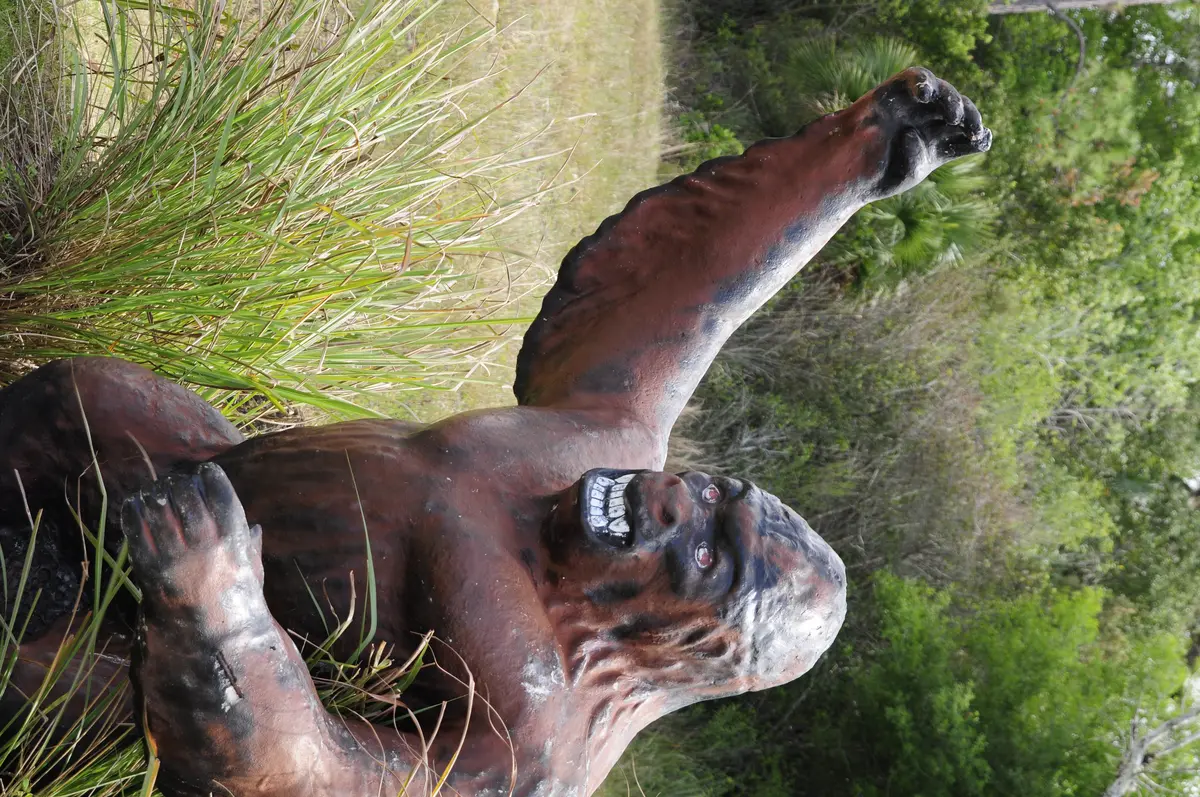
The Skunk Ape is Florida's answer to Bigfoot: a large, hairy, ape-like biped said to roam the swamps and hammocks of the Everglades and other wetlands across the state, distinguished above all by an overpowering smell of rotten eggs or stagnant swamp gas that gives it its name.
Where and when was Skunk Ape sighted?
- Location
- Everglades, Florida, United States
- Date sighted
- 1974-07-01
- Coordinates
- 25.9, -81.3
- Last updated
LOCATION
What is Skunk Ape?
Sightings and local rumors span much of the twentieth century, with a notable cluster of police reports around Dade County in 1974 that drew press attention and cemented the creature in Florida folklore, sometimes linked loosely to older Seminole stories about swamp-dwelling beings. Described as reddish-brown or dark-furred, somewhat smaller and more heavyset than the Pacific Northwest's Bigfoot, the Skunk Ape has become a minor tourism draw, complete with a dedicated 'research headquarters' in the Everglades run by a longtime local enthusiast. Skeptics attribute the reports to black bears standing upright, misidentified hunters or hikers in matted clothing, deliberate hoaxes and costume photos, and the simple fact that Florida's swamps do produce genuinely foul-smelling gases on their own.
What is the history of Skunk Ape?
The Skunk Ape is Florida's Bigfoot, and what witnesses describe first is its smell. Dave Shealy, who runs a research headquarters devoted to it, told Smithsonian Magazine in 2013 that it smells "kind of like a wet dog and a skunk, mixed together"; WestPalmBeach.com describes "a revolting mixture of wet dog, skunk and rotting eggs".
The reports are older than 1974. WestPalmBeach.com dates the earliest published one to 1942, in Suwannee County, and Smithsonian Magazine counts among the earliest well-publicised sightings two hunters who said in 1957 that the creature had invaded their camp; the name skunk ape, according to the magazine, seems to have surfaced in the 1960s.
In 1974 the reports reached the police. According to WestPalmBeach.com, just after midnight on 9 January Richard Lee Smith told the Florida Highway Patrol that his car had struck a hairy creature seven or eight feet tall near the junction of U.S. Route 27 and Hollywood Boulevard, in Pembroke Pines, on the eastern edge of the Everglades. At 2:12 a.m. a Hialeah Gardens patrolman reported a huge, hairy creature limping along the road a few miles away, and at dawn police searched the swamp with two helicopters and found nothing. The same page records that two Palm Beach County deputies, Marvin Lewis and Ernie Milner, said they shot a tall creature west of Lantana that year.
That same year, by his own account to Smithsonian Magazine, Dave Shealy, then ten, saw one for the first time. He was deer hunting with his older brother Jack in the swamp behind his house, in what is now Big Cypress National Preserve, a few years after his father had come upon a set of footprints. WestPalmBeach.com gives the year as 1973 and his age as nine. Shealy runs the Skunk Ape Research Headquarters on the Tamiami Trail at Ochopee, which also serves as a gift shop, a campground and a base for swamp tours.
The case's other celebrated item is the Myakka photographs. On 29 December 2000, WestPalmBeach.com reports, the Sarasota sheriff's office received an anonymous letter with two photographs from a woman who wrote that for two nights an animal had taken apples from her back porch, on property near I-75 east of Sarasota, and that her husband thought it was an escaped orangutan: "Is someone missing an orangutan?" The creature has been known ever since as the Myakka Skunk Ape.
Timeline: the documented record of Skunk Ape
- 1974 Just after midnight on 9 January, Richard Lee Smith tells the Florida Highway Patrol that his car struck a hairy creature seven or eight feet tall near U.S. Route 27 and Hollywood Boulevard, in Pembroke Pines; at dawn police search the swamp with two helicopters and find nothing.
- 1974 Dave Shealy, aged ten, says he sees one while deer hunting with his brother Jack in the swamp behind his house, today part of Big Cypress National Preserve. Years earlier his father had found a set of tracks.
- From the 1990s Dave Shealy founds the Skunk Ape Research Headquarters in Ochopee, on the Tamiami Trail, where he has spent decades collecting testimony, footprint casts and material on the creature.
- 2000 On 29 December the Sarasota sheriff's office receives an anonymous letter with two photographs from a woman who says the animal took apples from her back porch, on property near I-75 east of Sarasota.
Is there a rational explanation for Skunk Ape?
The official position is brief: Bob DeGross, public affairs officer of Big Cypress National Preserve, told Smithsonian Magazine in 2013 that "there has never been a substantiated sighting of the skunk ape that was verified by National Park Service wildlife staff". Critics quoted in the same article point out that dozens of unrelated research projects in the Everglades use motion-activated trail cameras and that none has captured indisputable proof of the animal or found its remains. Sharon Hill, of the Committee for Skeptical Inquiry, called the evidence "almost entirely eyewitness testimony, which is the most unreliable evidence you can have".
The wildlife zoologist Roland Kays told the magazine that for describing a new species "sightings are just useless", and that an animal living for centuries in south Florida would sooner or later leave a specimen, most likely as roadkill. His example was the cougar that travelled from South Dakota to New England in 2011 and left clear trail-camera photographs and, in the end, its body, hit by an SUV on a Connecticut parkway. Shealy's answer, in the same article, is that things decompose quickly in the swamp and that the preserve is large and rarely visited.
The favourite natural hypothesis has a problem of size: many researchers, according to WestPalmBeach.com, believe that Skunk Apes descend from orangutans that escaped from the travelling circuses that frequented Florida in the mid-twentieth century. The same page notes that the average orangutan stands only four and a half feet tall (about 1.4 metres) and weighs less than two hundred pounds, while many Skunk Apes have been reported at seven feet or more.
The best-known footage has its own critics: of Shealy's video of July 2000, the Smithsonian writer says that it is hard to watch "and see anything but a guy in a gorilla suit". It was released shortly before a hearing on Shealy's application to the Collier County Tourism Development Council for a grant, and the Naples Daily News columnist Brent Batten wrote at the time that the creature "bears a striking resemblance to a guy in a monkey suit". Critics also note that Shealy sells souvenirs and tours on the strength of the animal, and some have speculated that the figure in the images is his brother Jack in a costume.
Can you visit Skunk Ape?
Ochopee, the community where the 1974 reports were made, is a small unincorporated settlement on the Tamiami Trail (US 41) inside Big Cypress National Preserve. The pin of this entry, 25.9, −81.3, is Ochopee rounded to one decimal place; the witnesses described a creature crossing rural roads at night, so the point stands for the area and marks no particular spot. The preserve dates from the same year as the sightings: Congress established it by Public Law 93-440 of 11 October 1974. Ochopee's post office, at 38000 Tamiami Trail East, measures 61.3 square feet (5.7 m²) and is listed by the US Postal Service as the smallest in the country; the building was a storage shed for the irrigation pipes of a tomato farm and became a post office in 1953, after a fire destroyed the previous one.
The Skunk Ape Research Headquarters is Dave Shealy's business, at 40904 Tamiami Trail East, on the grounds of the Trail Lakes Campground. Its website, consulted on 23 September 2026, lists the campground with its chickee cabins, a gift shop, an animal exhibit and pole-boat and kayak tours on the Turner River run with Everglades Adventure Tours; it publishes no opening hours or prices. Countere's 2022 piece on Shealy counted "four fully grown gators" and "a batch of baby alligators in a tank" among the animals, along with a collection of snakes that included several Burmese pythons.
The preserve's Nathaniel P. Reed Visitor Center is on the same road. The National Park Service's trip-planning page, read on 23 September 2026, describes its exhibits and a short boardwalk behind the building that serves as "a great viewing platform of alligators, birds, turtles, and fish".
The Florida National Parks Association, the non-profit partner of the South Florida national parks, puts the dry season at "about December to mid-May" and the wet season at about mid-May to November, when higher water brings "a boom in mosquito activity", in an article of 25 August 2025.
Sources consulted
- Smithsonian Magazine, «On the trail of Florida's Bigfoot — the Skunk Ape» — Smithsonian Magazine, 2013 newspaper archive
- Countere Magazine, «Florida's Bigfoot: the legend of the Skunk Ape — Dave Shealy y los Everglades» — Countere, 2022 interview
- PantherNOW, «Inside the Skunk Ape Research Headquarters» — Florida International University, 2021 newspaper archive
- WestPalmBeach.com, «The Skunk Ape — recopilación de avistamientos y explicaciones propuestas» — Divulgación regional de Florida, 2023 web
Reviewed by V. Serrano on 2026-07-28 · How we verify our content
📎 Source: Folclore (curado)
💬 Field testimonies (0)
No testimonies yet. Add the first.
Add your testimony
🔒 Log in to add a testimony