🦶 CRYPTID SIGHTING · EXP. Nº6501
ACTIVE
Snallygaster
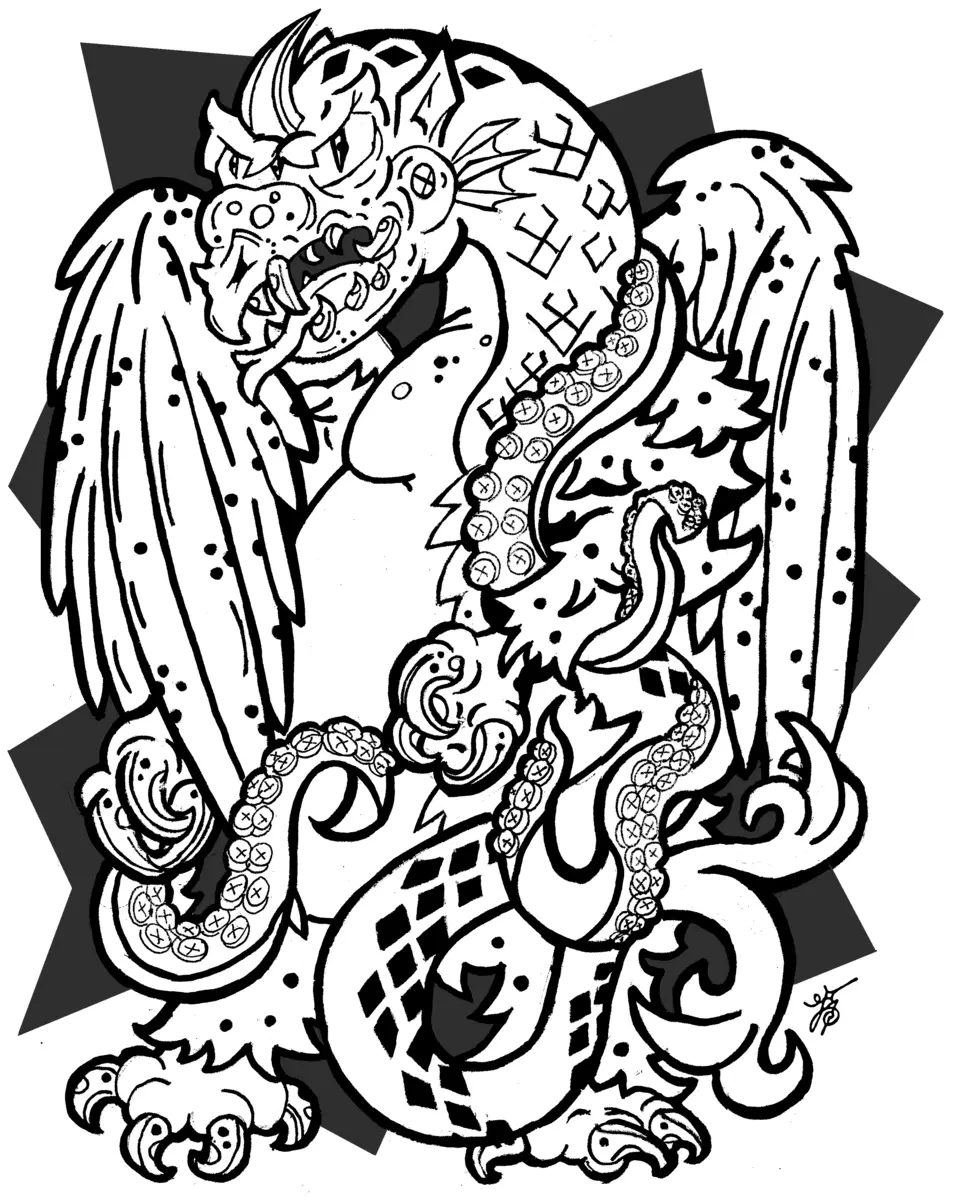
The Snallygaster is a winged monster of western Maryland folklore, pictured as half bird and half reptile, with an enormous wingspan, a long pointed bill, steel-hooked claws and, in its first description, a single eye in the middle of its forehead.
Where and when was Snallygaster sighted?
- Location
- Maryland, United States
- Date sighted
- Unknown
- Coordinates
- 39.6, -77.4
- Last updated
LOCATION
What is Snallygaster?
It belongs to a precise landscape: the Middletown Valley, South Mountain and the Catoctin ridge in Frederick County, and Sugarloaf Mountain on the Montgomery County line. It was launched on 12 February 1909 by the Valley Register, a Middletown weekly, under the headline "The Colored People Are in Great Danger"; the series is held on paper by Frederick County Public Libraries, and by 5 March 1909 it was printing the word Snallygaster. The Smithsonian reward and Theodore Roosevelt's plan to hunt it, often told as the national reaction, are part of that first article's joke. The best-documented outbreak ran through November and December 1932, when the Valley Register revived the creature and the Montgomery County Sentinel of Rockville described comic hunting parties around Sugarloaf whose fear was aimed at Black neighbourhoods. A 1940 state guide suggested the name may come from the German schnelle Geister, quick spirits.
What is the history of Snallygaster?
The Snallygaster is almost always introduced with the same paragraph. In February 1909 a weekly paper in Middletown, Maryland — the Valley Register — began running reports of a winged monster over the Middletown Valley; the story swelled week by week, papers across the country reprinted it, the Smithsonian Institution offered a reward for the carcass, and Theodore Roosevelt thought about delaying his African safari to shoot it.
The 1909 series is real, and it is on paper. The Valley Register is not in Chronicling America; its issues are held by Frederick County Public Libraries, in the Maryland Room of the C. Burr Artz Public Library, and Jake Seboe quoted them in December 2024 for WETA's Boundary Stones. The first piece ran on 12 February 1909 under the headline "The Colored People Are in Great Danger. Monster Go-Devil or Winged Bovalopus in This Section of Maryland". It carried an eyewitness who described "enormous wings; a long, pointed bill; four legs armed with claws like steel hooks; one eye in the center of its forehead", and it said the beast attacked only Black people. The Smithsonian and Roosevelt are in that first article, as part of the joke. On 19 February the novelist T. C. Harbaugh saw it in Ohio, sailing towards Maryland; on 5 March the headline was "Emmitsburg Saw the Great Snallygaster". Seboe names the paper's editors, George C. Rhoderick and Ralph Wolfe, and Harbaugh as the authors. The word itself is therefore in print by March 1909. In the Library of Congress's Chronicling America it does not appear before 1932, across five spellings (snallygaster, snalligaster, snarlygaster, snallygoster, snally gaster), according to a full-text query made for this file in 2026.
What Chronicling America can show, in full, is the outbreak of late 1932 — and it is not what the modern legend describes. According to Seboe, it began in the Valley Register itself on 18 November 1932, when George C. Rhoderick III, son of the 1909 editor, revived the story with his uncle Charles K. Rhoderick, as the hatchling of the 1909 monster.
On 2 December 1932 the Montgomery County Sentinel of Rockville gave page eight to a headline built to be read aloud: "Sleeping Snallygaster Snores Serenely In Sugar Loaf Sunday; Seven Snares Set." Under it: "Winged Bovalopus Frightens Ten, As Hunters Spy Him In His Den; Open Season On Monster Called And Countryside Is Appalled — Last Seen 23 Years Ago, Lives On Colored Men, Don't You Know."
The story itself opens: "It has been 23 years since the dreaded winged monster, the 'Snallygaster,' has appeared in the Western section of Maryland." It goes on: "With a spread of at least 30 feet, reaching out his tentacles like some prehistoric inhabitant of the Miocene age, the Snallygaster, or winged Bovalopus, has been seen by two score residents of Washington, Frederick, and Upper Montgomery counties within the past two weeks." Twenty-three years back from 1932 is 1909: the Sentinel counts from the Valley Register series and takes for granted that the county remembers it.
The rest of the article is a comic set piece. Ten men follow the beast over Dickerson "at a 60-mile-a-minute rate", armed "with rifles, pistols, shotguns, and oaths"; one carries a bag of "the powerful but rare 'snoozeberry', said to be the most efficacious lure for the snallygaster". At "eleven minutes and eleven seconds after eleven Sunday morning" they find it snoring in a cave on Sugarloaf Mountain, lose their nerve, forget the snoozeberries and back-track to Dickerson.
Two weeks later, on 15 December 1932, the Sentinel put it on the front page: "Snallygaster Glides Over Rockville; Autoist Scales Wall on Courthouse Lawn". A motorist at the corner of Montgomery Avenue and the Frederick road "so far lost his nerve that he drove his automobile up over the 2-foot wall and darted across the courthouse lawn"; witnesses reported "a large bird, fully 6-foot in wing spread"; and "fingerprint expert Ted Vollten said yesterday that he was looking for shadow marks in the snow in the vicinity of Snake's Den".
There is something in these articles that the modern retellings quietly drop. The joke has a target, and the target is Black Marylanders. It is there in the headline of 12 February 1909. The 2 December 1932 subhead says the monster "Lives On Colored Men"; the hunters withdraw only after "giving out a warning to the colored residents of the town"; the 15 December piece has the beast dive on "'The Run', Rockville's colored settlement". The Sentinel kept The Run as the monster's hunting ground for years afterwards, according to Seboe. It was written by white-run papers, for a white readership, about the fright of their Black neighbours; and the Sentinel, a Democratic paper, reported that some held the monster "appears after every election when the result shows that the colored voter cast his ballot for a Democrat".
After 1932 the creature became a running gag in the county press. In August 1933 the Sentinel reported that the Snallygaster had picked a fight with the Blue Eagle, the emblem of Roosevelt's National Recovery Administration, been beaten "with a crash which could be heard as far away as the Middletown Valley" and fled towards Brazil; the paper's own review of the year filed it under August, among the tax rate and the baseball. In March 1935 the Chaco War between Bolivia and Paraguay was said to have driven it home again, with Senator Huey Long taking the matter to the Senate Foreign Relations Committee.
It also escaped Maryland. In July 1934 the Worcester Democrat of Pocomoke City reported that Edward Lewis of Pleasant Walk, in the northern Middletown Valley, had shot a large speckled bird with a six-foot wingspan and a four-inch bill after losing chickens; neighbours wondered whether it was "the offspring of the dread Snallygaster, which appeared in this section in November, 1932". By January 1938 United Press was using the word for a panic in Mobile, Alabama; by September 1940 for a scare at Eastport, Annapolis; by January 1952 a Connecticut editor could joke that the newly announced ornithopter was "just an attempt to copy the snallygaster, which was famous in Maryland some twenty years ago", adding that the snallygaster "also had a habit of ra[z]ing moonshine stills in the North Maryland country". In August 1953 the Associated Press could describe northern Cecil County simply as Maryland's "Snallygaster" country.
The name has one reasonably old written explanation. The Federal Writers' Project guide Maryland: A Guide to the Old Line State (1940) places the creature in the Middletown Valley and near a Black settlement by the old Horsey distillery outside Burkittsville, at the foot of South Mountain, and offers the etymology twice — carefully hedged both times: "The name, those who have investigated the legend believe, may well have been a corruption of the German schnellegeister, meaning 'quick spirit', since that section of the State has been heavily infiltrated with German families who migrated from Pennsylvania." In January 1945 a German-language paper in Cleveland, the Siebenbürgisch-Amerikanisches Volksblatt, repeated it in the same conditional mood: the name "soll eine Verstümmelung des deutschen Wortes 'Schnelle Geister' sein" — is said to be a mangling of the German for "quick spirits".
Timeline: the documented record of Snallygaster
- 12 February 1909 The Middletown Valley Register opens the series under the headline “The Colored People Are in Great Danger. Monster Go-Devil or Winged Bovalopus in This Section of Maryland”; the Smithsonian reward and Roosevelt’s safari are inside that first, fictional article. By 5 March the headline reads “Emmitsburg Saw the Great Snallygaster”. The paper is not in Chronicling America: its issues are held by Frederick County Public Libraries and were quoted by Jake Seboe in 2024.
- 1910 — the family it belongs to William T. Cox publishes Fearsome Creatures of the Lumberwoods, a printed collection of American logging-camp tall tales. It contains no snallygaster, but it does contain the snoligoster of the Florida swamps — same comic ending, same repellent racial premise.
- November 1932 The first outbreak that can be read in full. Two years later the Worcester Democrat dates it precisely, calling the creature “the dread Snallygaster, which appeared in this section in November, 1932”.
- 2 December 1932 The Montgomery County Sentinel of Rockville prints “Sleeping Snallygaster Snores Serenely In Sugar Loaf Sunday; Seven Snares Set”: ten armed men, a lure of “snoozeberry” seed, a lair on Sugarloaf Mountain and a subhead announcing that the beast “Lives On Colored Men”.
- 15 December 1932 Front page of the Sentinel: the creature dives over “The Run”, Rockville’s Black settlement, a motorist drives over the courthouse wall, and a police fingerprint expert reports that he is looking for “shadow marks in the snow” near Snake’s Den.
- 17 August 1933 “Snallygaster Routed By Blue Eagle Seeks Haven In Brazilian Swamps”: the monster loses a fight with the emblem of Roosevelt’s National Recovery Administration. The Sentinel’s own review of the year files it under August, between the tax rate and the baseball.
- 27 July 1934 Edward Lewis, of Pleasant Walk in the northern Middletown Valley, shoots a large speckled bird with a six-foot wingspan and a four-inch bill after losing chickens. Neighbours debate whether it is a snallygaster hatchling.
- 7 March 1935 “Chaco Fight Drives Snallygaster Back To Montgomery County Lair”: the Sentinel reports that the Bolivia–Paraguay war has unsettled the beast, and that Senator Huey Long will raise the matter with the Senate Foreign Relations Committee.
- 31 January 1938 United Press reports from Mobile, Alabama, that police are disarming frightened Black residents who have spent three weeks shooting at “the Monster of Marmotte-st”. City commissioner Charles A. Baumhauer offers $2.50 for its capture, “dead or alive” — the only bounty on a snallygaster we could document.
- 1940 — the name in a state guide The Federal Writers’ Project guide Maryland: A Guide to the Old Line State places the creature in the Middletown Valley and by a Black settlement near Burkittsville, and offers the German etymology twice, hedged both times: the name “may well have been a corruption of the German schnellegeister, meaning ‘quick spirit’”.
- 4 January 1945 A German-language paper in Cleveland, the Siebenbürgisch-Amerikanisches Volksblatt, tells its readers that residents near Burkittsville believe in a “Snallygaster” and that the name “is said to be” (soll ... sein) a mangling of the German Schnelle Geister, “quick spirits”.
- 18 January 1952 An editorial in the East Hartford Gazette, Connecticut, jokes that the newly announced ornithopter is “just an attempt to copy the snallygaster, which was famous in Maryland some twenty years ago” — dating the creature’s fame to 1932, not 1909.
- 28 August 1953 An Associated Press dispatch about a “gorilla-like” animal in northern Cecil County identifies the area simply as Maryland’s “Snallygaster” country. The word has become a label for a region rather than a description of an animal.
Is there a rational explanation for Snallygaster?
The unusual thing about the Snallygaster is that scepticism does not have to be applied from outside. The sources are jokes, and they say so.
Look at what the 1930s articles actually contain: a mock-Linnaean name (bovalopus, also spelled bovalapus), a magical bait called the snoozeberry, a sighting timed to "eleven minutes and eleven seconds after eleven", a police fingerprint expert hunting for "shadow marks in the snow", a monster that loses a boxing match to a New Deal logo and emigrates to Brazil, and a return trip home caused by the Chaco War, to be raised in the United States Senate. The comedy is the article. Some contemporaries read it that way and others did not: according to Jake Seboe's 2024 account for WETA's Boundary Stones, one woman wrote to the Middletown Valley Register in 1932 that "we find it very humorous as well", and another correspondent, R. Austin Stine, objected to it "whether it is intended to be funny, to scare a certain class of people for some hidden reason, or for any other purpose".
The two most-repeated details come from inside the hoax. The Smithsonian reward and Theodore Roosevelt's safari are usually told as the national reaction to 1909. Seboe, who worked from the copies of the Valley Register held in the Maryland Room of the C. Burr Artz Public Library in Frederick, finds both in the paper's first piece, of 12 February 1909: the creature was wanted alive by the Smithsonian and dead by the federal government, and Roosevelt considered cancelling his African hunting trip to shoot it. The same article prices its hide at $100,000 a square foot, as the only substance that could polish the "punkle shells" of "Umbopeland", and neither place exists. Seboe calls the report entirely fictional: neither the Smithsonian nor the federal government ever claimed to have hunted the creature, and there is no evidence that Roosevelt ever commented on it. The only reward on a "snallygaster" in this file's sources that a real official offered is a great deal smaller and twenty-nine years later: on 31 January 1938, in a United Press dispatch from Mobile, Alabama, city commissioner Charles A. Baumhauer offered $2.50 for the capture of "the monster, dead or alive" — an item printed while police were disarming Black residents who had spent three weeks firing at shadows in the alleys off Marmotte Street.
The claim that the 1909 story swept the national press has a test, and it fails it. Chronicling America, the Library of Congress's archive of digitised newspapers, holds thousands of titles from that decade, including the Washington dailies, about 75 km (46 miles) in a straight line from Middletown. A full-text query of it made for this file in 2026 (reference 12) returned no use of the word, in any of five spellings, between 1900 and 1931; its first hits are of December 1932. The Valley Register itself is not in that archive, so the query says nothing about the series, which exists. It bears on the standard sentence about the story spreading far beyond the region in 1909: the archive that would hold that evidence does not show it.
The German etymology is a recorded belief. Both of our early sources hedge it: the 1940 state guide says the name "may well have been" a corruption of schnellegeister and, elsewhere, that it was "probably acquired from German settlers"; the 1945 German-language article says it soll be one. The word also has relatives. William T. Cox's Fearsome Creatures of the Lumberwoods (1910) — a printed collection of American logging-camp tall tales — describes the snoligoster of the Florida cypress swamps, a monster that, in the same ugly key, delights in feeding on Black children and grown men. Whatever the Pennsylvania-German connection is worth, -gaster / -goster belonged to a whole comic family of invented American beasts, and the Snallygaster is recognisably one of them.
Where there is a real animal in the record, it is a bird. The clearest case is the one the 1934 Worcester Democrat reported without any mystery at all: a farmer at Pleasant Walk who had been losing chickens shot something with a six-foot wingspan, a four-inch bill and speckled feathers. Those are the measurements of a large heron, vulture or eagle, all of them resident in the Catoctin and South Mountain ridges. The snallygaster came in afterwards, with the neighbours, who wondered whether the bird was "the offspring of the dread Snallygaster".
And there is a social explanation that the sources make impossible to avoid. The Snallygaster was aimed at Black people from its first headline: "The Colored People Are in Great Danger", on 12 February 1909, over a creature said to attack only them. The 1932 revival said the same, from the Sentinel's subhead "Lives On Colored Men" to the dive over "The Run", Rockville's Black settlement, and the 1940 state guide still described "a fabulous reptilian bird of vast size that preys on poultry and Negro children after nightfall". A story with that shape, printed for entertainment in Maryland in 1909 and again from 1932 to 1940, carries a target, and a reading of it as harmless whimsy leaves the target out.
What survives all this is small but real: a striking name, a landscape, and a piece of documented newspaper behaviour. The Snallygaster is one of the best-preserved specimens of a newspaper creature — an invention that a small-town weekly launched in February 1909, that reached the digitised national press only in 1932, and that has since been re-told as though someone once believed it.
Can you visit Snallygaster?
The places the Snallygaster stories name lie in Frederick and Montgomery counties, in western Maryland, and the newspaper pages that carry the stories are free to read online.
Sugarloaf Mountain. The Montgomery County Sentinel of 2 December 1932 put the sleeping monster in a cave "on top of the Sugar Loaf mountain". That mountain is private land owned and run by Stronghold, Inc., a non-profit set up in 1946 by Gordon Strong, at 7901 Comus Road, Dickerson, Maryland 20842, telephone (301) 874-2024. Stronghold gives the park hours as 8 a.m. until sunset, with the entrance gate closed at 4 p.m. year-round. There is no entrance fee; the same page asks for "a voluntary donation of $5 or more". Roadside parking is not permitted, and Stronghold puts the average cost of a tow at $325. Dogs go on a leash at all times, and the park has no bins at all, so rubbish leaves with whoever brought it. Those terms were still published on 22 September 2026. Dickerson, at the foot of the mountain, is where the ten hunters of 2 December 1932 set out from.
Rockville, Montgomery County. The courthouse lawn where a motorist supposedly drove over a two-foot wall on 15 December 1932 is in Rockville Town Center, a short walk from the Rockville Metro station on the Red Line.
The Middletown Valley, Burkittsville and South Mountain. Middletown sits on US 40 Alternate between Frederick and Boonsboro. Burkittsville, at the foot of South Mountain, is the village named in the 1940 state guide. A mile to the west stands the War Correspondents Memorial that the Civil War reporter George Alfred Townsend built for his colleagues, described in that same guide. Burkittsville is an incorporated town where a few hundred people live.
Catoctin Mountain Park. The National Park Service ridge along which the creature was said to fly is open daily from dawn until dusk. The visitor centre is at 6602 Foxville Road, Thurmont, Maryland 21788, open 9 a.m. to 4.30 p.m. and closed on New Year's Day, Thanksgiving Day and Christmas Day. When the visitor-centre lots fill, the park service points drivers to Thurmont Vista, Hog Rock or the Chestnut Picnic Area, and adds that parking along Route 77 is legal as long as the vehicle sits entirely outside the white line. Checked on 22 September 2026.
The archive. The newspaper pages behind this story are public and readable at full resolution in the Library of Congress's Chronicling America, among them the Montgomery County Sentinel of 2 December 1932, page 8, and of 15 December 1932, page 1. A full-text search of the same collection for the word returns nothing earlier than December 1932. The Middletown Valley Register of February 1909 is not digitised there, and reading it means the original microfilm in Frederick County.
Sources consulted
- Montgomery County Sentinel, «“Sleeping Snallygaster Snores Serenely In Sugar Loaf Sunday; Seven Snares Set”, Montgomery County Sentinel (Rockville, Md.), 2 December 1932, p. 8 — the earliest use of the word we could find in any digitised newspaper» — Montgomery County Sentinel, Rockville, Md.; Chronicling America, Library of Congress, 1932 newspaper archive
- Montgomery County Sentinel, «“Snallygaster Glides Over Rockville; Autoist Scales Wall on Courthouse Lawn”, Montgomery County Sentinel, 15 December 1932, p. 1» — Montgomery County Sentinel, Rockville, Md.; Chronicling America, Library of Congress, 1932 newspaper archive
- Montgomery County Sentinel, «“Snallygaster Routed By Blue Eagle Seeks Haven In Brazilian Swamps”, Montgomery County Sentinel, 17 August 1933, p. 1» — Montgomery County Sentinel, Rockville, Md.; Chronicling America, Library of Congress, 1933 newspaper archive
- Worcester Democrat and the Ledger-Enterprise, «“Middletown Valley Man Kills Strange Bird”, Worcester Democrat and the Ledger-Enterprise (Pocomoke City, Md.), 27 July 1934, p. 2 — dates the outbreak to November 1932» — Worcester Democrat and the Ledger-Enterprise, Pocomoke City, Md.; Chronicling America, Library of Congress, 1934 newspaper archive
- United Press, «“Snallygaster Turns Alley Into a No Man’s Land” (United Press, Mobile, Ala.), The Washington Daily News, 31 January 1938, p. 10 — the $2.50 reward offered by city commissioner Charles A. Baumhauer» — The Washington Daily News, Washington, D.C.; Chronicling America, Library of Congress, 1938 newspaper archive
- The Washington Daily News, «“Snallygaster’s Back, Wearing Size 12s, Puffing on Cheroots”, The Washington Daily News, 11 September 1940, p. 19 — the ‘bovalapus’ at Eastport, Annapolis» — The Washington Daily News, Washington, D.C.; Chronicling America, Library of Congress, 1940 newspaper archive
- Herbert Stein, «“Kulturspiegel: Aus Natur und Geistesleben”, signed Herbert Stein, Siebenbürgisch-Amerikanisches Volksblatt (Cleveland, Ohio), 4 January 1945, p. 7 — the Burkittsville belief and the ‘Schnelle Geister’ etymology, in German» — Siebenbürgisch-Amerikanisches Volksblatt, Cleveland, Ohio; Chronicling America, Library of Congress, 1945 newspaper archive
- East Hartford Gazette, «“Webster-Snallygasters” (editorial), East Hartford Gazette (East Hartford, Conn.), 18 January 1952, p. 6 — ‘famous in Maryland some twenty years ago’, and the moonshine stills» — East Hartford Gazette, East Hartford, Conn.; Chronicling America, Library of Congress, 1952 newspaper archive
- Associated Press, «“Gorilla-Like Beast Roaming Maryland ‘Snallygaster’ Area” (Associated Press, Elkton, Md.), Evening Star, 28 August 1953, p. 9» — Evening Star, Washington, D.C.; Chronicling America, Library of Congress, 1953 newspaper archive
- Federal Writers’ Project of the Works Progress Administration, «Maryland: A Guide to the Old Line State — the Middletown Valley passage in ‘Maryland, My Maryland’ (p. 7) and the Burkittsville tour entry (p. 348), with the hedged ‘schnellegeister’ etymology» — Oxford University Press, New York; Internet Archive, 1940 book
- William T. Cox, «Fearsome Creatures of the Lumberwoods, With a Few Desert and Mountain Beasts — ‘The Snoligoster’, pp. 15–16» — Judd & Detweiler, Washington, D.C.; Internet Archive, 1910 book
- Montgomery County Sentinel, «“Chaco Fight Drives Snallygaster Back To Montgomery County Lair”, Montgomery County Sentinel, 7 March 1935, p. 1» — Montgomery County Sentinel, Rockville, Md.; Chronicling America, Library of Congress, 1935 newspaper archive
- Library of Congress, «Full-text search for ‘snallygaster’ across the digitised American press — reproducible check: the results begin in December 1932 and there are none before» — Chronicling America, Library of Congress, 2026 archive
- Stronghold, Inc., «Sugarloaf Mountain — opening hours, gate closing time, suggested donation, parking rules and contact address of Stronghold, Inc.» — sugarloafmd.com, 2026 web
- National Park Service, «Catoctin Mountain Park — operating hours, visitor centre address and parking advice» — nps.gov, 2026 web
- Jake Seboe, «The Maryland Snallygaster: Devil of Racist Politics — the Valley Register series of 12 February–5 March 1909 and the 1932 revival, quoted from the copies held by Frederick County Public Libraries (Maryland Room, C. Burr Artz Public Library)» — Boundary Stones, WETA, 2024 web
Reviewed by V. Serrano on 2026-08-01 · How we verify our content
📎 Source: Enigma Atlas
💬 Field testimonies (0)
No testimonies yet. Add the first.
Add your testimony
🔒 Log in to add a testimony