🦶 CRYPTID SIGHTING · EXP. Nº0555
ACTIVE
Squonk
The squonk is not a sighting, it is a signed joke — and the signatures are the interesting part.
Where and when was Squonk sighted?
- Location
- Pennsylvania, United States
- Date sighted
- Unknown
- Coordinates
- 39.844, -77.558
- Last updated
LOCATION
What is Squonk?
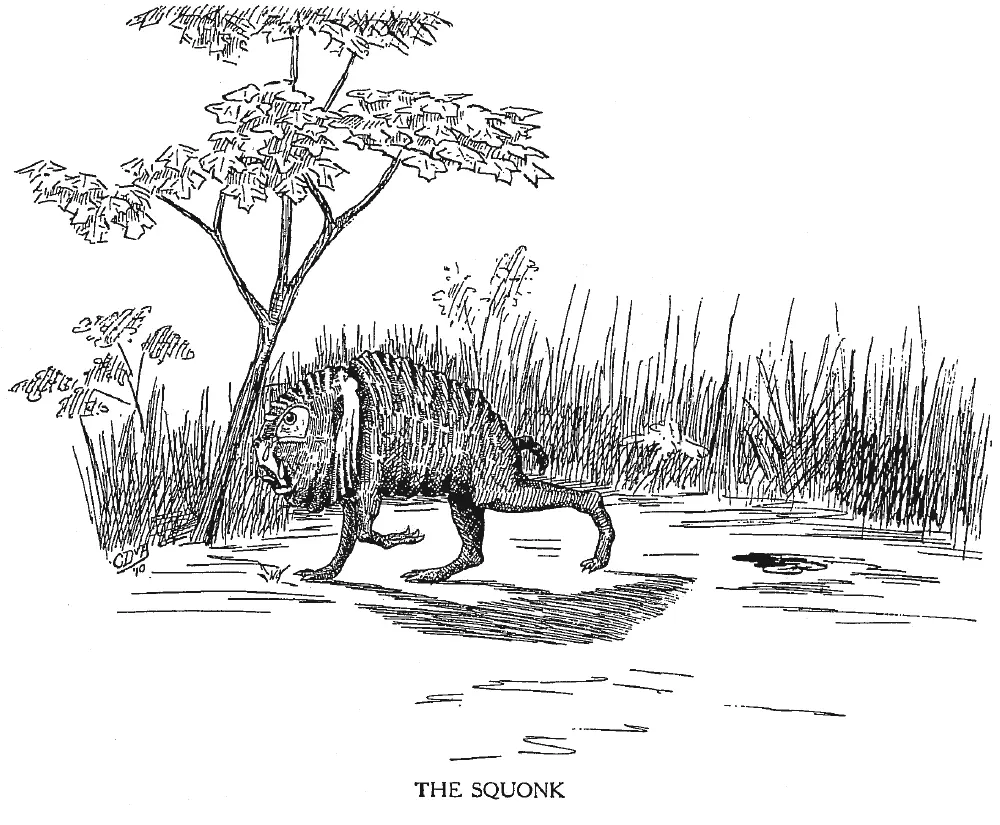
Its entire life fits on page 31 of Fearsome Creatures of the Lumberwoods (Washington, 1910), a mock field guide by William T. Cox, a professional forester, with plates by Coert Du Bois and Latin names supplied by George B. Sudworth, the US Forest Service's own dendrologist: Lacrimacorpus dissolvens, tear-body-dissolving. Cox says the beast is common in the hemlock forests of Pennsylvania, weeps constantly, can be tracked by its tear-stained trail, and may dissolve itself in tears when cornered. He then names the victim of the story: J. P. Wentling, who bagged one near Mont Alto and found nothing in the sack but tears and bubbles. Wentling was real — assistant director of the state forestry school at Mont Alto in 1908 — which makes the entry an in-joke among foresters rather than folklore. From Cox it passed to Tryon in 1939, to Botkin in 1944, to Borges in 1957 and to Genesis in 1976.
What is the history of Squonk?
The squonk has a paper trail, and it is exactly one page long. The page is number thirty-one of a book printed in Washington, D.C., in 1910.
The book is Fearsome Creatures of the Lumberwoods, With a Few Desert and Mountain Beasts, by William T. Cox, illustrated by Coert Du Bois, printed by Judd & Detweiler. The entry reads, in full: "The range of the squonk is very limited. Few people outside of Pennsylvania have ever heard of the quaint beast, which is said to be fairly common in the hemlock forests of that State. The squonk is of a very retiring disposition, generally traveling about at twilight and dusk. Because of its misfitting skin, which is covered with warts and moles, it is always unhappy; in fact it is said, by people who are best able to judge, to be the most morbid of beasts. Hunters who are good at tracking are able to follow a squonk by its tear-stained trail, for the animal weeps constantly. When cornered and escape seems impossible, or when surprised and frightened, it may even dissolve itself in tears."
That is the whole animal. Everything written about the squonk since is a gloss on those five sentences.
What the derivative accounts leave out is who signed them. Cox was a professional forester: at the time of the book he was a Forest Service man based in Washington, and the job he is now remembered for did not yet exist — the Minnesota legislature created the post of State Forester in 1911, and Cox took it up effective 1 May of that year, going on to become the state's first Commissioner of Conservation. Coert Du Bois, who drew the plates, had joined the Forest Service in 1900 and later left forestry altogether for the consular service, ending up as United States consul in Naples and Port Said and consul general at Batavia. And the Latin names — the part that makes the book look like a field guide — were supplied by a third federal employee. Cox's acknowledgment says so: "To Mr. George B. Sudworth, dendrologist of the Forest Service, also I am indebted for his kind assistance in classifying the animals." Lacrimacorpus dissolvens — "tear-body, dissolving" — was coined by the man whose day job was naming American trees. The same paragraph thanks "numerous friends among lumbermen and foresters throughout the country and in Canada for furnishing important scientific 'facts' concerning these creatures" — with the quotation marks around facts printed in the original.
The volume is dedicated "to the Concatenated Order of Hoo-Hoo", the real fraternal society of the North American lumber trade, and Cox signs it with his membership number, 19949.
So the squonk is a professional joke, and the man it was played on can be named. Cox continues: "Mr. J. P. Wentling, formerly of Pennsylvania, but now at St. Anthony Park, Minnesota, had a disappointing experience with a squonk near Mont Alto. He made a clever capture by mimicking the squonk and inducing it to hop into a sack, in which he was carrying it home, when suddenly the burden lightened and the weeping ceased. Wentling unslung the sack and looked in. There was nothing but tears and bubbles."
J. P. Wentling was John Philip Wentling, and he was not a name invented for a punchline. The Proceedings of the First Convention of Pennsylvania Foresters, held at Harrisburg in March 1908, print the staff of the State Forest Academy at Mont Alto: Robert S. Conklin, Commissioner of Forestry, Director in Chief; George H. Wirt, Director; "J. P. Wentling, Assistant Director", above the foresters of the classes of 1906 and 1907. Wentling was the deputy head of the Commonwealth's forestry school at Mont Alto — the school whose grounds are the hemlock woods in the story. By 1910 he had moved to St. Anthony Park, the Saint Paul neighbourhood built around the University of Minnesota's agricultural campus, where he became associate professor of forestry and co-wrote The Farm Woodlot (Macmillan, 1914) with Edward G. Cheyney.
Read with that in hand, the entry stops being folklore and becomes an in-joke with a forwarding address. Cox names a colleague, gives his old posting and his new one, and has him lose a squonk in the woods behind the school he used to run. Mont Alto in those years was not a backwater: the state park there, established in 1902, is the oldest surviving state park in Pennsylvania; the academy's first class had graduated in 1906, and it included Ralph Elwood Brock, believed to be the first African American trained as a forester in the United States. Mira Lloyd Dock, who sat on the State Forestry Reservation Commission listed on the same page of the 1908 proceedings, had been instrumental in launching the school.
The rest of the squonk's life is transmission, and it can be dated. Henry H. Tryon's Fearsome Critters (Idlewild Press, 1939), illustrated by Margaret R. Tryon, gives it page 49 and keeps Sudworth's authorship in the taxonomist's abbreviation — "Lacrimacorpus dissolvens Sudw." — while adding a straight-faced evolutionary backstory: the squonk once lived on high plains, was driven into swamp country, grew webbing "only on the submerged left feet", could therefore swim only in circles, and drowned in thousands. Tryon also supplied the reason for the weeping that everyone now repeats: the animal stays in its hemlocks on moonlit nights for fear "that it may catch a glimpse of itself in some moonlit pool". B. A. Botkin reprinted Cox's text verbatim, Wentling and all, in A Treasury of American Folklore (Crown, 1944), which is how the squonk entered the American folklore canon.
The Spanish-language squonk comes from one book. Jorge Luis Borges and Margarita Guerrero included it in the Manual de zoología fantástica (1957), later expanded as El libro de los seres imaginarios (1967), translating Cox almost sentence by sentence and citing him openly: "William T. Cox. Fearsome Creatures of the Lumberwoods. Washington, 1910." Their version carries one memorable slip. English hemlock is both the conifer Tsuga and the poisonous herb; Borges chose the herb, so the Pennsylvania hemlock forest became "los cicutales de aquel Estado" and the dark hemlock boughs became "los oscuros arbustos de cicuta" — bushes of poison hemlock. Mont Alto became "Monte Alto". Every Spanish retelling that puts the squonk among cicuta is downstream of that page.
The last leap was musical. "Squonk", written by Tony Banks and Mike Rutherford, opened side one of Genesis's A Trick of the Tail (1976), the first album after Peter Gabriel left. It was the song the band used to audition his replacements; when a candidate could not manage it in the right key, the drummer asked for a go, sang it, and became the singer. That is how a forester's practical joke from Mont Alto ended up as the song that made Phil Collins the voice of Genesis.
Timeline: the documented record of Squonk
- 15 April 1881 The Perrysburg Journal of Ohio prints a comic poem containing the line "there came a feeble mournful sort of squonk". It is the oldest occurrence of the word located in the Chronicling America newspaper corpus, and it is an onomatopoeia for a bird's cry, not an animal.
- 7 November 1896 The New York Journal runs an advertising jingle for its colour supplement listing comic place names: "From Squonk to Saccarappa, from Buffalo to Kent". Squonk here is a joke toponym — the homonym that muddies any search for the creature.
- 1902 Mont Alto State Park is established in Franklin County. It is the oldest state park still operating in Pennsylvania and the ground on which the squonk story would be set.
- March 1908 The proceedings of the first convention of Pennsylvania foresters list the staff of the State Forest Academy at Mont Alto: Commissioner Robert S. Conklin, Director George H. Wirt and "J. P. Wentling, Assistant Director". The man who would lose a squonk two years later was deputy head of the state forestry school.
- 1910 William T. Cox publishes Fearsome Creatures of the Lumberwoods in Washington, D.C. The squonk occupies page 31, with a plate by Coert Du Bois and a Latin name, Lacrimacorpus dissolvens, supplied by Forest Service dendrologist George B. Sudworth. This is the earliest datable printed appearance of the creature.
- 1 May 1911 William T. Cox becomes Minnesota's first State Forester, a post the legislature had just created. He wrote the squonk a year before holding the job he is usually credited with in accounts of the book.
- 1914 J. P. Wentling — John Philip Wentling — co-writes The Farm Woodlot with Edward G. Cheyney as associate professor of forestry at the University of Minnesota, confirming that Cox's victim was a real, traceable colleague.
- 1939 Henry H. Tryon gives the squonk page 49 of Fearsome Critters, keeps Sudworth's taxonomic authority ("Sudw."), and invents the details now repeated everywhere: webbing on the left feet only, swimming in circles, and weeping for fear of seeing itself in a moonlit pool.
- 1944 B. A. Botkin reprints Cox's entry verbatim, Wentling anecdote included, in A Treasury of American Folklore, moving the squonk from a forester's pamphlet into the American folklore canon.
- 1957 Jorge Luis Borges and Margarita Guerrero include the squonk in Manual de zoología fantástica, citing Cox by name. Their translation reads English "hemlock" as the poisonous herb rather than the conifer, so the Pennsylvania hemlock forest becomes "cicutales" — the source of every Spanish retelling since.
- February 1976 Genesis release A Trick of the Tail with "Squonk", written by Tony Banks and Mike Rutherford. It was the song used to audition Peter Gabriel's replacement; when a candidate could not sing it in key, drummer Phil Collins tried it and got the job.
- 7 August 2027 Squonkapalooza, the free cryptid festival held at Bottle Works in Johnstown, Pennsylvania, announces its fifth edition. The squonk now has a hometown festival it never had a sighting to justify.
Is there a rational explanation for Squonk?
This is one of the rare cases where nobody has to debunk anything, because the author did it himself, on page five.
Cox opens the book explaining what these creatures are for: every lumber district, he writes, has "mysterious stories or vague rumors of dreadful beasts with which to regale newcomers and frighten people unfamiliar with the woods". His stated purpose is to preserve "a description and sketch of some of the interesting animals which he has originated" — he being the logger, and originated being the operative word. The squonk is not a report of anything. It is the woods version of sending the new boy to fetch a left-handed hammer.
The joke is also signed twice inside the book. The scientific name that makes the entry look like zoology, Lacrimacorpus dissolvens, was coined by George B. Sudworth, the Forest Service's own dendrologist, at Cox's request; Tryon's 1939 version still carries the taxonomic authority "Sudw." after it. And Cox's acknowledgment thanks his colleagues for supplying "important scientific 'facts'" — with the scare quotes printed. A hoax does not usually come with its own punctuation.
Is there anything older? On 14 August 2026 I searched the Library of Congress's Chronicling America corpus — millions of digitised American newspaper pages — for squonk, across every state and every year. The search returns 60 pages, and it returned 60 on a second run. Control terms in the same corpus, same day: hemlock returns 234,236 pages and the phrase "mont alto" returns 3,215. So the corpus is searchable and the words of this story are all over it; the animal is not.
Of those 60 hits, only two are dated before 1910 and actually contain the string, and neither is the creature. On 15 April 1881 the Perrysburg Journal of Ohio printed a comic poem in which a bird complains about being drawn: "there came a feeble mournful sort of squonk" — the word as an onomatopoeia for a sad cry. On 7 November 1896 the New York Journal ran an advertising jingle for its colour supplement listing absurd place names: "From Squonk to Saccarappa, from Buffalo to Kent". The rest of the 60 are optical character recognition misreading something else. That is the homonym trap in this story: squonk was already a funny-sounding American word, as a noise and as a joke toponym, before Cox attached an animal to it.
So the honest formulation is the narrow one: the earliest printed appearance of the squonk that can be dated is Cox, 1910, page 31, and no Pennsylvania oral tradition older than that has been documented anywhere I have been able to search. The one thing that is genuinely old is the sound of the word.
One last caution about the modern trail. Not everything called Squonk descends from the squonk: the Pittsburgh performance company Squonk Opera, founded in 1992 a short drive from the supposed hemlock range, says its name came from a description of a saxophonist's playing as a "squonk-fest", not from the creature. The animal is contagious; the name travels on its own.
Can you visit Squonk?
The squonk's only address is a sentence in William T. Cox's Fearsome Creatures of the Lumberwoods (1910), which says that J. P. Wentling "had a disappointing experience with a squonk near Mont Alto". The 1910 edition, with Coert Du Bois's plate, is on the Internet Archive, and Henry H. Tryon's 1939 entry from Fearsome Critters is transcribed at lumberwoods.org.
Mont Alto State Park is on PA 233 at Mont Alto, PA 17237, in south-eastern Franklin County. The Department of Conservation and Natural Resources describes it as a quiet park of 24 acres (about 10 hectares) with a pavilion, picnicking and trout fishing, and as "the oldest park still in the Pennsylvania state park system"; a 2018 fact sheet from the Pennsylvania Parks & Forests Foundation dates its establishment to 1902. The department's page, consulted on 24 September 2026, gives the hours as every day of the year from sunrise to sunset, with day-use areas closing at dusk, and refers questions about facilities to the office of Caledonia State Park, whose address, 101 Pine Grove Road, Fayetteville, PA 17222, it gives as the park's mailing address; the telephone is 717-352-2161. From US 30, the Lincoln Highway, the page gives the route as seven miles (11 km) south on PA 233 from Caledonia; from the town of Mont Alto it is one mile (1.6 km) north on the same road. It publishes the park's position as 39.83897, -77.53735, about 1.9 km east-south-east of the pin on this file, which falls in the borough of Mont Alto. The nearest hospital it names is Chambersburg Hospital, 112 North Seventh Street, Chambersburg.
The borough is also home to Penn State Mont Alto, which the same fact sheet identifies as the former Pennsylvania State Forestry Academy; its first class of foresters graduated in 1906 and included Ralph Elwood Brock, believed to be the first African American trained in forestry in the United States. The proceedings of the 1908 convention of Pennsylvania foresters, printed in 1910, list the academy's staff with George H. Wirt as director and J. P. Wentling as assistant director.
Squonkapalooza, a free all-ages cryptid festival at Bottle Works in Johnstown, Pennsylvania, celebrates the squonk and other creatures of Appalachian folklore; on 24 September 2026 its site announced the fifth edition for 7 August 2027. The eastern hemlock, the tree in whose forests Cox placed the animal, is Pennsylvania's state tree. The Department of Conservation and Natural Resources calls the hemlock woolly adelgid, an invasive insect, "a serious threat" to it, and reports that by the end of 2023 the pest had been found in all 67 counties of the state.
Sources consulted
- William T. Cox, «Fearsome Creatures of the Lumberwoods, With a Few Desert and Mountain Beasts» — Press of Judd & Detweiler, Washington, D.C., 1910 book
- Pennsylvania Department of Forestry, «Proceedings of the First Convention of Pennsylvania Foresters, Held at Harrisburg, Pa., March 4, 5, 6, 1908» — Harrisburg: Printer to the State of Pennsylvania, 1910 report
- Henry H. Tryon, ill. Margaret R. Tryon, «Fearsome Critters» — Idlewild Press, Cornwall, NY, 1939 book
- Jorge Luis Borges y Margarita Guerrero, «Manual de zoología fantástica (después El libro de los seres imaginarios, 1967)» — Fondo de Cultura Económica, 1957 book
- Perrysburg Journal, «Comic poem spoken by a stork, page 4 (untitled in the digitised scan)» — Perrysburg, Ohio, 15 April 1881, 1881 newspaper archive
- New York Journal, «Advertising jingle for the Colored Supplement, page 7» — New York, 7 November 1896, 1896 newspaper archive
- Library of Congress, «Chronicling America: full-text search for "squonk" (consulted 14 August 2026)» — National Digital Newspaper Program, 2026 archive
- Minnesota Division of Forestry, «A History of Forestry in Minnesota» — Minnesota Department of Natural Resources, 1969 report
- Edward G. Cheyney y John Philip Wentling, «The Farm Woodlot: A Handbook of Forestry for the Farmer and the Student in Agriculture» — The Macmillan Company, 1914 book
- B. A. Botkin, «A Treasury of American Folklore: Stories, Ballads and Traditions of the People» — Crown Publishers, New York, 1944 book
- Pennsylvania Parks & Forests Foundation, «125 Facts on Pennsylvania State Parks and Forests» — PPFF, 2018 report
- Pennsylvania Department of Conservation and Natural Resources, «Mont Alto State Park» — Official visitor information, 2026 web
- Songfacts, «Squonk by Genesis» — Songfacts, 2026 web
- Squonkapalooza, «Squonkapalooza» — Bottle Works, Johnstown, PA, 2026 web
- Wikipedia, «Squonk Opera» — Wikipedia, 2026 web
Reviewed by V. Serrano on 2026-08-14 · How we verify our content
📎 Source: Enigma Atlas
💬 Field testimonies (0)
No testimonies yet. Add the first.
Add your testimony
🔒 Log in to add a testimony