🦶 CRYPTID SIGHTING · EXP. Nº6501
ACTIVE
Wampus Cat
The wampus cat is usually introduced as an ancient Cherokee legend: a woman who spied on a men's ritual and was condemned to wear a panther's skin.
Where and when was Wampus Cat sighted?
- Location
- Conway, Arkansas, United States
- Date sighted
- Unknown
- Coordinates
- 35.089, -92.442
- Last updated
LOCATION
What is Wampus Cat?
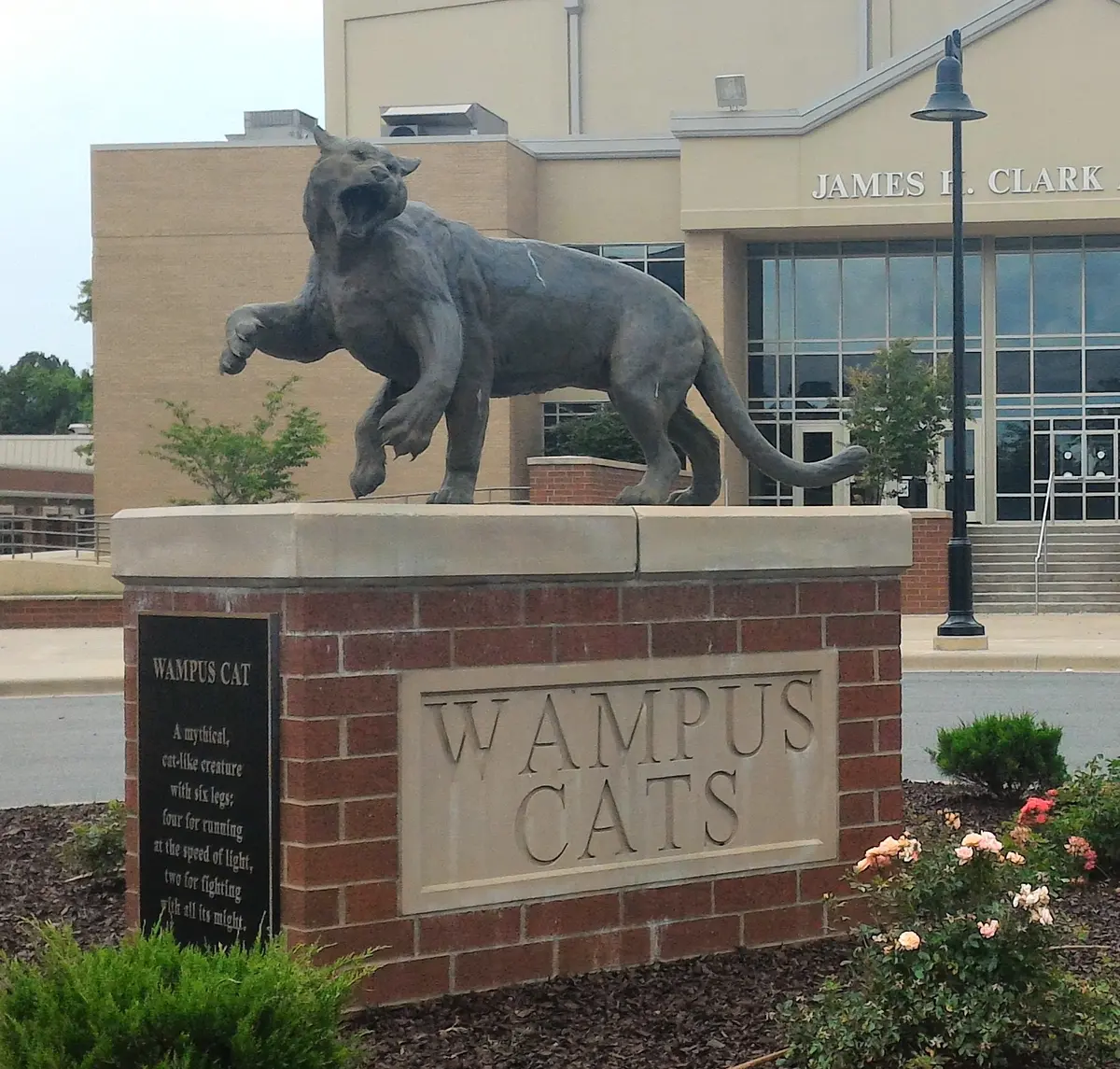
That story cannot be found in the Cherokee ethnographic record, and its earliest printing that can be dated is a 1992 book of East Tennessee tall tales by Charles Edwin Price. The creature's real paper trail starts elsewhere and earlier. In 1913 a U.S. Forest Service entomologist sent the American Dialect Society a word list from the logging camps of Maine, where the wampus cat was "an undefined imaginary animal" listed alongside the tree squeak and the swamp gaboon, invented beasts used to frighten new hands. In the same volume, a West Texas list glosses "catawampus (or wampus) cat" as a virago, a scolding woman. A Kansas college yearbook told a wampus-cat hazing story in 1916; Conway High School in Arkansas took the name in 1922 and still keeps a six-legged bronze one outside its auditorium. This is the story of a joke that grew a pedigree, and of the archives that can still date every step.
What is the history of Wampus Cat?
The wampus cat has a paper trail, and it does not begin among the Cherokee. It begins in a logging camp in Maine.
In 1913 Dialect Notes, the journal of the American Dialect Society, opened its fourth volume with word lists gathered in Maine. One batch came from Bartle T. Harvey, an assistant entomologist with the United States Forest Service, who submitted terms "which he has learned from the logging camps of Maine". On page 3 stands the entry: "wampus cat, n. phr. An undefined imaginary animal. 'All night long the wampus cat whined about the camp.'" Its neighbours on the list are of the same kind. A tree squeak is "an imaginary bird or animal. Really the noise made by trees rubbing in the wind". A swamp gaboon is "an imaginary animal by which the tracks of snow shoes are said to be made". A cross haul is "an imaginary article used in logging. A greenhorn is often sent to the boss to get one". The wampus cat entered print in that company, among the imaginary beasts and tools of the camps, one of which existed to send a greenhorn on a fool's errand.
The same volume records a second, independent life for the word. In "A West Texas Word List", page 225: "catawampus (or wampus) cat, n. phr. A virago. 'She's a regular catawampus cat.'" A virago is a scolding, quarrelsome woman. Decades before any story about a woman turned into a cat, the wampus cat was a Texan insult aimed at fierce women, and that is the likeliest ancestor of the half-woman half of the modern legend.
The same volume also supplies the control. Horace Kephart, the best-known collector of Southern Appalachian speech, contributed "A Word-List from the North Carolina Mountains". On page 409 he records "catawampus, adv. Mixed up; all awry" — the adverb, and nothing else. The volume's index gives "wampus cat" a single page, 3, the Maine list; its entry "catawampus (or wampus) cat" points to pages 104, 225 and 409, and on 104 and 409 what stands is the adverb.
After that the word travels with the men who used it. In May 1916 the junior class of Washburn College in Topeka, Kansas, printed a comic sketch in its yearbook The Kaw under the title "The Wampus Cat: A Little Story About Chet and Art", in which a Santa Fe railway gang camped near Wellington terrifies two new hires with wampus cats that kill cattle and horses, tear down barbed wire fences, uproot trees and raid watermelon patches, until both boys write home asking their fathers for guns. The point of the sketch, stated in its opening lines, is that "there aint no such animal as the wampus cat". In 1922 the high school in Conway, Arkansas, took the name for its teams. In September 1925 a band recorded "Arkansaw Wampus Cat" for OKeh in Dallas. In the Ozarks the folklorist Vance Randolph found the word alive in 1951, credited an earlier mention to G. H. Pipes's Strange Customs of the Ozark Hillbilly (1947), and separated the wampus cat from the "whistling wampus", "an immense black cat with supernatural intelligence". L. G. Sorden's Lumberjack Lingo (1969) still glossed it as "an imaginary animal to which night noises were attributed". Cratis Williams listed it in Southern Mountain Speech (1992), and on Ocracoke Island Walt Wolfram recorded it as "a fictitious cat, used to refer to a rascally person".
The Cherokee story is the youngest layer, printed seventy-nine years after the Maine list. The version now repeated everywhere — a woman called Running Deer, a demon called Ewah, conjurers called Adawehis, a mask that turns the demon's power back on itself — has a first printing that can be fixed: Charles Edwin Price, Demon in the Woods: Tall Tales and True from East Tennessee (Johnson City, Tennessee: Overmountain Press, 1992), whose second chapter is titled "The Wampas Cat and the Demon in the Woods". Price collected tall tales; he wrote that "the creature is known in East Tennessee as the Wampas Cat (sometimes spelled 'Wampus')", and introduced other material in the same chapter with "another story I heard recently". From there the tale went to storytelling websites, to A Haunted History of Knoxville (2014), and outward into every article that now calls it ancient.
Timeline: the documented record of Wampus Cat
- 1913 The earliest printed appearance of the creature that can be dated: Bartle T. Harvey, of the U.S. Forest Service, contributes logging-camp words from Maine to Dialect Notes IV. Page 3 reads "wampus cat, n. phr. An undefined imaginary animal. 'All night long the wampus cat whined about the camp.'" It is listed beside the tree squeak and the swamp gaboon, both openly imaginary.
- May 1916 The junior class of Washburn College, Topeka, Kansas, prints "The Wampus Cat: A Little Story About Chet and Art" in its yearbook. Two boys hired onto a Santa Fe railway gang near Wellington are hazed with wampus-cat tales until they write home for guns. The moral, stated up front: "there aint no such animal as the wampus cat".
- 1913-1917 In the same volume of Dialect Notes, "A West Texas Word List" glosses "catawampus (or wampus) cat" as "a virago", with the example "She's a regular catawampus cat". Horace Kephart's North Carolina mountain list, in that same volume, records only the adverb "catawampus" and no cat at all.
- 13 October 1922 Conway High School, Arkansas, takes the Wampus Cats as its team name. The Faulkner County Historical Society places the earliest printed use it has found in the local Log Cabin Democrat of that date, and credits the naming to Lewis Wilson of the 1921 football team.
- September 1925 A band records "Arkansaw Wampus Cat" in Dallas for OKeh, matrix 9380-A, issued as OKeh 45025 and credited on the label to the Cornfield Symphony Orchestra. By then the word is commercial shorthand for backcountry comedy.
- 1930 The last confirmed record of a puma native to Eastern North America in Tennessee, according to the U.S. Fish and Wildlife Service. The equivalent last records elsewhere are New Brunswick 1932 and Maine 1938.
- 1951 Vance Randolph publishes the Ozark wampus cat: old-timers on Roark Creek, Taney County, Missouri, told him the valley was full of them. He supplies the deflation himself, "There really are some bobcats in that region", and separates the animal from the "whistling wampus", "an immense black cat with supernatural intelligence".
- 1969 L. G. Sorden's Lumberjack Lingo still defines the creature from the camps that invented it: "wampus cat, an imaginary animal to which night noises were attributed".
- 1992 The earliest printing of the Cherokee version that can be dated: Charles Edwin Price, Demon in the Woods: Tall Tales and True from East Tennessee, second chapter, with Running Deer, the demon Ewah and the Adawehis. Price presents himself as a collector of tall tales, not as an ethnographer.
- 2006 The Cherokee writer Deborah L. Duvall records the belief from inside: "we believe the stories about the Wampus Cat are of ancient Cherokee origin. These stories are popular and still evolving in the southeastern United States."
- 23 January 2018 The U.S. Fish and Wildlife Service removes the eastern puma from the endangered species list because it is extinct (83 FR 3086, effective 22 February 2018), noting that 90 to 95 per cent of the thousands of reported eastern puma sightings had been shown to be invalid.
Is there a rational explanation for Wampus Cat?
Three checks can be run against the record, each with a count and a control.
The Cherokee attribution first: James Mooney's Myths of the Cherokee (Bureau of American Ethnology, Nineteenth Annual Report, printed 1900) is the standard collection of Cherokee narrative and is online in full text. A sweep of the entire Project Gutenberg text, some 297,600 words, run again on 4 October 2026, returns zero hits for wampus, zero for wampas, zero for catawampus and zero for Running Deer. The three apparent hits for Ewah all sit inside the Tennessee place name Ooltewah. Controls in the same sweep: panther 35 hits, witch 49, Spear-finger 7, and ada'wehi — the genuine Cherokee word for an adept, the one Price borrowed — present and glossed. The controls show that the search reads the book, and the four terms are absent from it. Mooney does record Cherokee panther narratives: in "The Underground Panthers" a hunter dances in a panther townhouse and dies within seven days of getting home "because he had already begun to take on the panther nature", and U`tlûñ'ta, Spear-finger, is a shape-shifting ogress with skin as hard as rock whose favourite haunt was the gap where Chilhowee Mountain comes down to the Tennessee. Neither of them is the wampus cat.
Second, the printed record: a full-text search of Open Library's scanned books, run on 4 October 2026, returns at least 400 volumes containing "wampus cat", against 3,051 hits for "snipe hunt" as a control. In the passages the search returns, no volume dated before 1992 ties the creature to the Cherokee; the only earlier hits for the word Cherokee are price guides to 78 rpm records, where the band Cherokee Ramblers follows the 1925 OKeh disc "Arkansaw Wampus Cat" in alphabetical order. "Wampas cat", Price's spelling, returns three volumes: his book, a 2009 racing manual and the 1937-38 run of Gold and Black, the student paper of Birmingham-Southern College in Alabama, in which a girl who "could hula like nobody's business" is "a wampas cat, hotcha", the slang of the West Texas list two decades on, while "Ew'ah" returns nothing.
These counts measure what was printed. The Cherokee author Deborah L. Duvall writes in Rabbit Plants the Forest (University of New Mexico Press, 2006) that "we believe the stories about the Wampus Cat are of ancient Cherokee origin. These stories are popular and still evolving in the southeastern United States." An absence in Mooney is not proof that nothing was ever told; it is proof that nothing was written down where the collectors were looking, Kephart in the Smokies and Mooney among the Cherokee included.
Third, the animal: in its final rule of 23 January 2018 (83 FR 3086, effective 22 February 2018) the U.S. Fish and Wildlife Service struck the eastern puma from the endangered species list as extinct. The rule states that "the most recent confirmed records of pumas native to Eastern North America are from Tennessee (1930), New Brunswick (1932), and Maine (1938)", that confirmed animals since then "have been shown to be either western puma dispersers... or released or escaped animals", and that of the thousands of reported sightings "90 to 95 percent of these sightings have been shown to be invalid", generally through misidentification and, at times, deliberate hoaxes; those figures are the agency's, as of January 2018. On the scream, the Missouri Department of Conservation states that "mountain lions rarely make any noises" and that "more often than not, when people hear scream like noises in the woods, it's a bobcat or fox, which make similar sounding noises". The creature's own first definition had already said as much in 1913: an imaginary animal to which night noises were attributed.
Can you visit Wampus Cat?
No wampus cat site exists to be visited, because no sighting was ever recorded to anchor one to. What the legend has instead is a bronze statue that can be stood in front of.
The pin on this file falls on Conway, Arkansas, the town whose high school took the name for its teams in 1922. A bronze mountain lion stands there on a brick and limestone plinth with WAMPUS CATS carved into it; a black plaque on the left face reads: "WAMPUS CAT — A mythical, cat-like creature with six legs: four for running at the speed of light, two for fighting with all its might." The Faulkner County Historical Society places the bronze in the roundabout of the east parking lot at Conway High School, put up soon after the new school building was finished in 2012, and the Arkansas Democrat-Gazette announced the unveiling of a six-foot bronze in front of the James H. Clark Auditorium in January 2013. The school gives its address as 2300 Prince Street, Conway, Arkansas 72034; its own traditions page dates the adoption of the name to 1922 and calls Conway High "one of only six schools in the world with the Wampus Cats name". The Historical Society dates the earliest printed use it has found to the local Log Cabin Democrat of 13 October 1922 and credits the naming to Lewis Wilson of the 1921 football team. The grounds belong to a working high school beside a public street, and the statue is visible from the pavement. Conway lies about 30 miles (50 km) north of Little Rock off Interstate 40.
East Tennessee, where the Cherokee version was published, has nothing on the ground to match it. Charles Edwin Price wrote from Knoxville, and his chapter is a retelling rather than a report of an encounter in any particular spot.
The written sources cost nothing to read. Dialect Notes volume IV (1913-1917), which carries the Maine, West Texas and North Carolina entries, is scanned at the Internet Archive, as is The 1916 Kaw in full, Mooney's Myths of the Cherokee is on Project Gutenberg, and Price's book can be borrowed from the Archive as well.
Sources consulted
- Bartle T. Harvey (U.S. Forest Service), «Lists from Maine: word list from the logging camps of Maine, in Dialect Notes vol. IV, part I, p. 3» — Dialect Notes IV, publication of the American Dialect Society, 1913 academic
- American Dialect Society, «A West Texas Word List, in Dialect Notes vol. IV, p. 225: 'catawampus (or wampus) cat, n. phr. A virago'» — Dialect Notes IV (parts I-VII, 1913 to 1917), 1917 academic
- Horace Kephart, «A Word-List from the North Carolina Mountains, in Dialect Notes vol. IV, p. 409: records the adverb 'catawampus' and no wampus cat» — Dialect Notes IV (parts I-VII, 1913 to 1917), 1917 academic
- James Mooney, «Myths of the Cherokee, Nineteenth Annual Report of the Bureau of American Ethnology» — Government Printing Office, Washington, 1900 book
- Junior Class of Washburn College, «The 1916 Kaw: 'The Wampus Cat. A Little Story About Chet and Art'» — Washburn College, Topeka, Kansas, May 1916, 1916 book
- Vance Randolph, «We Always Lie to Strangers: Tall Tales from the Ozarks» — Columbia University Press, New York, 1951 book
- L. G. Sorden, «Lumberjack Lingo: 'wampus cat, an imaginary animal to which night noises were attributed'» — Wisconsin House, Spring Green, Wisconsin, 1969 book
- Charles Edwin Price, «Demon in the Woods: Tall Tales and True from East Tennessee, chapter 'The Wampas Cat and the Demon in the Woods'» — The Overmountain Press, Johnson City, Tennessee, 1992 book
- Cratis D. Williams, «Southern Mountain Speech» — Berea College Press, Berea, Kentucky, 1992 book
- Walt Wolfram, Carolyn Temple Adger and Donna Christian, «Dialects in Schools and Communities: 'wampus cat n. A fictitious cat, used to refer to a rascally person'» — Lawrence Erlbaum Associates, Mahwah, New Jersey, 1999 book
- Deborah L. Duvall, «Rabbit Plants the Forest: A Cherokee World Story» — University of New Mexico Press, Albuquerque, 2006 book
- Ross Laird, «Discography of OKeh Records, 1918-1934: matrix 9380-A, 'Arkansaw wampus cat', Dallas, September 1925, issued as OKeh 45025» — Praeger, Westport, Connecticut, 2004 book
- U.S. Fish and Wildlife Service, «Endangered and Threatened Wildlife and Plants; Removing the Eastern Puma (=Cougar) From the Federal List of Endangered and Threatened Wildlife, 83 FR 3086, docket FWS-R5-ES-2015-0001» — Federal Register vol. 83, no. 15, 23 January 2018, pp. 3086-3099, 2018 report
- Missouri Department of Conservation, «Mountain Lion Signs» — mdc.mo.gov, 2024 web
- Faulkner County Historical Society, «Wampus Cat? What's That? ('Looking Back')» — faulknerhistory.org, 2018 web
- Conway High School Athletics, «Traditions: the school's own account of the Wampus Cats name» — conwaywampuscats.com, 2026 web
- Birmingham-Southern College, «Gold and Black, student newspaper of Birmingham-Southern College, 17 September 1937 to 27 May 1938: 'She's a wampas cat, hotcha'» — Birmingham, Alabama; digitised by the C. A. Rush Learning Center / N. E. Miles Library, Internet Archive, 1937 archive
Reviewed by V. Serrano on 2026-08-14 · How we verify our content
📎 Source: Enigma Atlas
💬 Field testimonies (0)
No testimonies yet. Add the first.
Add your testimony
🔒 Log in to add a testimony