👻 HAUNTED PLACE · EXP. Nº9478
ACTIVE
Alice Austen House
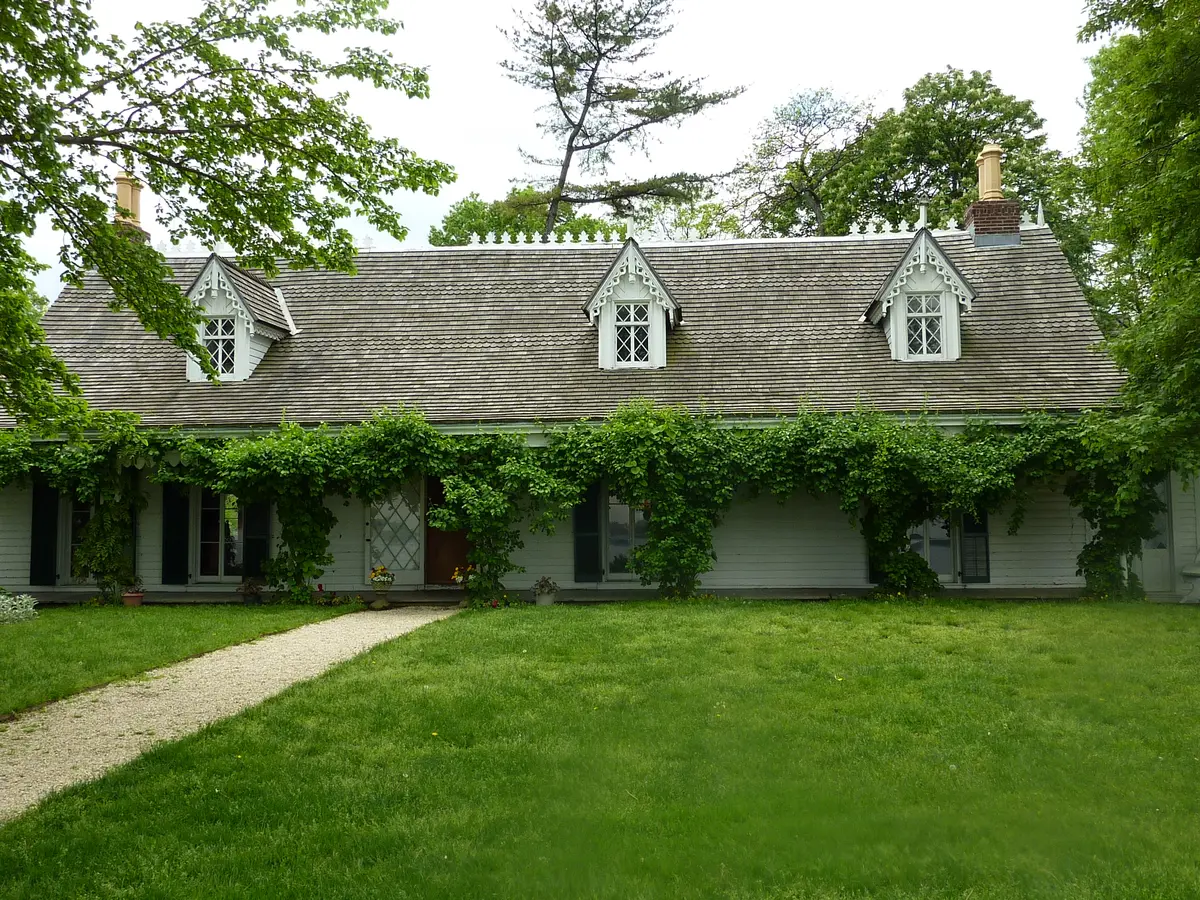
Clear Comfort is a Gothic Revival cottage on the shore of the Narrows in Staten Island, built around 1690-1700 as a one-room farmhouse and remodelled from 1844 by the family of the photographer Alice Austen.
Where is Alice Austen House?
- Location
- New York, United States
- Type
- House / mansion
- Coordinates
- 40.615, -74.064
- Last updated
LOCATION
Why is Alice Austen House said to be haunted?
She lived there from infancy until the bank evicted her in 1945, made some 7,000 negatives in a second-floor closet that is still her darkroom, and shared the house from 1917 with Gertrude Tate, her partner of fifty-three years; in 2017 the National Register file was amended to record that relationship. Its haunted reputation rests on two datable texts rather than on any record: a paragraph on Wikipedia since 2017, citing an 1895 magazine article about chains in the cellar and a British soldier hanged from a parlour beam, which no reachable archive has let us open; and a 2019 podcast in which the museum's own director tells the ghost story, including the caretaker whose photographs fell three times in a night. The museum does not tell it on its website - but it does run a Halloween evening.
What is the history of Alice Austen House?
The house came first, and it came a long way before anybody wrote a ghost into it.
A one-and-a-half-storey dwelling with a single room per floor was raised near the shore of the Narrows around 1690-1700, on land then held by the Woulter family. It is a rare survivor of half-timber and stucco construction. A wing went up to the south between 1725 and 1750; between 1750 and 1775 a second wing of plastered fieldstone was added to the west, almost certainly a detached kitchen, with a large fireplace and its original bake oven. That stone kitchen is the only fabric on the site that is demonstrably older than the American Revolution.
The farm was sold to Daniel Low in 1835 for $10,000 and broken up by a development concern, the Staten Island Association. On 10 October 1844 John Haggerty Austen, a wealthy New York merchant, bought the house and half an acre for $2,500, adding land until he had about an acre. The Austens found a 140-year-old farmhouse in poor repair and spent twenty-five years turning it into a picturesque Gothic Revival cottage: a north wing in 1844-46, dormers with carved bargeboards, elongated porch windows, diamond-pane glazing, roof cresting, chimney pots. Family tradition credits the architect James Renwick Jr., a connection of the family; the 2017 National Register documentation judges it more likely that the Austens and their craftsmen did it themselves. They named it Clear Comfort and used it as a summer house until 1852.
Elizabeth Alice Austen was born in 1866 and brought to the house as an infant by her mother, after her father abandoned them; both dropped his surname. In 1876 or 1877 her uncle Oswald Müller bought a camera and let her use it; another uncle, the chemist Peter Austen, taught her to develop plates. A closet in the second-floor stair hall became her darkroom and stayed her darkroom for the rest of her career. It is still there. Over some fifty years she made around 7,000 negatives - tennis and bicycling, quarantine stations photographed at the request of the Public Health Service, immigrants on the Manhattan streets, and the deliberately transgressive portraits of herself and her friends in men's clothes, unpinned hair and cigarettes.
In 1899, at the Twilight Rest Resort in the Catskills, Austen met Gertrude Tate, a kindergarten and dancing teacher from Brooklyn eleven years her junior. Tate broke off an engagement and left with her for Europe. They were together fifty-three years. Tate moved into Clear Comfort in 1917 over the objection of her sister, who called the relationship a "wrong devotion". They ran the Box Tree Tea Room, lunched at the Colony Club, and lost everything in the crash of 1929. The bank foreclosed and the two women were evicted in the summer of 1945. Austen ended in the Staten Island Farm Colony, the borough poorhouse, in 1950; that October Constance Foulk Roberts found her negatives in the basement of the Staten Island Historical Society while researching Oliver Jensen's The Revolt of American Women, and Life published them in 1951. Austen died on 9 June 1952 and was buried in the Moravian Cemetery. Tate died ten years later; she had asked to be buried beside Austen, and her sister buried her in Brooklyn instead.
The house was listed on the National Register in 1970, designated a New York City landmark in 1971, restored between January 1984 and April 1985, and made a National Historic Landmark on 19 April 1993. In 2017 the National Register file was amended by the NYC LGBT Historic Sites Project to put the fifty-three-year relationship on the record - the first New York City site so recognised for a woman.
Timeline: the documented record of Alice Austen House
- c. 1690-1700 A one-and-a-half-storey house with one room per floor is built near the shore of the Narrows, in half-timber and stucco, on land held by the Woulter family.
- 1750-1775 A plastered fieldstone wing goes up to the west, almost certainly a detached kitchen, with a large fireplace and its original bake oven. It is the only pre-Revolutionary fabric on the site.
- 10 October 1844 John Haggerty Austen buys the house and half an acre for $2,500 from the Staten Island Association, which had bought the farm from Daniel Low's holding in 1835. The family names it Clear Comfort.
- 1844-1846 The Austens add the north wing and turn the farmhouse into a Gothic Revival cottage: dormers, carved bargeboards, diamond panes, roof cresting. Family tradition credits James Renwick Jr.; the 2017 documentation thinks the family and its craftsmen did it.
- 1866-1868 Elizabeth Alice Austen is born and is brought to Clear Comfort as an infant by her mother, after her father abandons the family; both drop his surname.
- 1876 or 1877 Her uncle Oswald Müller buys a camera and lets her use it; a closet in the second-floor stair hall becomes her darkroom and remains so for her whole career. It survives.
- 1899 Austen meets Gertrude Tate, a kindergarten and dancing teacher from Brooklyn, at the Twilight Rest Resort in the Catskills. Tate breaks off her engagement and leaves with her for Europe.
- 1917 Tate moves into Clear Comfort over the objection of her sister, who calls the relationship a "wrong devotion". The two women share the house until 1945.
- Summer 1945 After the 1929 crash wipes out their savings and the mortgage payments stop, the bank forecloses and Austen and Tate are evicted. They move to a small flat at 151 St Marks Place.
- October 1950 Constance Foulk Roberts finds Austen's negatives in the basement of the Staten Island Historical Society while researching Oliver Jensen's The Revolt of American Women. Life publishes them in 1951; Austen dies on 9 June 1952.
- 1962 Gertrude Tate dies. She had asked to be buried beside Austen in the Moravian Cemetery on Staten Island; her sister buries her in the Tate plot at Cypress Hills, Brooklyn.
- 9 November 1971 The city designates the house an individual landmark (LP-0371) after three public hearings. The report praises the Gothic Revival cottage and its pre-Revolutionary fabric, and does not mention Gertrude Tate once.
- 19 April 1993 The house becomes a National Historic Landmark on a nomination that calls Tate a "friend" and their relationship a "fifty-year partnership". The file contains no reference to ghosts or to enslaved people.
- June 2017 The National Register file is amended by the NYC LGBT Historic Sites Project to record the fifty-three-year relationship - the first New York City site so recognised for a woman. On 11 June a Wikipedia editor adds the "Alleged haunting" paragraph sourced to an 1895 magazine article.
- 3 June 2019 In the first episode of the podcast Someone Lived Here, executive director Victoria Monroe tells Kendra Gaylord that Austen believed the house haunted, and recounts the caretaker whose photographs fell three times in one night until he introduced himself to Alice.
- 9 September 2025 The Landmarks Preservation Commission hears a $1,204,000 reconstruction project: a boardwalk giving step-free access to the main east entrance, an enlarged car park and rebuilt front steps. On 31 October the museum runs its own haunted evening.
Is there a rational explanation for Alice Austen House?
Two stories are told about this house, and they come from two texts that can be dated. Neither comes from a record.
The older one is bibliographic and I could not open it. Wikipedia has carried, since 11 June 2017, a paragraph saying that neighbourhood tradition heard chains clanking in the cellar after midnight, attributed to enslaved people held there during the Revolution, and that a British soldier hanged himself from a beam in the parlour over a broken heart, his boots and the clinking of his spurs audible in that room after midnight. Its single source is "Cromwell Childe, Haunted Houses, The American Magazine, Frank Leslie's Publishing House, New York, 1895" - with no volume, issue or page. Three checks are owed to a citation like that. Does the work exist? Partly answered: Cromwell Childe was a real journalist of the period (21 signed items in Chronicling America between 1890 and 1900), and the 1895 run of that magazine exists in twelve issues. Is the passage in it? Unverified. Every route to the text failed: the digitised issues are access-restricted, HathiTrust's full-text search returns a bot-challenge page instead of a document, and Chronicling America does not index magazines - a search there for "trooper of St. George" returned exactly one hit, and opening the page showed the phrase was not on it. Does the work say what we say? Unknown, and worth flagging: the same editor cited the same 1895 article on the page of Christopher Billopp, whose Staten Island manor is the borough's classic haunted house. Until someone reads the article, the safe statement is that the oldest printed appearance of the story anyone cites is dated 1895 and that our own text descends from a Wikipedia paragraph of 2017.
The second story is recent and fully attributable. On 3 June 2019, in the first episode of the podcast Someone Lived Here, the museum's executive director Victoria Monroe told host Kendra Gaylord that Austen believed the house was haunted by a man who hanged himself in the entryway after an unsuccessful courtship, and recounted that the caretaker, on his first night in the house, heard crashes as photographs fell from the walls three separate times, and that it stopped once he spoke aloud to Alice and introduced himself. That is one named person, one night, one resolution. It is the whole basis for the sentence "caretakers have reported their own unexplained incidents" that this page used to carry, and for the claim that Austen herself believed it: no letter, diary entry or interview of hers saying so has been located, and she left thousands of negatives and a large correspondence.
What the museum publishes is worth reading too. It does not tell the ghost story on its website. It does programme around it: on 31 October 2025 it ran "Victorian Shadows: A Haunted Evening at Clear Comfort", with a haunted grounds tour, aura-camera portraits and a $10 suggested donation, and in October 2022 an "Evening in the Spirit World" with spiritual readings. The older sentence on this page - that the museum permits no paranormal investigation, so nothing has been tested - had no source and does not sit well with the museum's own calendar. It has been removed.
The chains deserve a separate answer, because they are not a harmless detail. Slavery in Richmond County is documented and large: the 1790 federal census records roughly a fifth of the county's population as enslaved. But no document reachable here names an enslaved person on this lot. The National Historic Landmark nomination, the 1970 National Register nomination, the 1971 city designation report and the 20,000-word 2017 amendment contain the word not once between them, and none of them names an owner of the property between the Woulter family and 1835. Using unnamed enslaved people as a sound effect in a cellar is the opposite of documenting them, so this page no longer does it. If a name is ever found in the censuses, deeds or Staten Island Historical Society papers, it belongs in the history section, not in the ghost story.
One more absence is worth naming, because the official record made it before we did. The 1971 city designation report does not mention Gertrude Tate at all. The 1993 landmark nomination calls her a "friend" in a "fifty-year partnership". Only the 2017 amendment says plainly what she was. Our own earlier text managed to describe a house where two women lived for twenty-eight years as the setting for a rejected male suitor.
Can you visit Alice Austen House?
Clear Comfort is open to the public as the Alice Austen House Museum, at 2 Hylan Boulevard, Staten Island, NY 10305, in Rosebank on the shore of the Narrows. The house stands in Alice Austen Park, a New York City park, and the Friends of Alice Austen House run it as a museum under an agreement with the Department of Parks and Recreation. The Landmarks Preservation Commission designated it a city landmark on 9 November 1971 (LP-0371); it had been listed on the National Register of Historic Places in 1970 and was made a National Historic Landmark in 1993.
The museum's visit page, read on 24 September 2026, gives the telephone as 718-816-4506 and opens the house from Wednesday to Friday between 12pm and 5pm and on Saturday between 11am and 5pm; it is closed from Sunday to Tuesday. The page also lists closures on 27 June, from 25 to 28 November for Thanksgiving and from 23 December to 2 January for the winter break. General admission is a suggested $5. Entry is free for members of the museum and of six partner schemes that the page lists, and for up to four people receiving SNAP benefits.
From Manhattan the same page directs visitors to the Staten Island Ferry at Whitehall Terminal and then to the S51 bus from ramp B to the corner of Hylan Boulevard and Bay Street, a ride it puts at about fifteen minutes. By car from Brooklyn it gives Interstate 278 west over the Verrazzano-Narrows Bridge and the first exit, Bay Street. The lot behind the house has four spaces and, in the page's words, is "frequently reserved for staff and NYC Parks personnel"; street parking is generally available on Edgewater Street, at the corner of the museum.
A ramp leads into the house from the car park at the rear. The page describes the public areas as "largely wheelchair accessible" because the galleries and period rooms are on the first floor, and it routes accessibility questions to extension 10. On 9 September 2025 the Landmarks Preservation Commission held a public hearing (LPC-25-06304) on a reconstruction project for the park with a total budget of $1,204,000, funded by the City Council in fiscal year 2019. The presentation by CTA Architects and NYC Parks proposes an accessible boardwalk along the south façade, from the car park to the front porch and the main east entrance. The same project enlarges and repaves the car park with more accessible spaces and rebuilds the steps to the front lawn.
The museum's events calendar lists a Halloween programme on 31 October 2025, "Victorian Shadows: A Haunted Evening at Clear Comfort", from 3pm to 7pm with a suggested donation of $10; its schedule included a "Haunted Tour" of the park grounds from 5pm to 6pm. The next morning a museum guide led an off-site photowalk in Blood Root Valley, part of the Staten Island Greenbelt, announced as sharing "some of the history and haunted lore of the park". In 2022 the museum's Halloween evening was held on 28 October, with tickets at $40.
Sources consulted
- Jill S. Mesirow and Page Putnam Miller, «Alice Austen House — National Historic Landmark Nomination» — United States Department of the Interior, National Park Service, 1992 report
- NYC LGBT Historic Sites Project, «Alice Austen House — National Register of Historic Places, Additional Documentation (LGBT significance)» — United States Department of the Interior, National Park Service, 2017 report
- New York City Landmarks Preservation Commission, «Alice Austen House Designation Report, LP-0371» — City of New York, 1971 report
- Diana S. Waite, New York State Historic Trust, «Elizabeth Alice Austen House — National Register of Historic Places Inventory-Nomination Form» — United States Department of the Interior, National Park Service, 1970 report
- CTA Architects P.C. and NYC Parks / Historic House Trust, «Alice Austen House Reconstruction, P-501ALAS — Public Hearing presentation, LPC-25-06304» — New York City Landmarks Preservation Commission, 2025 report
- Kendra Gaylord, «Episode 1: Alice Austen House (with Victoria Monroe and Amy O'Hara)» — Someone Lived Here (podcast), 2019 interview
- Nicole Saraniero, «13 Famously Haunted Places in NYC» — Untapped New York, 2022 web
- English Wikipedia, user Secret Egypt, «Alice Austen House, revision of 11 June 2017 — the edit that introduced the "Alleged haunting" section» — Wikipedia, 2017 web
- Alice Austen House Museum, «The Home — Clear Comfort, and Plan Your Visit» — aliceausten.org, 2026 web
- NYC LGBTQ Historic Sites Project, «Alice Austen & Gertrude Tate Residence» — nyclgbtsites.org, 2017 web
- Alice Austen House Museum, «Plan Your Visit — hours, closures, admission, parking, directions and accessibility (read 24 September 2026)» — aliceausten.org, 2026 web
- Alice Austen House Museum, «Victorian Shadows: A Haunted Evening at Clear Comfort — event listing for 31 October 2025, with a 5-6pm "Haunted Tour" of the park grounds and a $10 suggested donation» — aliceausten.org, 2025 web
- Alice Austen House Museum, «Photowalk Series: Blood Root Valley (off-site) — 1 November 2025, with a museum guide sharing "some of the history and haunted lore of the park"» — aliceausten.org, 2025 web
Reviewed by V. Serrano on 2026-08-17 · How we verify our content
💬 Field testimonies (0)
No testimonies yet. Add the first.
Add your testimony
🔒 Log in to add a testimony