👻 HAUNTED PLACE · EXP. Nº9475
ACTIVE
Amargosa Opera House and Hotel
In March 1967 a flat tire stopped a touring dancer and her husband at a borax company town on the edge of Death Valley.
Where is Amargosa Opera House and Hotel?
- Location
- Death Valley Junction, California, United States
- Type
- Theater
- Coordinates
- 36.302, -116.415
- Last updated
LOCATION
Why is Amargosa Opera House and Hotel said to be haunted?
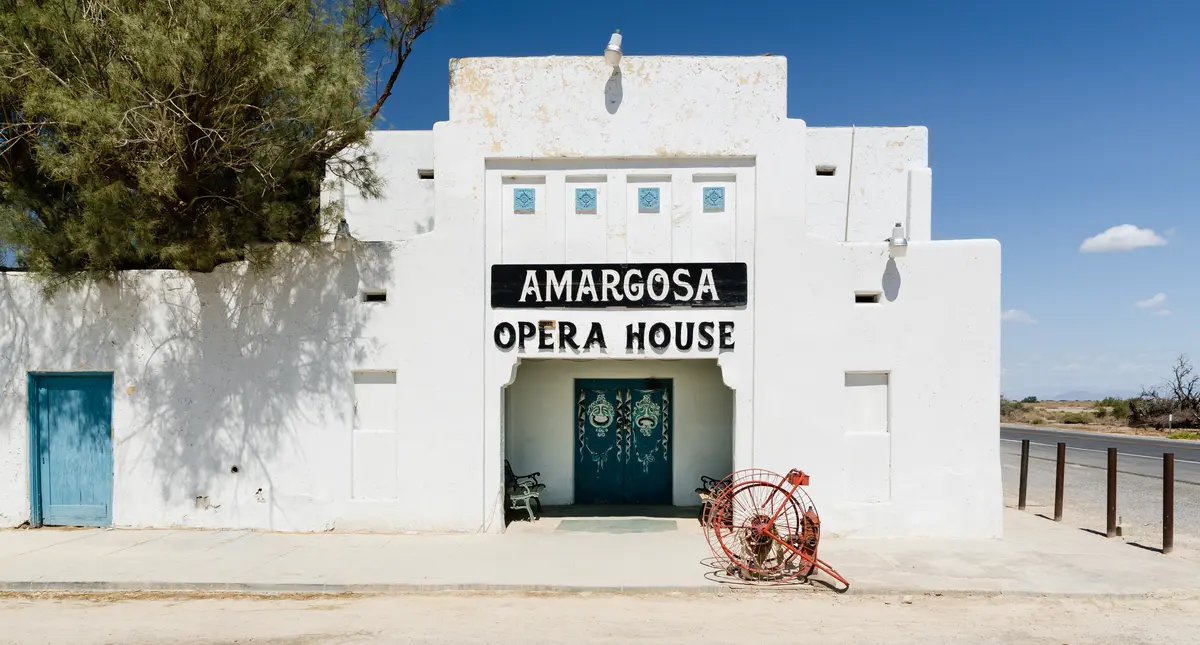
While the tire was being fixed, Marta Becket looked through a hole in the back door of Corkill Hall, the old recreation hall, and on Easter Sunday they rented it for forty-five dollars a month. Her first performance, on 10 February 1968, drew twelve people; on later nights nobody came at all. So between September 1968 and September 1974 she painted the audience she did not have — 266 Renaissance figures around the walls, a domed ceiling of cherubs and musicians — and performed in front of it for forty-four years, until her farewell show on 12 February 2012. She died at home in Death Valley Junction on 30 January 2017, aged 92. Guests and paranormal television crews have called the adjoining hotel haunted ever since; the nonprofit that runs the place says nothing of the kind on any page of its own website. The only spirit it advertises is the one Becket painted: a ghostly dancer, herself, spiralling through the colonnade like a dust devil.
What is the history of Amargosa Opera House and Hotel?
Death Valley Junction is not a village that grew. It is a company's drawing.
The place first appeared on the map in 1907, when the Pacific Coast Borax Company completed the Tonopah & Tidewater Railroad. In 1916 the company closed the Lila C mine, moved its mill to the Junction, picked up the mining town of Ryan and set it down ten miles to the north-west, and extended the rail spur as the Death Valley Railroad, sixteen miles of narrow gauge. The population jumped abruptly to about three hundred, living in shacks and tents.
In 1922 the company bought more land, and from 1923 it built what still stands: sixteen major structures raised in a single campaign through 1925, designed by the Los Angeles architect Alexander Hamilton McCulloch in a stripped Spanish Colonial idiom. Load-bearing adobe walls, flat wood-joist roofs behind adobe parapets, steel-framed skylights, a continuous wall linking low buildings around a U-shaped plaza. Offices, dormitories, a doctor's residence and hospital, a garage and service station, a railway platform, and at the north-east end a recreation hall for dances, church services, films, funerals and town meetings. It was called Corkill Hall.
The borax did not stay. From 1927 the company's mining shifted to the Kramer district near Barstow, and by the early 1930s the work here was all but finished. In 1932 part of the adobe dormitory was remodelled into a hotel for the public. In 1947 the company stopped mining altogether and the mill was dismantled.
Twenty years later, in March 1967, a car with a flat tire pulled into the service station across the road. In it were Marta Becket — born Martha Beckett in New York in 1924, corps de ballet at Radio City Music Hall, Broadway credits in Show Boat, A Tree Grows in Brooklyn and Wonderful Town — and her husband, Thomas B. Williams. They were mid-tour with her one-woman programme of ballet-pantomimes, headquartered in New York and on the road eight or nine months a year, and they had already agreed between themselves that they wanted to be based somewhere else. While the tire was being fixed, Becket wandered the abandoned north end of the complex and looked through a hole in the back door of the recreation hall.
They rented it on Easter Sunday, 26 March 1967, for forty-five dollars a month, on the condition that they paid for every repair themselves. They finished that spring's concert tour, ended the summer tour back at Death Valley Junction in August, and by October had decided to give up touring for good. Williams built the thirteen-foot thrust stage extension, hung the stage lighting, painted the building inside and out, and hand-lettered the new name on the exterior side wall: Amargosa Opera House.
Becket gave her first performance on 10 February 1968, to an audience of twelve, in a hall that seats 105. The curtain went up on Mondays, Fridays and Saturdays, and on some nights nobody bought a ticket at all. In September 1968 she started painting the audience she did not have. She finished in September 1974 — six years — leaving 266 sixteenth-century Spanish figures around the walls, a king and queen holding court on the back wall with a bullfighting family and two of her own cats asleep on red velvet cushions in the lower corners, and on the ceiling the Four Winds, bands of cherubs, seven doves for peace and a dome of sixteen figures playing antique instruments.
In 1973, finding they could buy the hall, Becket and Williams formed a California nonprofit to hold it. In 1980 that nonprofit bought the entire town, and Williams himself typed and signed the nomination that placed the Death Valley Junction Historic District on the National Register. Their marriage ended in 1983; her stage partner for the next two decades was Thomas J. Willett, "Wilget", who died in 2005. Becket was still rising en pointe into her seventies, and after a fall she reworked the whole thing into what she called The Sitting Down Show. She gave her farewell performance on 12 February 2012, aged 87, and handed the property to a nonprofit board. She died at home in Death Valley Junction on 30 January 2017, aged 92. Her autobiography, To Dance on Sands, had been published by Stephens Press in 2006.
Timeline: the documented record of Amargosa Opera House and Hotel
- 1907 Death Valley Junction appears on the map when the Pacific Coast Borax Company completes the Tonopah & Tidewater Railroad. Nine years later the company closes the Lila C mine, moves its mill here, relocates the town of Ryan ten miles north-west and lays the sixteen-mile Death Valley Railroad; the population jumps to about three hundred in shacks and tents.
- 1923–1925 The borax company builds the U-shaped adobe complex to designs by the Los Angeles architect Alexander Hamilton McCulloch: sixteen major structures in one campaign, including the recreation hall known as Corkill Hall. Mining shifts to the Kramer district from 1927; part of the dormitory becomes a public hotel in 1932, and the mill is dismantled in 1947.
- March 1967 Marta Becket and her husband Thomas B. Williams stop at the service station to have a flat tire repaired while on a concert tour. She looks through a hole in the back door of the disused recreation hall; on Easter Sunday, 26 March, they rent it for forty-five dollars a month on condition they pay for all repairs.
- 10 February 1968 First performance in the renamed Amargosa Opera House, before an audience of twelve in a hall seating 105. Williams had built the thrust stage, hung the lighting and hand-lettered the new name on the outside wall. Shows ran Mondays, Fridays and Saturdays, and on some nights nobody bought a ticket.
- September 1968 – September 1974 Becket paints her permanent audience: 266 sixteenth-century Spanish figures on the walls, then the ceiling with the Four Winds, cherubs, seven doves and a dome of sixteen musicians. The nomination form written by Williams in 1980 gives both dates and records that by then she had performed 1,575 times, "for audiences numbering from Zero to Capacity, 105".
- 14 May 1980 Williams, as president of Amargosa Opera House, Inc., signs the National Register nomination for the Death Valley Junction Historic District, filed under reference number 80000802. The same year the nonprofit — formed by the couple in 1973 — buys the entire town so that it can be preserved.
- 2002 The earliest printed haunted-hotel treatment that can be dated: Robert and Anne Wlodarski's California Hauntspitality carries an entry for the Amargosa Hotel reporting that the manager, Lori Novak, called it the most spirited place she had ever been in.
- 26 November 2010 Ghost Adventures broadcasts an episode filmed at the Amargosa, framed around a claim of several suicides on the site. It is the first of the two paranormal television visits that supply most of the lore now attached to the hotel.
- 12 February 2012 Becket's farewell performance, on a Sunday afternoon, at 87. She drops the usual programme for her own songs, in a velvet gown and a false moustache; the house is packed with roughly as many people as the town had at its peak. "I've never had an audience like this before," she tells them.
- 17 May 2013 The Dead Files airs its Death Valley Junction episode, introducing a janitor called Thomas Blower said to have hanged himself in the old wing, a brothel keeper nicknamed Shotgun Kitty, and "sick men who could be borax miners" — the likeliest source of the borax-worker footsteps repeated about this hotel ever since.
- 30 January 2017 Becket dies at home in Death Valley Junction, aged 92, confirmed by the Inyo County deputy coroner. Susan Sorrells, who knew her for decades, tells the Las Vegas Review-Journal that the spirit she remembers is the ghostly ballerina Becket painted into the colonnade.
- 14 February 2026 The 58th anniversary show, two performances devoted to the murals with Vegas City Opera and the pianist Jérémie Favreau, sells out in advance. Tours still run twice daily and the sixteen-room hotel still takes bookings by telephone; the café on the site has been closed since before 2020.
Is there a rational explanation for Amargosa Opera House and Hotel?
The ghost story here has an unusual property: the people who own the building will not tell it.
Across the eight pages of the Amargosa Opera House's own website — opera house, hotel, café, history, reservations, press, and the two about Becket herself — the words ghost, haunted, spirit and paranormal appear three times in total, all on the same page, and all of them metaphors: Becket often painted herself as a dust devil, "a ghostly figure spiralling up out of nowhere", and "her spirit is eternal". As a control on the same sweep, her surname appears more than forty times. The only hotel room the operator singles out is Room 22, and it does so for a mural: a ballerina dancing on a ball, painted in tribute to Red Skelton, who stayed there.
Where the room-by-room lore does live is in haunted-tourism publishing and on television. The earliest printed treatment I could date is California Hauntspitality (Robert and Anne Wlodarski, Whitechapel Productions, 2002), whose Death Valley Junction entry reports that the hotel manager, Lori Novak, called the Amargosa "the most spirited place she has ever been in". Ghost Adventures filmed here for an episode first broadcast on 26 November 2010, built around a claim of "several suicides". The Dead Files followed on 17 May 2013 with a janitor named Thomas Blower said to have hanged himself in the old wing, a bar and brothel keeper nicknamed Shotgun Kitty, and "sick men who could be borax miners". That last item is the likeliest origin of the borax workers who are routinely blamed for footsteps in this hotel: a psychic's on-camera impression in 2013, not a testimony anyone wrote down.
Two things about those miners are worth saying plainly. The men who dug the borate ore lived at Ryan, first six and later sixteen miles away; Death Valley Junction was the mill, the railhead, the offices and the dormitories. And they left. Mining moved to the Kramer district from 1927, the mill came down in 1947, and by the time the hotel had a front desk worth haunting the company town had stood mostly empty for a generation.
The person best placed to comment gave the fairest verdict. Susan Sorrells, who owns nearby Shoshone and knew Becket throughout her decades in the desert, told the Las Vegas Review-Journal in 2017 that film crews and "so-called paranormal investigators" turned up periodically, but that the spirit she remembers is the one Becket painted: a ghostly ballerina twirling through the opera house colonnade. "That pretty much let everyone know what her wishes were," Sorrells said. The only first-hand claim in that obituary came from Amy Noel, an artist in Tecopa, and it is a joke Becket made about herself: "She promised to haunt it, so I expect she'll be around."
Can you visit Amargosa Opera House and Hotel?
This is a working hotel, not a ruin, and it is open. The address is California Highway 127 at State Line Road, Death Valley Junction, CA 92328. The front desk, on (760) 852-4441, is staffed daily from 8 a.m. to 8 p.m., and rooms are booked by telephone or e-mail rather than online.
Tours of the opera house run twice a day, at 9 a.m. and 6 p.m., at $20 for adults and $10 for children, paid at the front desk; group tours are arranged in advance. The price held at $15 and $5 from 2022 until some point in 2025. Performances are occasional rather than seasonal, and they sell out: the 58th anniversary show on 14 February 2026 — two performances devoted to the murals, with Vegas City Opera and the pianist Jérémie Favreau, at $40 — was sold out before the date, as the 54th anniversary "grand reopening" of 12 February 2022 had been. The anniversary is always on or around 10 February, the date of Becket's first night in 1968. The most recent event advertised on the site at the time of writing was a Mother's Day weekend matinee on Saturday 9 May 2026.
The hotel has sixteen rooms, air conditioned in summer and heated in winter, with no televisions and no telephones; guests share a pantry open around the clock in the painted dining room. Eat before you arrive: the Amargosa Café on the same site is closed, its own page says so in as many words, and its last post dates from 2019. There is no fuel in Death Valley Junction. Furnace Creek is about 27 miles north-west, Shoshone lies south, the Longstreet Inn is seven miles north across the Nevada line, and Las Vegas is roughly 95 miles east.
Time it. The hotel's own guidance is that daytime temperatures run 110–120 °F (43–49 °C) from June to October and may not drop below 95 °F at night; August and September are monsoon season, and the town floods, because the water table sits about nine feet down and the Junction is the low point for runoff off the surrounding mountains. November to April is comfortable. The hotel asks guests to keep clothing off the floor and to shake out their shoes, on account of scorpions and spiders. The campground across the road takes RVs and tents for a maximum of two nights of dry camping at $10, permit from the front desk.
Sources consulted
- Thomas B. Williams, Amargosa Opera House, Inc., «National Register of Historic Places Inventory–Nomination Form: Death Valley Junction Historic District (reference no. 80000802)» — United States Department of the Interior, Heritage Conservation and Recreation Service, 1980 archive
- Henry Brean, «Marta Becket, who made Amargosa Opera House famous, dies at 92» — Las Vegas Review-Journal, 2017 newspaper archive
- Maude Standish, «Last Song in Death Valley Junction (eyewitness account of Becket's farewell performance)» — The Hairpin, 2012 newspaper archive
- Amargosa Opera House, Inc., «A Brief History of Marta Becket's Amargosa Opera House» — Official site of the Amargosa Opera House and Hotel, 2026 web
- Amargosa Opera House, Inc., «Hotel: a brief history, the hotel today and planning your visit» — Official site of the Amargosa Opera House and Hotel, 2026 web
- Amargosa Opera House, Inc., «Marta Becket, August 9, 1924 – January 30, 2017» — Official site of the Amargosa Opera House and Hotel, 2026 web
- Amargosa Opera House, Inc., «News & updates: anniversary and event announcements, 2022–2026 (homepage, with Wayback Machine captures)» — Official site of the Amargosa Opera House and Hotel, 2026 web
- Robert Wlodarski and Anne Wlodarski, «California Hauntspitality (entry for the Amargosa Hotel, Death Valley Junction)» — Whitechapel Productions, 2002 book
- Wikipedia contributors, «Amargosa Opera House and Hotel (article and cited television episode records)» — English Wikipedia, 2026 web
Reviewed by V. Serrano on 2026-08-11 · How we verify our content
💬 Field testimonies (0)
No testimonies yet. Add the first.
Add your testimony
🔒 Log in to add a testimony