👻 HAUNTED PLACE · EXP. Nº9478
ACTIVE
Attmore–Oliver House
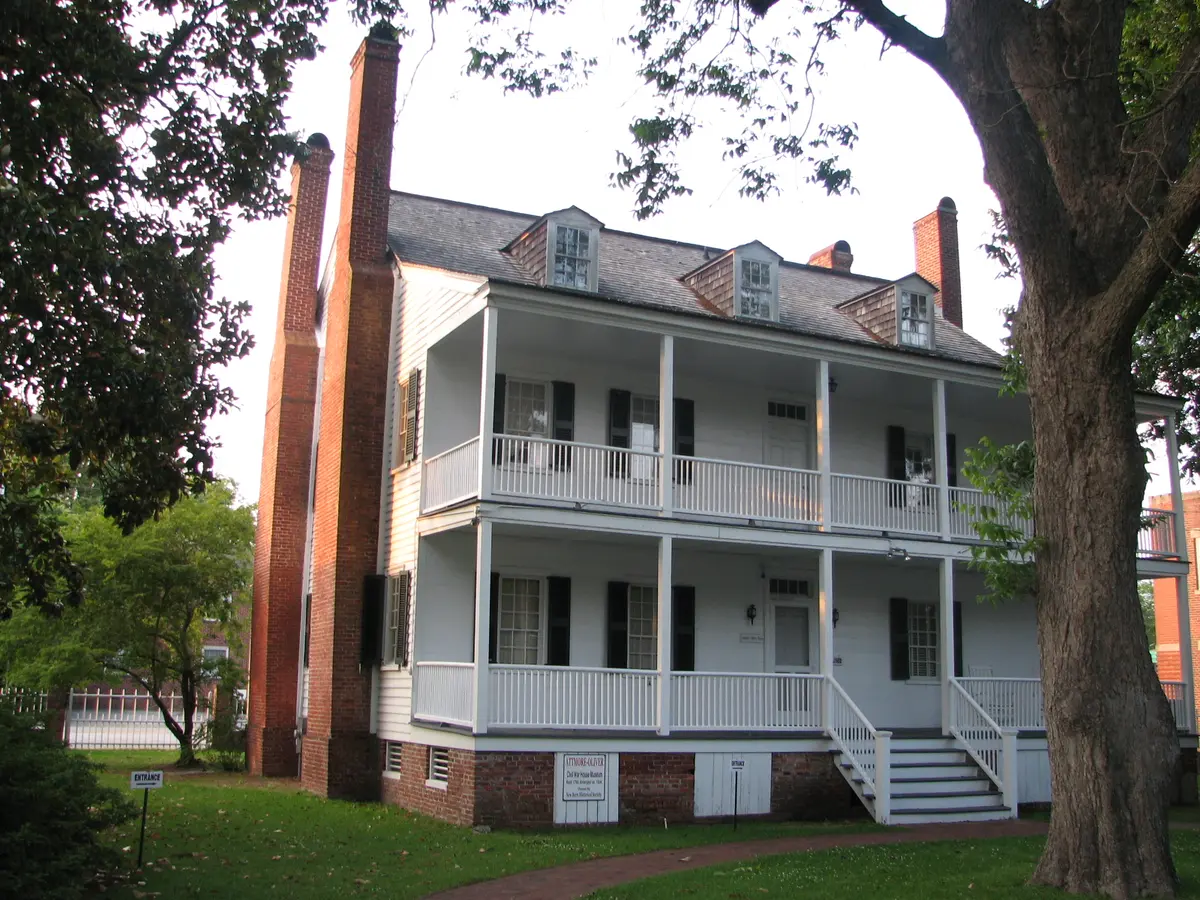
The Attmore-Oliver House stands on lot 102 of the New Bern plan, on the south side of Broad Street in New Bern, North Carolina.
Where is Attmore–Oliver House?
- Location
- North Carolina, United States
- Type
- House / mansion
- Coordinates
- 35.108, -77.042
- Last updated
LOCATION
Why is Attmore–Oliver House said to be haunted?
Samuel Chapman, clerk of the superior court of Craven County, bought the lot in 1790 and built a storey-and-a-half frame cottage on it. What visitors see today is the enlargement of about 1834-1835, which raised the house to two and a half storeys and added a fourth chimney, carried out after the maritime merchant Isaac Taylor bought the property for his daughter Mary and her husband, George Sitgreaves Attmore. It stayed in that one family line, Attmore and then Oliver, until Mary Taylor Oliver, "Miss Mary", died in 1951; the New Bern Historical Society bought it from her nephews for $30,000 and has owned it ever since. Its Civil War use is not documented. The National Register nomination says only that medical material recovered in a 1962 excavation "indicates a possible hospital or U. S. Sanitary Commission use". The ghost story belongs to Miss Mary, and the oldest datable print trace of the word is a 1961 newspaper caption about broken windows: the neglected house, it said, had "a haunted look".
What is the history of Attmore–Oliver House?
The house has two ages, and the one in the photograph is the younger of them.
Lot 102 in the plan of New Bern passed to William Wickliffe and his children in 1775, and in 1790 Elizabeth Wyckcliffe sold it to Samuel Chapman. Chapman had served in the Revolution as a lieutenant under George Washington and had been appointed clerk of the superior court of Craven County in December 1788, a post he held until his death. He prospered as a merchant, bought a good deal of land, and rose to senior warden of St John's Masonic Lodge; when Washington reached New Bern on his Southern Tour in 1791, Chapman sat on the ceremonial committee appointed to "wait upon" the President. He appears to have begun building soon after buying the lot, in a town of "about 2000 souls", and the house was certainly standing by 1806, when he died and left his daughter Carolina "The House lot & improvements number one hundred and two, on the South side of Broad Street in New Bern, and whereon I now live". The inventory read in 1807 listed the furniture of a comfortable household, about twenty-five gallons of brandy, and twenty-one enslaved people working his plantation outside the town.
What Chapman built is not the building anyone sees now. Stanley South's excavation of 1962 recovered its size and shape: a storey-and-a-half frame cottage with two exterior chimneys at the west end and only one at the east, and a lean-to at the back. No picture of it survives.
Carolina Chapman Waring and her husband Henry occupied the house until 1834, when it was sold to Isaac Taylor, a New Bern maritime merchant and banker whose own brick house on Craven Street was among the handsomest in the town. Taylor never lived on Broad Street. He bought the house for his daughter Mary, who married George Sitgreaves Attmore that same year, and both the architectural and the archaeological evidence date the enlargement to about then: the cottage was raised to two and a half storeys, given a fourth chimney, and fitted on the Broad Street side with the classical front — porch, cast-iron balconies and jib doors under the windows — that the Historical Society calls one of the earliest Greek Revival fronts in New Bern. Attmore was the son of Sarah "Sallie" Sitgreaves, sister of Judge John Sitgreaves, and of William Attmore, the Philadelphia merchant whose 1787 journal of a business trip to New Bern is still quoted for its description of the town.
Taylor's will, dated 4 September 1844, took effect when he died on 4 July 1846. It left Mary the Broad Street house and one seventh of the people he owned. There were seventy-five of them, from an eleven-month-old infant named Betty to sixty-four-year-old Bill Foy, and valued from fifty dollars for Sam Lane, aged fifty-nine, to six hundred and twenty-five for Bill Martin, aged twenty-two. Most of them worked Taylor's Glenburnie Plantation. They are named in the Historical Society's own published research on this house, and in almost nothing written about it since.
Mary Taylor Attmore died on 29 February 1852, aged forty-five. Her eldest daughter Hannah had married William Hollister Oliver on 20 April 1854, and when George S. Attmore died on 15 December 1859 Hannah inherited the house. That is where the second surname comes from. The deed did not survive the war: an 1885 conveyance to her children notes that the earlier one had "been misplaced doubtless caused by the removal of the records during the War".
The war reached the family, even though no document places it inside the house. New Bern fell to Ambrose Burnside on 14 March 1862 and stayed in Union hands until September 1865. All of Hannah's brothers enlisted in the Confederate army, and her husband served as a quartermaster; his marker in Cedar Grove Cemetery still reads "Quartermaster, C.S.A.". Isaac Taylor Attmore, who enlisted nine days after North Carolina seceded, was killed at Spotsylvania Court House on 12 May 1864. Sitgreaves Attmore was captured when Fort Fisher fell in January 1865, held at Elmira, exchanged, and died of chronic diarrhoea at Point Lookout on 22 May 1865. The youngest brother was wounded in May 1864, was at Appomattox and was paroled at Greensboro. Many New Bern families sat out the occupation in High Point; Hannah's maiden aunts Phebe, Catharine and Frances Taylor were allowed to keep their Craven Street house after signing Lincoln's Amnesty Proclamation. The Olivers came through Reconstruction without losing the house.
Hannah died of rheumatism on 25 February 1881, leaving her real estate to her daughters. The 1880 census had found eleven people living there, including the family's maid, Emily Grimes. William Hollister Oliver, by then selling fire, marine and accident insurance, died on 21 October 1908 aged seventy-nine, and his daughter Mary Taylor Oliver inherited. Born in 1859, "Miss Mary" lived her entire life in the house and became its sole owner. What New Bern remembered about her was not spectral: she is reputed to have taken the daring step of smoking a cigarette in public at the corner of New and Middle Streets, to the great shock of the town. Her will, dated 17 October 1945, left the house to five nephews, four Huske brothers of Fayetteville and Henry B. Constable. They sold it to the New Bern Historical Society for $30,000, a bold commitment for a body that then had forty members and little more than two hundred dollars in its treasury.
Timeline: the documented record of Attmore–Oliver House
- 1775 Lot 102 in the plan of New Bern is transferred to William Wickliffe and his children, according to the deeds summarised in the National Register nomination.
- 1790 Elizabeth Wyckcliffe sells the lot to Samuel Chapman, clerk of the superior court of Craven County, who begins building a storey-and-a-half frame cottage soon afterwards.
- 1791 Chapman, senior warden of St John's Masonic Lodge, sits on the committee appointed to "wait upon" President Washington during his two-day visit to New Bern on the Southern Tour.
- 1806, inventory read in 1807 Chapman dies and leaves the house to his daughter Carolina. The inventory read the following year lists the furnishings, some twenty-five gallons of brandy, and twenty-one enslaved people working his plantation outside New Bern.
- 1834 Carolina Chapman Waring, by then living in New York, sells the house to the maritime merchant Isaac Taylor, who buys it for his daughter Mary and her new husband George Sitgreaves Attmore. The enlargement to two and a half storeys, with a fourth chimney and a classical front, is dated to about this time.
- 4 July 1846 Isaac Taylor dies. His will of 4 September 1844 leaves Mary the Broad Street house and one seventh of the seventy-five people he owned, four of whom are named with their ages and prices: Betty, eleven months; Bill Foy, sixty-four; Sam Lane, fifty-nine, at fifty dollars; Bill Martin, twenty-two, at six hundred and twenty-five.
- 15 December 1859 George Sitgreaves Attmore dies and his eldest daughter Hannah, married since 1854 to William Hollister Oliver, inherits the house. The nomination's statement that "the Attmores gave the house and lot to their daughter" in 1860 cannot be right: her mother had died in 1852 and her father in 1859.
- 14 March 1862 New Bern falls to Union forces under Ambrose Burnside and remains occupied until September 1865. Hannah's husband was serving as a Confederate quartermaster and all her brothers had enlisted; the 1860 deed to the house was lost, an 1885 conveyance recording that it had been "misplaced doubtless caused by the removal of the records during the War".
- 12 May 1864 Isaac Taylor Attmore, Hannah's brother, is killed at Spotsylvania Court House. A second brother, Sitgreaves, would die at Point Lookout on 22 May 1865 after being captured at Fort Fisher.
- 21 October 1908 William Hollister Oliver dies aged seventy-nine and his daughter Mary Taylor Oliver, born in 1859, inherits the house she had lived in all her life.
- 1951 "Miss Mary" dies, the last of the family to live in the house. Her age at death is given as ninety-one in the 1989 study and as ninety on the Society's website, which also gives her dates as 1859-1951. Her will of 17 October 1945 left the house to five nephews.
- 1953 The New Bern Historical Society buys the house from Miss Mary's nephews for $30,000, with forty members and little more than two hundred dollars in its treasury, and begins restoring it. Hughey's 1989 study dates the sale by the four Huske brothers to 1954.
- 23 June 1961 The New Bern Mirror runs two photographs of the house with captions by the Society. The first is the oldest datable association of this house with the word: "UGLY AND FORLORN - Broken windows and a dingy exterior gave the neglected Attmore-Oliver House a haunted look in 1953." It is a remark about neglect, not about a ghost.
- February 1962 Stanley South excavates the site for the state Department of Archives and History, establishing the size and shape of the vanished 1790 cottage and recovering "much medical and other material" of the Civil War era. His thirty-page report is listed in the nomination's bibliography.
- 20 January 1972 The house is listed on the National Register of Historic Places, reference 72000932, on a nomination prepared by John B. Wells of the state Department of Archives and History and signed on 9 September 1971. It is the document that says the Civil War use of the building is unknown.
- 1991 The Historical Society holds the first Ghostwalk, dated by its own billing as the "22nd Annual" in 2012 and as its "36th year" in 2026. Historical skits are performed on the Attmore-Oliver back porch. It is forty years after Miss Mary's death.
- October 2007 A New Bern-area community paper, listing the attractions of that month's MUMfest, prints that "the historic Attmore-Oliver House features haunted evening tours". The same year, Roger Manley's Weird Carolinas gives the sentence that Wikipedia still cites for the house's reputation.
- Summer 2011 The Society's administrative offices move back into the Attmore-Oliver House, which stops being a house museum and becomes a working headquarters with three furnished rooms open to visitors.
Is there a rational explanation for Attmore–Oliver House?
The best evidence about this ghost comes from the institution that owns the house, and most of it is silence.
The New Bern Historical Society has published two pieces of research on this building: Jim Gunn's account of the Society's first thirty-five years of ownership, in May 1988, and Patricia M. Hughey's history of the families, in April 1989. Together they run to roughly 3,600 words about this house and these people. In them the words ghost, ghosts, haunting, spirit, apparition, supernatural and legend appear zero times, against thirty-four occurrences of "Oliver", twenty-nine of "Attmore", thirty-three of "house" and three of "restoration" in the same two texts. The single appearance of "haunted" is a quotation, and it is not about a ghost. Gunn reprints a photograph caption from The New Bern Mirror of 23 June 1961, and the original reads: "UGLY AND FORLORN - Broken windows and a dingy exterior gave the neglected Attmore-Oliver House a haunted look in 1953." The subject of that sentence is broken glass. (Gunn's reprint quietly drops the words "in 1953" from inside the sentence and moves them into his own framing.)
The search can be pushed further. The Mirror is digitised for 1958 to 1974, 798 issues. Pages carrying both "Attmore" and "ghost": none. Both "Attmore" and "ghosts": none. Both "Attmore" and "haunted": one, and it is a false positive, a list of building lots mentioning "Attmore's field" printed beside a poem containing the word "haunting". Controls run the same day in the same corpus: "Attmore" with "Historical", forty-three pages; "Attmore" with "restoration", six; an invented word, none. One caveat cuts the other way and is worth stating: the 1961 page that does print "haunted look" is invisible to a search for "haunted", because its scanned text reads "haiinthd". A zero from this corpus is worth only what its controls are worth.
What can be dated precisely is the business. The Society's Ghostwalk was advertised as its "22nd Annual" in 2012 and as being in its "36th year" in 2026 - two independent statements that put the first edition in 1991, forty years after Miss Mary's death and thirty-eight after the Society bought the house. Historical skits are staged on the Attmore-Oliver back porch; in 2026 an adult ticket costs $20 in advance and $25 during the event. The Society is careful about what it is selling: "Ghostwalk is not a haunted house, spooky, supernatural, or a homes tour!" And in the one place where it does mention the ghost, its self-guided tour text, it says so in the passive and then trails off. Having described Miss Mary's portable lap desk on a table in the sitting room, the text reads: "'Miss Mary' died in 1951 at the age of 90. And her ghost is said to still occupy the house..." That single sentence, at the end of a furniture inventory, is the whole of the claim. It is also where the Society's own arithmetic slips: it gives her dates as 1859-1951, which does not leave her ninety, and the 1989 article says ninety-one.
The Civil War hospital, which is the other half of this house's reputation, can be watched growing. Stanley South's excavation report of February 1962 recorded medical material. The National Register nomination, signed in September 1971, turned that into "the use of the structure during the Civil War years is unknown, but the discovery of much medical and other material of that era ... indicates a possible hospital or U. S. Sanitary Commission use". Hughey, in 1989, citing the nomination, wrote that the house "may have been used as a hospital during the occupation because medical supplies were found". Ghost-tourism pages, and until recently this one, print it as established fact and add a Confederate phase that no source supports. Two of the largest such sites offer instead unnamed "poltergeists" traced to a "long-ago smallpox epidemic", with no source at all; one of them files the house under an address, 563 U.S. 17 Business, that is not the house's.
Two questions could not be closed. Wikipedia's claim that this is "one of the most haunted houses in New Bern" rests on a single citation, page 195 of Roger Manley's Weird Carolinas of 2007, and on the day this was written that book was unreadable in every full-text corpus tried: the Internet Archive copy answered "Item not available" even to a nonsense control word, HathiTrust returned 403, and the Google Books interface returned 429, daily quota exhausted. A local ghost book that would matter more, Rose Goode McCullough's Ghosts on the River (Raleigh: Edwards and Broughton, 1972), listed as a source in the Society's own journal, could not be found in any reachable digital library. Miss Mary's obituary is a third open question, and for a measurable reason rather than an absence: no New Bern newspaper of 1951 is digitised. The Sun Journal is available for 1917 to 1922 and the Mirror from 1958, while the same archive on the same day returned 2,388 hits for "Attmore" and 395,313 for "New Bern". Both statements are therefore left open rather than settled with a zero.
Can you visit Attmore–Oliver House?
The Attmore-Oliver House is the headquarters of the New Bern Historical Society, which gives its address as 511 Broad Street, New Bern, North Carolina 28560. The 1971 National Register nomination and Patricia M. Hughey's article in the Society's journal of 1989 both place the house at 513 Broad Street. It has been on the National Register of Historic Places since 1972, reference 72000932. The Society's self-guided tour text, read on 24 September 2026, says that its administrative offices returned to the house in the summer of 2011, with the main office on the first floor and the offices of the director and the curator on the second. The Society's page for the house describes most of the building as offices; the parts open to visitors hold "a small collection of photos, artifacts, and 19th-early 20th century period furnishings".
According to the tour text, the dining room, the parlor and the sitting room are furnished as a background for life in New Bern in the mid-nineteenth century, and an exhibit of Civil War objects on the first floor covers the Battle of New Bern and its aftermath. Miss Mary's portable lap desk stands on a table in the sitting room. A dollhouse replica of the house, given in 2002 by descendants of Hannah Attmore Oliver Hurke, is in the second-floor hallway. The Society lists these displays as open for self-guided visits during business hours, Monday to Friday from 10am to 4pm, with the office closing at noon on Fridays in summer, and asks visitors to call +1 252-638-8558. On the same date its page gave no admission price for the house.
The Attmore-Oliver Heritage Garden was laid out from 2007 around the mature pecan, magnolia and crape myrtle trees already on the grounds. The Society gives it as open daily during daylight hours and "a city block deep", entered from 512 Pollock Street or through its front gate at 511 Broad Street.
The two sides of the house do not match. The 1971 nomination sets the "classical street facade" on Broad Street against "the two-story porch on the rear". Jim Gunn, writing in the Society's journal in 1988, called the rear "the approach usually seen by visitors", with full-width porches on the first and second floors, and it is the side that appears in most photographs of the house.
Ghostwalk, the Society's October fundraiser, reached its 36th year in 2026 and runs on the evenings of 22 to 24 October 2026 from 6 to 9.30pm. The schedule lists thirteen sites, six of them in Cedar Grove Cemetery and the rest on front porches, with historical skits on the back porch of the Attmore-Oliver House and a bakery stall behind it. Adult tickets cost $20 in advance and $25 during the event, plus North Carolina sales tax; members, active-duty military with their families and students aged 13 to 23 with identification pay $17, and children aged 3 to 12 pay $5, with under-3s free. Paper tickets are required and are valid on all three evenings, although not every site opens every night. The event page states: "Ghostwalk is not a haunted house, spooky, supernatural, or a homes tour!"
Sources consulted
- John B. Wells, North Carolina State Department of Archives and History, «Attmore-Oliver House, Craven County (CV0001) - National Register of Historic Places nomination, reference 72000932» — North Carolina State Historic Preservation Office, 1971 report
- Jim Gunn, «Attmore-Oliver House: The Society Celebrates 35 Years of Ownership, pp. 5-10» — Journal of the New Bern Historical Society, Vol. I, No. 1, 1988 academic
- Patricia M. Hughey, «The Families of the Attmore-Oliver House, Part II: The Attmore-Oliver Family, pp. 15-23» — Journal of the New Bern Historical Society, Vol. II, No. 1, 1989 academic
- The New Bern Mirror (photographs by Billy Benners), «Ugly and Forlorn / Restored to Beauty - photograph captions on the Attmore-Oliver House, p. 1» — The New Bern Mirror, 23 June 1961, digitised by the North Carolina Digital Heritage Center, 1961 newspaper archive
- Julie Hipps, «Three Windows in Christ Church, pp. 3-19» — Journal of the New Bern Historical Society, Vol. XVIII, No. 1, 2005 academic
- New Bern Historical Society, «Our Historic Home & Heritage Garden: The Attmore-Oliver House» — Official site of the owner, 2026 archive
- New Bern Historical Society, «Attmore-Oliver House Self-Guided Tour» — Official visitor text, 2026 archive
- New Bern Historical Society, «What is Ghostwalk? - 2026 schedule, sites and ticket prices» — Official event page, 2026 archive
- New Bern Historical Society, «Ghostwalk, Spirited Through Time - 22nd Annual, October 25-27, 2012» — Archived event page, Internet Archive Wayback Machine, snapshot of 8 October 2012, 2012 archive
- The Shoreline, «MUMfest 2007 Returns to New Bern in October, p. 17» — The Shoreline, October 2007, digitised by the North Carolina Digital Heritage Center, 2007 newspaper archive
Reviewed by V. Serrano on 2026-08-17 · How we verify our content
💬 Field testimonies (0)
No testimonies yet. Add the first.
Add your testimony
🔒 Log in to add a testimony